
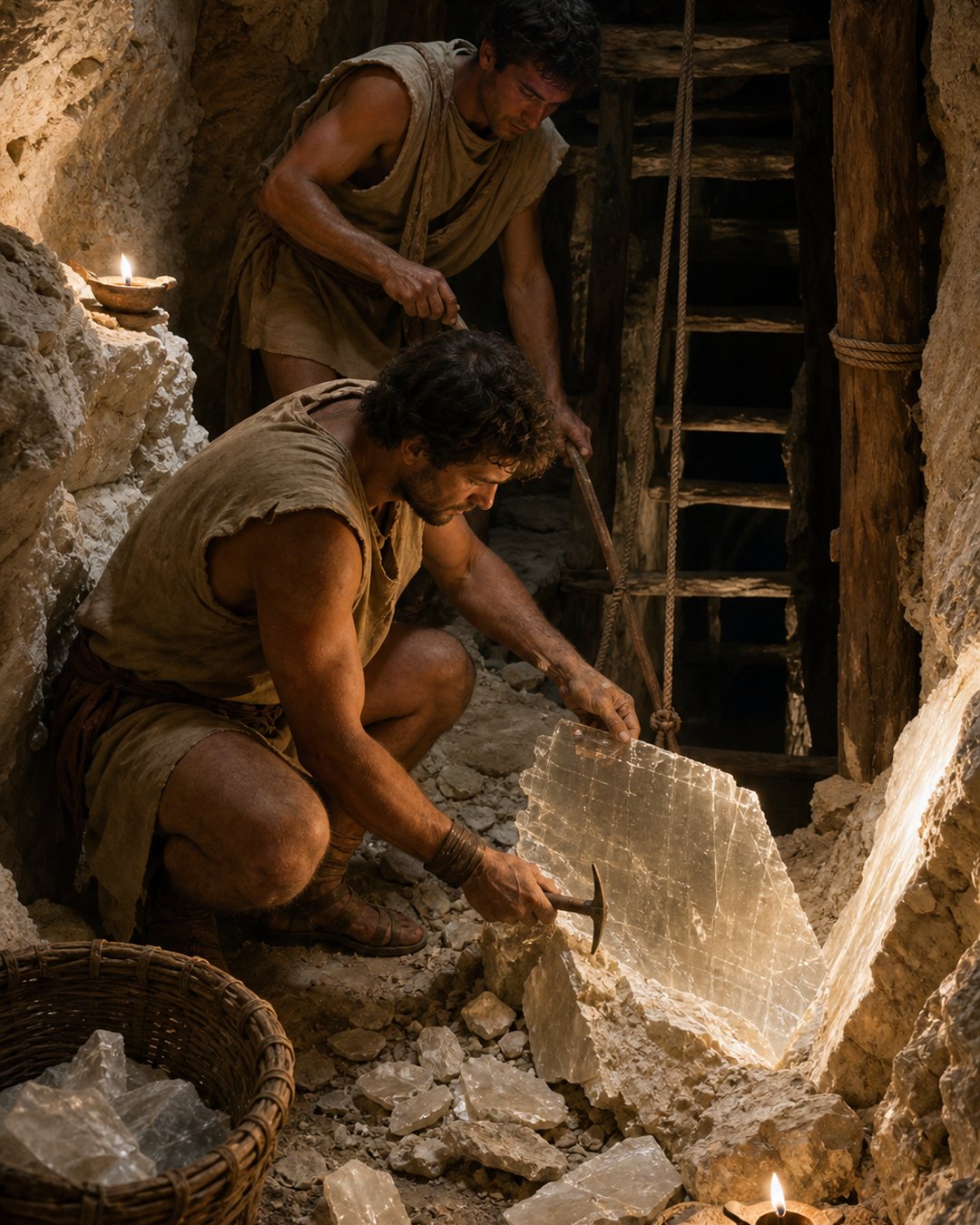
A plate of stone came out of the Spanish ground and became thin enough to carry daylight. Pliny the Elder calls it specular stone. Around Segobriga, miners recovered it from shafts, sometimes at considerable depth. Above ground, its natural structure allowed workers to split a plate into leaf after leaf.
The result was not glass. It was a translucent mineral sheet whose usefulness depended on cleavage. Pliny says it could be divided as thinly as desired, while the best Spanish material combined clarity with endurance against sun and cold. In the next chapter he treats light passing through specular stone as the familiar comparison for another unusual translucent material.
This chain makes Segobriga’s lapis specularis more than an attractive rock. Extraction, selection, splitting, framing, and transport turned geology into an architectural technology. A Roman interior could receive daylight because miners and craftspeople preserved a fragile plate across every stage.
A Hundred-Mile District Supplied the Preferred Stone
Pliny locates the old center of supply in Nearer Spain. He does not give the entire province equal importance. He describes a district extending about one hundred miles around Segobrica, the ancient city now called Segobriga.
That radius turns a city name into the center of a landscape of extraction. The useful material was scattered through a mining district rather than quarried from one civic pit. Paths, shafts, sorting places, and carriers connected deposits to a market whose demand reached well beyond inland Hispania.
Other supplies had appeared by Pliny’s lifetime. He names Cyprus, Cappadocia, Sicily, and, more recently, Africa. Bononia in Italy also produced small pieces. Yet he ranks all of these below the Spanish material.
The comparison was about usable qualities, not origin alone. Cappadocia yielded the largest sheets, but Pliny says they were cloudy. Near Bononia the pieces were small, spotted, and embedded in silex. A broad panel needed dimensions, clarity, and sound structure at once.
Roman stone markets already sorted materials by behavior. Stone sawyers matched abrasive slurry to difficult cutting work. Specular stone demanded another skill: following natural planes closely enough to gain thinness without destroying area.
Deep Shafts Put Fragile Plates at Risk
In Spain, Pliny says, workers often reached the material through shafts sunk to considerable depth. Some pieces occurred nearer the surface, enclosed in solid rock and cut away more easily. Most were isolated pieces that could be dug out.
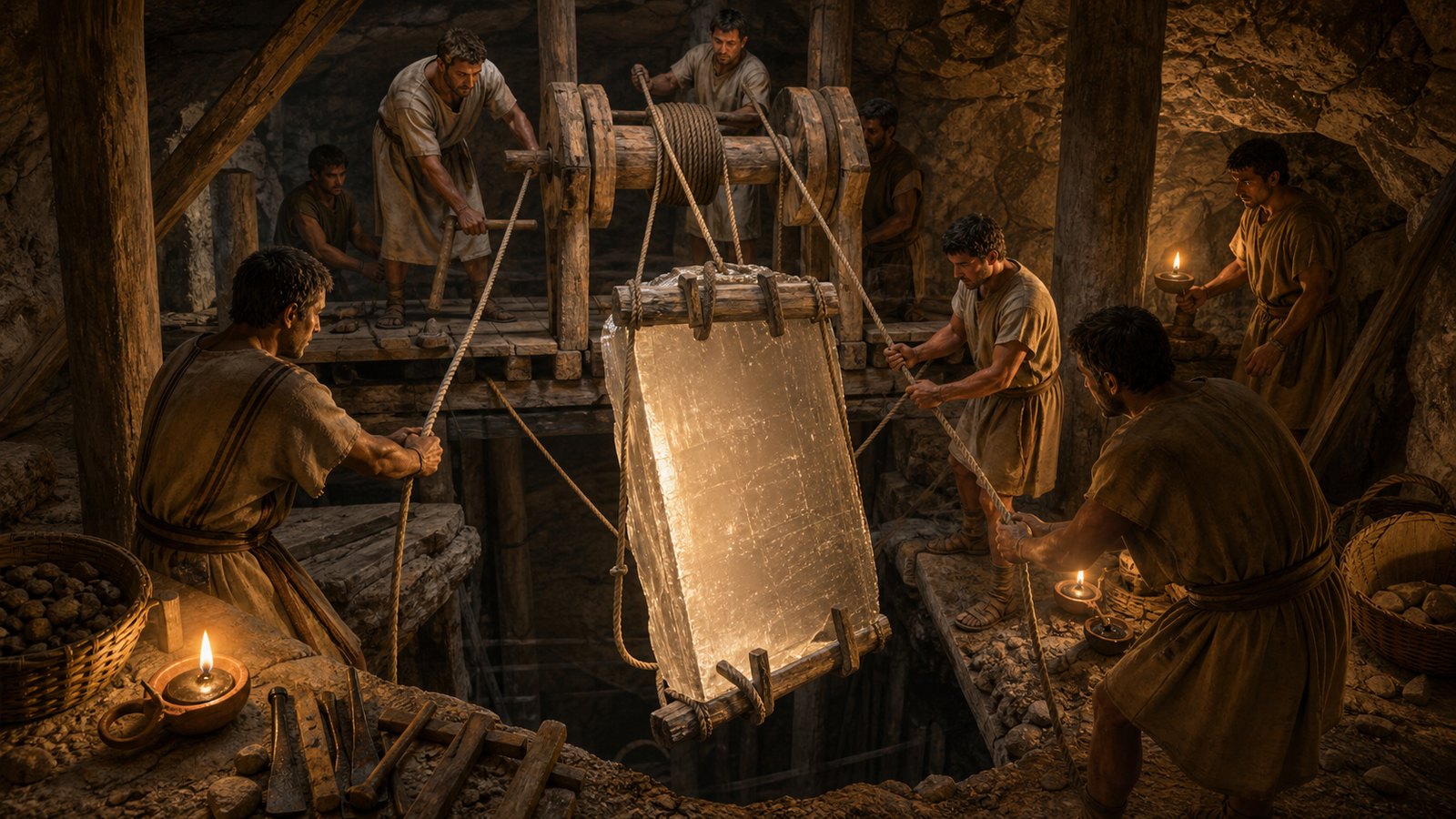
The source does not provide a mine plan, crew size, lamp count, or lifting schedule. Those details should not be invented. The word “shafts” nevertheless establishes a vertical problem. Workers had to descend, see the pale seams under artificial light, loosen plates, and raise them without turning valuable clear surfaces into fragments.
Pliny says pieces had not been known to exceed five feet in length. That limit gives physical scale without proving that every sheet approached it. Even a smaller plate would be awkward underground: broad enough to crack under its own leverage, soft enough to scar, and valuable precisely when it remained whole.
The mining sequence therefore began with restraint. A hydraulic operation could deliberately shatter and wash huge volumes, as in the Spanish gold workings fed by five sluices. Specular stone rewarded the opposite behavior. The miner needed intact planes, not pulverized rock.
Pliny adds a strange theory that the substance had once been liquid and congealed like crystal. He even repeats a claim about animal bones petrifying after a winter in the shafts. Those ideas belong to his ancient explanation of formation, not to modern mineralogy. They show that the mine inspired theories as well as trade.
Cleavage Turned a Block into Translucent Leaves
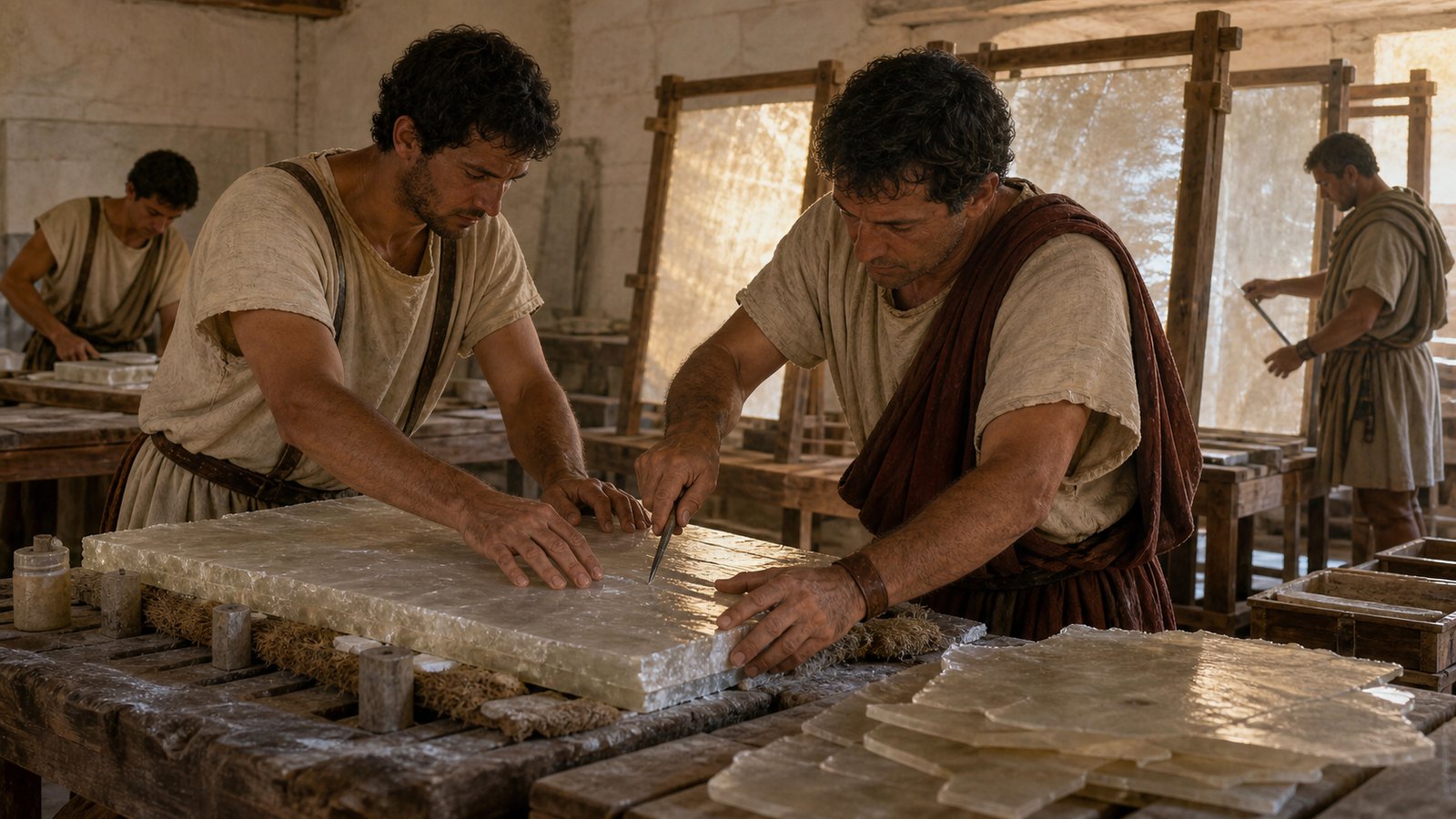
The defining operation happened after extraction. Pliny says the stone admitted division with exceptional ease and could be split into leaves as thin as desired. Each successful split traded thickness for transmitted light.
That did not mean splitting was effortless. A natural plane can guide a fracture, but a broad thin leaf becomes progressively less tolerant of uneven pressure. The craftsperson needed to open the layer across its area without punching through it or letting one corner race ahead.
Selection began before the tool touched the edge. Cloudiness, dark color, spots, stone inclusions, and hidden fractures could reduce the worth of a plate. The Spanish source won Pliny’s praise because it offered a favorable combination, not because every mined piece was perfect.
The finished leaf also needed support. Pliny does not describe a surviving frame in this passage, so no single mounting system should be declared universal. A thin mineral sheet, however, could not serve an opening while loose. Builders had to protect its edges and distribute pressure as it was fitted.
This was controlled fracture in service of light. Glassmaking produced transparency by heating and forming a melt. Lapis specularis began as a solid whose internal structure already held the possibility of a thin sheet. The workshop’s task was to reveal that possibility without breaking it.
Daylight Passed Through Stone Rather Than an Open Door
Pliny makes the architectural role clearest through comparison. In the next chapter he describes Nero’s translucent phengites and says its interior light did not arrive in the ordinary way, transmitted from outside through a medium of specular stone. His contrast assumes readers understood the normal effect: external daylight crossing a specular sheet.
Such a panel changed the choices available to a room. An uncovered opening admitted air, dust, rain, noise, and intrusion together with light. An opaque shutter controlled exposure but darkened the interior. Translucent stone separated some of those functions, admitting brightness while closing the opening.
The light would not have behaved like a perfectly clear modern window. Pliny’s concern with cloudy sheets and spots indicates variable transparency. Thinness, color, surface condition, and thickness all shaped what passed through. The panel was valuable even when it softened the view because illumination itself mattered.
A useful comparison appears in the translucent coverings over Tiberius’s wheeled cucumber beds. There, protected cultivation depended on moving plants and admitting light. In architecture, specular sheets performed a related separation for people and interiors.
The stone’s endurance supported the application. Pliny says the white material resisted sun and cold and, if protected from accidents, did not deteriorate with time. “Protected from accidents” is crucial. Weather resistance could not save a brittle panel from impact, poor framing, or mishandling.
Offcuts Still Carried Value into the Circus
Splitting and fitting produced shavings and scales. Pliny records a recent secondary use for them: scattering the fragments in the Circus Maximus to create an agreeable whiteness during games.
The detail shows a supply chain using more than intact panels. Large clear leaves held architectural value. Small waste pieces could become a bright surface treatment in Rome’s largest entertainment setting. The same mineral moved from mine face to workshop bench to building opening and, in fragments, to spectacle.
That final use also depended on visual effect rather than transparency. Once a piece was too small for a panel, its pale reflective surface still mattered. Waste from one product became material for another temporary display.
Segobriga’s mining district therefore supported several transformations. Deep extraction made plates available. Careful splitting multiplied their surface area. Framing converted leaves into a daylight barrier. Sorting separated cloudy, spotted, broken, and clear material. Even the remnants could be gathered for whiteness.
Pliny’s chapter preserves the logic because he follows properties into use. The stone was soft, divisible, variously clear, durable under ordinary exposure, and vulnerable to accident. Roman workers made a technology by organizing those traits rather than by changing the substance into something else.
The most remarkable stage was also the quietest. No furnace roared and no river tore down a mountain. A craftsperson opened a natural plane, eased one pale leaf from another, and made solid earth thin enough for the day to enter a room.
Sources
Pliny the Elder, Natural History, 36.45–46. Modern studies: Roman Mining in Hispania: Segobriga and the Exploitation of Lapis Specularis; The Roman Lapis Specularis Mining District of Castilla-La Mancha.