
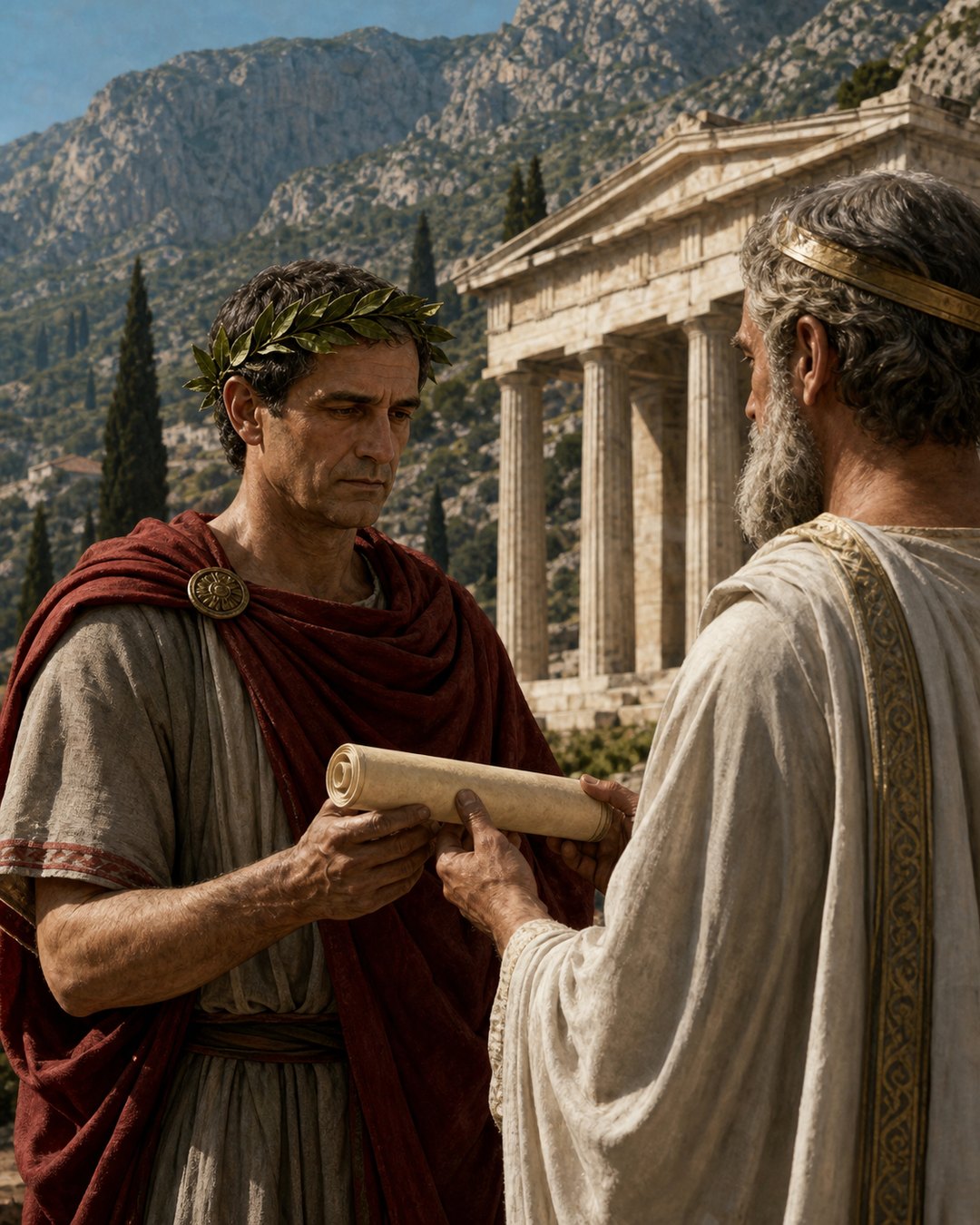
Rome’s answer to Cannae travelled home on a senator’s head. Quintus Fabius Pictor returned from Delphi carrying a written oracle in Greek and wearing the same laurel garland in which he had approached Apollo’s shrine. A priest had instructed him not to remove it until he reached Rome.
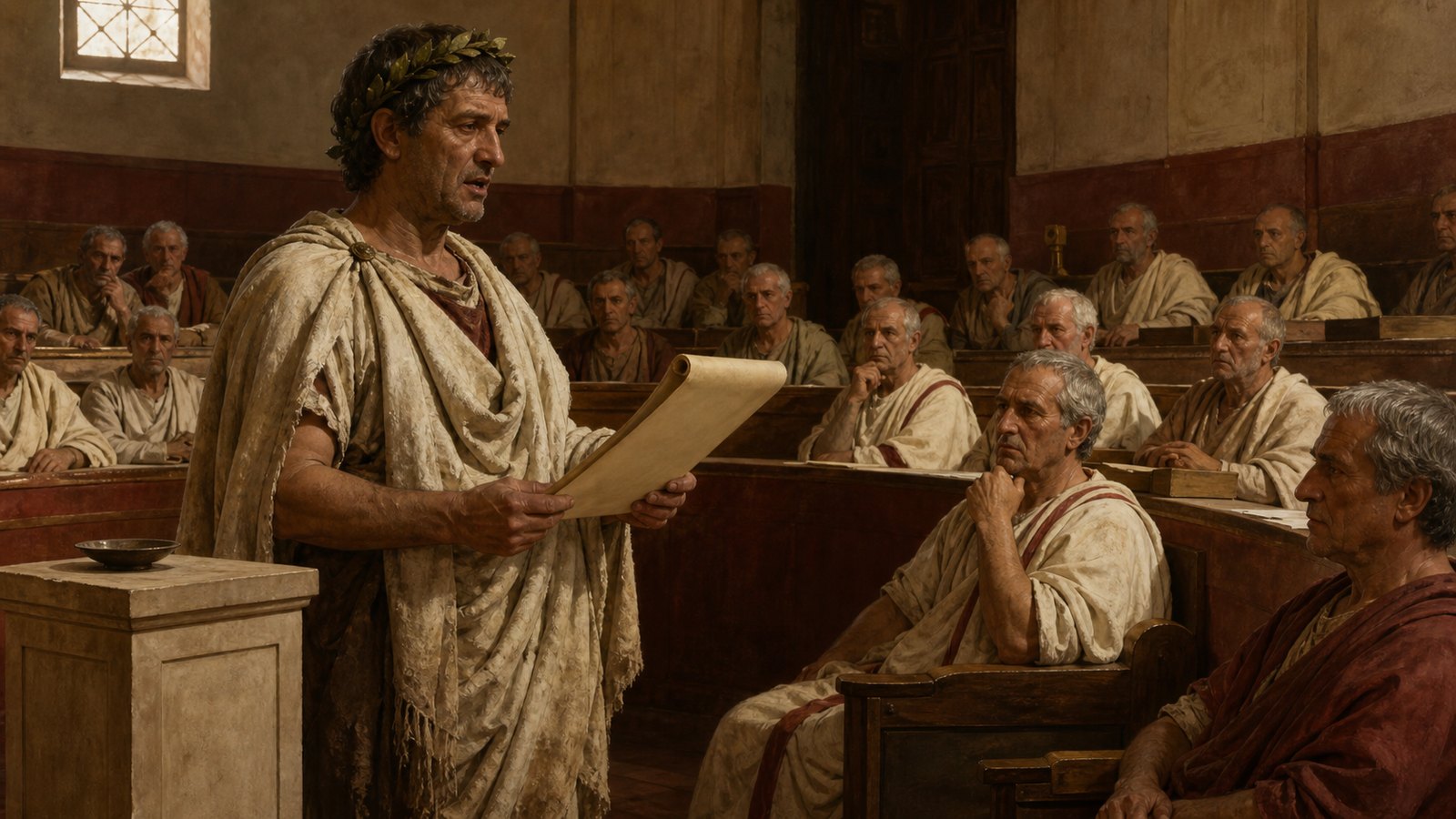
Livy says Fabius read the response before the Senate, translating it as he went. The manuscript named gods and goddesses, specified forms of supplication, promised relief if the instructions were followed, and required a future gift to Pythian Apollo. Fabius then reported how he had sacrificed at Delphi and carried the garland home exactly as ordered.
This was not prophecy floating free of administration. The journey had inputs, a messenger, a written output, an embodied chain of observance, public translation, and a senatorial decree. In a moment when military defeat had broken ordinary expectations, Rome made ritual advice portable and checkable.
Cannae Created a Question Strategy Could Not Answer Alone
Livy places the mission amid the institutional shock after Cannae. Consular and praetorian dispatches were read, commands were rearranged, new troops were raised, weapons were gathered, and ancient spoils were taken down from temples and colonnades. Rome was rebuilding military capacity while trying to understand why disaster had reached such a scale.
The religious crisis was not separate from the military one. Two Vestal Virgins, Opimia and Floronia, were condemned for unchastity. Livy says Floronia killed herself, while Opimia suffered the customary live burial near the Colline Gate. Lucius Cantilius, implicated with Floronia, was scourged so severely by the chief pontiff that he died.
Romans treated the offense, arriving among repeated calamities, as a portent. The decemvirs were ordered to consult the Sacred Books. Livy also records extraordinary rites, including the live burial of a Gaulish man and woman and a Greek man and woman in a stone chamber under the Forum Boarium. He calls the practice repulsive to Roman feeling even while recording it as part of the response.
Fabius’s mission belonged to that landscape of fear, but its form was different. He was sent beyond Roman ritual archives to ask Apollo’s oracle at Delphi what prayers and supplications should be used and how the terrible sequence would end. The Senate sought both procedure and prognosis.
The question did not cancel mobilization. Rome still enrolled men, reassigned commanders, and rebuilt units. The same state that improvised new military resources also admitted that its normal religious repertoire did not feel sufficient. Scipio’s repeated camp drills made military action dependable through practice. The Delphic mission pursued another kind of dependability: exact ritual forms carried back from an acknowledged foreign shrine.
One Envoy Carried a Public Problem Across the Sea
Livy names the envoy as Quintus Fabius Pictor. He should not be confused with the earlier member of the Fabian family remembered for painting the Temple of Salus. This Fabius belonged to the generation of the Hannibalic War and is associated with Rome’s earliest historical writing in Greek.
The choice suited a mission that crossed languages and political worlds. Delphi was Greek, but its oracle had international prestige. A Roman senator could approach it without treating the answer as private divination. He travelled on behalf of the state, asked questions framed by public disaster, and returned to an audience empowered to order collective action.
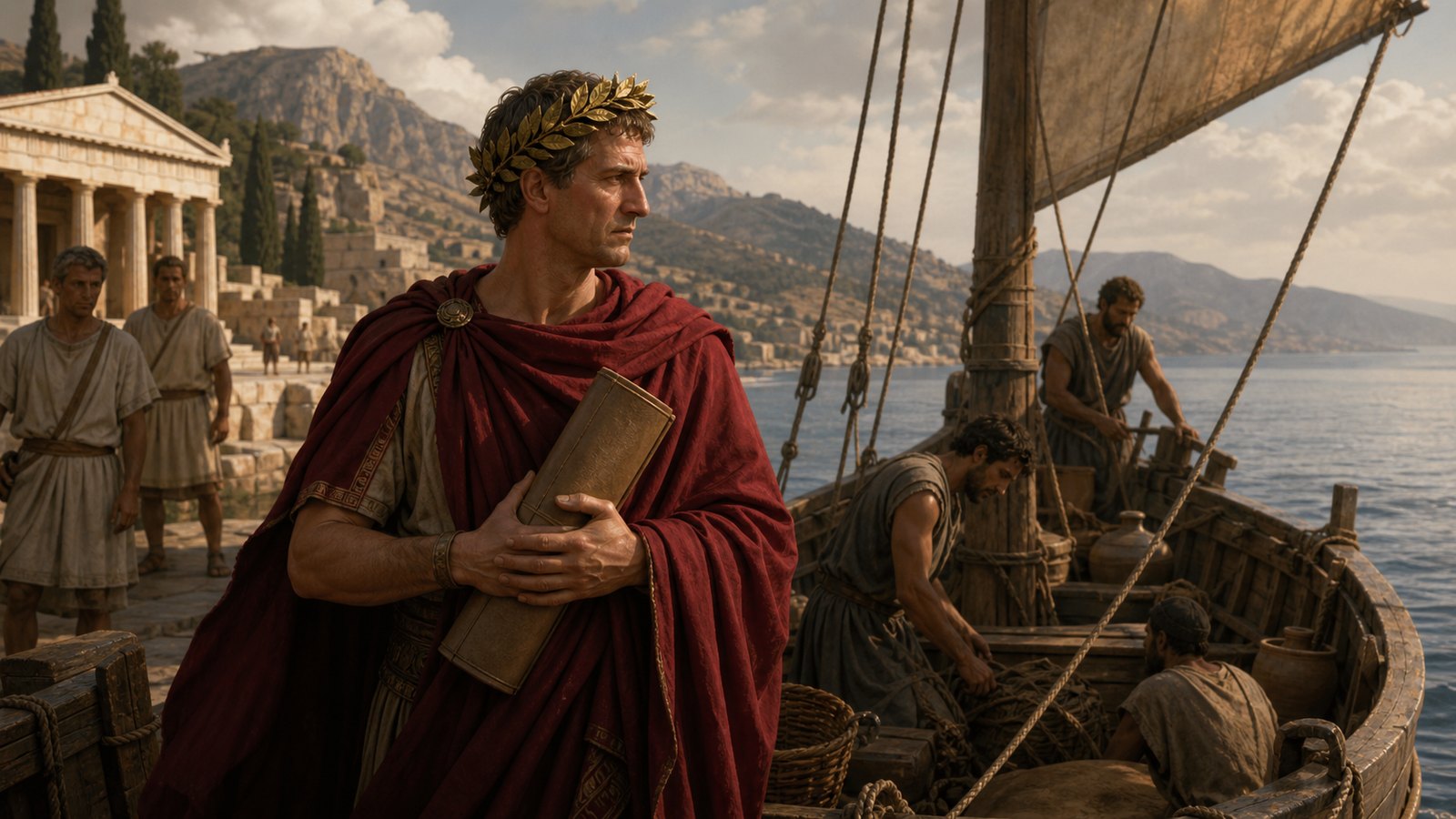
Livy does not give an itinerary, ship type, departure date, or list of companions. Inventing those details would turn a precise institutional story into false travel writing. Distance still mattered. Fabius had to move from central Italy to a Greek sanctuary, receive the response, and bring it intact back to Rome while the war continued.
The mission therefore depended on trust concentrated in one person. The Senate was not present at the consultation. It needed the envoy to preserve words, ritual conditions, and material signs of compliance. The manuscript reduced dependence on memory. The garland added a visible link between the man who stood at Delphi and the man who later stood before the Senate.
Diplomacy often works through such controlled compression. A distant encounter must become an object and report that a council at home can judge. Fabius returned with both: text that could be translated and a body that had obeyed a continuous instruction.
The Oracle Arrived as a Manuscript with Named Actions
When Fabius returned, Livy says he read the response from a manuscript. It contained the names of gods and goddesses to whom Romans should direct supplications and the forms to observe. That detail keeps the oracle from dissolving into a single famous sentence.
The surviving summary gives a conditional promise. If Romans acted as instructed, their condition would become better and less troubled, the republic would advance as they wished, and victory would belong to Rome. Once the commonwealth was prosperous and safe, they should send Pythian Apollo a gift drawn from their gains and honor him from plunder, booty, and spoils.
The future gift bound relief to repayment. Apollo was not asked only for an immediate answer; success would create a later obligation. The command to put away wanton and godless living made conduct part of the response alongside sacrifice.
Fabius translated the Greek as he read. Translation was not an invisible preliminary performed somewhere offstage. It formed part of the senatorial reception. Greek divine instructions became language in which Roman magistrates could debate and execute them.
The written form also constrained improvisation. A messenger might summarize a dramatic impression or remember only the line about victory. A manuscript preserved a sequence: named recipients, ritual forms, conditions, a future dedication, and moral correction. Rome had requested operational detail and received something the Senate could turn into orders.
The Garland Made Obedience Visible from Delphi to Rome
Fabius supplemented the text with an account of his own actions. After leaving the oracle, he sacrificed with wine and incense to all the deities named in the response. A priest then told him to board his ship wearing the same laurel garland he had worn at the consultation.
The instruction continued: he must not remove it until he reached Rome. Livy has Fabius insist that he performed everything carefully and conscientiously. At home he placed the garland on Apollo’s altar.
Laurel already belonged closely to Apollo. Here it also worked as a fragile chain of custody. A seal proves that a container remained closed; the garland marked the envoy’s continued ritual state. Leaves could wilt, fall, or be disturbed. Their vulnerability made uninterrupted observance meaningful.
We should not pretend the Senate could scientifically prove that Fabius had never lifted the wreath. The value was ritual and testimonial. He appeared wearing the prescribed object, gave a public report, and deposited it at the destination named by the logic of the mission.
The contrast with a durable monument is useful. Marcellus had to divide one temple vow into two buildings when priests found its original ritual arrangement unacceptable. There, architecture had to be corrected before dedication. In Fabius’s case, correctness travelled through a perishable plant worn continuously from oracle to altar.
The garland made the return journey part of the rite rather than dead time between revelation and report. Sea crossing, landing, road, arrival, reading, and deposition became one extended act of compliance.
The Senate Converted Prophecy into a Work Order
The final step belonged to the Senate. After hearing the manuscript and Fabius’s account, it decreed that the sacrifices and intercessions should be performed carefully at the earliest opportunity.
That sentence reveals the administrative destination of the oracle. Delphi did not execute rites in Rome. The envoy did not possess authority to reorganize public worship by himself. He delivered instructions to the body that could assign urgency, resources, and official responsibility.
The procedure also separated roles. The Senate authorized the question. Delphi supplied an answer. Fabius preserved, translated, and testified. Roman religious specialists and magistrates performed what had been ordered. Authority moved because each stage had a recognizable custodian.
Livy writes with the benefit of knowing Rome eventually defeated Hannibal, so the promise of victory sits inside a completed national story. Readers should retain that narrative distance. The account does not let us hear the oracle independently of Livy’s Roman history, and it does not prove how every instruction was recorded at Delphi.
What it securely reveals is the kind of story Romans told about managing divine uncertainty. They did not describe the answer as a private flash of inspiration. They described a mission that could be audited through manuscript, translation, ritual report, visible garland, altar deposit, and decree.
Cannae had made ordinary confidence impossible. Rome responded with levies and weapons, but also with a carefully bounded journey to a sanctuary across the sea. The laurel on Fabius’s head did not win a battle. It showed that the question had reached Delphi and that the answer had reached Rome without the route between them being treated as irrelevant.
Sources
Livy, History of Rome, 22.57 and 23.11.