
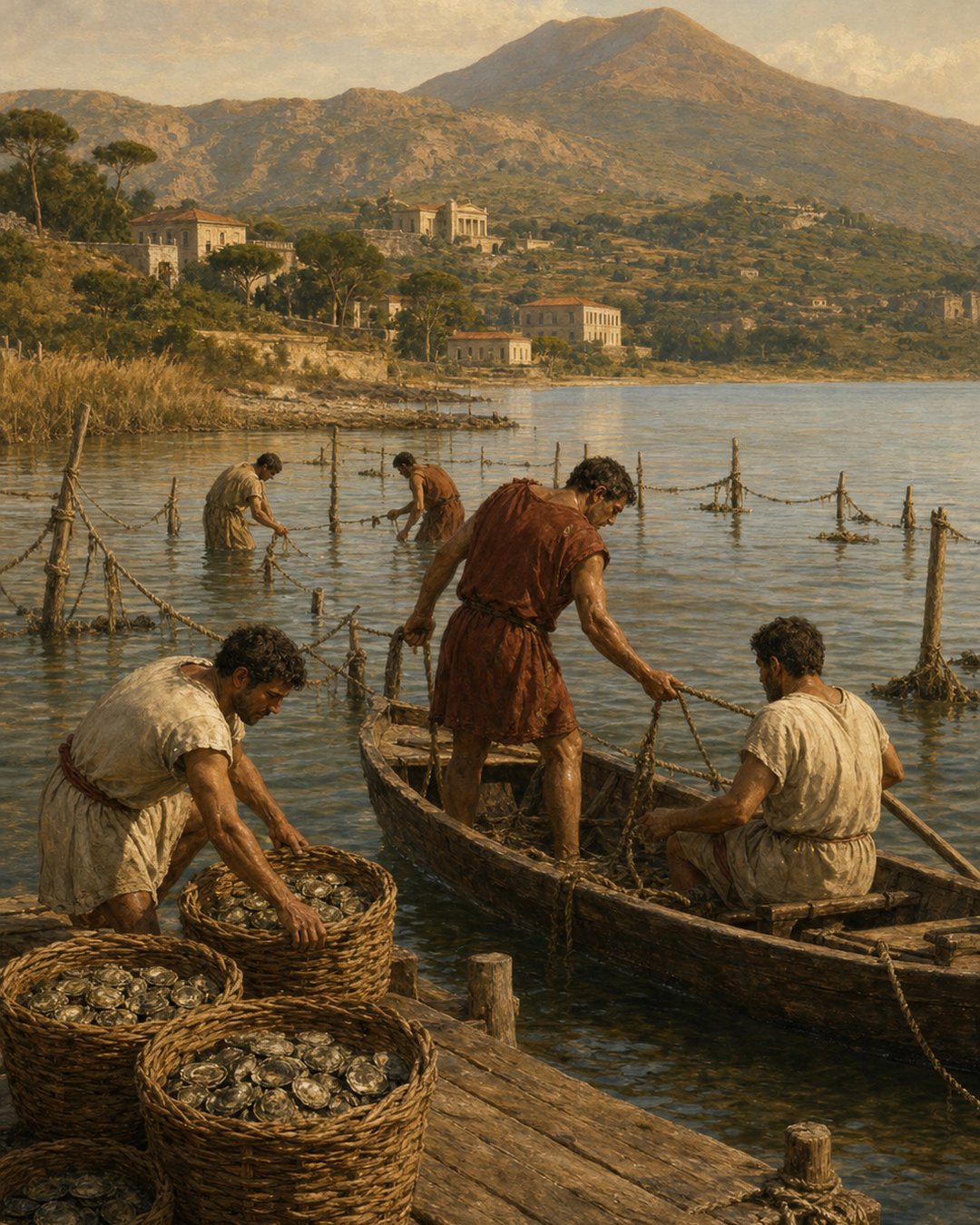
Sergius Orata’s oyster beds began with a stretch of water at Baiae and ended with a claim about taste. Pliny the Elder calls him the first person to form artificial beds, then immediately explains how the invention made money. Orata established them shortly before the Social War, promoted oysters from nearby Lake Lucrinus as the finest, and moved through the same Campanian market buying villas, improving them and selling them again.
The story is not simply about an ancient appetite discovering a better shellfish. It is about a merchant teaching buyers to value a managed place. An oyster could be cultivated, named by its water and sold with a reputation that exceeded the shell itself. Later dealers carried oysters north from Brundisium and fed them in Lucrinus after the long journey, as if one origin could be finished inside another.
Pliny disliked the luxury surrounding elite seafood, so his account makes greed the motive. That moral judgment should not hide the commercial mechanism he records. Orata linked aquaculture, property improvement and regional distinction. The lake supplied animals, but it also supplied a story that could change what customers believed those animals were worth.
The beds converted a shoreline into productive equipment
Pliny places Orata at Baiae in the age of Lucius Crassus the orator, just before the Social War. That dating puts the experiment in the late Republic, when the Campanian coast already attracted wealthy Romans to villas, baths and leisure. The same sheltered water that formed part of an elite landscape could be organized to produce food.
An artificial oyster bed is different from collecting whatever a natural shore happens to offer. It depends on selecting and maintaining a site where shellfish can remain, feed and be recovered. Pliny gives no construction manual, and it would be wrong to invent racks, dimensions or harvest calendars that his chapter does not name. His decisive word is artificial: human arrangement turned a location into a repeated source of oysters.
That arrangement reduced one kind of uncertainty. A collector follows a scattered resource; a cultivator returns to a prepared one. The value of the bed therefore rested partly in control over access and timing. Water that looked open could function as inventory attached to a particular enterprise.
The change resembles the processing chain that turned fish and salt into garum, but Orata’s product remained alive in its environment. Instead of transforming flesh in a container, he made the growing place itself carry the commercial method.
Orata sold judgment along with the oysters
Pliny says Orata was the first to award pre-eminence in delicacy to the oysters of Lake Lucrinus. The phrasing makes him sound less like a neutral diner than a judge announcing a winner. He possessed an interest in oyster beds near that water, then supplied the language that made the location desirable.
Place mattered throughout Pliny’s culinary catalogue. He names the best wolf-fish as those caught in one part of the Tiber, praises Ravenna for turbot, Sicily for murena and Rhodes for elops. The list assumes that species alone did not determine value. Buyers also asked where an animal had lived or been caught.
Orata’s ingenuity lay in joining production to that geography. If Lucrinus meant delicacy, oysters raised or finished there carried a distinction before anyone opened the shell. A buyer could not see flavour from the outside. Reputation bridged the gap between a closed object and an expected experience.
This was a claim vulnerable to self-interest. Pliny’s hostile explanation—avarice rather than gluttony—warns readers that the man praising Lucrine oysters profited from their fame. Yet even suspicion confirms the importance of the claim. Orata’s judgment was worth criticizing because it could organize demand.
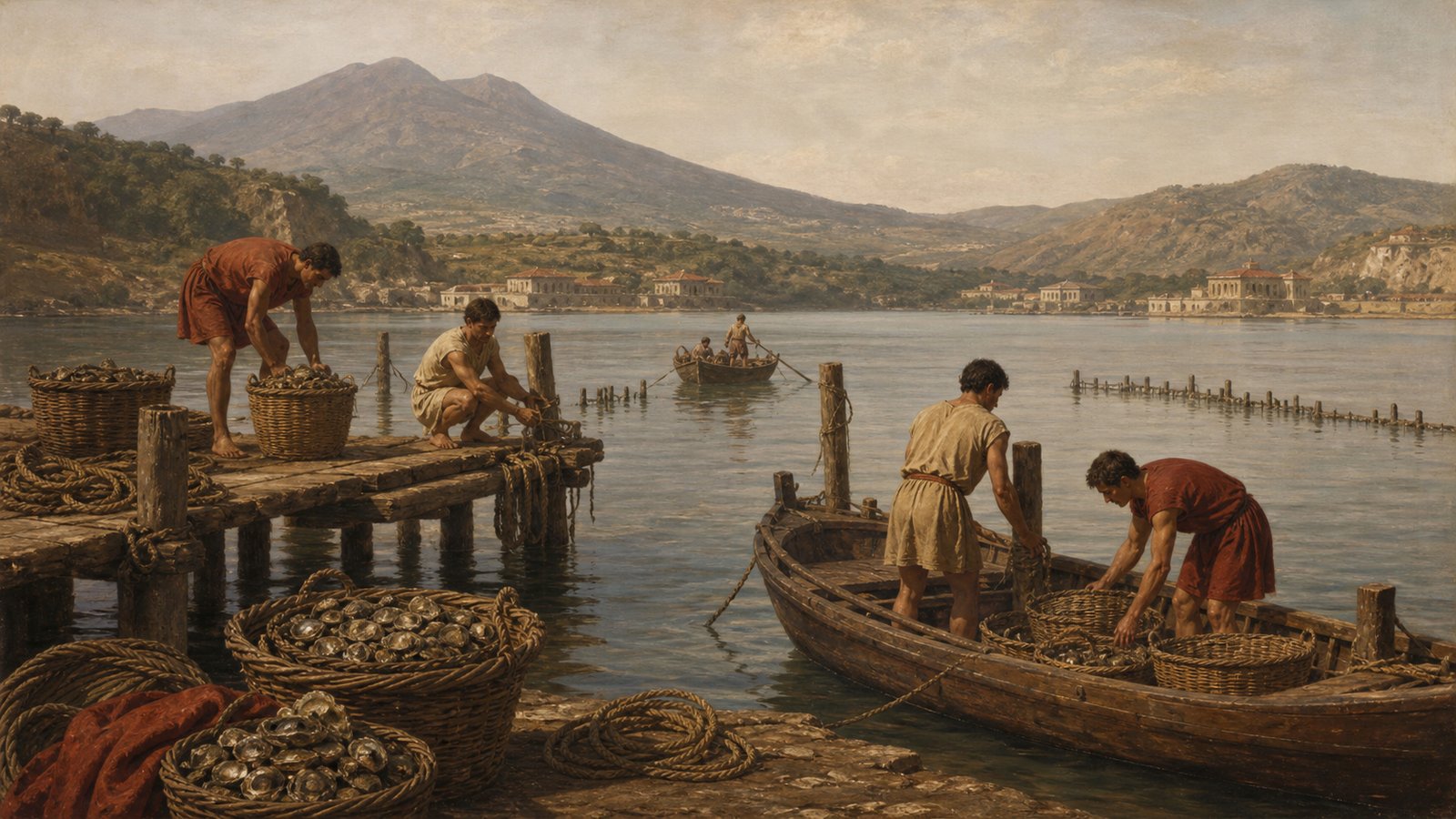
Baths and villas reveal the same commercial habit
Pliny interrupts the oyster story to credit Orata with suspended baths. The exact technical interpretation has been debated, but the chapter links the innovation to his treatment of houses. Orata bought villas, trimmed or improved them and sold them again. He was not tied to one commodity. He recognized settings whose value could be increased by designed amenities.
The oyster bed and the refurbished villa share a pattern. Both begin with a desirable Campanian location. Both receive an intervention that makes use of leisure, comfort or taste. Both can then be presented to wealthy customers as more valuable than the underlying site alone.
That does not prove the same buyer purchased an oyster and a house, nor that every villa sale depended on a bath. It shows why Pliny thought the details belonged in one portrait. Orata repeatedly converted ingenuity into income by improving the terms on which people experienced a place.
His enterprise therefore sits between production and promotion. The beds supplied oysters, but the assertion about Lucrinus supplied status. The villas supplied buildings, but new fittings supplied a reason to reconsider their price. Orata’s talent was making an alteration and then teaching the market to notice it.
A long journey created a second finishing stage
Pliny says British oysters had not yet entered Roman supply when Orata made Lucrinus famous. Later, merchants found it worthwhile to fetch oysters from Brundisium, near the far end of the Italian peninsula. The distance matters because oysters arrived not as an abstract regional name but as living, perishable cargo after a demanding journey.
The solution was to feed the Brundisium oysters in Lake Lucrinus. Pliny jokes that they must have been famished by travel. Beneath the joke is a distinct commercial operation: transport did not end when the cargo reached Campania. The oysters entered another managed environment before sale.
That step let merchants combine reputations. Brundisium supplied the transported shellfish; Lucrinus supplied the finishing water already associated with delicacy. Pliny says the plan prevented rivalry between the two flavours. Rather than force customers to choose one famous origin, dealers created a product that had passed through both.
The method complicates any simple idea of provenance. The oyster’s starting point remained meaningful, but its latest environment could modify how it was described and valued. Ancient traders were not merely moving regional foods toward Rome. They were intervening after movement to repair condition and reshape identity.
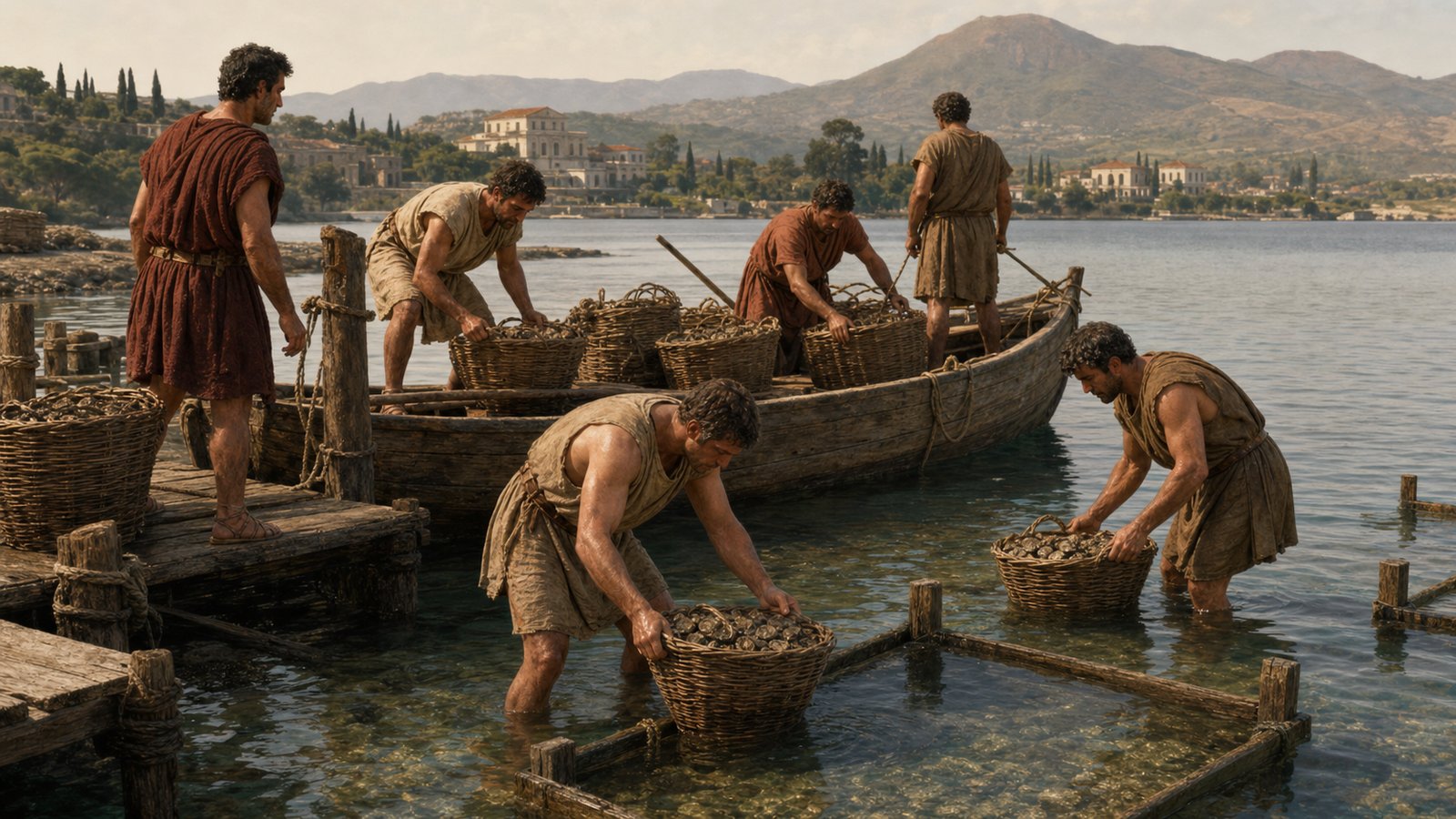
The lake became more valuable because its name travelled
Three layers of value accumulated around Orata’s water. The artificial beds made oysters more controllable. The claim about superior flavour gave Lucrinus a rank in elite conversation. Later conditioning made the lake useful even for oysters that began hundreds of kilometres away.
That commercial reputation worked much like the prestige attached to a coastal workshop’s production of purple dye. In both cases, unpleasant or ordinary marine labour disappeared behind a finished distinction. Customers encountered a colour or flavour whose price depended on knowing the right place and process.
Pliny wanted readers to see appetite turning ingenuity into avarice. His criticism preserves something more precise: luxury markets reward whoever can define comparison. Orata did not need every oyster in Italy to come from his beds. He needed Lucrinus to become the water against which other oysters were judged.
The later Brundisium practice shows that the definition outlived its first promoter. Once a lake possessed recognized flavour, merchants could route distant shellfish through it and sell the journey as improvement. Orata’s most durable construction may not have been a bed or bath. It was the expectation that a named body of water could confer quality.
Sources
Pliny the Elder, Natural History, 9.79.