
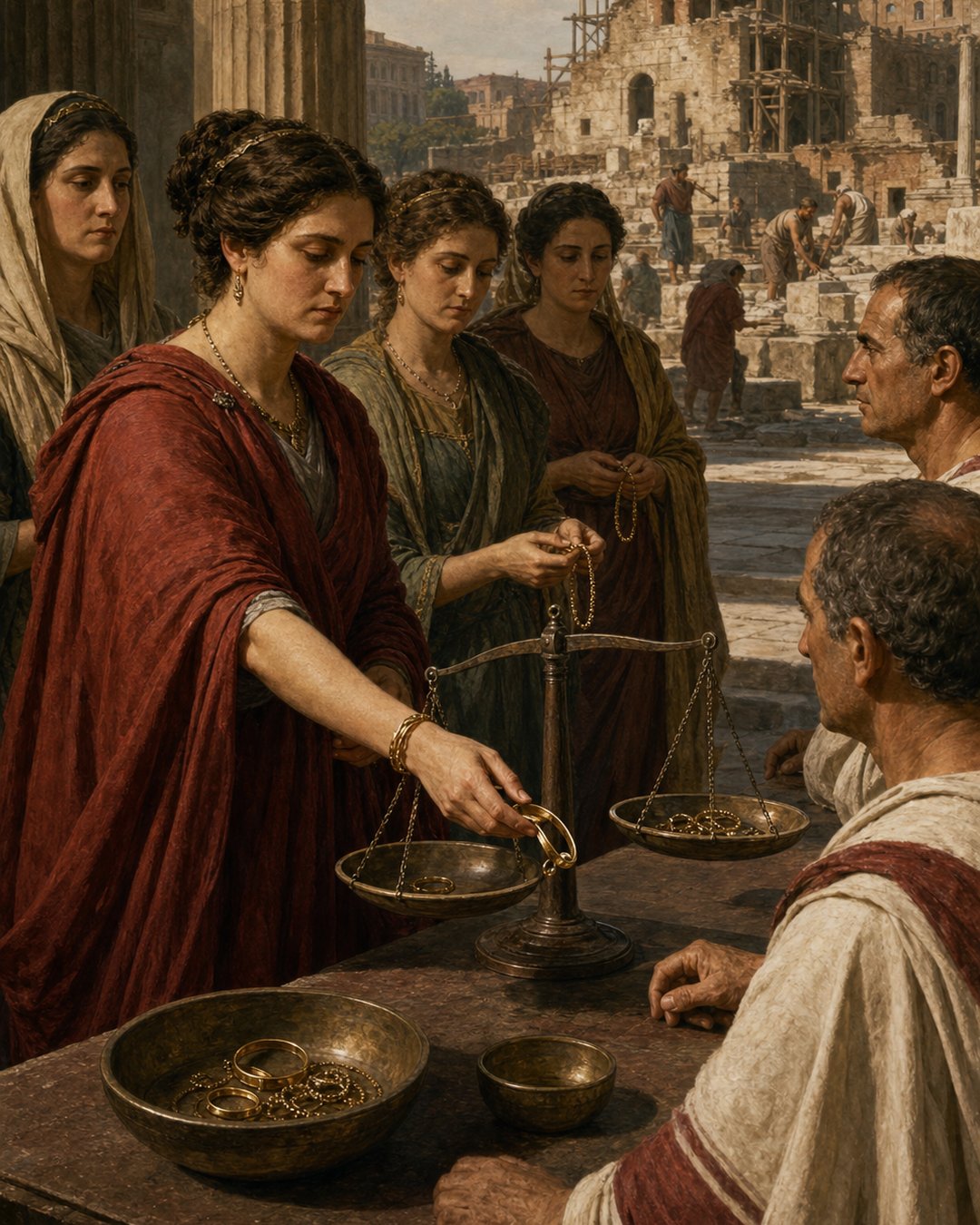
Roman women gave up gold, and the gift changed what could be said when a woman died. On that outcome Livy and Plutarch agree. They do not agree on the transaction that produced it. Livy places the contribution in the panic over ransom after the Gallic attack. Plutarch weighs the ornaments at eight talents and sends their metal toward a gold bowl promised to Delphi after the capture of Veii.
The difference is too large to hide inside a smooth retelling. One account protects sacred reserves while finding gold for an enemy payment. The other repairs Camillus’s forgotten vow after soldiers have surrendered a tenth of their spoils. Different shortage, different destination, different moral pressure—and the same senatorial reward: women would thereafter receive a suitable public eulogy at death, as men did.
Read together, the passages show how civic memory can hold an exchange more securely than an event. Private ornaments entered public need; public speech answered the contribution. Ancient historians could move the gold between crises while preserving the political meaning attached to its donors.
Livy placed the gift beside sacred gold and ransom
Livy’s chapter begins with Rome rebuilding religious order after the Gauls. Temples occupied by the enemy were to be restored and purified. Caere received public friendship for sheltering sacred objects and priests. Gold recovered from the Gauls, along with metal gathered from temples during the alarm, was judged sacred when no one could confidently return each piece to its original sanctuary.
That decision created a boundary during shortage. Gold existed, but the state would not treat every available mass as spendable. Livy says the public lacked enough for the agreed ransom and accepted what the matrons contributed so that sacred metal would remain untouched.
The contribution therefore did more than increase a total. It protected a classification. Temple gold could stay beneath Jupiter’s throne because women transferred ornaments from private possession into civic use. Their gift allowed Rome to meet an immediate claim without solving the emergency by violating property already assigned to the gods.
Livy’s narrative surrounds the act with recovery measures, including the belated honour to the warning voice later housed as Aius Locutius. The chapter treats rebuilding as a problem of restoring correct destinations: temples to their bounds, rites to their books, sacred gold to divine custody and civic debt to human resources.
Plutarch began with a vow that Camillus forgot
Plutarch locates the shortage earlier in a different chain of obligation. Camillus had vowed a tenth of Veii’s spoils, then admitted that he had forgotten the promise. Soldiers who had already carried off and sometimes spent their gains were ordered to bring a tenth under oath to the treasury.
The collection angered them. Plutarch emphasizes the strain on men who had fought hard and now had to retrieve part of property they regarded as won. Once the tithe had been assembled, Rome decided to make a bowl of massive gold for Delphi. The vow required not simply value, but metal suitable for a conspicuous dedication.
Then a material mismatch appeared. The treasury could receive a tenth of varied spoil, yet the magistrates still did not know where to obtain enough gold. In Plutarch’s version the women resolved it themselves. They offered the ornaments worn on their bodies, and he assigns the contribution the striking weight of eight talents.
This destination links their gold to Rome’s larger practice of turning to Delphi in moments of danger and obligation. The offering had to cross the sea and stand before a distant sanctuary. Personal jewellery became the material that allowed a Roman vow to appear abroad in finished form.
Voluntary ornaments carried a different meaning from a levy
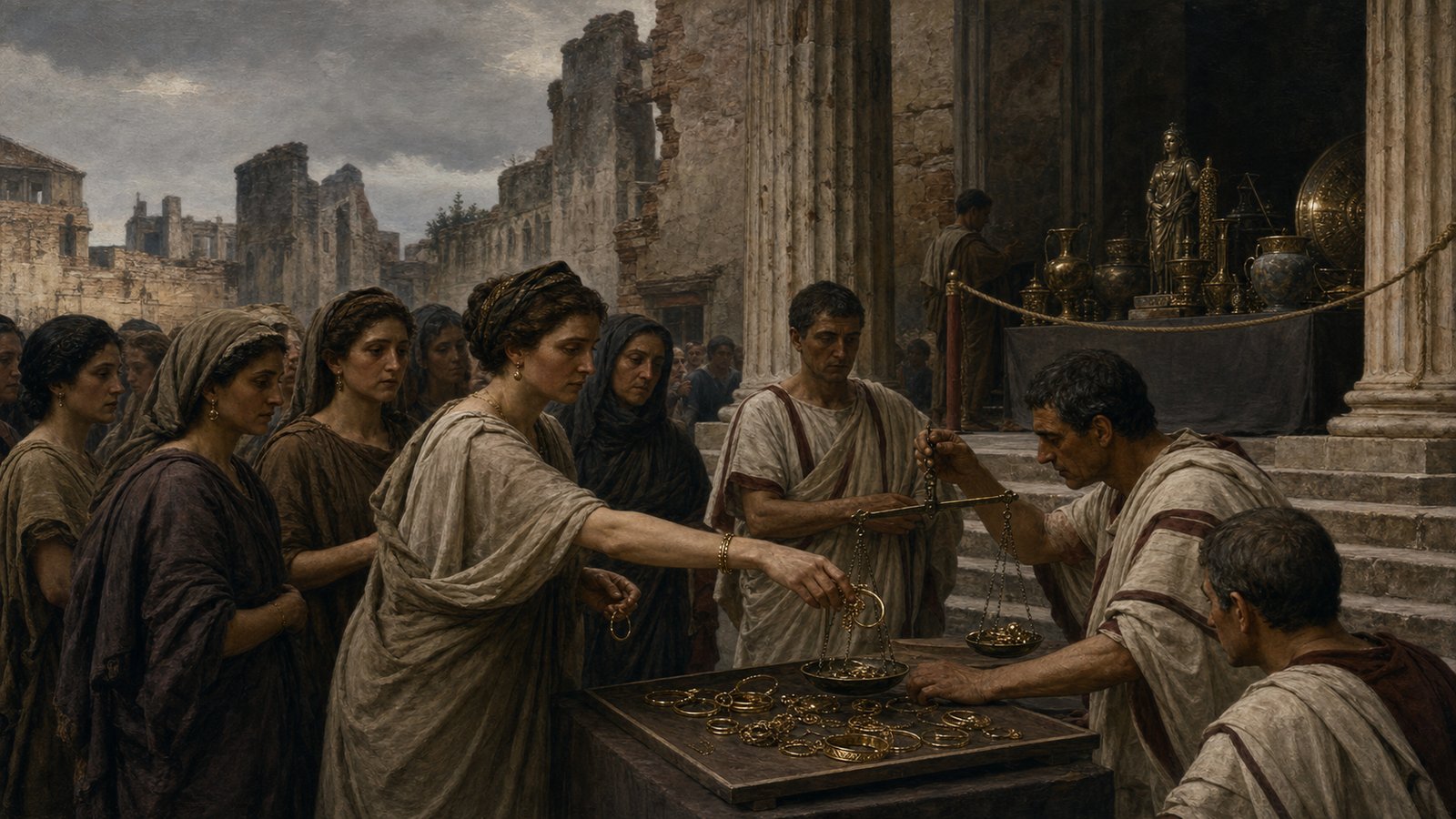
Both writers insist that the women offered their gold. That voluntary quality separates the ornaments from the collections imposed elsewhere in each story. Livy’s state faces a payment and safeguards sacred reserves. Plutarch’s soldiers contribute a tenth under oath while complaining about the demand. Against those compulsory pressures, the matrons act of their own accord.
Jewellery made the transfer visible. This was not an invisible balance moved between accounts. Gold left bodies and households. Bracelets, rings or other ornaments could be recognized as possessions before they were weighed as civic metal, even though neither passage provides a catalogue detailed enough to reconstruct every object.
The act also crossed the conventional division between household wealth and magistrates’ decisions. The Senate could decree rites, negotiate money and commission an offering, but shortage exposed the limits of what officials controlled. Women who did not occupy those magistracies possessed material the state suddenly needed.
Livy makes that material preserve divine boundaries. Plutarch makes it complete a male commander’s neglected promise. In either account, the donors repair a failure located beyond their formal authority. Their ornaments become useful precisely where public institutions have reached an impasse.
The reward changed who could be praised in public
The Senate’s answer was not repayment by weight. Livy records thanks and the right to funeral orations. Plutarch says a suitable eulogy would be spoken over women as over men, adding that such a public encomium had not previously been customary when a woman died.
A funeral speech turns contribution into repeated memory. Gold can be melted, spent, carried away or dedicated beyond Rome. The privilege of praise returns whenever an eligible death summons a household and audience. A single emergency thus supplied precedent for words spoken generations later.
The honour also matched the form of the gift. The women had made private possessions legible as civic service. Funeral oratory made private lives legible in public language. Each eulogy could place a woman within the moral history of family and community rather than leaving her death entirely inside the household.
This did not create equality in office or erase the restrictions Roman women faced. The same culture could celebrate female sacrifice while policing behaviour, as seen in the tradition that made a household kiss into a test for wine. The honour was specific: a recognized form of posthumous speech, justified by remembered material aid.

The disagreement reveals what memory refused to lose
It is tempting to choose one account, correct the other and continue with a single clean episode. The sources do not permit that confidence. Livy’s ransom context and Plutarch’s Delphic bowl are not two names for the same destination. Their shared ending must therefore be handled as a tradition preserved in competing narrative settings.
That competition is historically valuable. Livy organizes recovery after the Gauls around restored religious and civic boundaries. Plutarch organizes Camillus’s vow around the burdens of leadership, soldierly resentment and a dangerous embassy. Each author puts women’s gold where it resolves the pressure his story has built.
Yet neither discards the funeral honour. The stable element is the political exchange: women supplied precious metal voluntarily, and the community answered by admitting women to a form of commemorative speech associated with men. Roman historical writing remembered that this honour required an origin in service.
The gold’s destination changed because crisis stories competed for a powerful example. The reward endured because it explained a living custom. A listener could encounter a woman’s funeral eulogy without seeing the ancient ornaments or the payment they made possible. The speech itself kept asking why women had gained that place in public memory. Livy and Plutarch supplied different treasuries, but both answered with the same gift.
Sources
Livy, History of Rome, 5.50.
Plutarch, Life of Camillus, 8.