
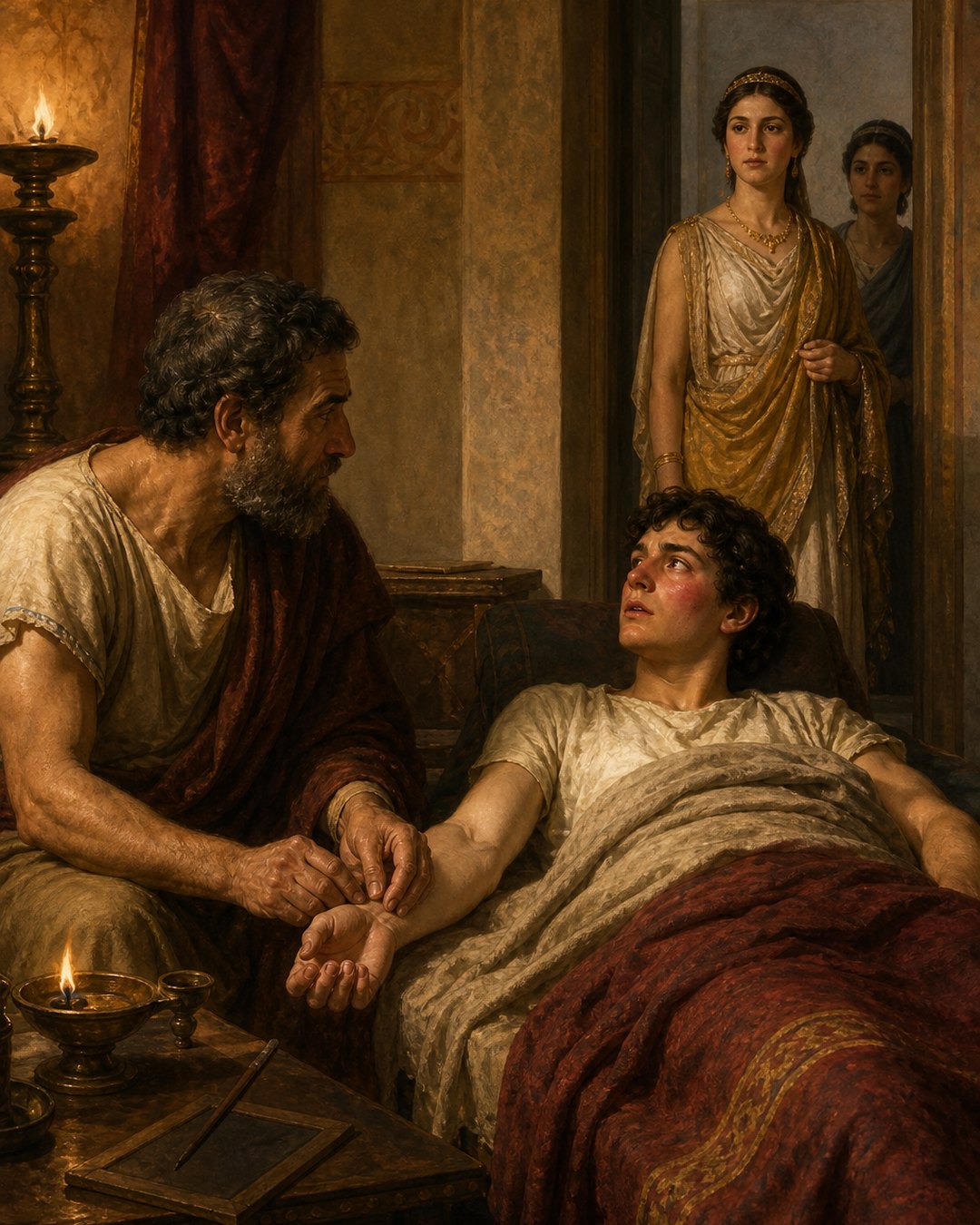
Antiochus was starving himself under the cover of illness. His physician Erasistratus believed that the prince was in love, but that diagnosis left the most dangerous question unanswered: with whom? Plutarch says the doctor remained in the chamber day after day and watched what happened when different people entered.
Most visitors produced nothing. Stratonice produced a cascade. Antiochus stammered, flushed, lost clarity of vision, sweated, suffered an irregular heartbeat and finally passed through helplessness, stupor and pallor. The prince would not give her name because she was already married to his father, Seleucus.
Erasistratus therefore had two problems rather than one. He had to identify the person hidden behind the symptoms, then tell a king that his son desired the king’s young wife. His solution used comparison in the sickroom and indirection in conversation. Observation exposed the name; a carefully invented story tested what the father was prepared to give before the truth appeared.
Antiochus tried to make desire look like disease
Plutarch introduces the crisis as an effort at concealment. Antiochus fell in love with Stratonice, who was young and already the mother of a small son by Seleucus. He treated the desire as intolerable. After trying to fight it down, he condemned himself for wanting what he believed he could not honourably pursue.
The prince’s proposed escape was gradual rather than theatrical. He neglected his person, refused food and pretended that some unnamed disease was consuming him. The performance worked because it borrowed the visible language of illness. Weakness produced by fasting could confirm the story that weakness had made food impossible.
That feedback made the case urgent. Every day of concealment damaged the body and made the disguise more convincing. A physician who accepted the surface complaint would see a patient declining despite treatment. Erasistratus instead suspected that the apparent disease was an effect of a conflict Antiochus would not confess.
The episode is very different from the operation in which Marius offered a surgeon his leg. There, pain had an anatomical target and treatment was performed openly. Antiochus presented no wound to cut. The missing evidence was a relationship, and the patient was committed to keeping it absent from speech.
The physician made every visit part of the comparison
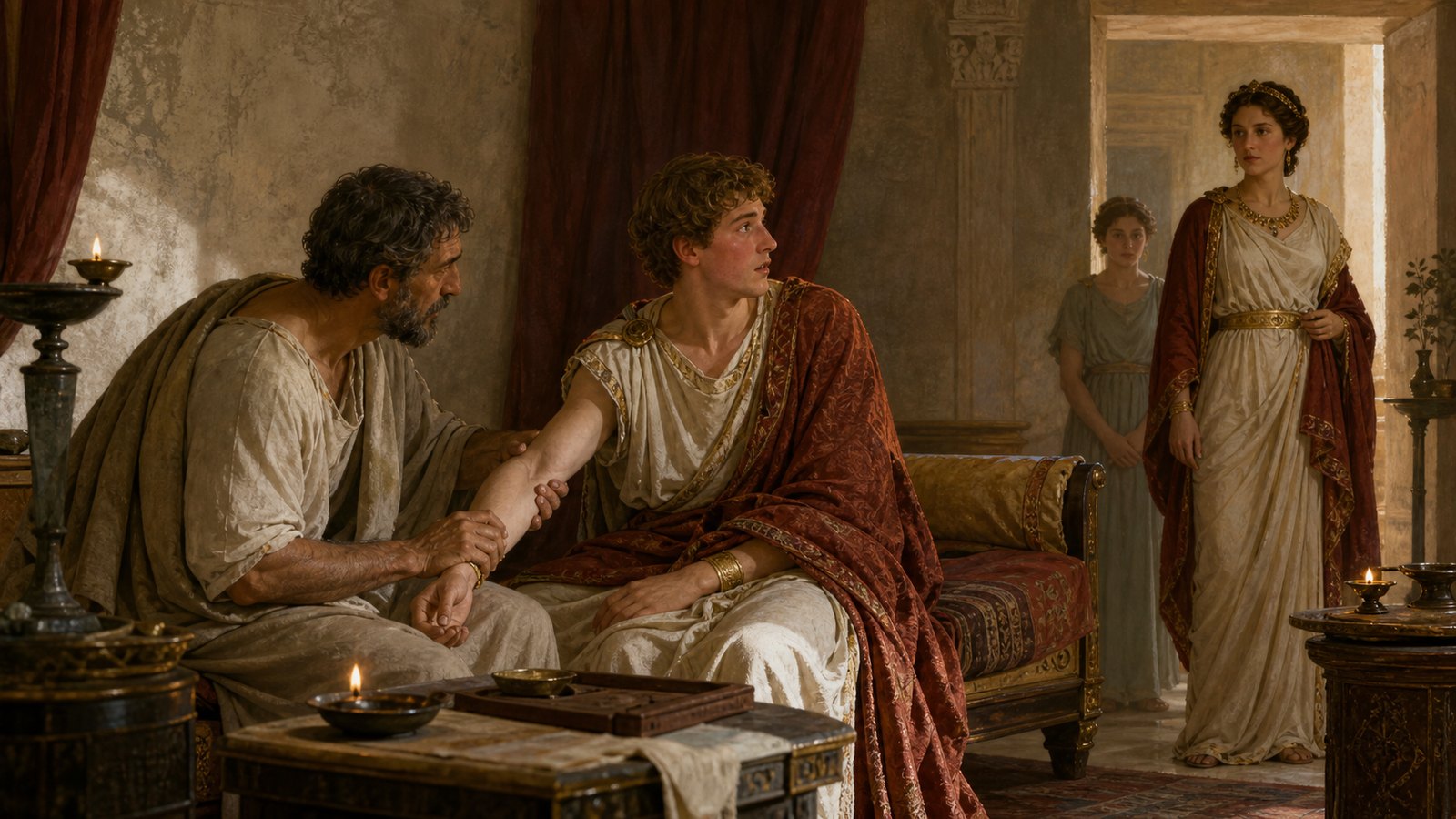
Recognizing lovesickness did not identify its object. Plutarch says Erasistratus stayed beside Antiochus and studied his face and bodily movements whenever the beauties of the court entered, whether male or female. The range matters. The doctor did not begin by assuming which visitor the prince desired.
This was repeated observation rather than one dramatic glance. Day followed day. Visitors entered under ordinary court conditions. Antiochus’s lack of reaction to them supplied the baseline that made one exception meaningful. A flush by itself might have many explanations; a flush that reliably followed one person and not the others formed a pattern.
Stratonice sometimes came alone and sometimes with Seleucus. Her arrival nevertheless brought the same cluster of signs. Plutarch borrows the language of Sappho to list them: speech faltered, heat and colour rose, sight darkened, sweat appeared, the heart beat irregularly, then strength and colour collapsed into stupor and pallor.
The symptoms moved in opposite directions. Fire and sweat suggested agitation; pallor and helplessness suggested withdrawal. Their sequence showed a body unable to keep the secret its owner guarded. Erasistratus did not need Antiochus to describe the passion because the controlled contrast among visitors repeatedly selected Stratonice.
Plutarch also gives the physician a social inference. If Antiochus had loved someone else, Erasistratus reasoned, he would not have chosen death rather than disclose it. The extremity of the silence narrowed the possibilities. The person was not merely unavailable. Naming her threatened the structure of the royal household.
A false answer measured the king before the true one
Evidence did not eliminate danger. Erasistratus now had to explain the case to the husband, father and king whose roles collided inside it. A blunt statement could sound like accusation, insult or manipulation. The physician approached Seleucus with only half the truth: Antiochus was dying from a love that could neither be satisfied nor cured.
When Seleucus demanded an explanation, Erasistratus said the prince loved the physician’s own wife. The claim was false, but it created a safer version of the moral problem. Seleucus could answer before realizing that the requested sacrifice concerned his own marriage.
The king asked Erasistratus to give the woman to Antiochus, invoking friendship and the prince’s position as the only anchor of a storm-tossed house. That response established the principle Seleucus wanted another man to follow: a marriage should yield if surrendering it could save the heir.
Erasistratus then reversed the test. Seleucus, he said, would not act so generously if Antiochus had fixed his desire on Stratonice. The physician did not yet make a direct accusation. He let the king hear his own request returned with the names changed.
Seleucus answered with tears that he wished heaven or earth could turn the passion in precisely that direction. He declared that he would gladly let even his kingdom go if he could keep Antiochus alive. Only then did Erasistratus reveal that no outside physician possessed the remedy. Seleucus, as father, husband and king, could treat the household himself.
The cure required a public transfer of rank
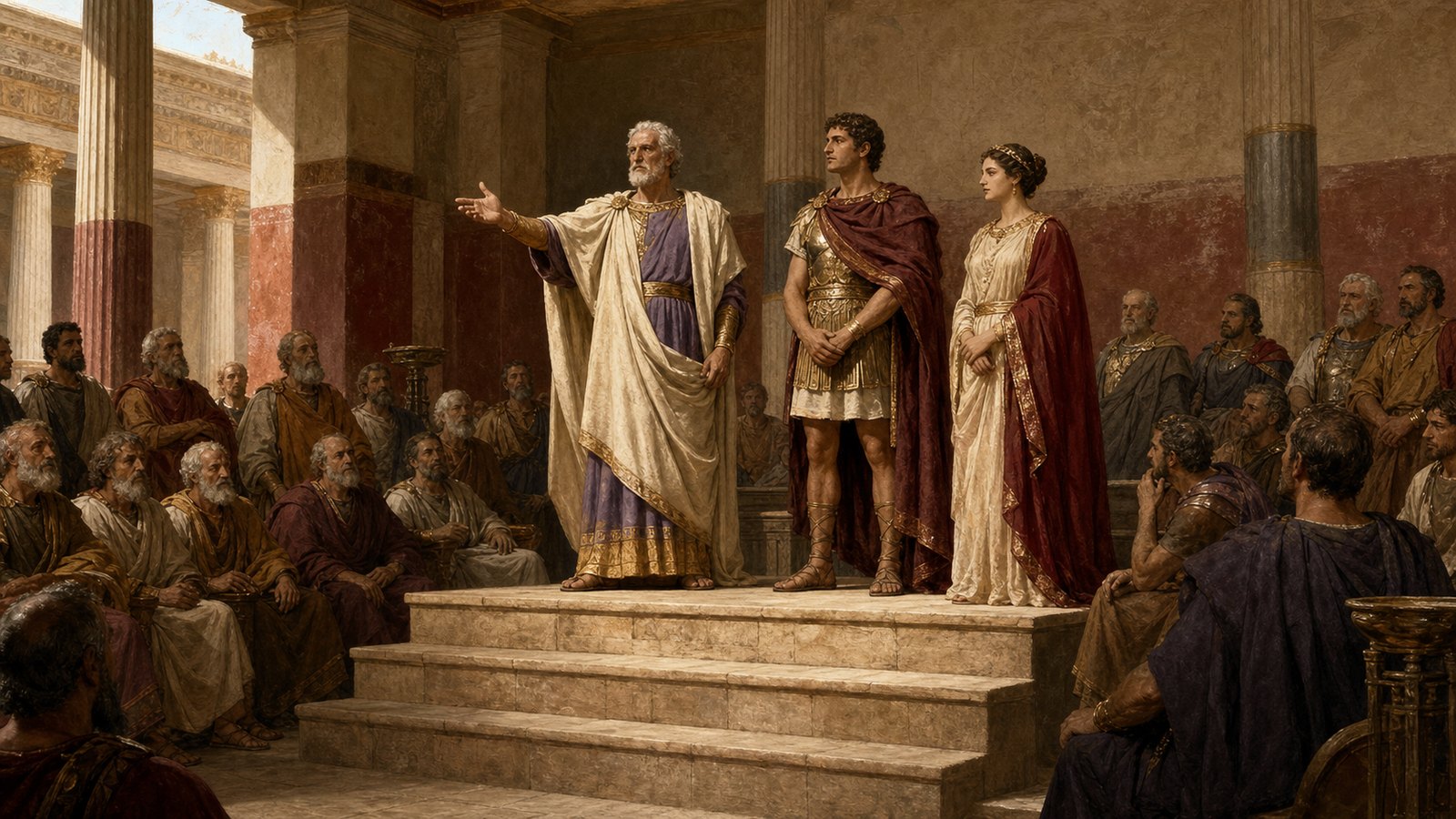
The diagnosis did not end at the sickbed. Seleucus called an assembly of the people and announced that Antiochus would become king of Upper Asia and that Stratonice would be his queen and wife. A private bodily pattern therefore led to a public rearrangement of marriage and government.
Plutarch’s wording preserves how much authority the settlement required. Seleucus said that his obedient son would not oppose his father’s decision. If Stratonice resisted the extraordinary change, the king instructed his friends to persuade her that what served the general welfare should be regarded as just and honourable.
That language does not give Stratonice an independent account of the event. Plutarch reports what Antiochus felt, what Erasistratus inferred and what Seleucus decided. Stratonice enters the sickroom as the decisive stimulus and the assembly as the woman to be persuaded. The cure for one person depended on power exercised over another.
The new kingship also prevented the marriage from appearing as a private concession without political form. Antiochus and Stratonice received a territory and matching royal titles. Seleucus did not simply dissolve one union. He placed the new couple within a dynastic division that could be proclaimed as government.
Household medicine and succession had become inseparable. The patient was an heir, the desired woman a queen, and the husband the ruler able to redefine all three positions. Erasistratus’s achievement was not that he prescribed a drug. He identified where the authority to change the conditions of illness actually sat.
Plutarch made diagnosis a lesson in controlled disclosure
The story has often been admired as an early clinical tale because Erasistratus notices bodily changes and compares them across repeated encounters. It deserves that attention, but Plutarch’s scene is equally concerned with communication. Knowing the answer would have been useless if the physician could not disclose it without destroying trust.
The invented wife is therefore part of the diagnostic method’s success. It separates the moral principle from the threatening identity. Seleucus first decides what a loyal friend should sacrifice; only afterward does he learn that the sacrifice belongs to him. The physician turns the king’s own answer into permission to continue.
This indirectness contrasts with Cato’s blunt programme of cabbage, walking and household treatment. Erasistratus works in a court where the most dangerous fact is not a symptom but a name. His treatment must pass through rank, marriage and succession before it can reach the patient.
Plutarch wrote biography, not a case report. The scene is shaped around recognition, reversal and a ruler’s emotional generosity. Its literary finish should prevent us from treating every gesture as a modern clinical record. Yet the sequence remains precise about its own mechanism: compare visitors, isolate the exception, test the father with a safer fiction, then reveal who holds the remedy.
Antiochus could hide his words and refuse his food. He could not keep his body unchanged when Stratonice entered. Erasistratus read that difference, but his more delicate skill came afterward. He made Seleucus state the cost he would accept before showing the king that the bill was already his.
Sources
Plutarch, Life of Demetrius, 38.