
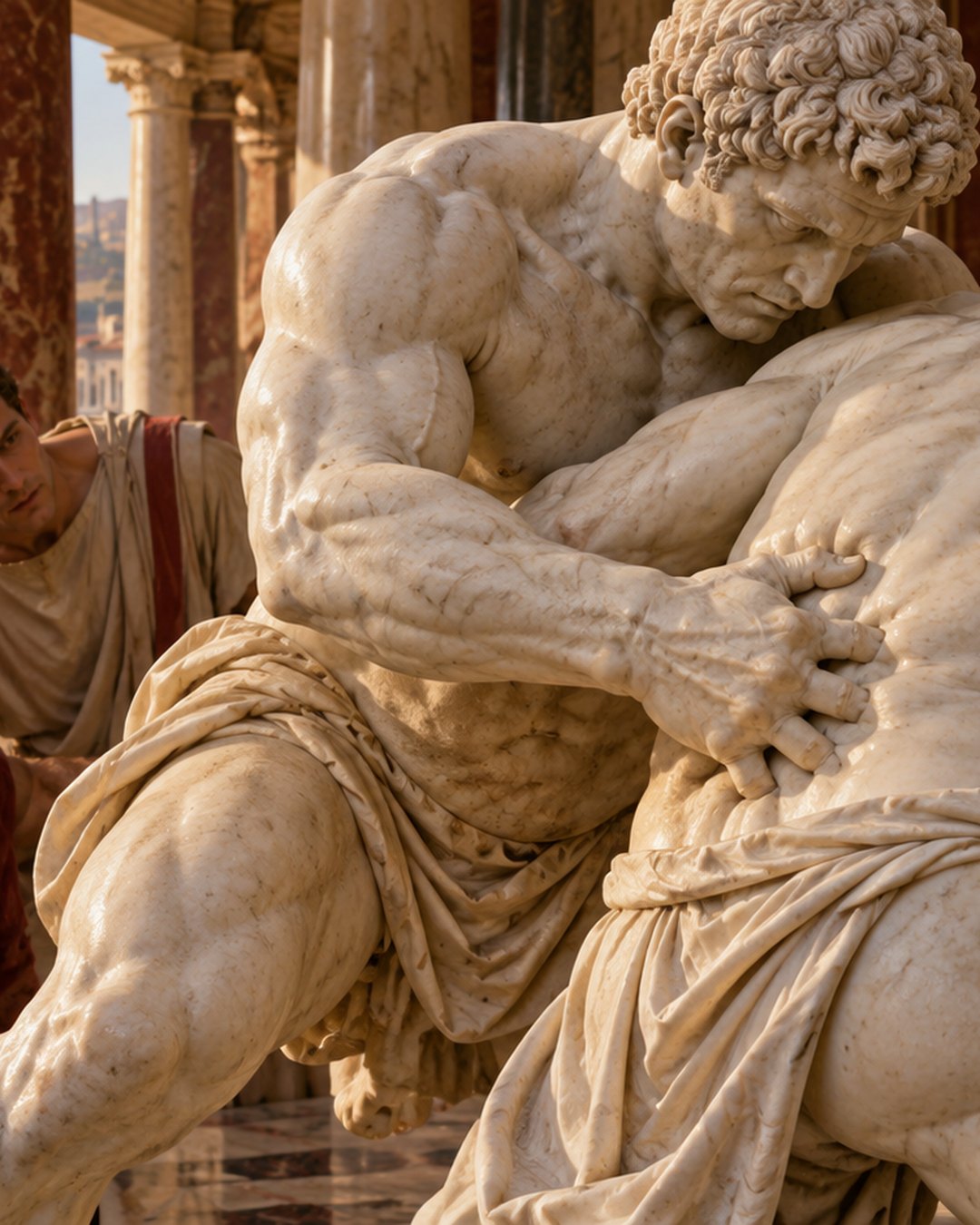
Pliny the Elder pauses over one small physical impossibility. In a marble group by Cephisodotus, fingers appeared to press into living flesh. The material was cold stone; the eye registered yielding skin. For Pliny, that contradiction was enough to identify what made the work memorable.
The remark opens a much larger view of sculpture in imperial Rome. Statues arrived with family reputations, changed homes, entered temples and private collections, acquired gold coverings, and sometimes lost the names of their makers. Technical brilliance could survive even when attribution did not. Rome possessed so much art that abundance itself became a threat to memory.
The proof of skill was a hand pressing into stone
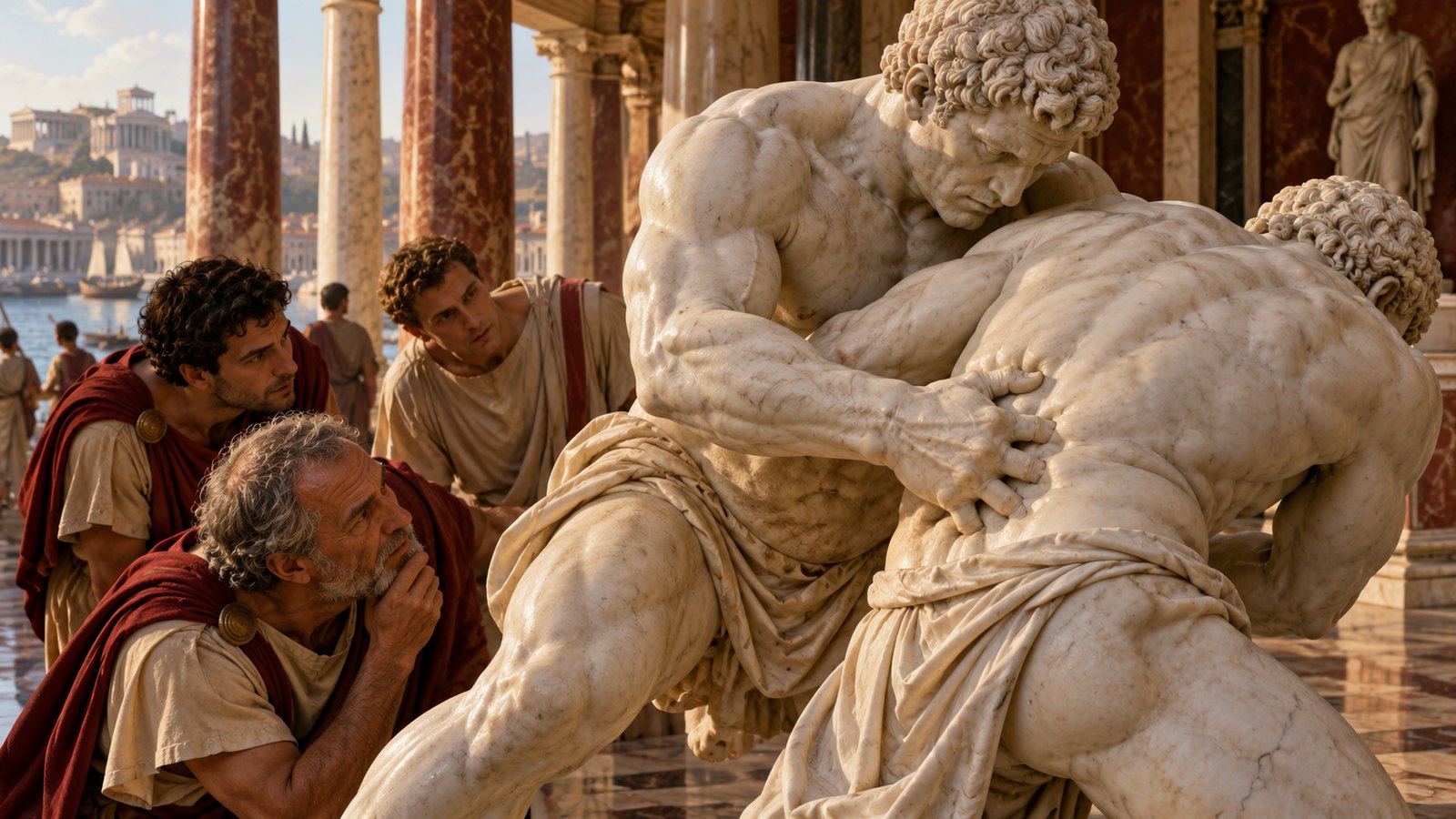
Cephisodotus was the son of Praxiteles, and Pliny presents artistic inheritance almost as plainly as a family possession: the son inherited his father’s skill. Yet lineage was not the final proof. Pliny singled out a group called Persons Grappling at Pergamum and directed attention to its fingers. They seemed to sink into living flesh rather than dead marble.
That choice of detail matters. Pliny did not begin with the size of the group or the fame of its patrons. He chose a point of contact between bodies. A sculptor had to make one hard surface appear to compress another hard surface. The illusion depended on the transition around each finger: the suggestion of weight, resistance, and a body answering pressure.
The viewer did not need a workshop manual to understand the achievement. Everyone knew how skin behaved under a grip. The test was immediate and physical. Marble succeeded when it contradicted what the viewer knew about marble.
Cephisodotus’s group therefore belonged to a wider ancient habit of judging art through impossible effects. A work could seem to breathe, move, speak, or soften. The point was not that spectators literally mistook stone for a person. The marvel lay in feeling the pull of both truths at once: it was unmistakably carved, and it behaved as if alive.
A celebrated sculptor could be scattered across the city
Pliny’s next sentences move from Pergamum to Rome and from one masterpiece to several addresses. Cephisodotus had a Latona in the temple of Apollo on the Palatine. A Venus stood in the collection of Asinius Pollio. An Aesculapius and a Diana were in the temple of Juno inside the Portico of Octavia.
This was not a modern museum catalogue arranged in one building. A viewer would encounter the sculptor through journeys across sacred and private space. The Palatine linked a statue with Apollo’s temple. Pollio’s collection placed another work inside the orbit of an elite collector. The Portico of Octavia held further divine figures within a dense monumental district.
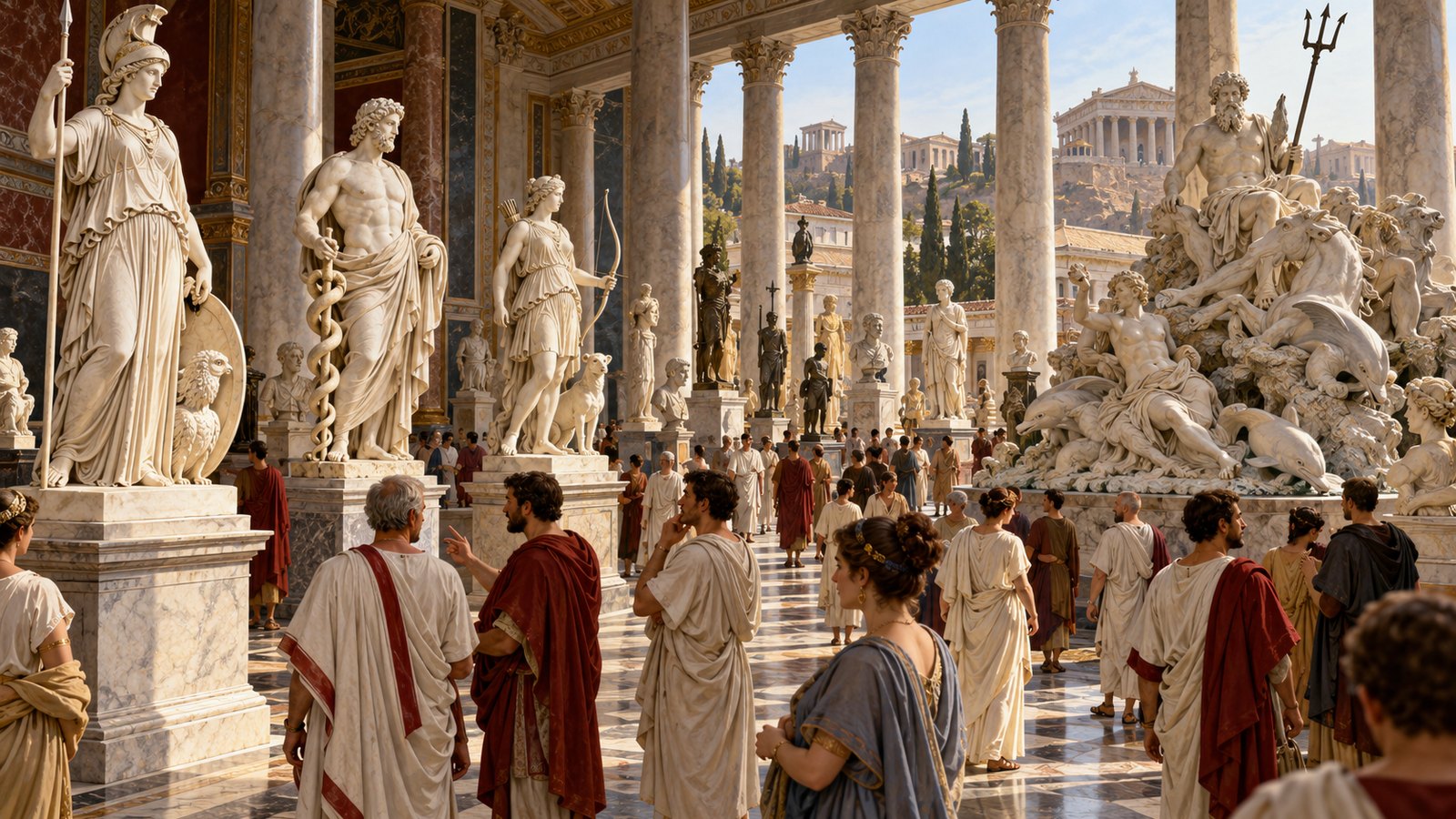
Location altered the experience. Latona, Venus, Aesculapius, and Diana did not form one surviving set in Pliny’s account. Their shared maker connected them across the city. Knowing sculpture meant remembering names, walking routes, recognizing collections, and understanding that a Greek artist’s reputation had been redistributed through Roman places.
That movement also helps explain why an artwork could gain a second life in Rome. Cephisodotus’s Persons Grappling was praised at Pergamum, while his Roman works were identified by where viewers could find them. Reputation travelled through objects, but the city gave those objects new institutional frames.
Scopas filled one shrine with an entire sea
Pliny then turns to Scopas, whom he treats as a rival in merit. The list begins with individual sacred works: a Venus and a figure of Pothos, or Desire, worshipped with solemn rites on Samothrace. He also names an Apollo on the Palatine and a seated Vesta in the Servilian Gardens, accompanied by two turning-posts. Copies of those flanking objects stood in Pollio’s collection, where Scopas’s girl carrying a sacred basket could also be seen.
The scale changes dramatically in the shrine built by Gnaeus Domitius in the Circus Flaminius. There Scopas created a marine company around Neptune, Thetis, and Achilles. Nereids rode dolphins, large fish, and seahorses. Tritons and other sea creatures crowded the composition. Pliny stresses that one man made the whole ensemble.
For him, this would have been a magnificent achievement even if it had consumed the sculptor’s entire career. It had not. Scopas also made a colossal seated Mars for the temple built by Brutus Callaecus in the Circus Flaminius, along with a nude Venus in the same place. Pliny judged that Venus superior to Praxiteles’s famous version and dryly observed that it could have made the reputation of any city except Rome.
The remark captures the pressure of abundance. Elsewhere, one extraordinary statue might define a locality. In Rome it competed with temples, porticoes, imported masterpieces, colossal gods, private collections, and official business. Artistic greatness had not become smaller. The city around it had become too large.
Rome’s riches erased the labels in people’s minds
Pliny does not celebrate abundance without cost. He says the sheer number of artworks at Rome led to their effacement from memory. Official duties and business made the problem worse. Proper appreciation required leisure and deep quiet, exactly what the capital denied to many of its inhabitants.
His complaint is revealing because it separates possession from attention. Rome could own masterpieces without truly knowing them. A temple might protect a statue physically while urban distraction weakened its identity. The archive was present in stone yet unstable in memory.
Pliny gives the Venus dedicated by Vespasian in the precinct of the Temple of Peace as an example. He believed it deserved to rank with the old masters, but its maker was unknown. Imperial dedication, prominent placement, and aesthetic quality could not restore the missing name.
This is a different kind of loss from destruction. The object remained visible. What disappeared was the chain joining hand, work, and reputation. Pliny’s catalogue tries to repair that chain where evidence permits. Where it does not, he marks uncertainty rather than inventing certainty.
The problem also complicates the story told by the alarm used to expose Praxiteles’s favourite works. A sculptor’s name could make statues intensely desirable, but Rome also shows the reverse: admired statues could outlive secure knowledge of who carved them.
Gold, copies, and arguments made attribution harder
Uncertainty did not end with one anonymous Venus. Pliny says people disputed whether the dying children of Niobe in the temple of Apollo Sosianus were by Scopas or Praxiteles. The problem was not indifference. Both names mattered so much that the disagreement endured.
The Father Janus offered another warning. Augustus had brought the sculpture from Egypt and dedicated it in the god’s proper temple. Pliny says the work could not be assigned confidently to either Scopas or Praxiteles, and a covering of gilt had hidden its secret still further. Gold increased splendour while obscuring the surface that might have helped a practiced eye judge the hand behind it.
There was also argument about a Cupid holding a thunderbolt in the Hall of Octavia. The sculptor’s identity was uncertain, but one claim was repeated with confidence: the figure represented Alcibiades, remembered as the most handsome young man of his time. The subject’s identity held while the maker’s did not.
Copies added another layer. Pliny notes facsimiles of the turning-posts associated with Scopas’s seated Vesta in Pollio’s collection. A Roman viewer could therefore know a composition through repetition as well as through an original setting. Recognition did not always establish authorship, and display history did not always preserve origin.
The city’s sculpture culture was not a neat progression from named master to labelled object. It was a living field of transport, imitation, restoration, covering, dedication, and debate. Even an imperial face could be inserted into an older celebrated image. Attribution survived only when memory, surface, documentation, and place continued to agree.
Cephisodotus’s fingers stand out because they needed no label to make their effect. The viewer could feel the sculptural problem in an instant. Pliny preserved the maker’s name, but he preserved the reason for praise too. Against Rome’s ocean of objects, one grip remained specific: dead marble made to yield like living flesh.
Sources
Pliny the Elder, Natural History, 36.24–28.