
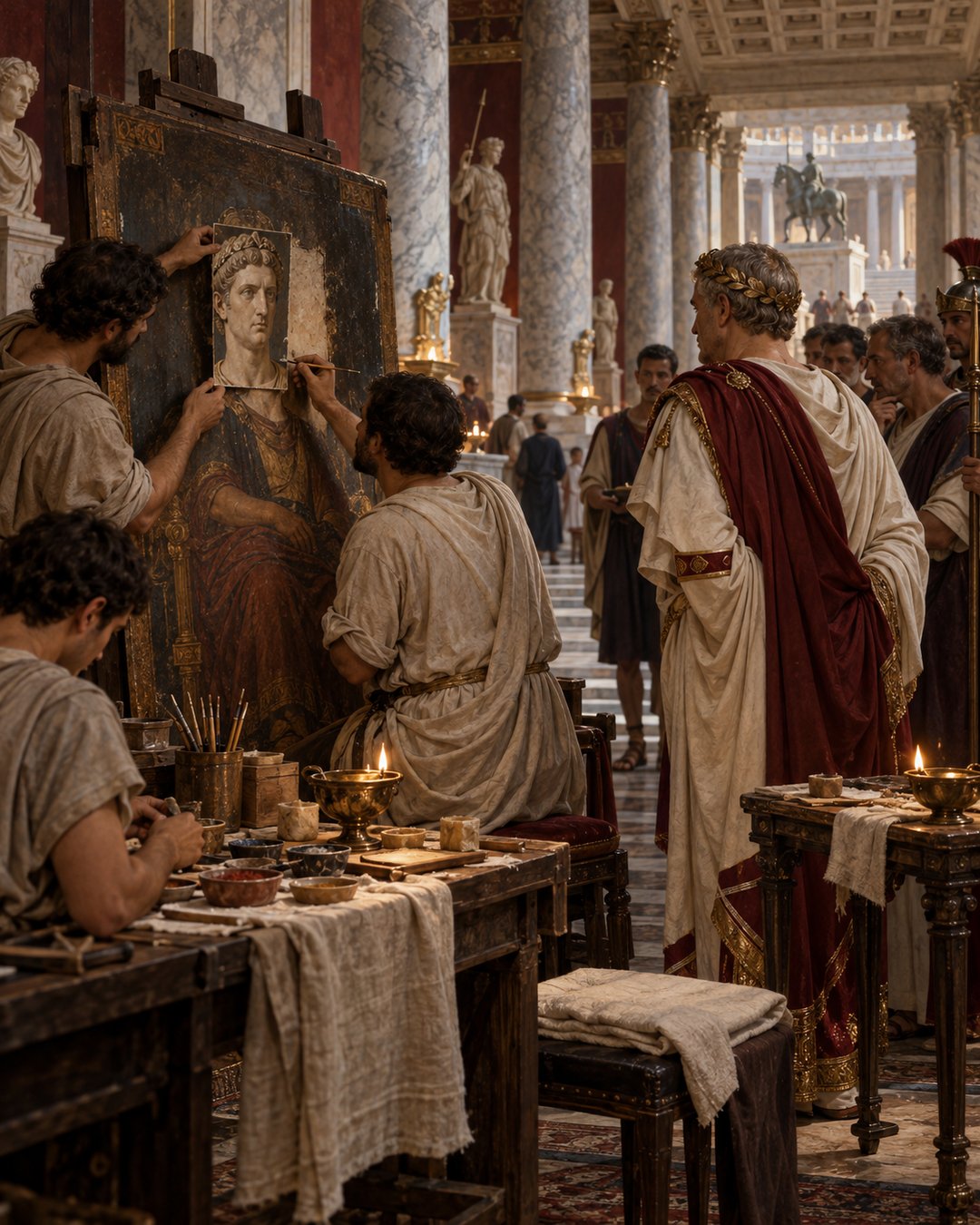
Two old panel paintings stood where the crowds of Augustus’s forum could see them. Alexander the Great appeared in both. Under Claudius, the Macedonian king lost his painted face, and Augustus acquired it.
Pliny the Elder reports the intervention without describing the hands that carried it out. The faces of Alexander were cut from both works and portraits of Augustus were substituted. A new emperor revised an earlier emperor’s public art by altering the surface itself.
The episode is brief, but it catches imperial memory at the moment it became a material operation.
Augustus Made Greek Victory Part of a Roman Forum
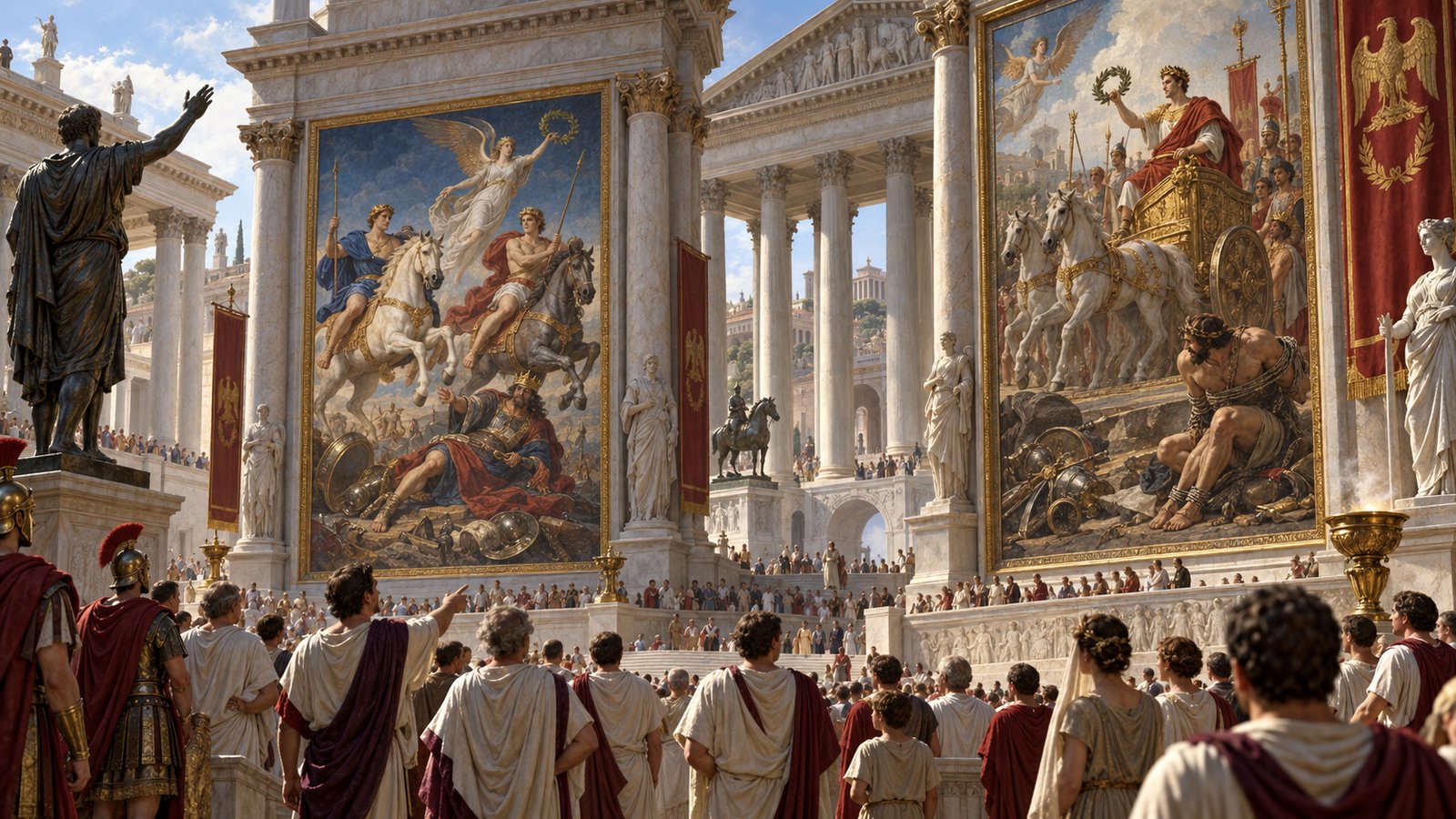
The paintings came with the prestige of Apelles, the artist most closely associated in Pliny’s account with Alexander. One Roman work showed Castor and Pollux together with Victory and the Macedonian king. The other presented War with its hands tied behind, while Alexander rode in triumph in a chariot.
These were not private cabinet pieces in Pliny’s description. Augustus dedicated both in the most frequented parts of his forum. Their placement joined old Greek royal imagery to a new Roman complex built for law, ceremony and public movement.
The figures made victory legible through bodies and sequence. Divine twins and Victory accompanied Alexander in one picture. Bound War and a triumphal chariot organized the other around conquest already secured. Pliny does not preserve every compositional detail, but his labels show why the works suited an imperial forum.
Augustus’s decision is striking because he did not initially replace Alexander. The foreign conqueror remained identifiable. His prestige could be displayed, collected and placed within Roman architecture without pretending that he had always been Roman.
The forum changed the paintings even before Claudius touched them. A work associated with an older court acquired a new audience and political setting. Every visitor who passed it encountered Alexander through Augustan selection.
Lost Eagles has followed Apelles listening from behind a picture while viewers criticized a sandal. That workshop anecdote asks who may judge a painter’s decisions. The forum episode asks a harsher question: who may revise a celebrated picture once imperial ownership has turned it into public memory?
Claudius Chose Substitution over a New Commission
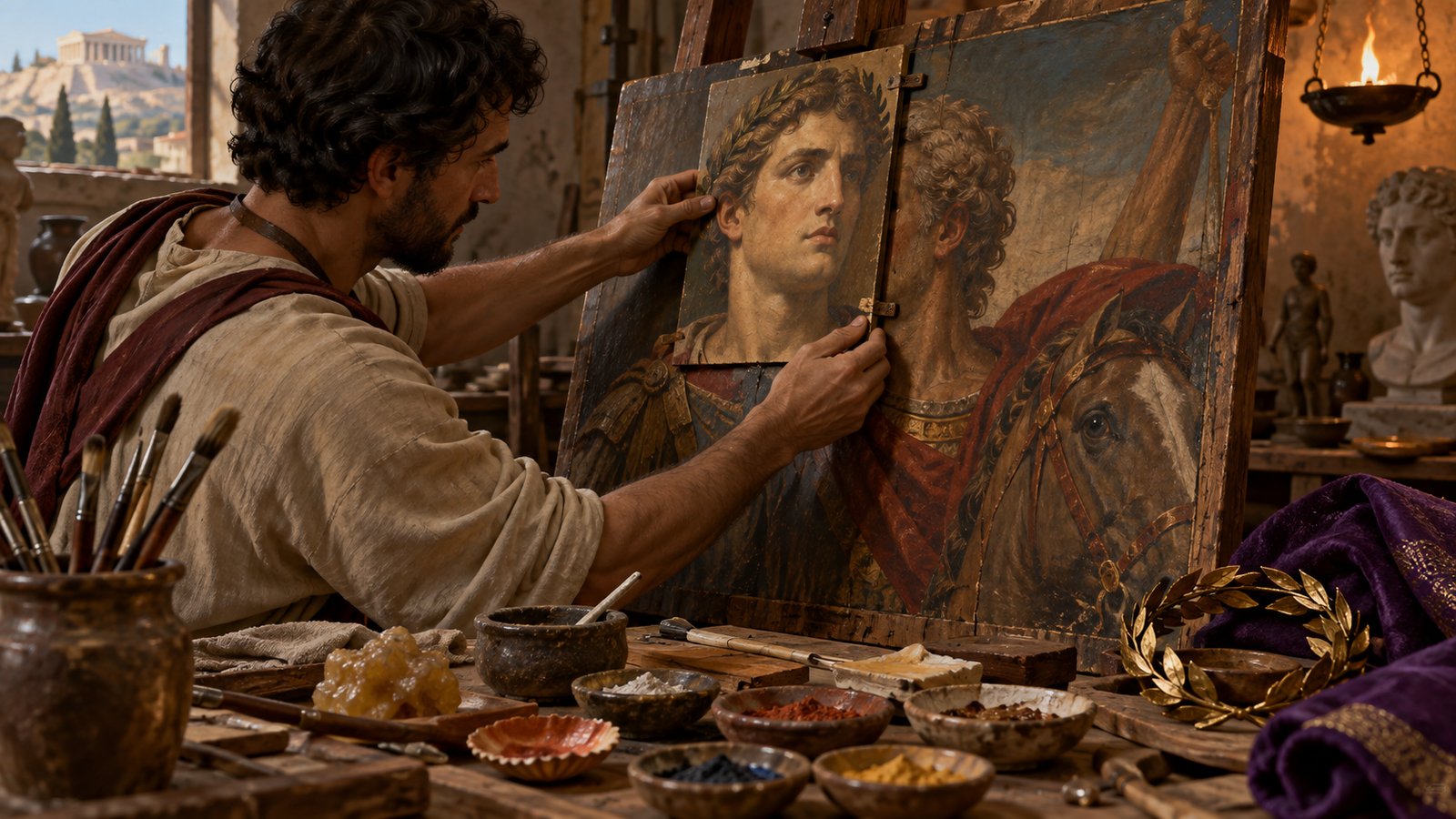
Pliny says Claudius thought it more advisable to cut Alexander’s face from both paintings and substitute portraits of Augustus. The wording gives the emperor a choice, even if it does not preserve his full reasoning.
Commissioning two fresh pictures would have produced Augustan images without disturbing the old panels. Moving the paintings elsewhere would have changed their audience. Adding labels would have guided interpretation while leaving the figures intact. Claudius instead retained the compositions and changed their human center.
The alteration depended on recognition. Victory, bound War and the triumphal chariot could continue to perform their old work, but the face redirected the honor. A viewer now met Augustus where Alexander had occupied the scene.
That was not a neutral repair. It converted inherited authority. Apelles’s reputation and the paintings’ Alexander-era associations remained useful, while the identity of the victorious ruler became Roman and dynastic.
Pliny does not explain whether a rectangular section, a shaped portion or a larger area of each panel was removed. He does not name the later painter, record the pigments or describe the joins. Those details must remain unknown. What is secure is the double action: Alexander was cut out, Augustus was put in, and it happened twice.
The repetition matters. One altered face might be treated as an isolated practical decision. Two parallel substitutions reveal a program applied to the pair that Augustus had installed.
The Painted Face Carried More Than a Likeness
Apelles’s fame in Pliny rests partly on portraits that seemed uncannily alive. In another notice, the artist hid King Antigonus’s blind eye by showing only the undamaged side in a three-quarter view. A face could control what a viewer knew about the subject.
Alexander’s own portraits were central to that reputation. At Ephesus, Apelles painted him holding a thunderbolt for twenty talents in gold. Pliny says the fingers seemed to project from the surface and the thunderbolt appeared to stand out. Payment arrived in gold measured by weight rather than counted.
That picture helps explain why an imperial substitution was potent. Apelles did not merely supply a generic victorious body. His Alexander imagery linked a recognizable ruler to divine force, technical illusion and extraordinary value.
In the forum works, Claudius preserved the wider heroic apparatus and changed the portrait identity. Augustus inherited the victory without needing a new chariot, a new bound War or a new artist of equal fame.
Portraiture therefore worked as a hinge between biography and political type. The surrounding body could communicate triumph broadly; the face told the crowd whose triumph it had become.
The site’s account of Caesar paying eighty talents for Timomachus’s Medea and Ajax shows another ruler turning expensive Greek painting into Roman temple display. Claudius’s intervention went further. Ownership authorized not only placement but alteration.
Pliny Distinguished Damage, Incompletion, Replacement, and Editing
The surrounding pages of Natural History make the face substitution more revealing because Pliny records several different responses to vulnerable art.
Apelles’s Venus emerging from the Sea was dedicated by Augustus in the shrine of his father Caesar. When the lower part was damaged, nobody could be found to restore it. The injury remained and, in Pliny’s formulation, even contributed to the painter’s glory because later hands would not presume to match him.
Age and rot eventually forced a different decision. Nero substituted a picture by Dorotheus. Here the old work was not given a new face; it was replaced by another work when deterioration had gone too far.
A second Aphrodite at Cos posed another limit. Apelles died before finishing it, and nobody could continue the picture in conformity with the prepared outlines. Respect for the master appeared as refusal to complete what his hand had left unresolved.
Claudius’s two forum paintings received the opposite treatment. They were valuable enough to keep and authoritative enough to exploit, yet not untouchable. The court accepted an intervention that deliberately changed identity rather than merely stabilizing damage.
Pliny also praises Apelles’s finishing varnish: a black layer so thin that its presence became visible only close up, while reflection heightened the colours and protected the surface from dust and dirt. From protective coating to invasive substitution, his catalogue preserves a spectrum of choices about what a painting should become over time.
A Famous Image Survived by Becoming a Different Image
The Claudian edit complicates any simple claim that antiquity either preserved masterpieces reverently or destroyed them carelessly. These paintings survived because rulers continued to find them useful, and usefulness exposed them to change.
Augustus first transformed their meaning through location. Claudius then transformed it through portrait identity. Viewers still saw compositions credited to Apelles, but they no longer saw the ruler for whom those compositions had originally been understood.
The physical panel carried several historical moments at once: an Alexander-era artistic reputation, an Augustan forum setting and a Claudian act of dynastic revision. The newest layer did not erase every trace of the older ones. It depended on their prestige.
Pliny’s sentence is also a warning about evidence. A famous ancient image might keep its frame, much of its paint and its attribution while losing the identity at its center. Survival is not always sameness.
That is the power of the two faces. Claudius did not need to declare that Augustus surpassed Alexander in writing. He made Augustus occupy Alexander’s victorious body before the people moving through the forum.
The edit was small compared with rebuilding the complex, but conceptually immense. A cut in painted wood joined conquest, dynasty and memory. In that join, public art became an argument that later power could literally put a new face on the past.
Sources
Pliny the Elder, Natural History, book 35, sections 91–97.