
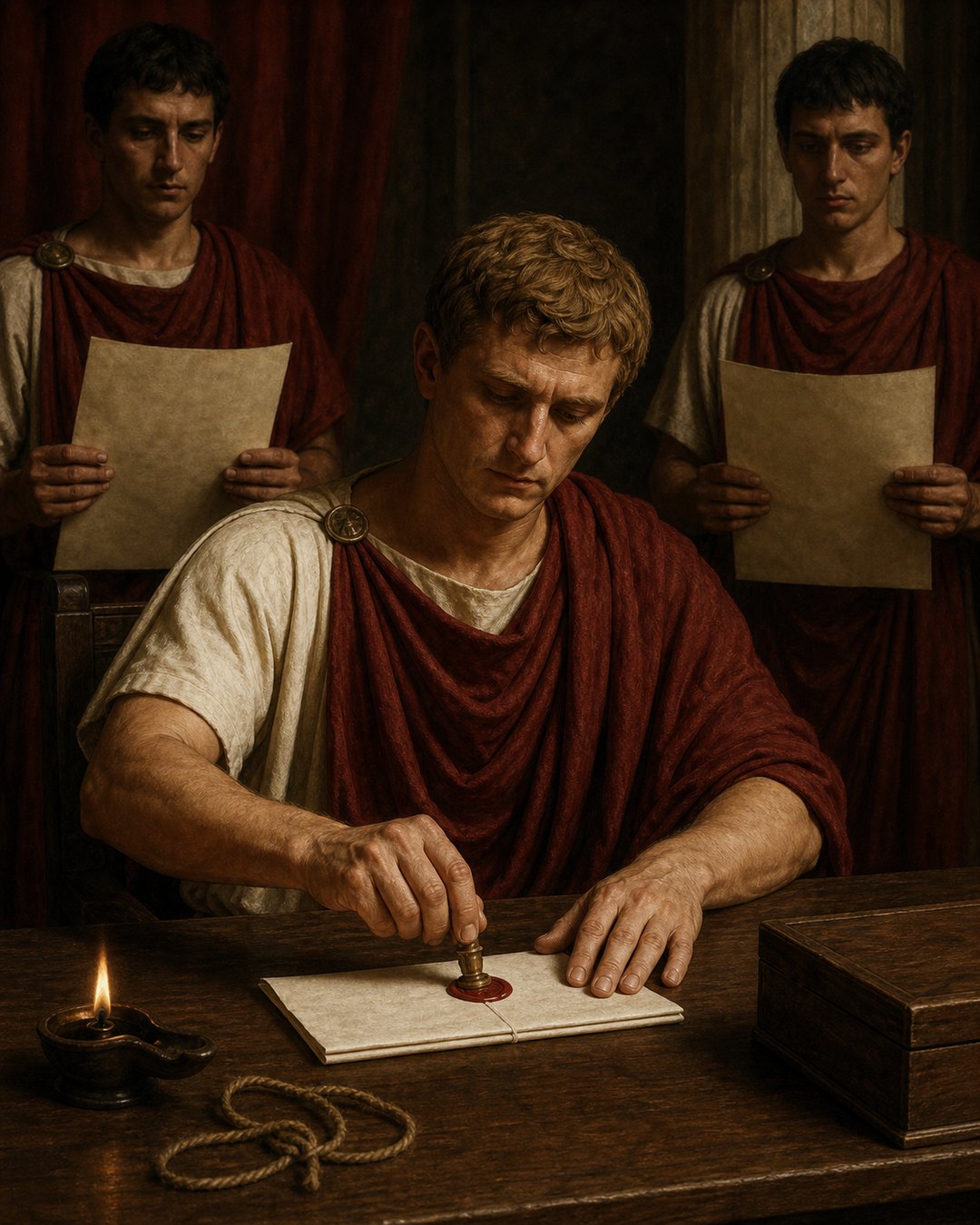
An obscure letter from Augustus could provoke a joke before it provoked obedience. The emperor’s first seal showed a sphinx. When recipients struggled with his meaning, Suetonius says, they remarked that the sphinx had brought riddles.
The joke reveals what a signet could and could not do. Its impression could identify the sender and protect a closed document from casual substitution. It could not make the prose inside clearer. Augustus eventually changed the image twice: first to Alexander the Great, then to his own portrait cut by the gem engraver Dioscurides.
That final likeness survived its owner. Augustus’s successors continued to use the portrait signet. A miniature face pressed into wax had moved from personal possession to an imperial credential, while the retired sphinx remained in Suetonius’s story as a warning that authentication and comprehension were different problems.
A Joke Exposed the First Emblem’s Weakness
Suetonius lists letters, official papers, and other documents among the things Augustus sealed with the sphinx. The range matters. This was not simply a decorative ring worn at dinner. Its engraved stone participated in correspondence and administration.
A seal impression tied a particular object to an authorized hand. Fresh wax took the reversed design, and the recipient could compare that small image with an expected mark. If the closure was broken or the image unfamiliar, trust became harder. The mechanism compressed identity into a repeatable surface.
The sphinx was a strong image for secrecy because it already carried associations with riddles. Those associations also made it vulnerable to mockery. When Augustus’s wording was ambiguous, the emblem seemed to comment on the text. The messenger delivered not only an instruction but a puzzle bearing a puzzle’s face.
Suetonius preserves the joke because it cuts imperial control down to scale. Augustus could choose the seal and command the administrative channel, yet recipients still evaluated what they read. Authority arrived intact while meaning remained contested.
Alexander Supplied Borrowed Authority
The second signet carried Alexander the Great. Augustus thus moved from a mythical creature to a historical conqueror whose image could suggest youth, victory, and world rule. The source does not explain his motive, so the transition should not be reduced to a single slogan. What is clear is that Alexander replaced the sphinx as the repeated mark on documents.
A portrait also worked differently from a symbolic beast. The sphinx invited interpretation; Alexander offered recognition. His face was not Augustus’s face, however. The seal authenticated Augustus through an admired predecessor, borrowing a visual identity whose political force had accumulated for centuries.
That borrowed image suited a ruler who constantly negotiated between novelty and precedent. Augustus held unprecedented power while framing his authority through restored offices, inherited customs, and carefully selected titles. An Alexander signet performed a similar balancing act in miniature: exceptional ambition presented through someone already famous.
The replacement also changed what a recipient compared. A sphinx belonged to a class of mythic images that another gem-cutter could imitate. Alexander’s profile was equally reproducible in principle, but its association with Augustus depended on known administrative habit. Authentication rested on more than iconography: correspondents had to know which image the emperor was using at that time.
The archive’s discussion of Roman signet rings as portable authority explains the broad technology. Suetonius gives a personal sequence within it. The stone did not merely prove that Augustus owned a ring; each replacement changed the visual story carried by his correspondence.
Dioscurides Cut the Emperor into the Workflow
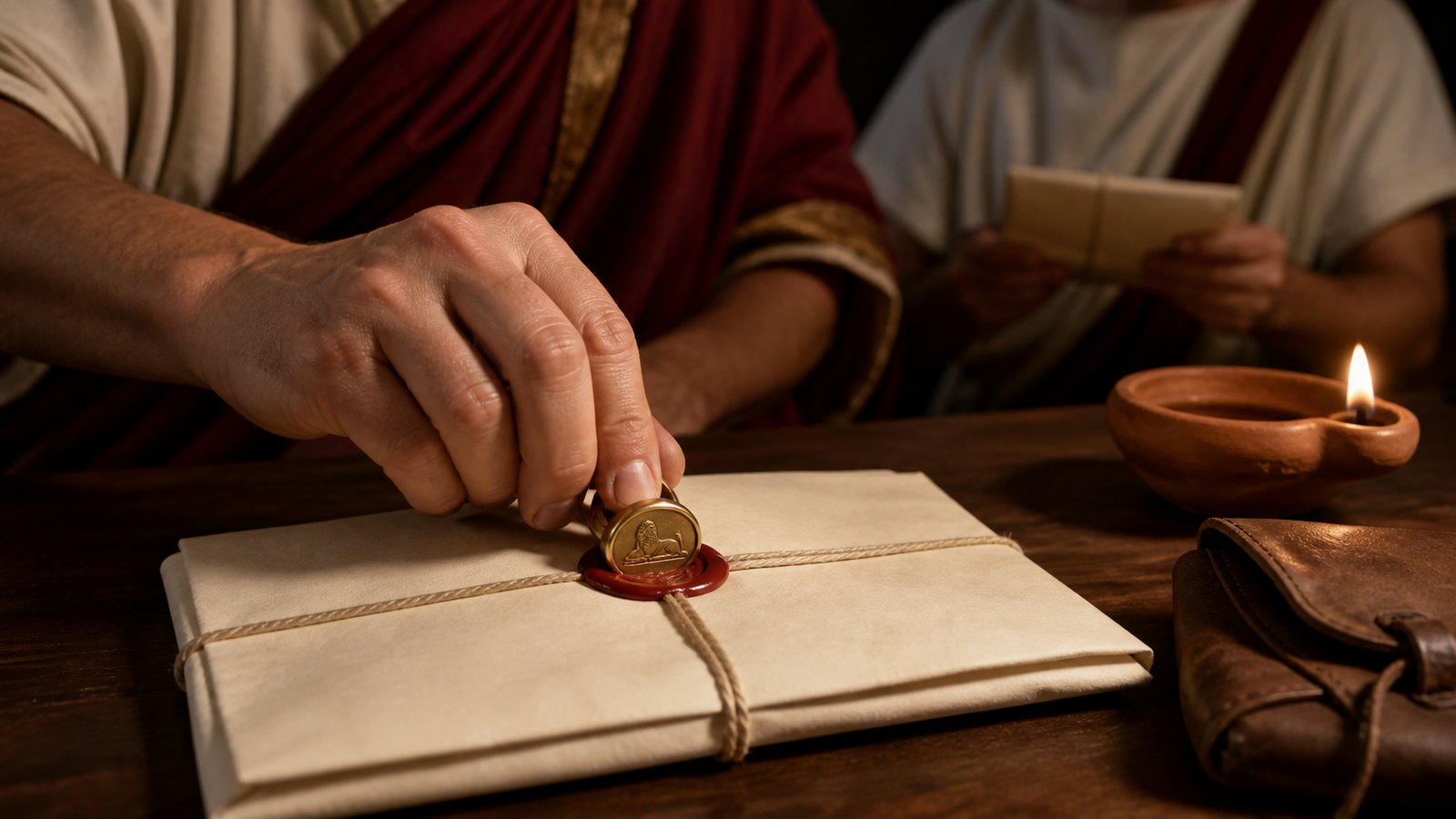
For the final seal, Augustus chose his own likeness. Suetonius names the craftsman: Dioscurides engraved it. That attribution turns a political image into a made object. Before the emperor’s face could authenticate a letter, a specialist had to reduce profile, features, and identity to lines cut into a tiny hard surface.
The carving had to work in reverse. What Dioscurides cut into the stone became the readable orientation in wax. Details needed to survive pressure, release, repeated handling, and the small size of the impression. A successful imperial portrait was therefore not only recognizable art but reliable equipment.
Choosing his own face removed the layer of borrowed identity. The document no longer arrived beneath a sphinx or another king. Augustus’s portrait directly represented the authority behind the message. The signer, ruler, and image converged.
Yet the seal was still a collaboration. Augustus selected the identity; Dioscurides constructed the matrix; secretaries prepared documents; wax received the impression; messengers carried the closed object; recipients inspected and opened it. Personal rule depended on a chain of skilled actions.
The Ring Worked Beside Controlled Prose and Cipher
Suetonius’s later chapters show Augustus managing the words as carefully as the closure. He describes the emperor’s style as clear and plain, directed toward expressing his thought without ornament that obscured meaning. Augustus even marked affected or confusing expressions and mocked writing that seemed to require an interpreter.
The practice responds neatly to the sphinx joke. A distinctive seal could establish origin, but clear prose had to establish intent. Augustus prepared important speeches in writing and even drafted serious conversations with Livia before speaking. Spontaneity yielded to control when the stakes were high.
For messages that required concealment, he used a simple substitution cipher. Each letter was replaced by the next one in the alphabet; x became a double a. The system was not modern encryption, but it forced an unintended reader to perform an additional operation before recovering the text.
The double a at the alphabet’s end reveals the method’s practical edge. A rule that sounds simple still needs an agreed treatment for the final letter. Sender and intended reader had to share that exception. Without it, a short encrypted instruction could become uncertain precisely where the sequence wrapped around.
Image, style, and cipher solved separate problems. The portrait identified authority. Plain wording reduced ambiguity for the intended reader. Substitution obstructed a reader who lacked the method. None of the three was sufficient alone.
Succession Preserved the Authentication Habit
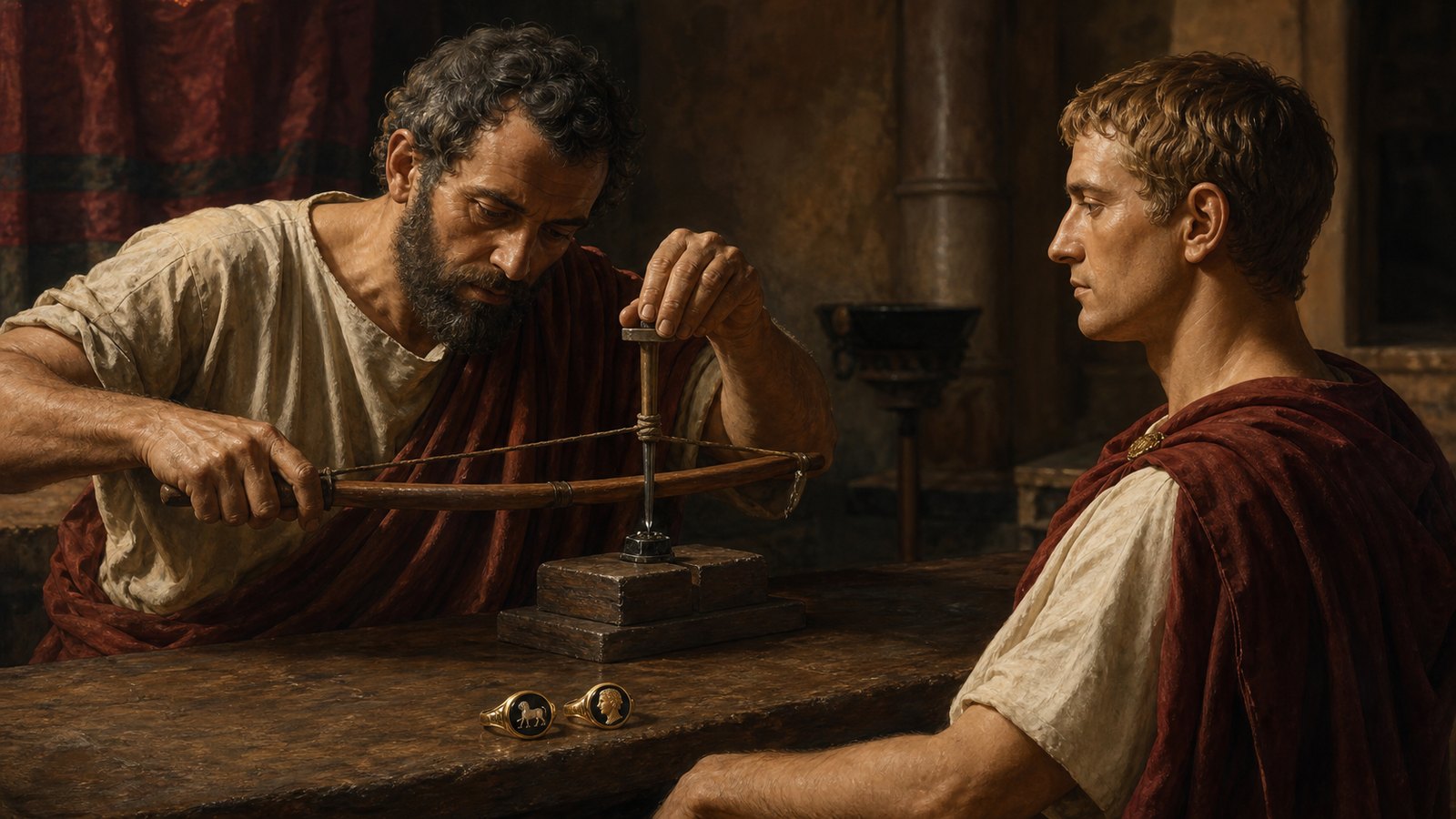
Suetonius says the successors of Augustus continued using the Dioscurides portrait seal. That is the most consequential step in the sequence. An object made for one ruler became part of the office that followed him.
The face remained Augustus’s while another emperor governed. Such continuity could present a new command as connected to the founder of the principate. It also saved recipients from learning an entirely new credential at every succession. Familiarity increased administrative usefulness.
Continued use made Dioscurides’s craftsmanship politically durable. The cutter had fashioned one ruler’s likeness, yet each later impression could validate business conducted after that ruler’s death. A portrait gem became an administrative heirloom whose value lay in the consistency of its tiny reversed lines.
There was risk in that continuity. A credential detached from its original owner can be controlled, inherited, copied, or misused. Roman government answered not through the image alone but through custody, trusted staff, recognizable channels, and the physical state of the document.
Caesar’s public records made official information visible on a wall. Augustus’s seal addressed the opposite end of political communication: a closed message traveling to a particular reader. One system expanded access; the other narrowed trust.
The three rings therefore tell a story larger than taste. The sphinx authenticated but invited jokes about riddles. Alexander lent a conqueror’s face. Dioscurides then turned Augustus himself into a repeatable mark, and succession converted that mark into institutional memory. Power traveled through wax because image and procedure agreed.
Suetonius’s arrangement lets the reader see an emperor correcting several kinds of friction. He replaced an emblem that attracted the wrong joke, chose a more direct portrait, refined serious speech before delivery, criticized obscurity, and used cipher only when concealment was intended. The governing problem was not simply secrecy. It was deciding when a message should be recognized, understood, or hidden.
Sources
Suetonius, Life of Augustus, chapters 50, 84, 86, and 88.