
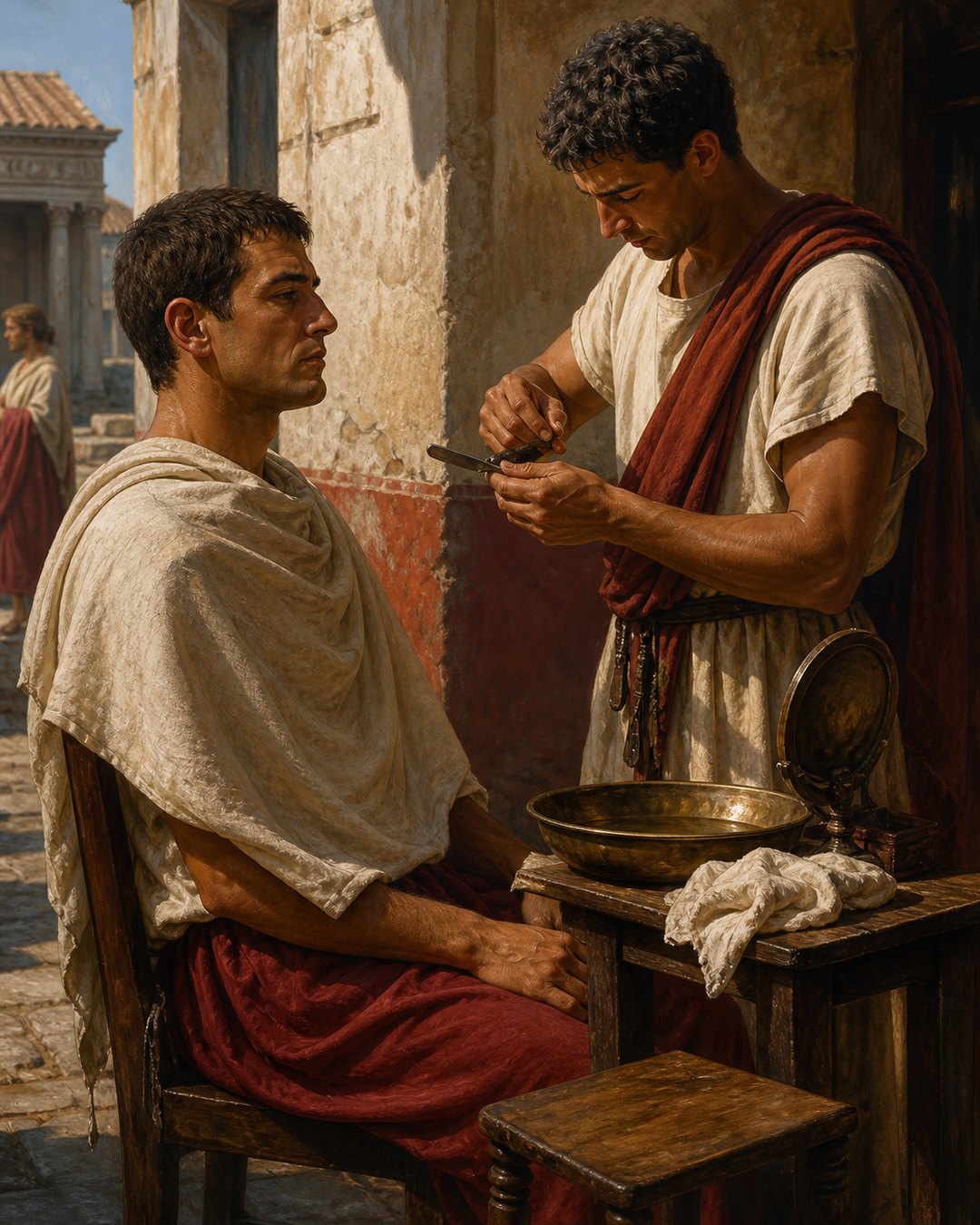
Pliny did not imagine the clean-shaven Roman face as something the city had always possessed. He gave it a transfer route, a date, and a name. Barbers, he says, came from Sicily in Rome’s 454th year. Publius Ticinius Mena brought them. Only later did Scipio Aemilianus turn shaving into a daily practice.
That sequence matters because a tool, a trade, and a habit are not the same event. A razor can exist without a shop. A shop can remove a beard without requiring its client to return tomorrow. Daily shaving needs skilled repetition, time, money, and a reason for a smooth face to be seen as worth maintaining.
Pliny’s final detail belongs to Augustus. The emperor used razors and then had the skin smoothed with pumice. By that point shaving was no longer merely a Sicilian service newly available in Italy. It had become a carefully finished bodily routine attached to the most visible man in the Roman world.
A Sicilian Arrival Split Roman Faces into Before and After
Pliny places shaving among practices on which different peoples eventually reached agreement. His wording makes beard removal a late arrival in a longer history of ordinary inventions. Romans had faces, knives, mirrors, and grooming before they had the professional service he dates. What changed was not the existence of hair or metal, but the organization of removal.
The transfer came from Sicily. That direction is a useful correction to stories in which Rome simply radiates habits outward. Republican Italy absorbed techniques and services from the communities around it. A barber arriving with practiced hands could carry more than a blade: he brought a repeatable sequence for seating a client, stretching the skin, guiding an edge, trimming awkward contours, and finishing without turning grooming into injury.
Pliny dates the arrival to the 454th year of the city. Converted into the familiar chronology, that falls around 300 BC. The number should not be treated like a surviving shop licence. Pliny is preserving a learned Roman chronology, and he tells readers that his authority was Varro. The precision reveals how Roman antiquarians wanted to pin ordinary habits to civic time.
The result is a before-and-after story written on the body. Beards did not vanish at once, and the source does not say every Roman rushed to a chair. It identifies the moment a specialized occupation entered Italy. From then on, choosing a shaved face could depend on a service that was available, visible, and reproducible.
The date also keeps the barber distinct from the razor. Romans could trim hair with household blades before a named profession arrived, just as cooking existed before every specialized food seller. Pliny’s claim concerns an occupational threshold. It identifies when trained shaving became memorable as an imported service, not when metal first touched a Roman cheek.
One Name Anchored a Shop Trade to 300 BC
Publius Ticinius Mena is the hinge in Pliny’s account. He is not remembered for a speech, a battle, or a magistracy. His historical role is the movement of barbers from Sicily into Italy. That is a rare kind of fame: an individual attached to the arrival of a profession.
The name prevents the story from dissolving into a vague claim that Greek or Sicilian fashions influenced Rome. A person made the connection. Whether Mena recruited craftsmen, opened an establishment, or introduced a service through his household is not explained, so the evidence should not be stretched. What Pliny preserves is the association between one man and one occupational transfer.
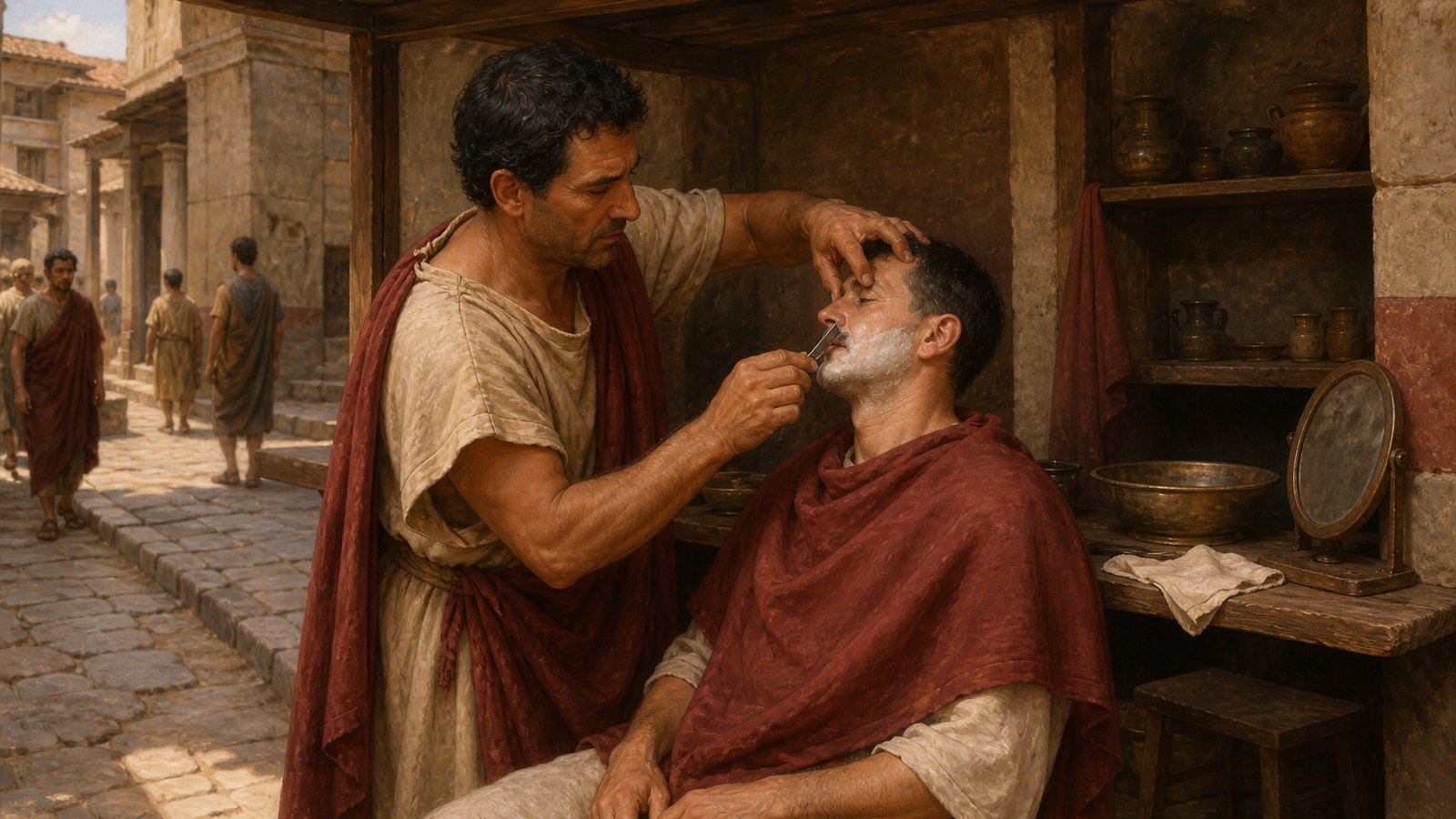
Barbering also belonged to the street-level economy. The work needed customers close enough to return, a chair or stool, water, cloth, edged tools, and enough trust for someone to place metal against the jaw and throat. A new barber did not sell a durable object that a buyer carried away. He sold controlled action performed on another person’s body.
That makes the arrival different from importing a luxury material. Amber could travel hundreds of miles and end in an arena, as Nero’s amber commission demonstrates. A grooming service had to move embodied knowledge, then reproduce that knowledge locally each day.
Daily Shaving Was a Second Innovation
Pliny assigns the next threshold to Scipio Africanus the younger, better known as Scipio Aemilianus. He was the first, the source says, to adopt daily shaving. The distinction is exact. Mena brought barbers; Scipio changed frequency.
Frequency transformed the social meaning of the service. An occasional shave can mark a ceremony, a season, or the removal of an established beard. A daily shave makes regrowth itself the problem. The desired appearance lasts only briefly, so maintenance becomes part of the morning’s discipline.
Scipio’s status made that repetition conspicuous. He was not merely one anonymous client testing a foreign trade. An elite man’s smooth face appeared before soldiers, senators, petitioners, allies, and rivals. Daily maintenance could therefore become legible as self-command even though the cutting occurred in private or in a modest shop.
A Roman grooming kit of wood, metal, and imported materials shows how many objects could gather around bodily care. Pliny’s shaving chronology adds time to that material picture. Equipment mattered, but the decisive novelty was returning often enough to sustain a chosen surface.
Razors and Pumice Made Smoothness a Process
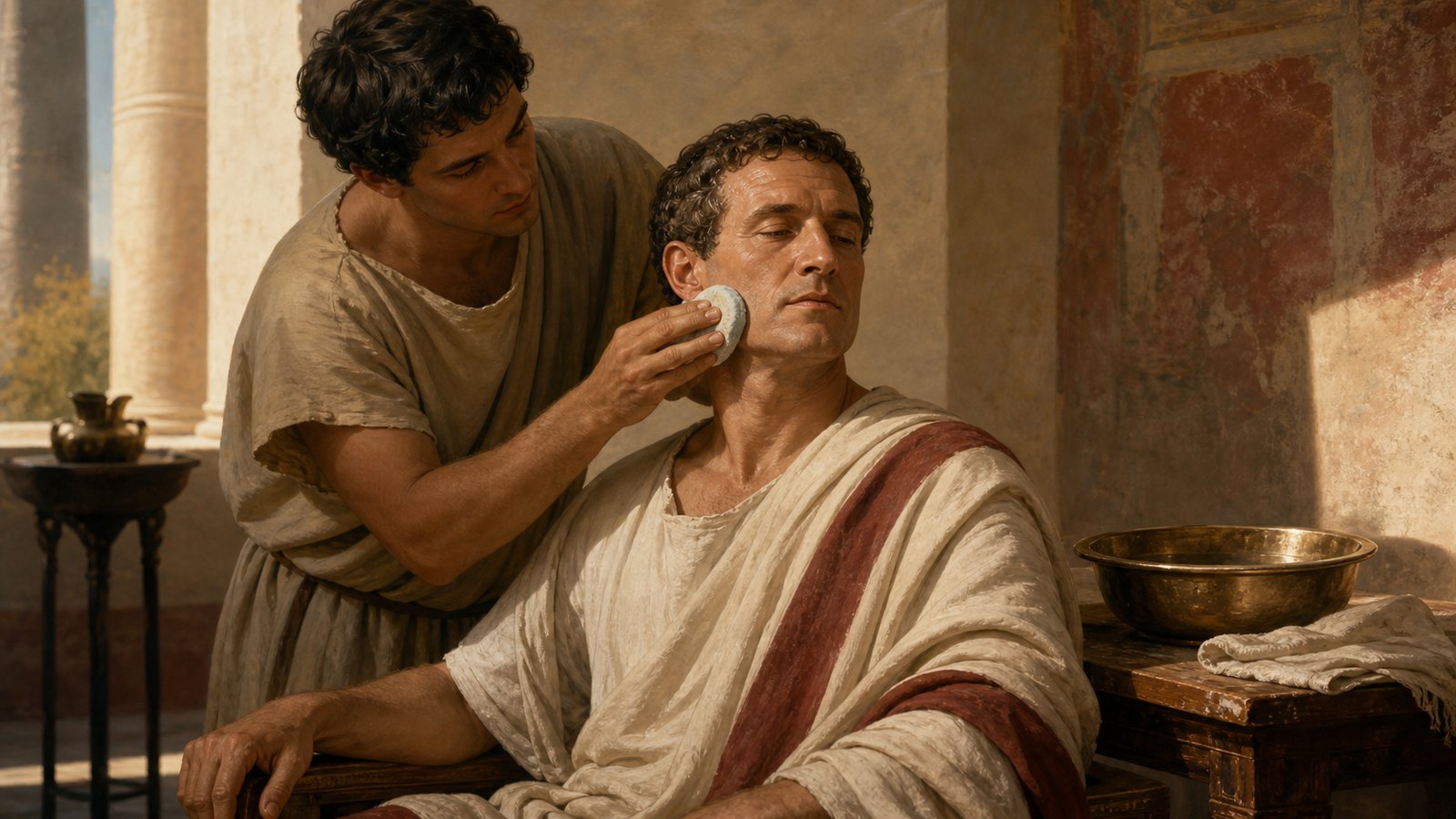
Augustus supplies Pliny’s most tactile detail. The emperor always used razors and then smoothed the skin with pumice. The two stages imply different jobs. The edge removed hair close to the skin; the abrasive finish addressed what the blade left behind.
Pumice changes the imagined texture of the scene. This is not a single theatrical stroke of a gleaming razor. It is scraping followed by rubbing, with water, cloth, and patient handling likely close at hand. The desired result had to be felt as well as seen.
The routine also exposes the limits of ancient shaving. A metal edge could pull, nick, and leave roughness. Pliny does not praise a miraculous razor. He records a compound procedure that compensated for the first tool by adding another material. Smoothness emerged from sequence.
Augustus’s practice need not prove that every Roman man used pumice. It does show an imperial body managed through specialized attention. The emperor’s face was encountered in audiences, processions, portraits, and memory. A finish that seems intimate belonged to a public identity whose smallest irregularities could attract notice.
The Barber Changed the City More Than the Beard
Pliny’s compressed chronology contains three speeds of change. The occupation arrived in a particular year. Daily shaving appeared later as an elite habit. A refined imperial method then combined blade and abrasive. None of these stages automatically produced the next.
The first barber created access. Scipio’s repetition created a model of maintenance. Augustus’s finishing process displayed how far technique could be elaborated. Together they show a cultural practice accumulating infrastructure and expectations rather than appearing fully formed.
This is why the date of the trade matters more than a simple question about whether Romans wore beards. Facial hair changed across centuries, reigns, ages, and personal choices. Pliny is documenting one branch of that history: when professional shaving entered Italy and how named elite men made regular smoothness memorable.
His evidence is brief, antiquarian, and selective. Yet its mechanism is concrete. A Sicilian service crossed the water. An individual attached his name to the transfer. A general returned to the razor every day. An emperor followed the blade with stone. The Roman face became a surface maintained by labor.
Each stage required a different kind of commitment. Mena had to establish access, clients had to trust the edge, Scipio had to repeat the appointment, and Augustus’s attendants had to complete the abrasive finish. What looks like fashion from a distance was, at close range, a schedule of skilled contact between skin, steel, stone, and hand.
Sources
Pliny the Elder, Natural History, Book 7, chapter 59, section 211.