
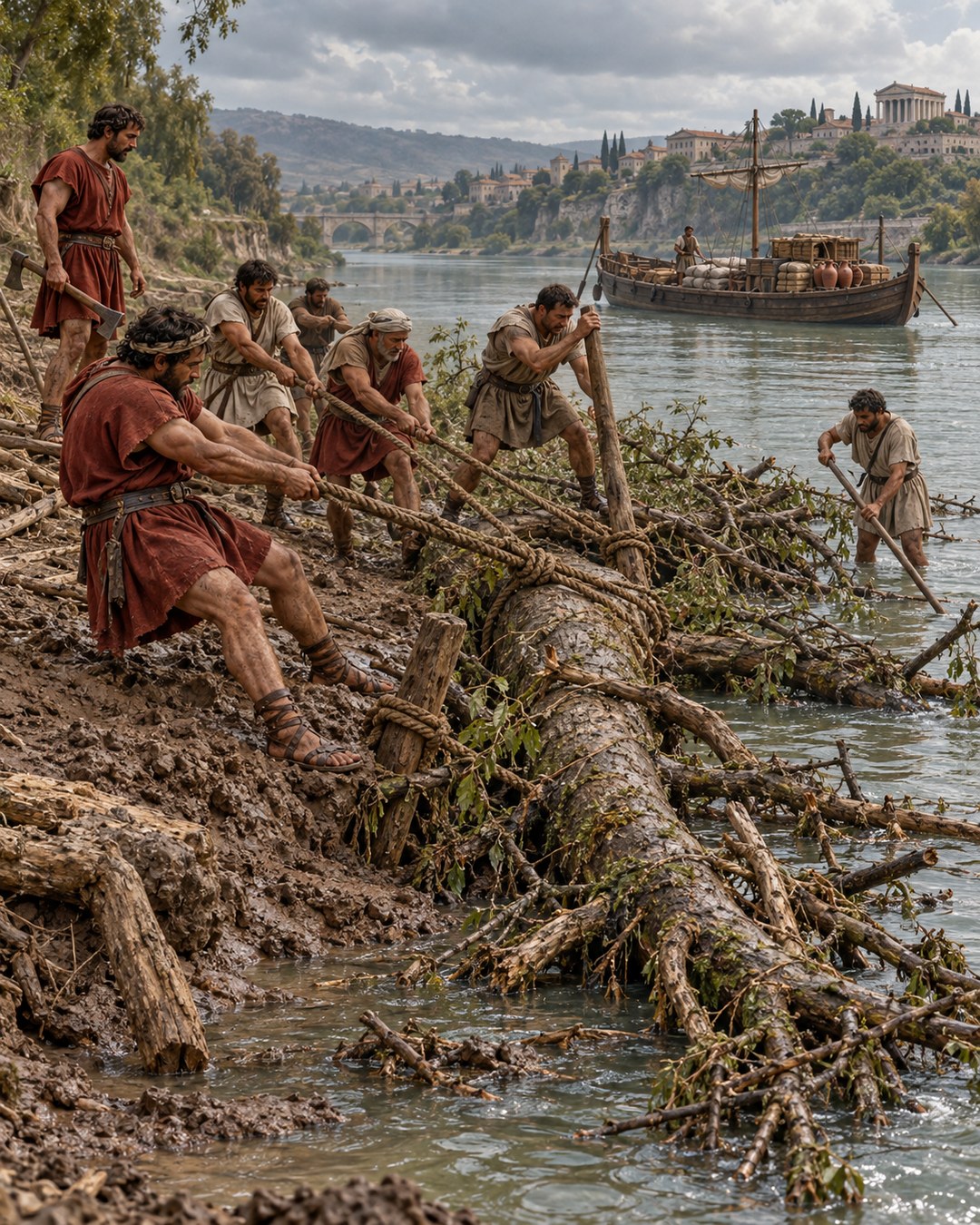
A tree could become a net without rope or knots. Aulus Gellius found the expression in an old praetorian edict while reading in the library of Trajan’s temple. The text concerned contractors hired to clear rivers of “nets,” and it threatened action when they failed to perform the work promised.
The phrase looked strange because the obstruction was not fishing gear. A companion supplied the older meaning. Trees leaning out from a bank, or timber lodged in a riverbed, were called retae. They caught and impeded boats as a net catches what moves into it.
Behind one obsolete word stood an entire maintenance system. A physical hazard entered official language, the work of removal was farmed out by public contract, and failure could bring the contractor before a magistrate. Roman river traffic depended not only on hulls and ports but on someone being answerable for the branch across the channel.
An old edict survived in Trajan’s library
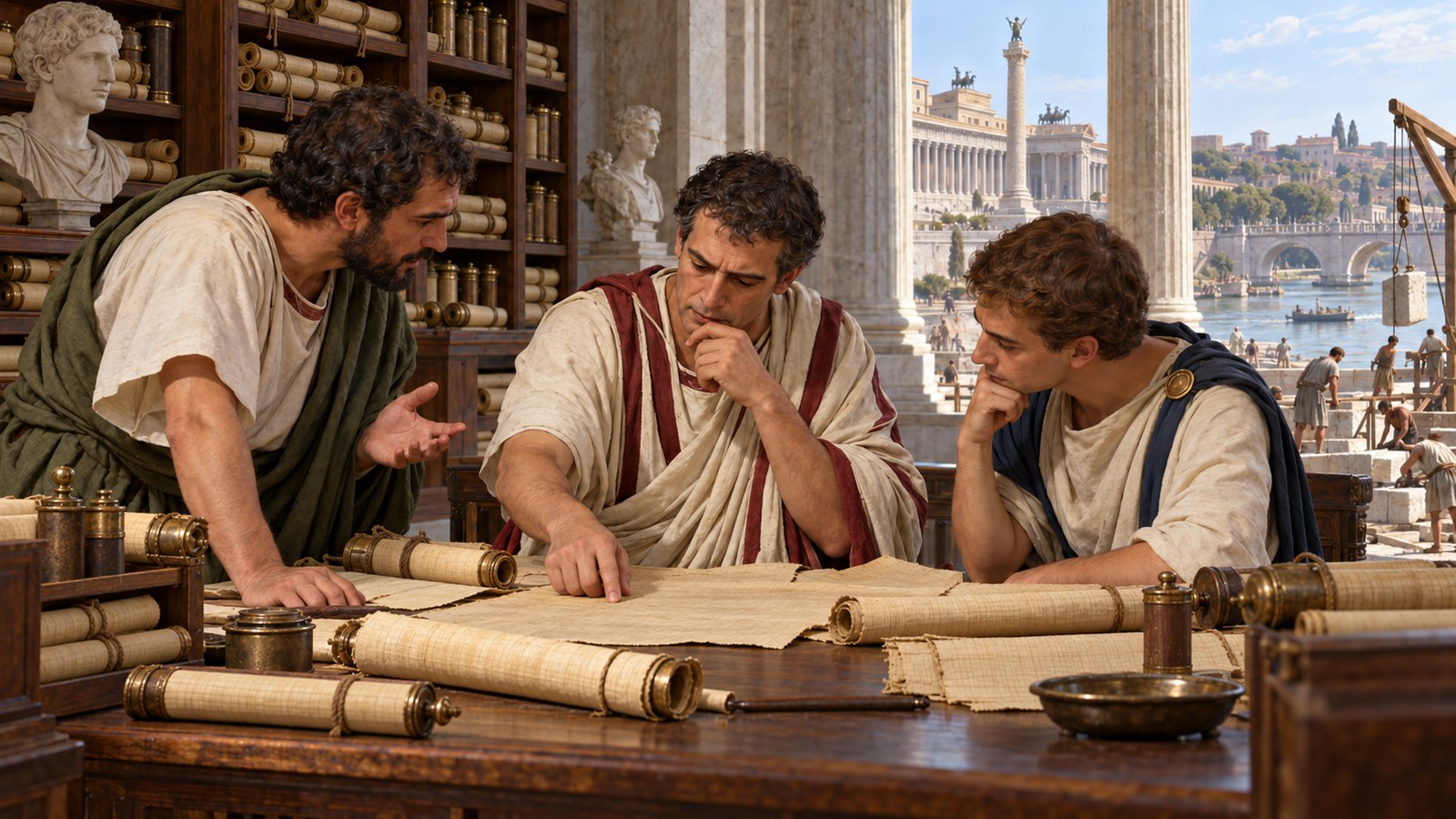
Gellius begins with the place where he encountered the problem. He was sitting in the library attached to Trajan’s temple and looking for something else when early praetorian edicts came into his hands. The discovery joined two different moments of Roman administration: older magistrates had issued the language, while a later imperial library preserved it for readers.
The survival of the document mattered because its vocabulary no longer explained itself. Gellius could read the clause but still stop at its image of clearing “nets” from rivers. An official text could remain legible while the practical meaning of one term faded.
His response was not to smooth the phrase into familiar language. He recorded the puzzle. That decision lets us see how Roman institutions carried technical expressions across generations. A reader could meet public works through the vocabulary of a contract rather than through a monumental inscription.
The edict’s sentence is conditional and procedural. It imagines a person who has taken a public contract, has allegedly failed to do what its terms demanded, and is brought before the praetor. Each part defines a link: commissioned work, a stated obligation, an accusation of non-performance, and a magistrate able to hear it.
This is a different archive from the daily records kept by aqueduct crews. Frontinus’s system made labour visible through continuing reports. The river clause appears at the enforcement end, preserving what could happen when contracted work was said to be incomplete.
The library setting also warns against treating the words as a complete engineering manual. Gellius gives no crew size, tool list, payment schedule, or named river. Those details should not be supplied from imagination. What survives is narrower but still valuable: the obstacle, the contractual duty, and the legal route created for a complaint.
Retae were trees that behaved like fishing gear
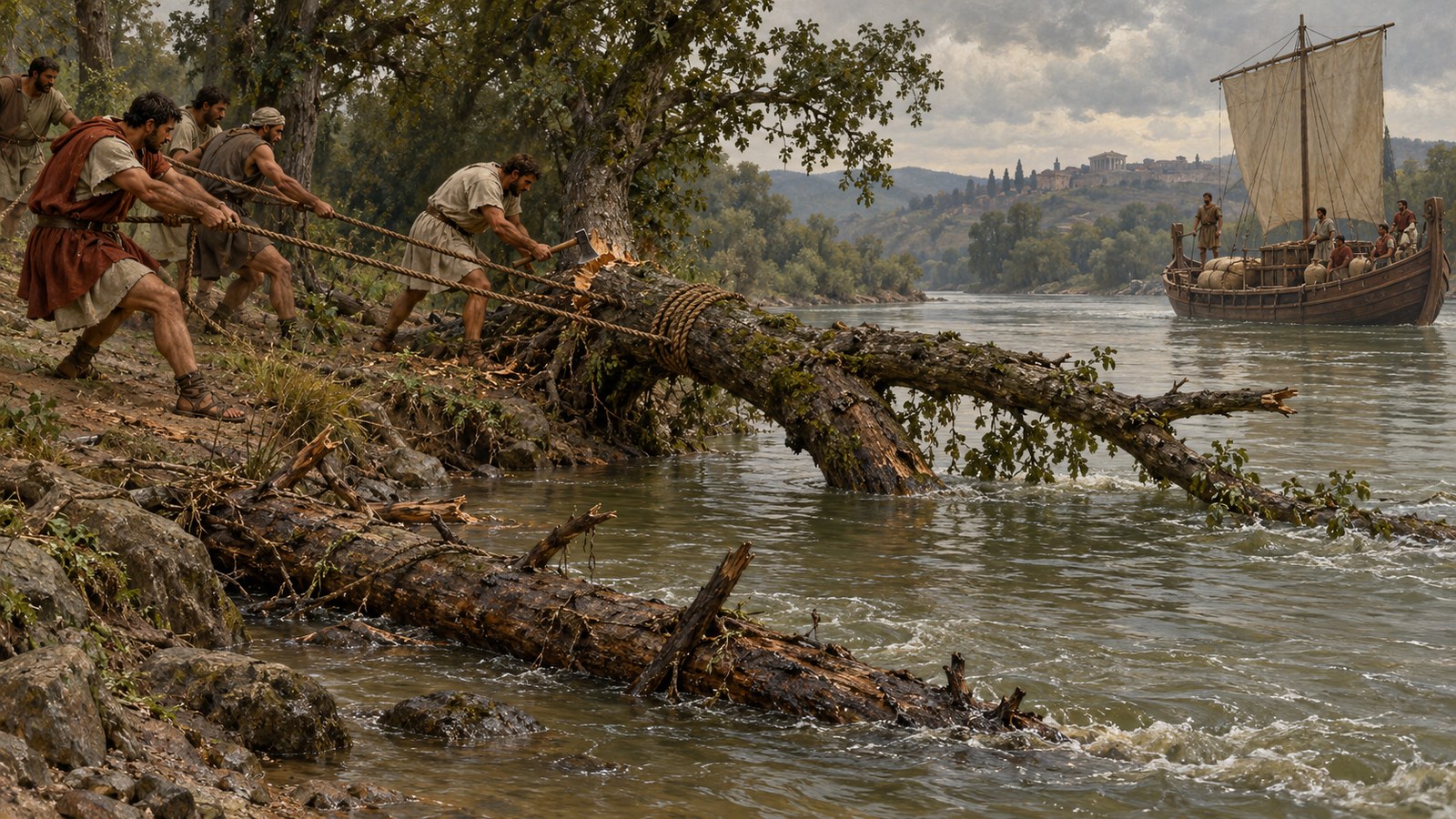
Gellius’s companion remembered an explanation in the seventh book of Gavius’s On the Origin of Words. Trees could be called retae when they projected from riverbanks or lay in the riverbed. Their position, not a special species, made them relevant.
A trunk growing or falling toward the current narrowed the space through which a vessel could pass. Timber already in the bed created another obstruction, partly hidden by water and fixed where a pilot expected depth. Both forms turned ordinary vegetation into part of the navigational channel.
Gavius connected the name with nets. The branches impeded ships and, in the ancient explanation, seemed to net them. The comparison captured more than a solid collision. A spread of limbs could catch, hold, deflect, or delay a boat as it pressed downstream.
The metaphor made the danger easy to picture. A wall simply blocks. A net reaches into movement and entangles it. River timber did the latter: it occupied an irregular area, presented multiple points of contact, and made the safe route uncertain.
Nothing in Gellius says that every tree beside a river was removed. The term applied to trees that projected from banks or were found in the bed and interfered with shipping. The problem was relational. Vegetation became a public navigational hazard when its position met a vessel’s path.
That distinction matters for the contractor’s task. “Clear the river” did not have to mean stripping the banks. It meant removing the objects described by the contract as dangerous impediments. The old word condensed location, behaviour, and required result.
The contract turned a branch into public business
The edict speaks of people who had undertaken public contracts. River clearance was therefore not presented as an improvised favour by whichever boatman arrived first. Work had been assigned, and the assignment carried terms against which performance could be judged.
Public contracting separated responsibility from immediate inconvenience. A merchant delayed by timber might feel the loss, but the contract identified someone whose duty was to prevent or remove the obstruction. The magistrate’s clause gave that duty a public frame.
The wording also distinguishes undertaking work from completing it. Winning or accepting a contract did not satisfy the obligation. The edict anticipated an accusation that the contractor had not done what the agreement bound him to do.
That is where maintenance becomes visible as governance. New construction leaves stone, brick, and inscriptions. Clearance disappears when it succeeds. The river looks merely open. Legal language preserves the otherwise invisible labour by defining failure.
Roman water administration used several kinds of accountability. Frontinus’s discovery of unauthorized water pipes concerned diversions from a supplied network. The retae clause concerned natural obstructions in a navigable course. In both cases, movement through water infrastructure depended on inspection and enforceable boundaries.
The source does not reveal whether the contractor personally cut timber or supervised labourers. It does show that the person holding the agreement could be called to answer for its result. The chain of responsibility reached beyond the worker at the bank.
Delay and danger were the two failures to prevent
Gellius closes the explanation with the purpose of clearance. Vessels meeting the branches were not to suffer delay or danger. The pairing captures two scales of harm.
Delay could begin before contact. A pilot might slow, wait, search for another line, or stop the voyage until a passage opened. Even without a wreck, the obstruction consumed time and made movement less predictable.
Danger was the sharper possibility. Projecting wood and submerged timber could threaten a vessel because the channel no longer offered an unobstructed path. Gellius does not narrate a particular accident, so the article need not invent one. The edict’s preventive purpose is explicit enough.
The two terms also explain why the work belonged in a public contract. A navigable river served repeated movement, not a single crossing. Leaving an obstacle in place imposed the same uncertainty on every approaching vessel. Clearing it restored a shared route.
The clause therefore links language, landscape, and law with unusual economy. A tree occupies the wrong part of a river. Sailors experience it as a net. Officials define its removal as contracted work. A praetor preserves a route for accusing the person who fails to provide the promised clearance.
Gellius found this chain because one word had become obscure. His curiosity recovered more than an etymology. It recovered a category of routine infrastructure whose best evidence was the threat of non-performance.
Rome’s rivers did not remain useful by nature alone. Banks shifted, timber projected, and branches entered the bed. Keeping vessels moving required repeated attention. The old edict made that attention somebody’s job—and made the unfinished job a matter for the magistrate.
Sources
Aulus Gellius, Attic Nights, 11.17.