
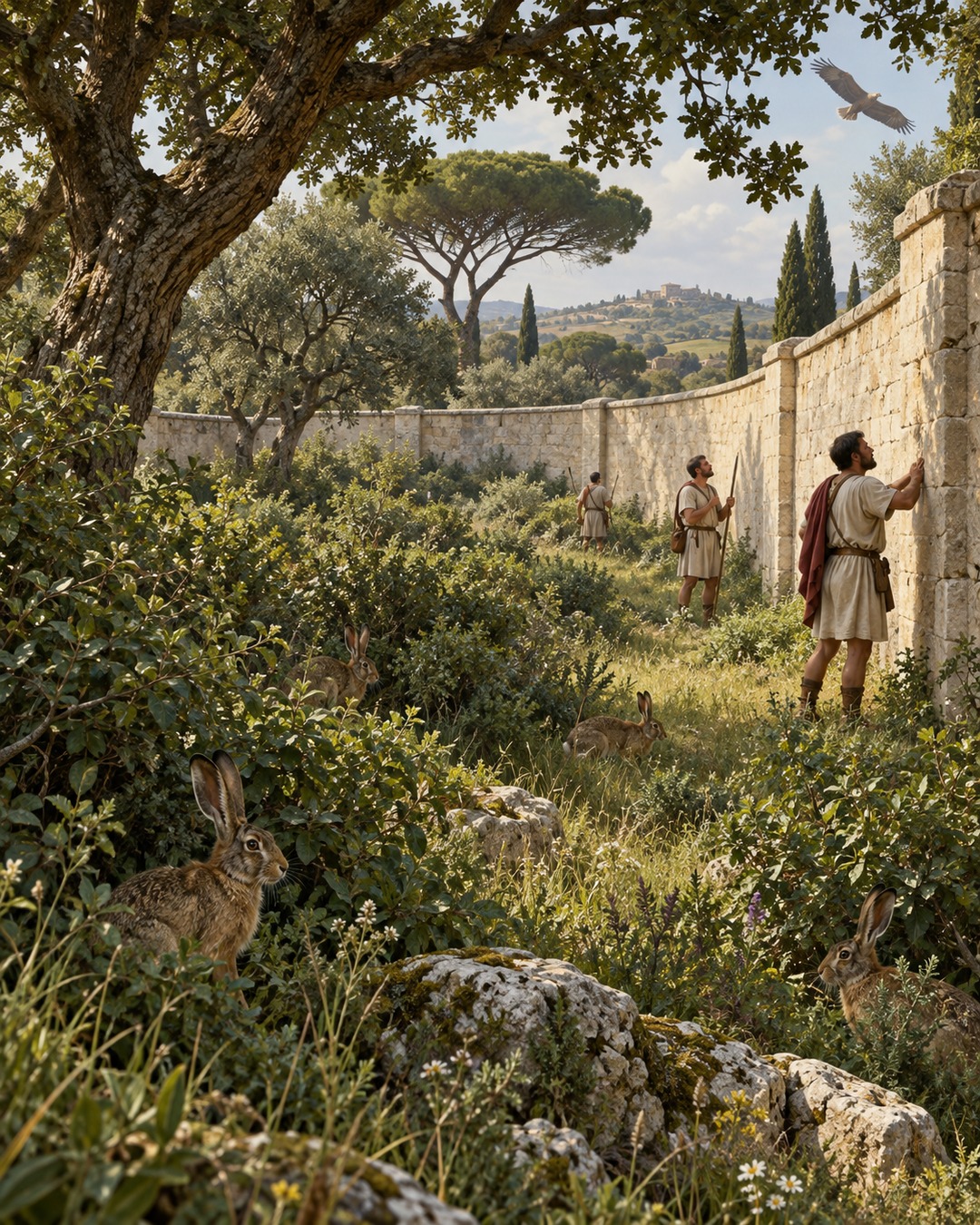
A Roman warren had enemies at ground level and in the sky. Varro wanted its masonry smooth enough to stop wild cats and badgers, high enough to stop wolves, and its interior planted densely enough to hide hares by day. Broad tree branches supplied a roof against eagles.
The enclosure was therefore more than land behind a wall. Every surface answered a threat. Predators might climb, leap, dig, or descend. The animals inside needed open ground to feed, cover to disappear, and enough protected space to multiply.
Once the preserve produced a surplus, some hares left the larger habitat for small hutches where they were fattened. Breeding and finishing occupied different spaces. Varro’s warren joined landscape design to a production sequence, while the Spanish rabbit added another challenge: an animal named for its habit of vanishing underground.
A warren could grow from an acre to four miles
Varro begins with scale. The old term leporarium came from hare keeping, but by his day it could describe preserves containing red deer, roe deer, wild sheep, and other game. A name rooted in one small animal had expanded with the ambition of elite estates.
He reports that Quintus Fulvius Lippinus enclosed forty jugera near Tarquinii. Elsewhere, especially in Etruria, preserves were larger. Titus Pompeius in transalpine Gaul supposedly possessed one with a boundary about four miles around.
These measurements made the enclosure into managed countryside. At the largest scale, the owner was not building a cage but drawing a perimeter around woodland, pasture, and cover. Animals could behave as if in a fragment of wild habitat while remaining within an estate economy.
Large preserves served several purposes at once. They could maintain breeding populations, furnish animals for the table, support hunting, and display control over land and living creatures. The wall converted movement across a landscape into inventory belonging to one proprietor.
Scale also multiplied weak points. A four-mile perimeter demanded inspection. A fallen tree, eroded foundation, rough patch, or low section could turn the whole investment into an escape route or predator entrance. Size increased capacity only when maintenance kept the line continuous.
Varro’s report of boars encountered during Pliny’s hunt shows game as an elite rural setting for leisure and thought. The warren chapter looks behind that experience. A preserve that seemed wild from inside could be the product of expensive boundaries and deliberate stocking.
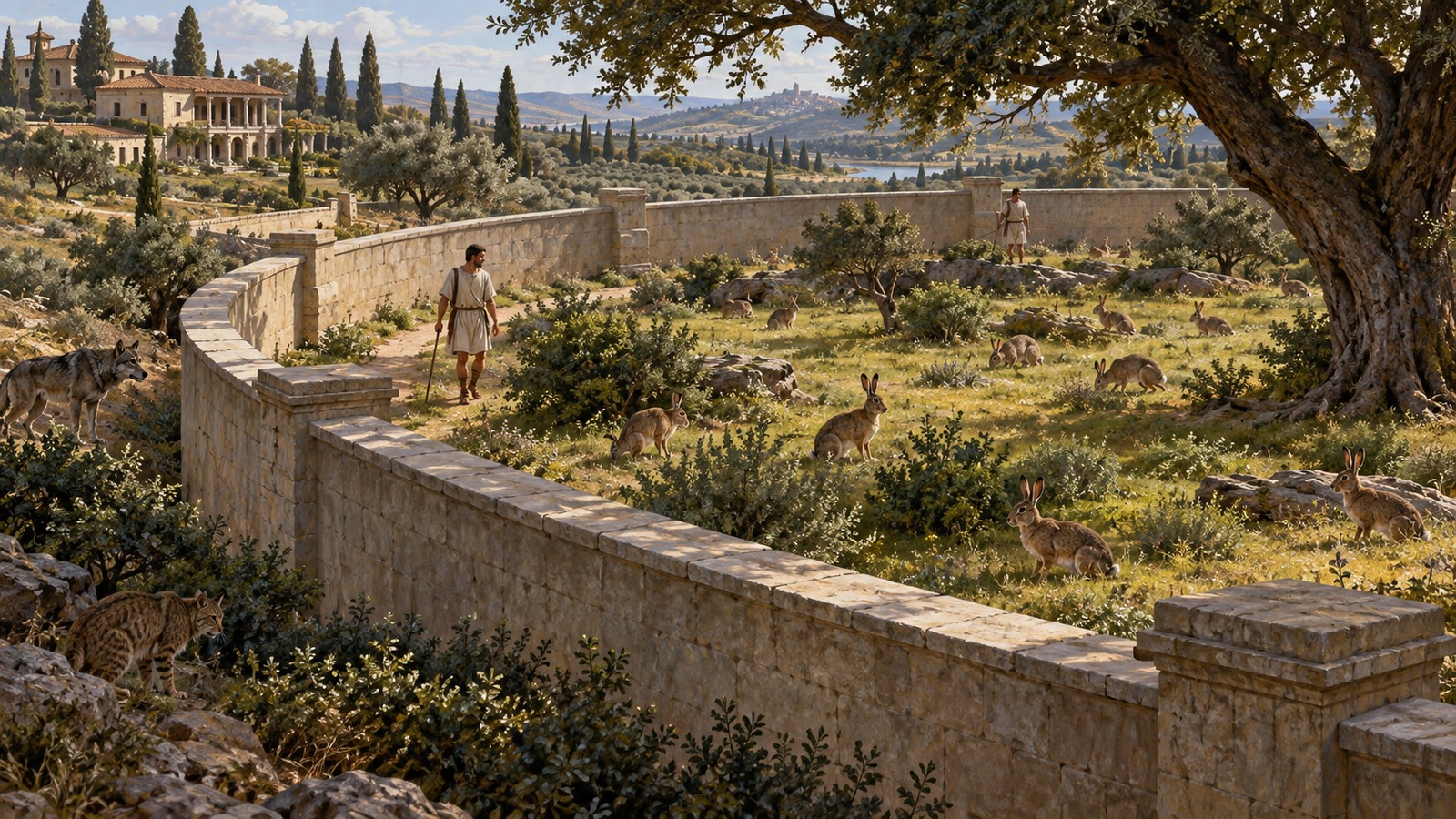
The wall had two jobs because predators moved differently
Varro specifies masonry that is both smooth and high. Those qualities are not decorative. Smoothness was aimed at wild cats, badgers, and similar animals; height was aimed at wolves. One surface answered climbing and purchase, the other leaping or scrambling over the top.
A rough stone wall might look stronger while offering claws and paws more holds. Finishing the face reduced the usefulness of joints and projections. The desired wall was not simply massive. It had to be difficult for a particular body to negotiate.
Height addressed a different vector. Even if a wolf could not climb like a smaller predator, a low crest would not deter it. The builder had to imagine the wall from the outside, testing not human comfort but the abilities of animals seeking food.
The same boundary also kept valuable inhabitants from wandering. Hares were swift, and rabbits added burrowing to the problem. Varro concentrates here on exclusion of predators, but the commercial logic required retention as well. A breach worked in both directions.
Predator control did not mean eliminating every wild animal around the estate. It meant separating them from concentrated prey. By gathering many hares into one preserve, the owner made the site attractive to hunters other than himself. The wall was a response to the risk created by density.
This behaviour-led construction resembles the water barrier around a Roman snailery. A vertical wall could contain a hare but not necessarily a climbing snail. A ring of water stopped the snail; smooth tall masonry guarded the warren. Roman husbandry selected boundaries according to the animal rather than applying one universal pen.
Grass hid the hares, and branches hid the sky
Walls could not protect animals already visible from above. Varro therefore moved inward from masonry to vegetation. Bushes and grass gave hares places to lie concealed during the day. Broad-spreading branches reduced exposure to eagle attacks.
The arrangement formed layers. Low cover met the animal at ground level. Tree canopies interrupted the line between sky and prey. Open patches remained for movement and feeding, but safety depended on being only a short dash from concealment.
Daytime refuge matched the rhythm Varro expected from hares. He did not ask the keeper to build individual boxes across the preserve. Vegetation performed the work at scale, allowing animals to choose shade and cover while retaining the appearance of a natural range.
Broad branches mattered more than trunks alone. A tall narrow tree might offer little interception. The useful tree spread laterally, creating overlapping zones beneath which an eagle could not easily descend or keep sight of a moving animal.
Planting therefore belonged to animal security, not landscape ornament. A beautiful but open park would fail the inhabitants. The measure of a tree was the shadow and obstruction it placed between talons and ground.
The design also complicated human observation. Hiding places that protected hares made counting them harder. A keeper had to infer population from feeding, tracks, sightings, and reproduction rather than expecting every animal to remain visible. Productive opacity was part of the system.
Varro says only a few breeding pairs could fill the preserve quickly. Dense refuge helped that multiplication survive. Reproduction without cover would merely supply predators. Cover without reproduction would leave expensive land underused. The two functions reinforced one another.
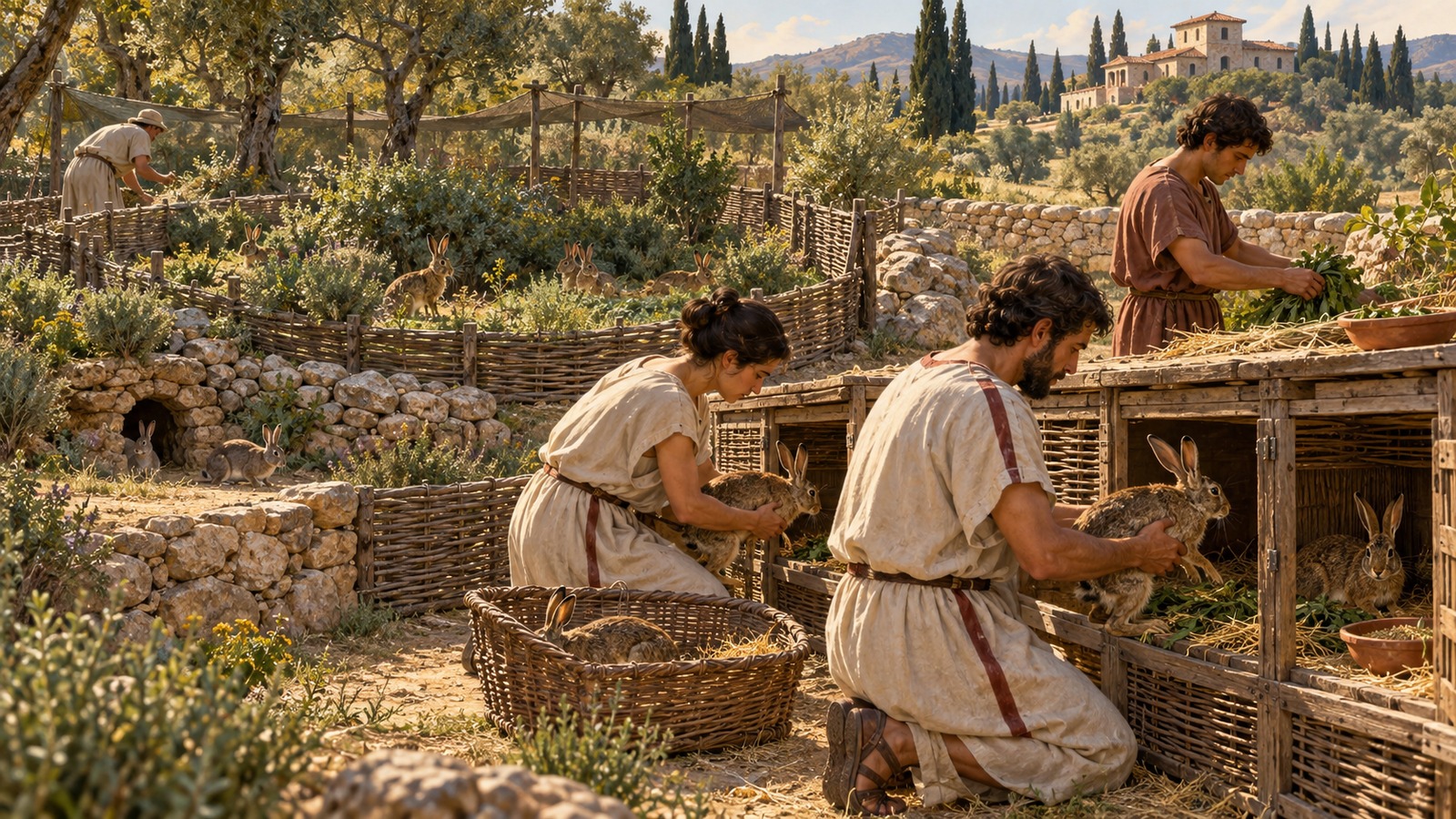
Small hutches separated fattening from breeding
Varro calls the fattening of hares in small hutches a recent practice. Animals were removed from the warren and confined more closely, just as poultry could be shifted from general keeping into a finishing regime.
The move changed the purpose of space. In the preserve, hares needed room, refuge, mates, and a stable population. In the hutch, selected animals were temporarily concentrated so their feeding and condition could be controlled before use.
Keeping those stages separate protected the breeding base. If the owner treated the whole warren as a finishing pen and removed animals indiscriminately, rapid reproduction might not compensate for harvest. Selection allowed the larger enclosure to continue producing.
Varro distinguishes three animals within what a casual observer might call hares. The common Italian kind had dark upper colouring, a white belly, long ears, shorter forelegs, and longer hind legs. A white form lived near the Alps and appeared at Rome only rarely. The Spanish cuniculus resembled the Italian hare but was smaller.
The rabbit’s underground refuge supplied its Latin name in Varro’s explanation. Burrowing complicated the enclosure because the animal could make its own hidden architecture. The keeper had to manage not only what stood above ground but what might pass beneath it.
That detail gives the warren a third dimension. Wolves challenged the top of the wall, smaller predators its face, eagles the open air, and rabbits the soil below. Successful containment depended on seeing the preserve from each animal’s direction of travel.
Regional difference also entered the market. White Alpine animals were rare at Rome, while Spanish rabbits arrived from a province where their behaviour was familiar enough to shape their name. A mixed warren could display reach as well as productivity.
Varro’s chapter is not a neutral zoological survey. It tells an estate owner what makes animals manageable and valuable: secure boundaries, breeding speed, rarity, distinctive origin, and the ability to shift selected stock into controlled finishing.
The warren succeeded because no single feature carried the whole burden. Masonry stopped some threats. Vegetation stopped others. Breeding renewed numbers. Hutches prepared a final crop. The Roman keeper built a small ecology and then divided its stages according to risk and return.
Sources
Varro, On Agriculture, 3.12.