
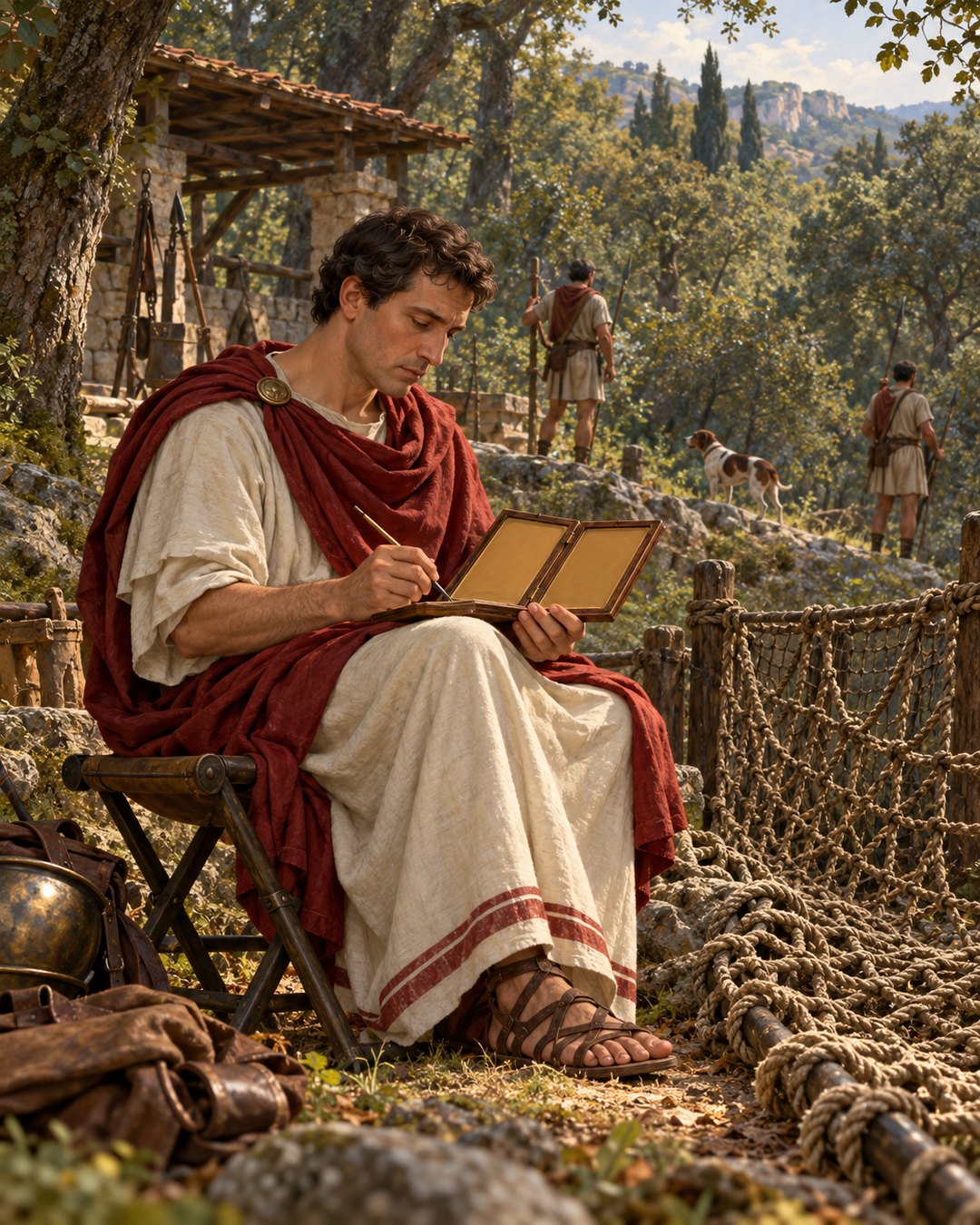
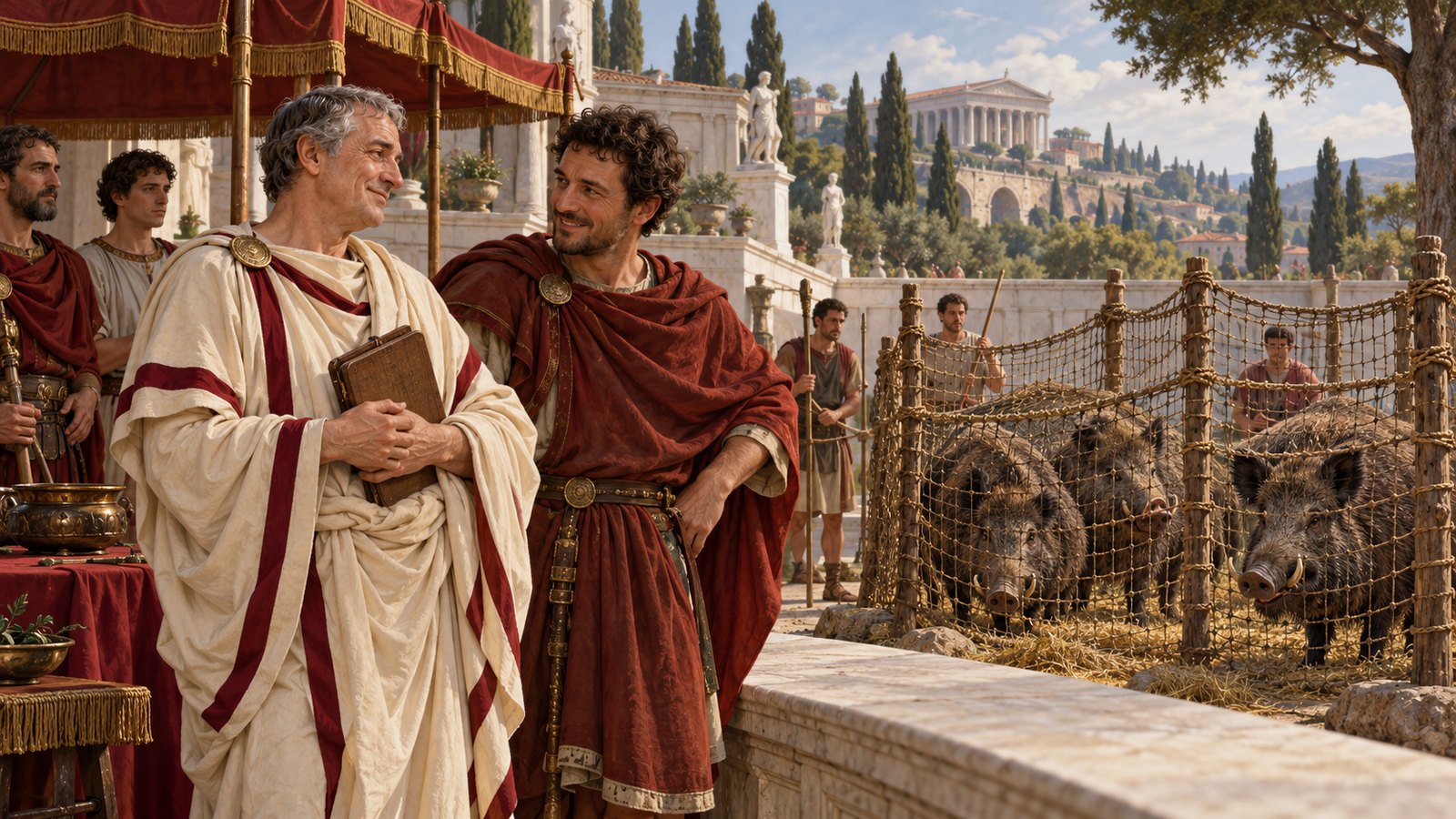
Pliny the Younger had news for Tacitus: he had bagged three magnificent boars. He immediately gave his friend permission to laugh. The joke depended on Pliny’s version of himself—a man more likely to be caught with a pen than a spear.
That was exactly how he described the hunt. He sat beside the nets with writing tablets and composed while waiting. If the animals never appeared, he could still return with the tablets full even when his hands were empty. The three boars supplied a successful ending, but literary work made failure impossible before they arrived.
The boast arrived with its own heckler
Pliny opened by predicting Tacitus’s reaction. “You will laugh,” he effectively said, and then granted permission. The imagined laughter lets him boast about three boars while pretending to stand beside his friend and hear the disbelief.
He reinforced the surprise by calling each animal a splendid specimen and asking the reader to picture the unlikely hunter. Yet he denied any drastic change in his habits. The result had been achieved without a violent departure from his usual laziness.
This is careful comic positioning. Pliny receives credit for the hunt while keeping the cultivated idleness that makes the story amusing. He does not present himself crashing through brush or overpowering an animal. He occupied a station at the nets and allowed the larger machinery of the hunt to bring the moment to him.
The letter therefore begins with a trophy and immediately redirects attention toward temperament. Tacitus is not being sent a field report. He is being offered a small portrait of Pliny as an author who can enter another activity without ceasing to be recognizably himself.
A pen replaced the spear beside the nets
At his position Pliny kept neither hunting spear nor dart by his side. He had a pen and writing tablets. While the nets waited for animals, he worked on a composition and jotted notes. The contrast is deliberately neat: pointed weapons belong to the expected hunter; the stylus marks Pliny’s preferred pursuit.
Sitting beside nets was not the same as wandering alone through untouched woodland. An organized boar hunt required people, positions and prepared barriers. Pliny’s stillness belonged inside that arrangement. Others could drive or manage the animals while he occupied the moment assigned to waiting.
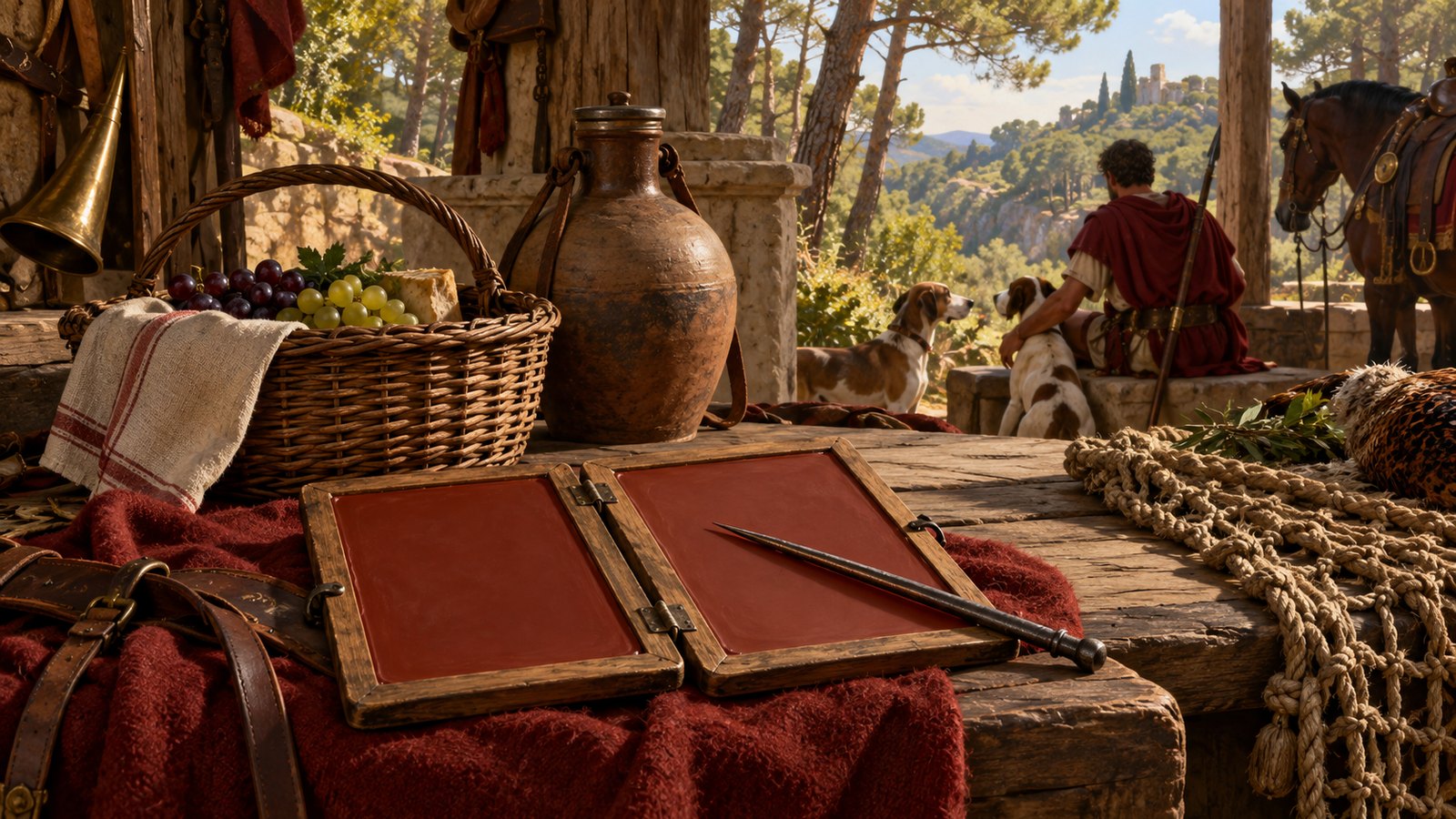
Wax tablets were well suited to provisional work. A writer could make notes and revise rather than carry a finished book into the woods. In the surviving iron stylus that carried a maker’s joke, the tool itself shows how small and portable writing equipment could be. Pliny’s letter gives that portability a scene.
The choice also transforms status. Carrying a spear might have made him one hunter among others. Carrying tablets makes the anecdote belong to literary friendship. He returns from the nets not just with game, but with a story designed for Tacitus.
Full tablets insured against empty hands
Pliny states the bargain plainly. He wrote so he could take full tablets home even if his hands were empty. Hunting normally made success uncertain. The animal could escape the nets, arrive elsewhere or never appear. Composition created a second measure that did not depend on the boar.
The line is more than a productivity slogan. It turns the physical contrast between hands and tablets into a joke about value. Empty hands would signal no quarry. Full tablets would show that time had still yielded something. Literary material could be carried away from a failed hunt.
Because three boars did appear, Pliny gets both outcomes. He can report abundance without conceding that the day was surrendered to sport. The writing had already protected his preferred identity; the animals then supplied the comic excess.
A different Pliny routine used architecture to protect attention. An empty passage in his villa kept sound away from a working room. At the nets he did not have walls. He treated the pause built into hunting as a temporary study.
Movement and silence worked together
Pliny anticipated an objection to scholarship outdoors. He insisted that bodily movement and exercise could stimulate the mind. The woods, solitude and the silence observed in hunting became powerful incentives to thought rather than distractions from it.
There is a productive tension in that list. Exercise implies motion, but the hunter at a net may wait quietly. The larger activity moves him out of the house, through open air and into a different sensory setting; the assigned station then gives him stillness. Pliny turns the alternation into a writing method.
His “solitude” was also literary. An elite hunt was unlikely to lack attendants and coordination, and the capture of three boars did not happen through a notebook alone. The letter suppresses that labour because its frame needs one author, one quiet place and one amused recipient.
That suppression is part of the source’s limitation. We learn how Pliny wanted Tacitus to imagine the outing, not a complete account of everyone who made it possible. The letter is valuable precisely as self-fashioning: hunting becomes a setting in which study appears natural enough to follow him.
Minerva joined Diana on the mountain
Pliny ended with advice. The next time Tacitus went hunting, he should take tablets along with his luncheon basket and flask. The practical list keeps the tone light. Writing equipment is packed beside food and drink as one more necessity for a day outdoors.
Then the deities arrive. Minerva, associated with cultivated skill, loves to wander the mountains no less than Diana, goddess of the hunt. Pliny does not make one expel the other. The joke allows the literary and hunting worlds to share ground.
The pairing is also the letter’s final claim about authorship. Thought need not wait for a formal library, scheduled recitation or closed study. It can happen where an interval opens—beside nets, among woods, before the quarry arrives. A writer proves constancy by carrying the work into another person’s idea of leisure.
The boars remain important because they make the boast worth sending. Yet the tablets control the meaning of the day. Without them, Pliny merely reports an unlikely success. With them, he shows Tacitus how to turn waiting into composition, sport into persona and three captured animals into one polished letter.
The addressee sharpens that performance. Tacitus was not a random audience but another writer, exactly the person likely to appreciate a joke in which authorship defeats the uncertainty of sport. Pliny can expect him to understand why a full tablet counts as a catch and why Minerva’s presence in Diana’s landscape is worth announcing.
The advice about carrying lunch, a flask and tablets also reduces inspiration to preparation. The woods may stimulate thought, but only the writer who brought the tools can keep what occurred there. The practical inventory grounds the divine joke. Minerva reaches the mountain in the luggage, with ordinary provisions for the wait.
Nothing in the short letter proves that every elite Roman carried writing equipment on hunts or that exercise reliably improved composition. It proves that Pliny found the combination plausible, useful and amusing enough to preserve. The scene belongs to his habits and his persona before it can stand for anyone else.
Even the number of animals serves the craft. One boar would establish success; three make Tacitus’s disbelief easier to stage. Pliny calls them excellent, hears the imagined question, and then unveils the tablets. The anecdote proceeds like a compact speech: surprise, explanation, principle and memorable closing image.
Sources
Pliny the Younger, Letters, 1.6.