
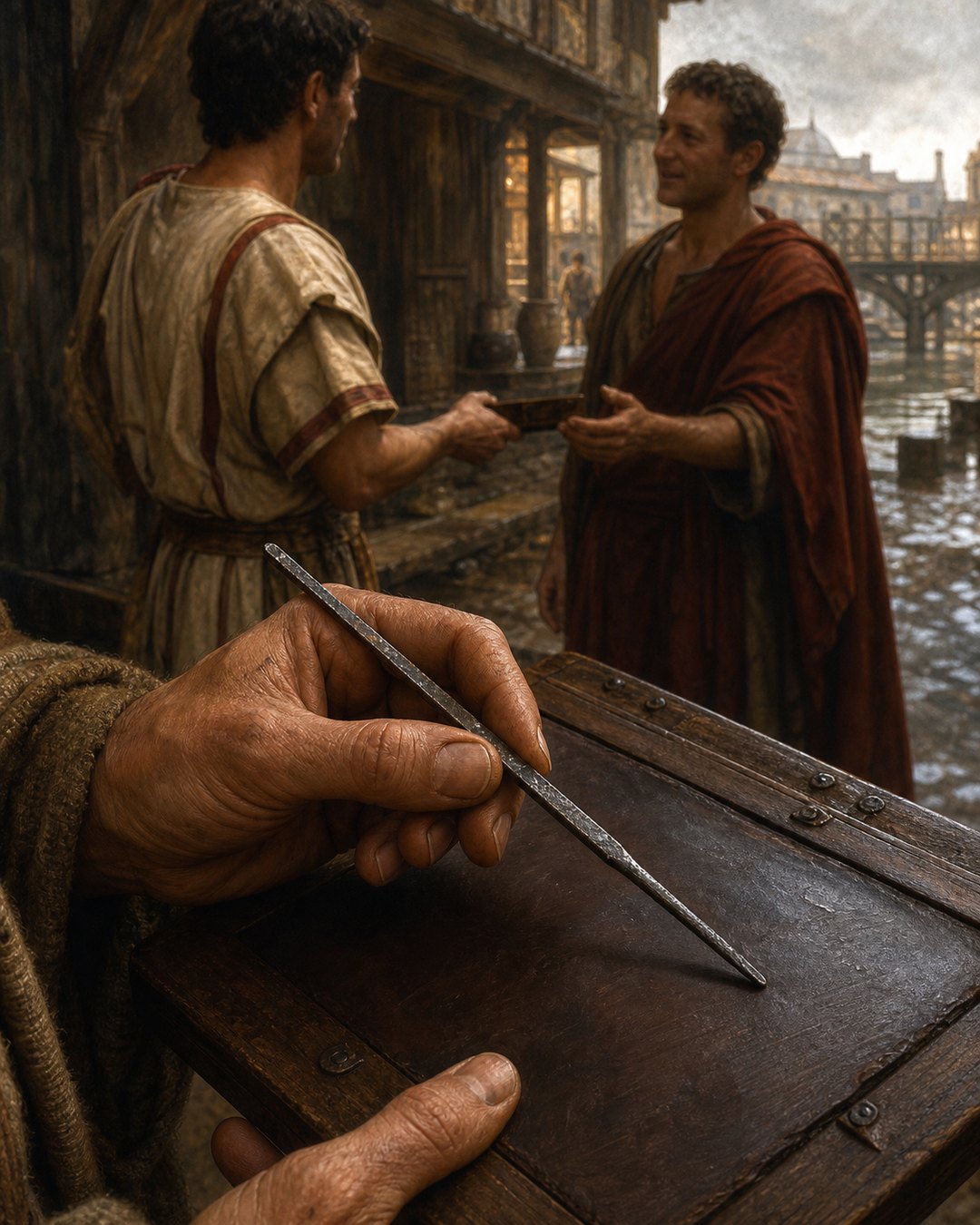
The gift was iron, about 132 millimetres long, and cheap enough for its own inscription to make fun of the buyer. Scratched around the slim sides was a Latin message from someone who claimed to have come from Rome. The traveller brought a pointed present, asked to be remembered and apologized that an empty purse could not match the length of the road.
Archaeologists found the stylus beside the buried Walbrook during excavations for Bloomberg’s London headquarters. It dates to about 70 CE, when Londinium was still a young Roman town. Corrosion made the tiny letters difficult to see; conservation and repeated reading eventually recovered a voice that had crossed both an empire and nearly two millennia.
Calling it the ancient equivalent of a joke souvenir is irresistible, but the comparison is only the beginning. Its humour depended on a working writing culture, expensive travel, recognizable verse and a recipient who knew what a stylus did. The object turns literacy from an abstract statistic into a pointed exchange between two people.
The Walbrook Kept an Ordinary Tool in Extraordinary Company
Museum of London Archaeology excavated the Bloomberg site between 2010 and 2014 near Cannon Street, beside the course of the Walbrook, a tributary now hidden beneath the City. Waterlogged conditions preserved an exceptional group of early Roman material. Reports counted roughly 14,000 artefacts from the project, ranging from footwear and buildings to objects connected with work, trade and writing.
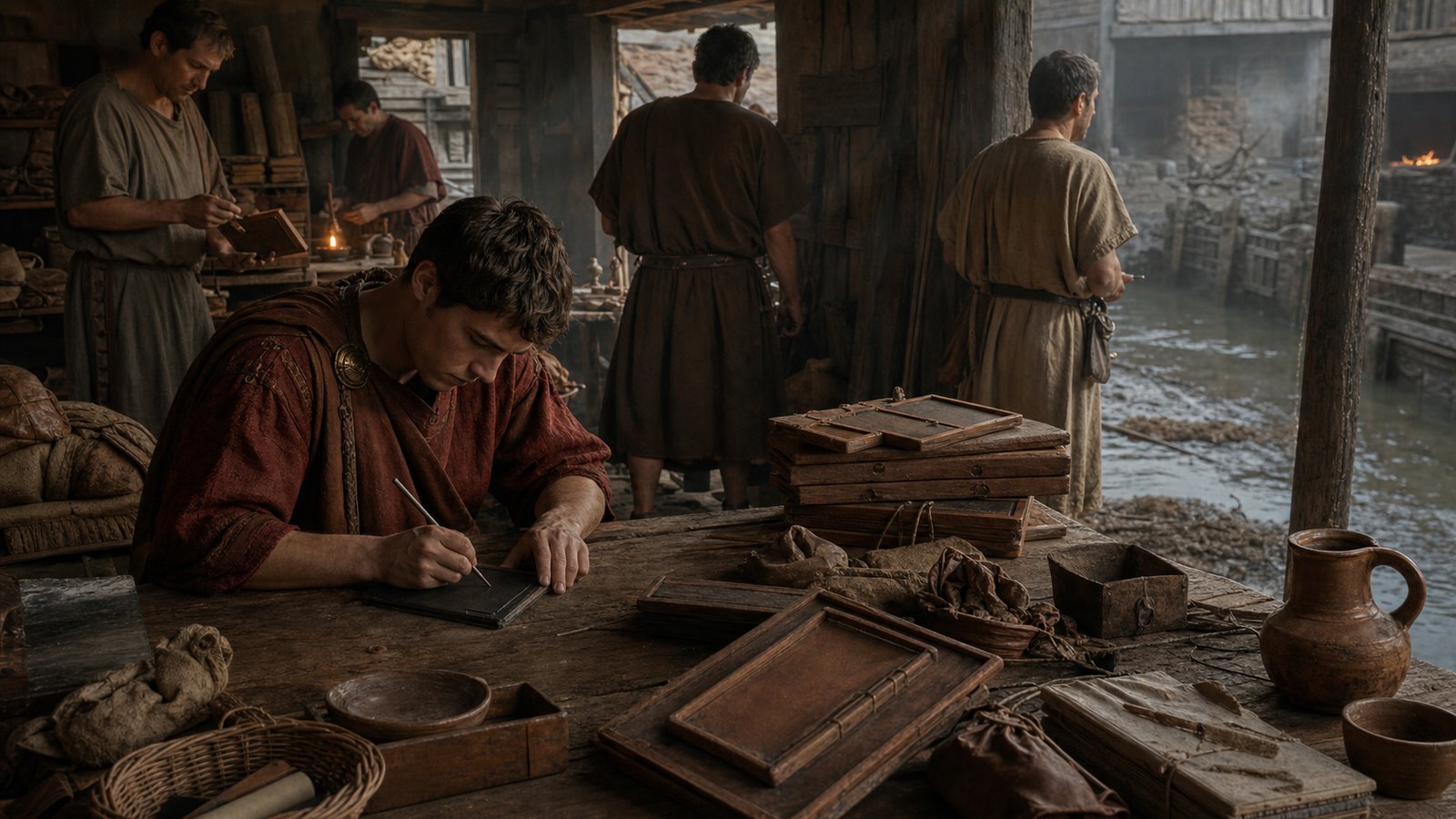
More than 400 waxed writing tablets came from the same broad excavation. Their surviving texts concern business, legal arrangements and administration in the first decades of Roman London. The stylus belonged to that material world: its pointed end incised letters into wax, while the opposite end could flatten the surface so a tablet could be reused. Writing was an action performed through pressure, reversal and correction.
Yet this iron tool differs sharply from a tablet carrying an account. Its text is on the instrument itself, cut into a space barely wider than a modern pen. The medium forces intimacy. A reader has to hold the object close, rotate it and follow compressed letters around the sides. The physical act of deciphering repeats part of the attention demanded by the ancient gift.
The find sits beside the wax records that preserved risky Roman loans, but its narrative engine is different. A contract makes memory enforceable. This stylus makes memory affectionate and comic. Both rely on writing, yet only one pretends that its own modest price is the point of the present.
Four Narrow Faces Held a Carefully Built Complaint
The translated message begins with arrival from the City, meaning Rome. It offers a welcome gift with a sharp point so that the recipient may remember the giver. The closing wish contrasts the long road with the traveller’s empty purse: if fortune had allowed, the giver would have been as generous as the journey was long. Expense is admitted, exaggerated and converted into charm.
That translation rests on difficult work. Corrosion obscured the surface, and the lettering is exceptionally small. Conservators made the inscription legible enough for specialists to trace and restore damaged sequences. Denis Keyer’s study treats the text as a polymetric composition: two iambic senarii followed by an elegiac couplet, with compressed sounds and disputed restorations that reveal deliberate literary construction rather than casual scratching.
The distinction matters because a polished joke implies more than basic name-writing. Someone composed or copied a compact performance suited to the object. Meter gave shape to the complaint, while the stylus supplied the final visual punch line. The recipient did not merely receive words about a pointed gift; the words occupied the pointed gift in hand.
Uncertainty should remain visible. Individual letters and divisions have been debated, and English translations smooth choices that are much rougher on corroded iron. The broad movement—from Rome, with a sharp remembrance, limited by fortune and purse—is secure enough to explain the joke. Its exact poetic scansion belongs to continuing scholarship, not to a single effortless reading.
A Cheap Present Still Required an Imperial Road
The message works because the journey was long. Around 70 CE, travel from Rome to Londinium meant sea passages, roads, changes of vehicle or ship, lodging and risk. The inscription does not identify the route, traveller or recipient. It does preserve a social fact: movement between the imperial centre and a recently established provincial city was familiar enough to become the premise of a personal gift.
The traveller may have been a soldier, merchant, official or someone attached to those mobile communities. The object cannot choose among them. Nor does the claim to come from Rome prove that the giver personally bought it there; a formula could travel through workshops and markets. A responsible reading separates the voice performed by the inscription from a biography the artefact does not supply.
Even so, the contrast between distance and price is concrete. The road increases the emotional value while the iron advertises economy. A silver vessel could display wealth without explanation. This stylus has to persuade. It turns the inconvenience of a small budget into evidence of thought, making wit perform the generosity that metal value could not.
That portable social logic complements the reed pens that carried Roman voices onto papyrus. A reed pen required ink and a prepared surface; a stylus worked by displacing wax. Different technologies supported the same larger need: distant people wanted orders, accounts, jokes and remembrance to survive beyond the speaking moment.
The Point Wrote, and the Flat End Erased
A Roman stylus was not a modern pen without ink. Its point cut a pale groove through darkened wax to expose the writing surface beneath. The broader end could push wax back across unwanted lines. That reversible system suited calculations, letters, drafts and records that did not need to remain permanent. The tool made writing both visible and revisable.
Iron provided stiffness and a fine working point, but most surviving styli are visually modest. That is why the Bloomberg example is so unusual. Inscribing a long text on the shaft required extra labour on an object designed to make marks elsewhere. The maker temporarily reversed the normal relationship: instead of the stylus carrying language into wax, language was made to cling to the stylus.
Its dimensions sharpen the achievement. At roughly the length of a current ballpoint pen, the object carried an elaborate message around narrow surfaces rather than across a tablet-sized field. Letter cutters had little room for correction. The concentration of wording, meter and metal explains why archaeologists describe it as unparalleled in poetry and humour among the small number of inscribed Roman styli.
Use-wear, corrosion and missing context prevent a complete object biography. We do not know how often it wrote, whether the recipient laughed, or how it entered deposits by the Walbrook. Archaeology recovers the durable endpoint, not every exchange before it. The survival of the joke is therefore accidental even though its original composition was highly intentional.

The Empty Purse Became the Most Valuable Line
The easiest modern paraphrase—someone went to Rome and brought back a lousy pen—captures the tone but loses the ancient workmanship. The original does not simply mock a disappointing souvenir. It asks the recipient to remember the giver, balances fortune against generosity and stretches a tiny object into a poem about a long journey. Affection and embarrassment occupy the same sentence.
Its date gives that intimacy historical weight. Londinium had been founded only a few decades earlier and rebuilt after the revolt of Boudica in 60 or 61 CE. By about 70, the city already contained people who handled wax records and understood a literary gift from Rome. Provincial life was not merely orders arriving from the centre; it included private humour moving through the same channels.
The stylus also corrects a habit of seeing literacy only through monumental inscriptions. Public stone announces office, victory or law. Here thirteen centimetres of iron preserve teasing self-deprecation. The audience may have been one person. The message mattered precisely because it was held, turned and perhaps used, not because a crowd could read it from a forum.
Its sharpest achievement is to make lack itself generous. An empty purse excuses the cheap material, the long way enlarges the gesture, and the pointed tool promises remembrance through future writing. The giver could not make iron expensive, so the inscription made it personal. That exchange is why an ordinary stylus now ranks among Roman London’s most human objects.