
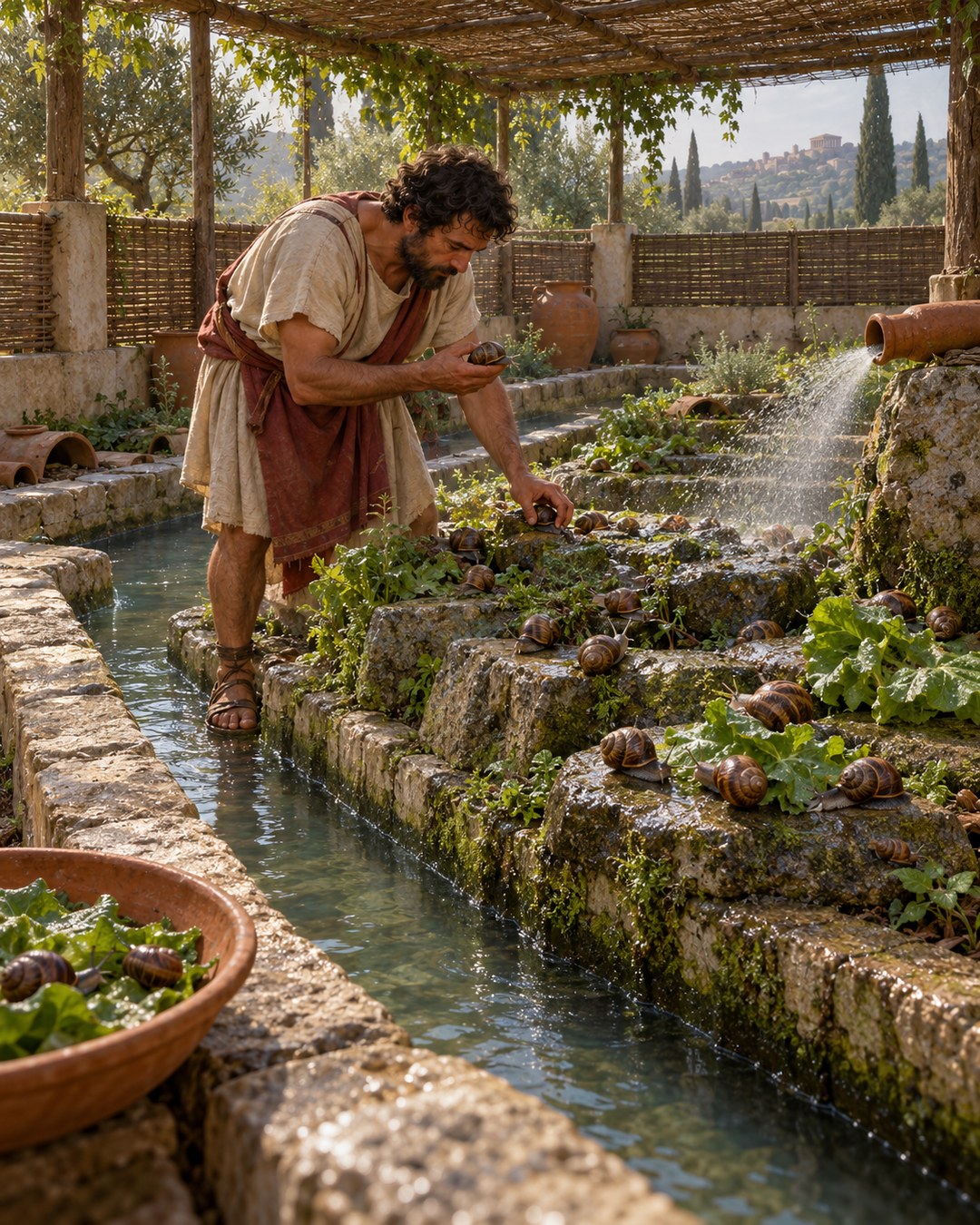
A Roman snail farm needed a moat before it needed feed. In Varro’s account, the enclosure stood open to the air but was entirely surrounded by water. The barrier kept breeding adults and their tiny offspring from crawling away, while shade and moisture kept the animals from drying under the Italian sun.
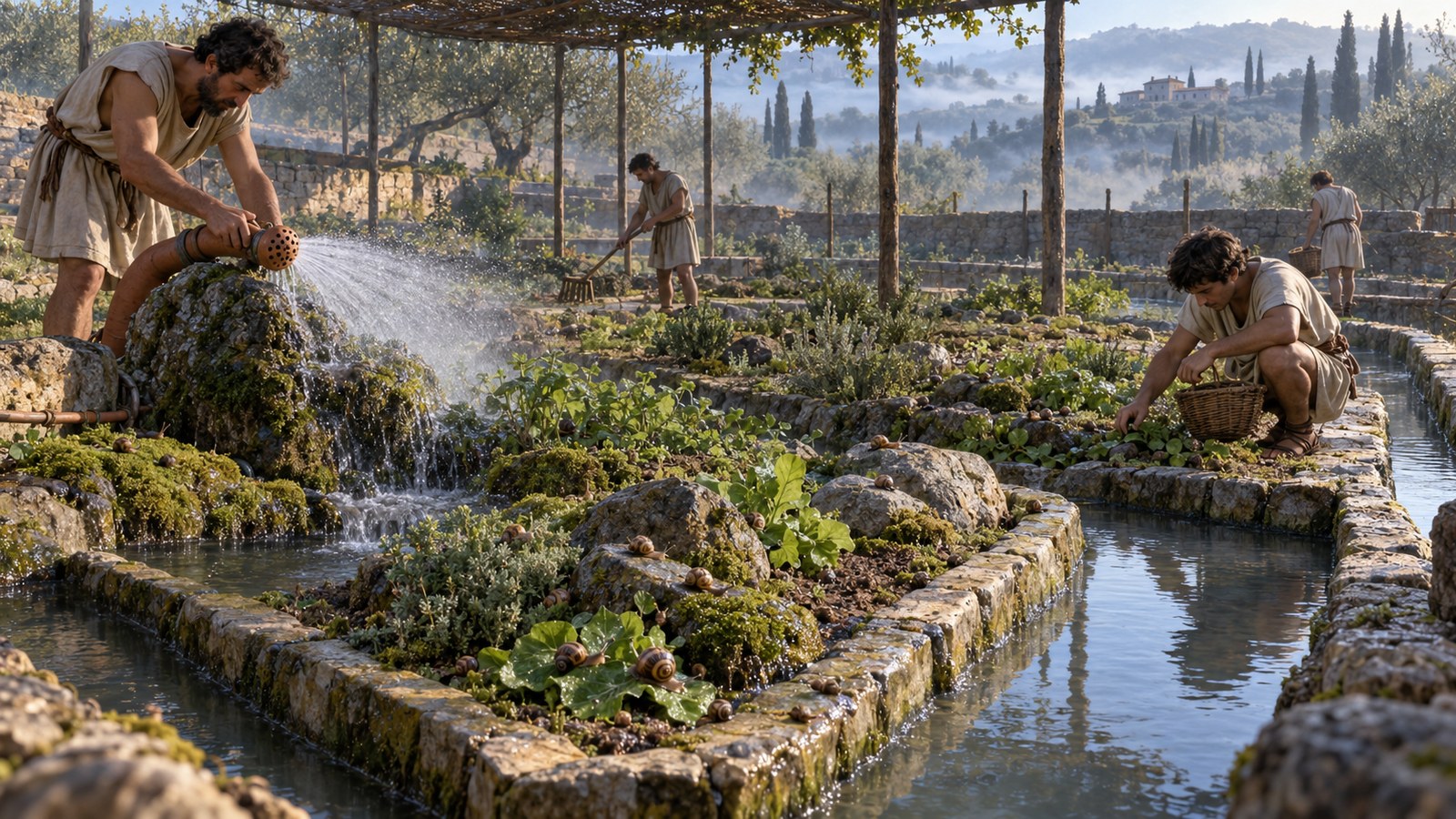
Where natural dew failed, the keeper was not told simply to pour water over the ground. A pipe ended in a rose-shaped nozzle and drove water against a rock, breaking the flow into spray. The device recreated the damp surface conditions that a shaded bank or lakeside recess supplied without machinery.
The system joined containment, microclimate, regional stock, market survival, and final fattening. Varro’s snails were not a casual woodland bonus. They were living inventory whose movement, moisture, growth, and sale condition had to be managed from enclosure to cooking pot.
A ring of water became the fence
Varro introduces the subject through a joke. Axius assumes there can be little trouble in keeping snails and dormice. Merula immediately corrects him: a suitable snailery must be outdoors yet wholly surrounded by water, or its owner will spend his time pursuing both the original breeders and their children.
The humour sharpens the engineering point. A normal wall is a surface a snail can climb. Height therefore offered little security unless the boundary changed the animal’s route. Water did that work horizontally. It turned the edge of the enclosure into an interruption rather than another path.
Varro adds that such a boundary saved the expense of a dedicated catcher. The line reveals the commercial calculation behind the design. Labour spent recovering escaped stock would reduce the value of an animal praised elsewhere in the book as easy to keep. A passive barrier made the enclosure profitable by working continuously.
The water also divided the interior into usable ground and isolated islands. Varro associates large islands with a rich haul. They expanded the damp surfaces on which stock could spread while the channels kept the population within a known perimeter.
This was enclosure built around animal behaviour rather than architectural habit. The same Roman countryside could produce highly controlled plant forms, as in the wicker sheaths used to shape gourds. Here the intervention acted on movement. The keeper did not force a shell into a mould; he redesigned the path beneath it.
A rose nozzle manufactured morning dew
Containment solved only half the problem. Varro preferred ground that was not baked by the sun and on which dew remained. A naturally shaded hollow beneath rocks, or a slope beside a lake or stream, could preserve the cool dampness that snails required.
Sunny ground demanded an artificial answer. A pipe carried water into the snailery and ended in what the translation calls a rose nozzle. Instead of releasing one heavy stream, it forced water against a rock so that the impact scattered droplets over the nearby surface.
The rock was part of the apparatus. It converted pressure into spray and spread moisture without turning the enclosure into a torrent. Fine droplets could wet stone, soil, plants, and shells while leaving feeding ground accessible. Varro’s instruction is brief, but it identifies the desired effect precisely: supply dew when the site does not provide it.
That distinction matters. Flooding and humidity are not the same condition. Too much running water could block access to walls where snails found food, while too little moisture exposed them to heat. The keeper had to maintain a wet surface without destroying the routes and forage within the enclosure.
The rose nozzle therefore joined climate control to fencing. Channels defined the outside edge, and spray managed the inside atmosphere. Both used water, but in different forms: a continuous boundary to prevent escape and dispersed droplets to preserve a viable habitat.
Reate, Illyricum, and Africa supplied different stock
Varro does not treat every snail as interchangeable. He names small white snails associated with Reate, large stock imported from Illyricum, and medium-sized African varieties. He also warns that size varied within each region, so a geographic label did not guarantee a uniform animal.
The list places the snailery inside a wider market. A farm could begin with local breeding stock or acquire animals that had travelled across the Adriatic and Mediterranean. Choosing among them affected the expected size of the mature crop and perhaps the price for which it could be sold.
Growth had its own timetable. The young were initially very small and soft, then hardened their shells with age. A rich enclosure therefore contained animals at visibly different stages. Harvesting everything at once would confuse new offspring with stock ready for finishing.
Varro’s regional catalogue should not be mistaken for a modern biological classification. It records the distinctions that mattered to buyers and keepers: origin, relative size, and commercial promise. The precision lies in husbandry rather than taxonomy.
Trade also continued after removal from the farm. At hucksters’ stalls, snails could remain alive for a long time with only laurel leaves and bran scattered over them. That hardiness gave sellers flexibility. Unlike a slaughtered animal, living stock could wait while demand caught up.
The arrangement resembles other Roman efforts to manage valuable goods between origin and sale. Alexandria’s sealed work clothes protected frankincense by controlling human access; the snailery protected value by controlling animal movement and moisture. Different commodities required different boundaries.
A pierced jar finished what the enclosure began
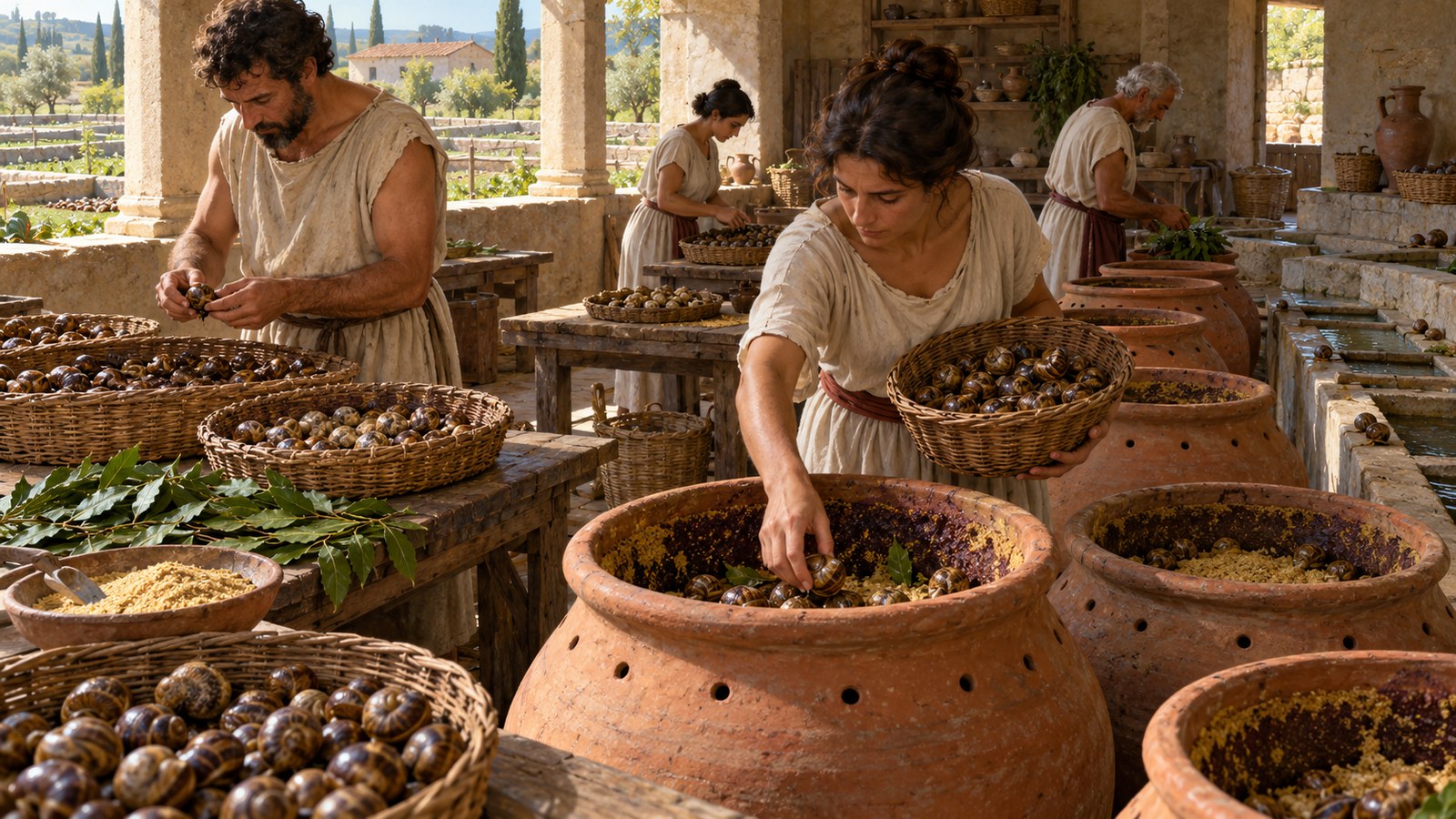
The final fattening stage compressed the system into a clay vessel. Varro describes a jar smeared with boiled must and corn meal, then pierced with holes to admit air. Selected snails fed against the coated interior while ventilation kept the closed container from becoming a sealed trap.
Each feature answered a different need. The jar prevented dispersal. The sweet, grain-based coating put concentrated food within reach on the walls. Small openings allowed exchange with the outside air without creating an easy exit. The finishing vessel was therefore not a miniature snailery by accident; it reproduced containment and access on a tighter scale.
Varro calls snails naturally hardy, but his instructions do not rely on hardiness alone. He modifies the habitat, imports stock, observes age, sustains animals at market, and concentrates feed before sale. The supposedly effortless creature generated a sequence of decisions.
The survival of snails on stalls also created uncertainty for the cook. Varro jokes that their persistence made it difficult to know whether they were being cooked alive or dead. The line is unsettling to a modern reader, and it exposes how commercial convenience could erase concern for the animal’s condition once it left the enclosure.
Laurel leaves and bran served a different purpose from the boiled-must coating in the finishing jar. The first kept market stock viable with little effort; the second concentrated feeding before sale. Varro’s sequence therefore distinguishes maintenance from fattening. A seller did not need to recreate the whole humid breeding ground at a stall, but a producer seeking extra condition enclosed selected animals with richer food and air holes.
Behind that joke is a clear production chain. The farm first prevented loss, then maintained moisture, allowed breeding and shell growth, separated desirable stock, moved it alive, and finished it in ventilated jars. No one element explains the yield. The profit came from keeping the chain intact.
A rose of water striking a rock is the most memorable detail because it makes invisible management visible. The keeper could not command dew to fall, but could copy its effect. Roman snail farming began when the landscape stopped being accepted as given and became something adjusted droplet by droplet.
Sources
Varro, On Agriculture, 3.14.