
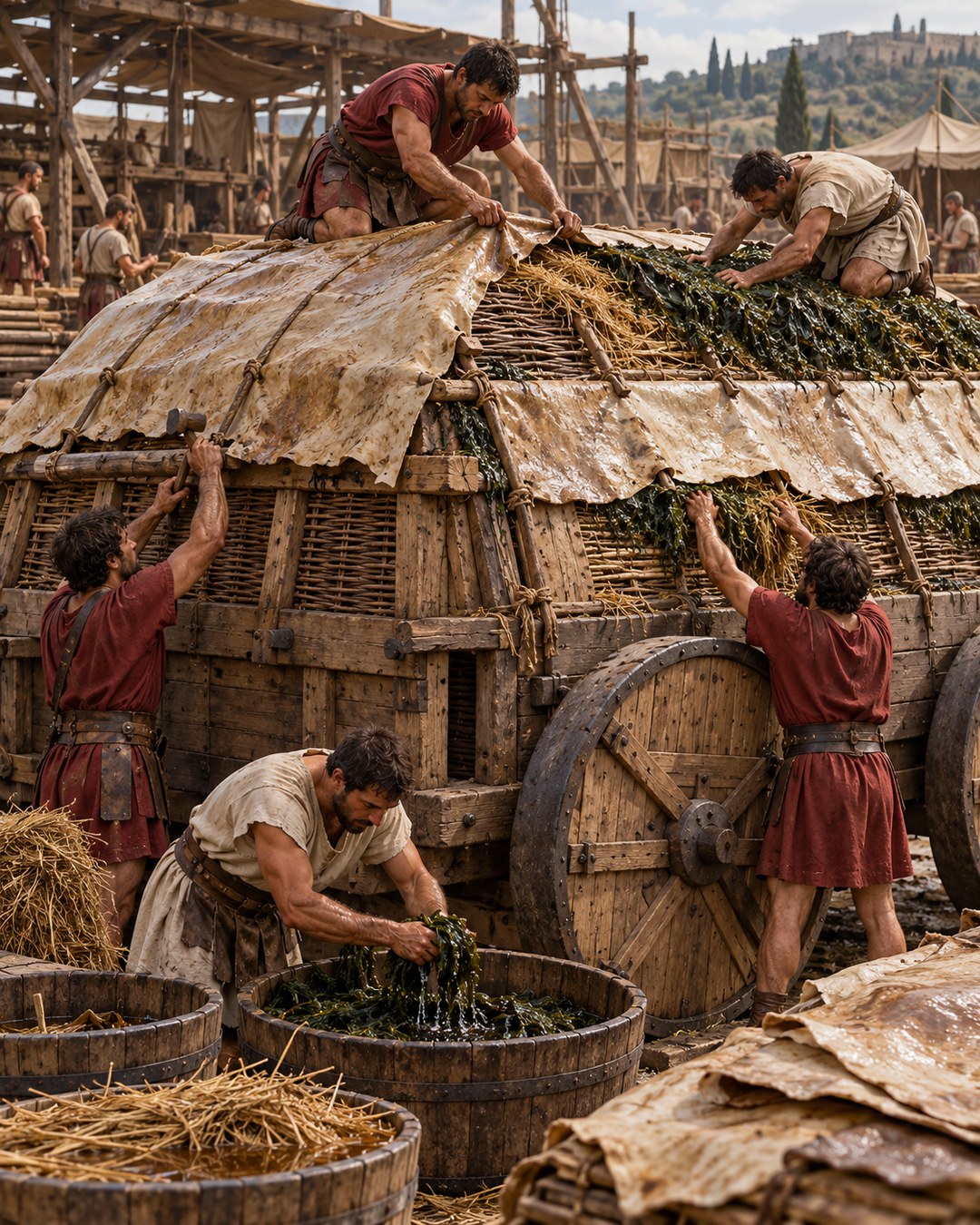
A Roman siege machine could wear seaweed. In Vitruvius’s construction sequence for a wooden tortoise, double-sewn rawhide covered the roof and held a stuffing of seaweed or straw soaked in vinegar. Beneath it sat woven twigs, strong boards, rafters, beams, and posts. The wet organic layer was armour against fire.
The tortoise protected people working close to a wall, where missiles arrived from above and defenders could drop or throw burning material. A single roof material had to resist impact, flame, and its own weight while the entire structure moved over broken ground.
Vitruvius therefore describes a stack rather than a shell. Timber carried loads. Oak boards resisted penetration better than weak, flammable woods. Fresh wattles spread force. Hide bound and covered. Wet stuffing absorbed heat. Movement underneath kept the protection useful instead of turning it into a fixed target.
Four directions were not enough for the base
The machine began with a base arranged on heavy wheel supports. Vitruvius says it could go forward and backward, toward either side, or obliquely. The last option mattered because the safest approach to a wall would not always align with a road, gate, or prepared surface.
Directional movement did not make the tortoise nimble in a modern sense. Every change had to overcome mass and uneven ground through timber wheels, axles, ropes, and coordinated labour. Manoeuvre was designed into the base so crews could adjust without exposing themselves by dismantling the shelter.
Above it rose mortised posts, beams, rafters, and crosspieces. These members did more than hold a roof. They transferred the shock of impacts down through the frame and kept the skin from collapsing onto the workers it was meant to protect.
The construction followed the same Roman preference for repeatable order seen in the four flags that organized an empty field into a camp. Yet the problem here was mobile. The frame had to remain coherent while rolling, turning, receiving blows, and approaching a vertical obstacle.
Proportions filled Vitruvius’s account because scale changed behaviour. A beam thick enough for a model might flex in a machine. A wheel adequate on firm ground could sink elsewhere. Protection had to survive not only the enemy but the forces generated by moving its own weight.
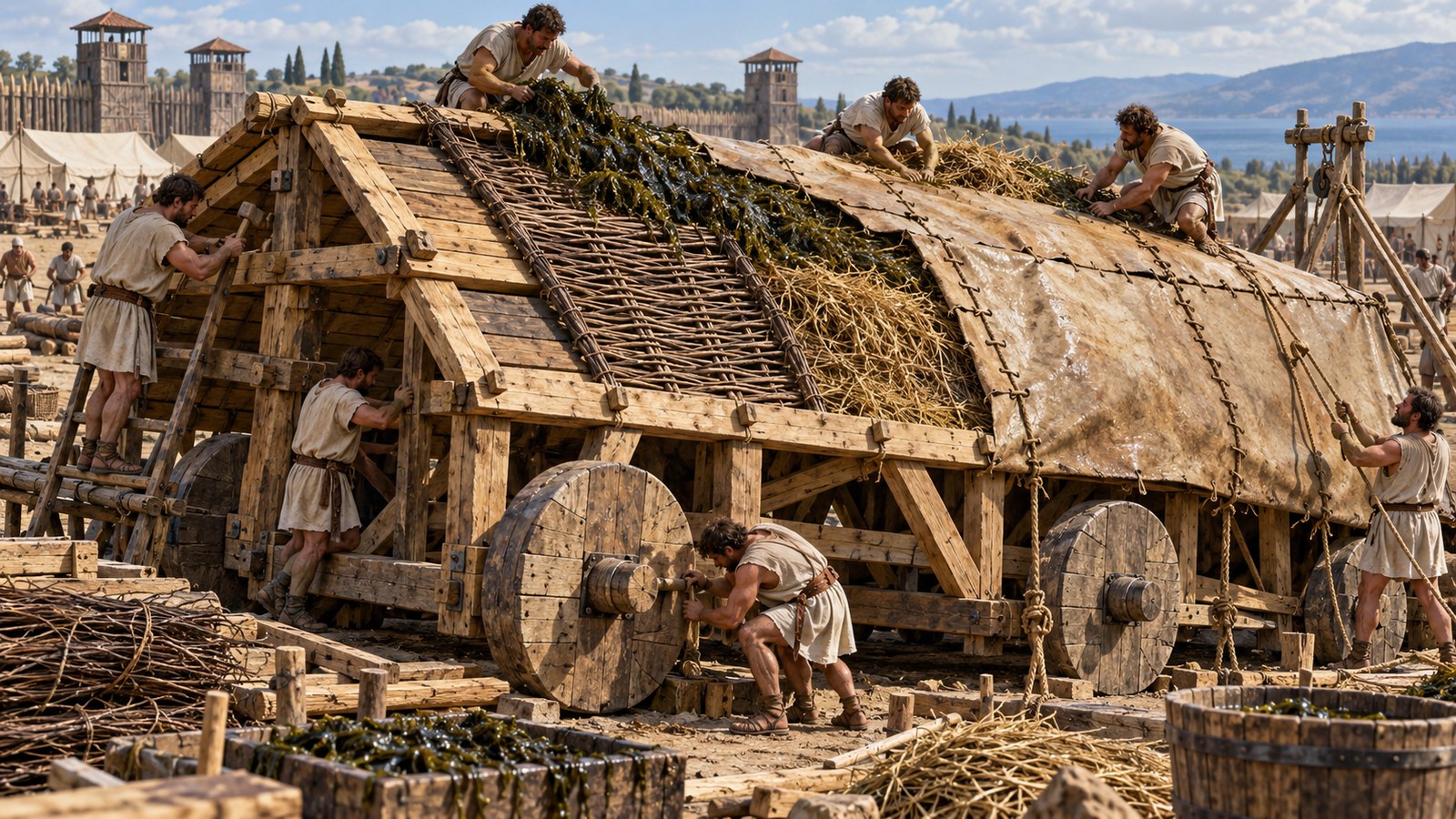
Oak and green wattles sat beneath the wet hide
Vitruvius preferred holm oak for the roof boards, or another wood with the greatest available strength. He specifically excludes pine and alder because he regarded them as weak and quick to catch fire. Material selection joined structural and incendiary threats in the same decision.
Fresh, thin twigs were then woven closely into wattles over the boards. Green material bends and retains moisture better than dry brittle brush. Woven coverage could distribute a local impact and create an uneven layer through which heat and force had to travel before reaching the main planks.
Rawhide sewn double covered the whole. Sewing converted separate skins into a continuous envelope and allowed stuffing to remain where it was needed. Hide also lacks the rigid joints of boards, so it could wrap roof edges and reduce exposed seams.
The stuffing was seaweed or straw soaked in vinegar. Vitruvius does not offer a chemical analysis of why vinegar was chosen. The immediate physical principle is clear enough: wet packed matter requires incoming heat to overcome moisture before the dry wooden structure burns freely. The layer could char, steam, and be damaged while preserving what lay below.
Seaweed is especially revealing because it tied siege preparation to supply beyond the carpenter’s yard. A machine operating near a coast might use abundant wet marine vegetation; inland crews might turn to straw. The alternatives filled the same role but demanded different gathering, transport, and replacement.
Vitruvius says the stack repelled ballista blows as well as the force of fire. That claim should not be read as invulnerability. Repeated stones could break framing, and prolonged flame could dry protection. The design bought working time under attack, which crews then had to use before damage accumulated.
A triangular front turned direct hits aside
Different work under a wall produced a different nose. Excavating tortoises received fronts shaped like the angles of triangles. Missiles from the wall then met sloping faces instead of a broad square surface and were encouraged to glance away from the people digging beneath.
The geometry transformed protection without requiring an impossibly thick barrier. A direct blow concentrates energy normal to the face; an angled surface changes the encounter and may redirect part of the motion. Vitruvius expresses the result in practical terms: workers inside were protected from shots that did not land squarely.
Another variant carried sloping eaves, boards, hides, and a coating of clay kneaded with hair thick enough to resist fire. Hair reinforced the earthen layer while clay shielded the combustible structure. It was heavier than wet stuffing and could crack under movement, but it provided another answer to the same threat.
Terrain could require eight wheels. That brief allowance shows why a written design was not a kit assembled identically everywhere. Ground, gradient, load, and approach changed the undercarriage. A machine that protected perfectly but could not reach the wall had failed before the defenders touched it.
The daily discipline behind such movement belonged to the same army that trained pace and endurance. The five-hour marching standard for recruits prepared bodies for coordinated travel; a tortoise demanded another coordination, turning dozens of workers into the hidden engine of a single structure.
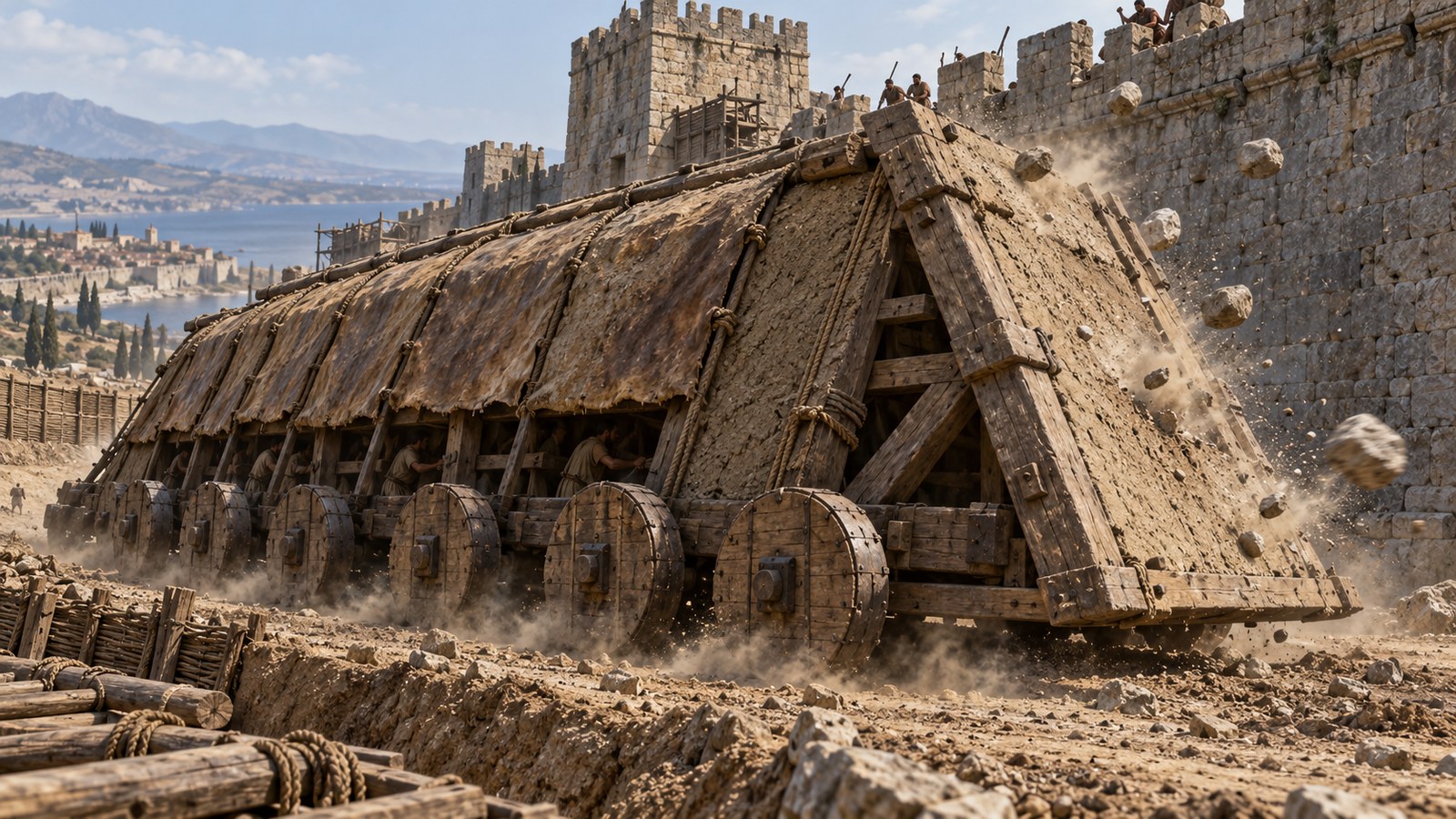
Hegetor’s giant machine turned shelter into a building
Vitruvius follows the general types with a machine attributed to Hegetor of Byzantium. Its base measured sixty-three feet by forty-two, and four corner posts rose thirty-six feet. Eight wheels were each described as six and three-quarter feet high and three feet thick.
Those numbers turn “tortoise” into a misleadingly small image. The machine was a moving timber building. Dovetailed wheel pieces, cold-worked iron plates, framed posts, floorings, rafters, bridges, clamps, axles, ropes, chains, hides, and weapons all had to remain aligned while the base advanced.
A middle floor carried scorpions and catapults. Two protected soldiers could stand above the ram, watch the defenders, and report what they were attempting. Observation became another layer of the machine: people below supplied motion and force, while eyes above supplied warning.
Vitruvius gives the ram itself extraordinary dimensions and says it could be raised, lowered, and swept laterally. Whether every transmitted number represents a machine built exactly as described is less important than the technical imagination on display. Protection, weapon, lookout, and motion were integrated rather than treated as separate equipment.
That integration created vulnerabilities too. Wet hides grew heavy. Wheels concentrated weight. Tall frames swayed. Fire protection had to be maintained. Ropes and chains wore under repeated load. The machine was not a single invention but a temporary agreement among materials that aged at different speeds.
Maintenance followed directly from the design. Wet packing that dried had to be soaked again; torn hide had to be sewn or overlapped; loosened wattles had to be rebound before they exposed a board seam. Wheel damage threatened every protective layer at once because a stalled machine left the roof under repeated attack. The shelter therefore depended on crews outside the dramatic moment of impact: carpenters checking joints, leatherworkers closing cuts, labourers carrying liquid, and soldiers coordinating turns. Protection was not installed once. It was renewed while the approach consumed it.
Seaweed and vinegar stand out because they expose the distance between appearance and function. To defenders, the tortoise presented a bulky roof creeping toward the wall. Inside that roof, ordinary substances were arranged so that water, fibre, skin, wood, iron, and human timing could absorb just enough violence for work to continue.
Sources
Vitruvius, On Architecture, 10.14–15.