
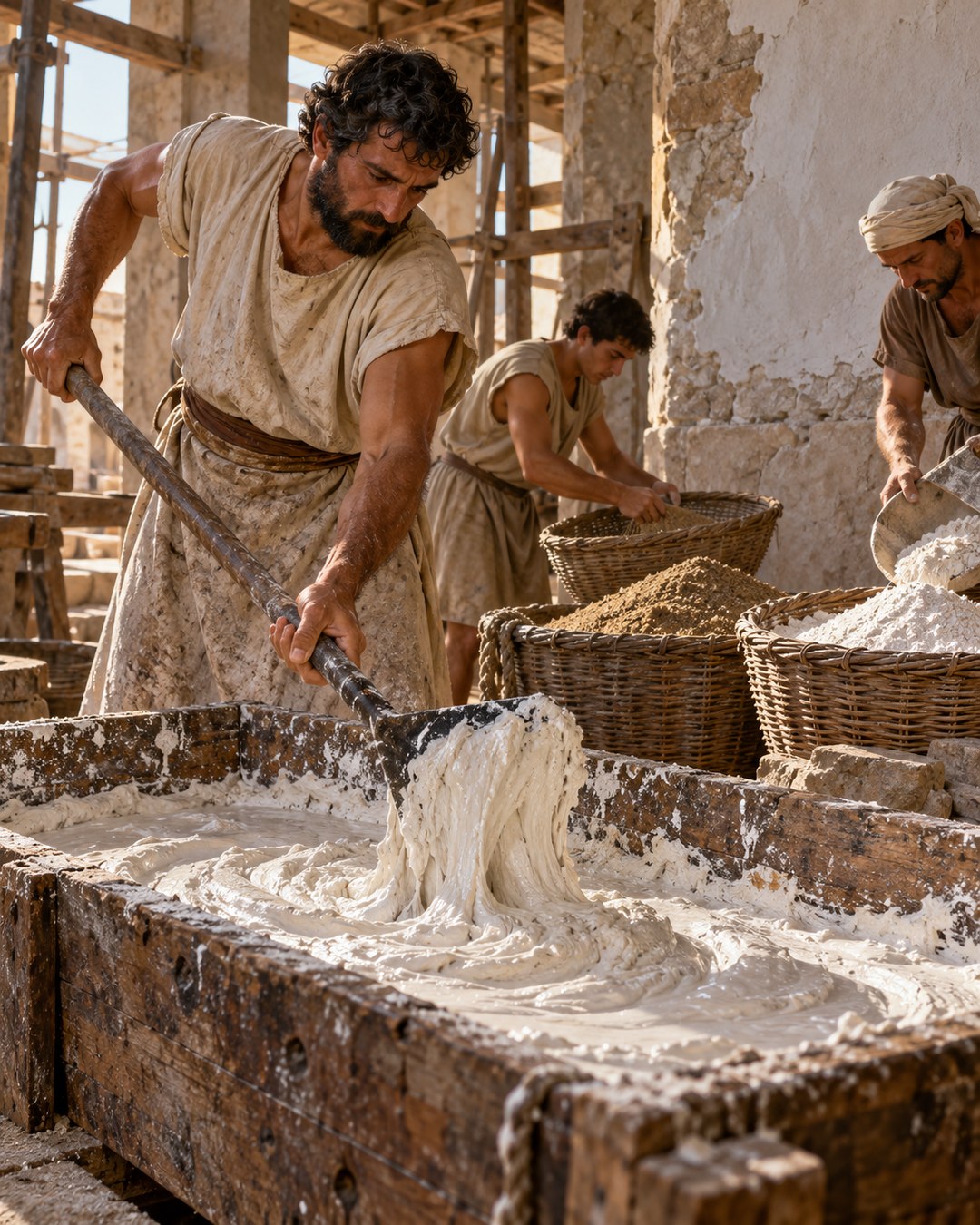
A Roman plasterer could discover a future blister with a hoe. Vitruvius instructed the worker to cut into slaked lime as though hewing wood and watch what happened to the iron. Bits clinging separately meant the material was not ready. A dry, clean blade meant the lime was weak and thirsty. Properly prepared lime held to the tool like glue.
The test happened before the wall received its polished skin. That timing mattered because bad lime could conceal under-burned fragments. If they completed their reaction only after application, they expanded within the finish, raised blisters, and broke the smooth surface that later labour had made expensive.
Vitruvius’s stucco is often remembered for brilliance. His instructions begin instead with waiting, wet material, and a tool that must be read correctly. The wall’s visible success depended on refusing lime whose internal process had not finished.
Time in the mortar bed protected the finished room
The best lime, Vitruvius says, should be taken in lumps and slaked well before it was needed. Water did not simply make the material spreadable. A long interval forced pieces inadequately burned in the kiln to throw off their remaining heat and reach a common condition before they entered the work.
Fresh lime could deceive because crude bits hid inside an apparently usable mass. Once spread on a wall, those particles did not remain harmless. They continued slaking in place, disrupted the coat around them, and spoiled the polish. The defect was delayed, so the surface might look finished before its own ingredients broke it.
This is a different problem from obvious bad mixing. A visible stone can be picked out. An unfinished reaction is concealed until moisture and time expose it. The safest intervention therefore came upstream: lengthen preparation and test the batch before scaffolding, reeds, mortar, and marble powder multiplied the cost of failure.
The logic resembles the five-year waiting rule in Utica’s inspection of aged mud bricks. Both procedures used delay to reveal material weakness before incorporation into a building. Patience was not idleness. It was quality control performed by time.
Vitruvius does not provide a universal number of days for slaking in this passage. He defines readiness by behaviour. That omission made the craft test essential, since temperature, burning, lump size, and water could make a calendar alone unreliable.
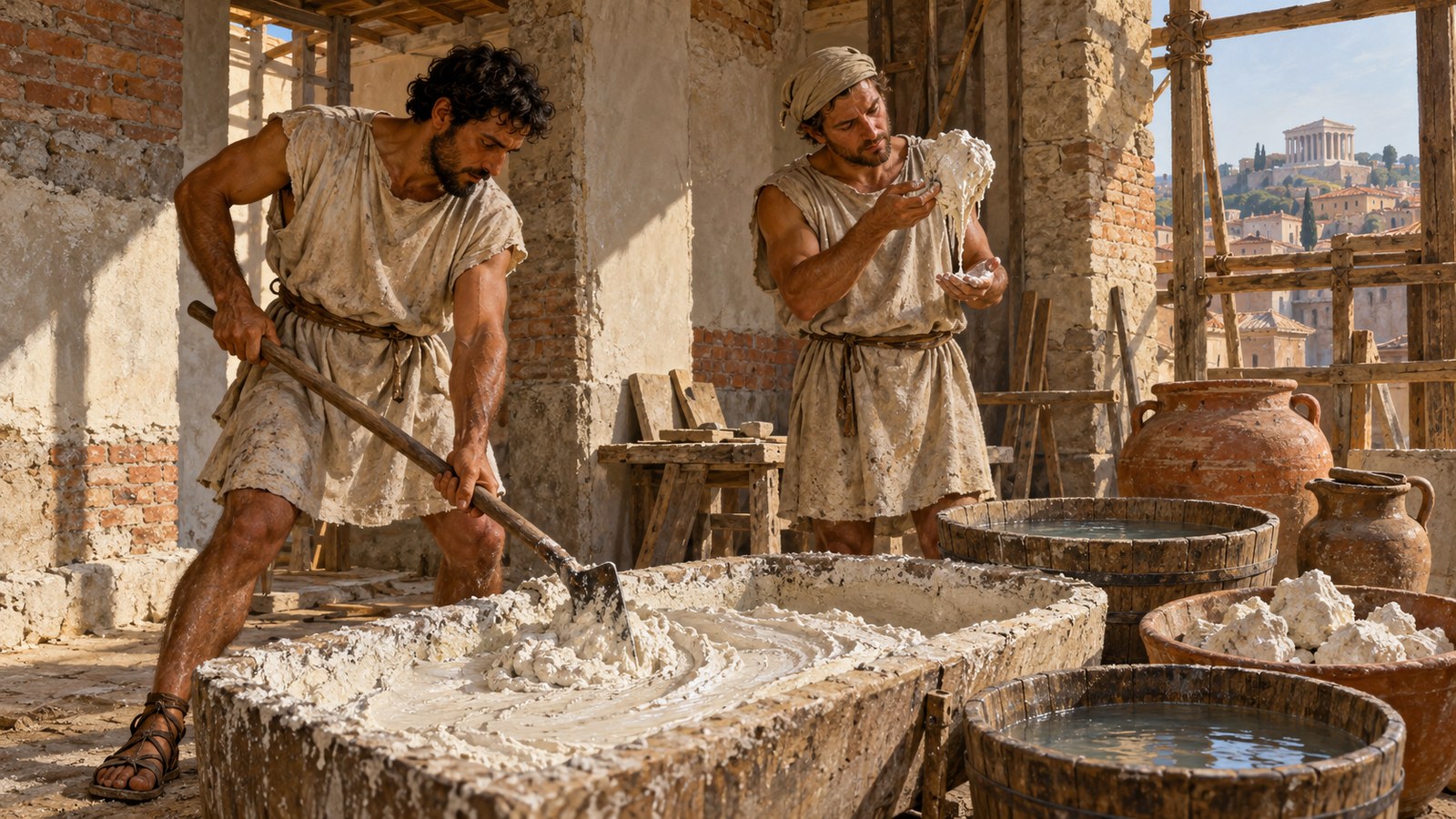
The iron hoe gave three different answers
Vitruvius asks the worker to apply a hoe to the mortar bed as one would hew wood. The comparison implies force and resistance, not a delicate touch on the surface. The blade entered the mass and drew material with it, making cohesion visible.
If lime stuck in bits, it was not yet tempered. Separate clumps suggested an uneven material in which all parts had not reached the same condition. Continuing to wait and work the lime was safer than hiding those differences beneath a wall coat.
The opposite-looking result could also fail. If the iron came out dry and clean, Vitruvius called the lime weak and thirsty. Cleanliness here was not proof of quality. A batch that would not engage the tool lacked the rich, adhesive character required for the work.
The passing result lay between crumbling attachment and no attachment. Properly slaked lime stuck like glue. The metaphor gave the craftsperson a tactile standard: the mass should cohere and grip the iron rather than fall into bits or leave it untouched.
This three-way reading makes the hoe more than a mixing implement. It was a diagnostic surface repeatedly inserted into the same material it helped work. The test required no separate sample, and the worker could continue tempering the batch until its response changed.
Such judgment depended on experience. “Like glue” is not a measured force, and two workers might disagree at the margin. Yet the criterion was linked to a specific failure mechanism. It did not merely praise smooth lime; it tried to stop hidden particles from completing their expansion after the polish was done.
The wall multiplied one early decision into six coats
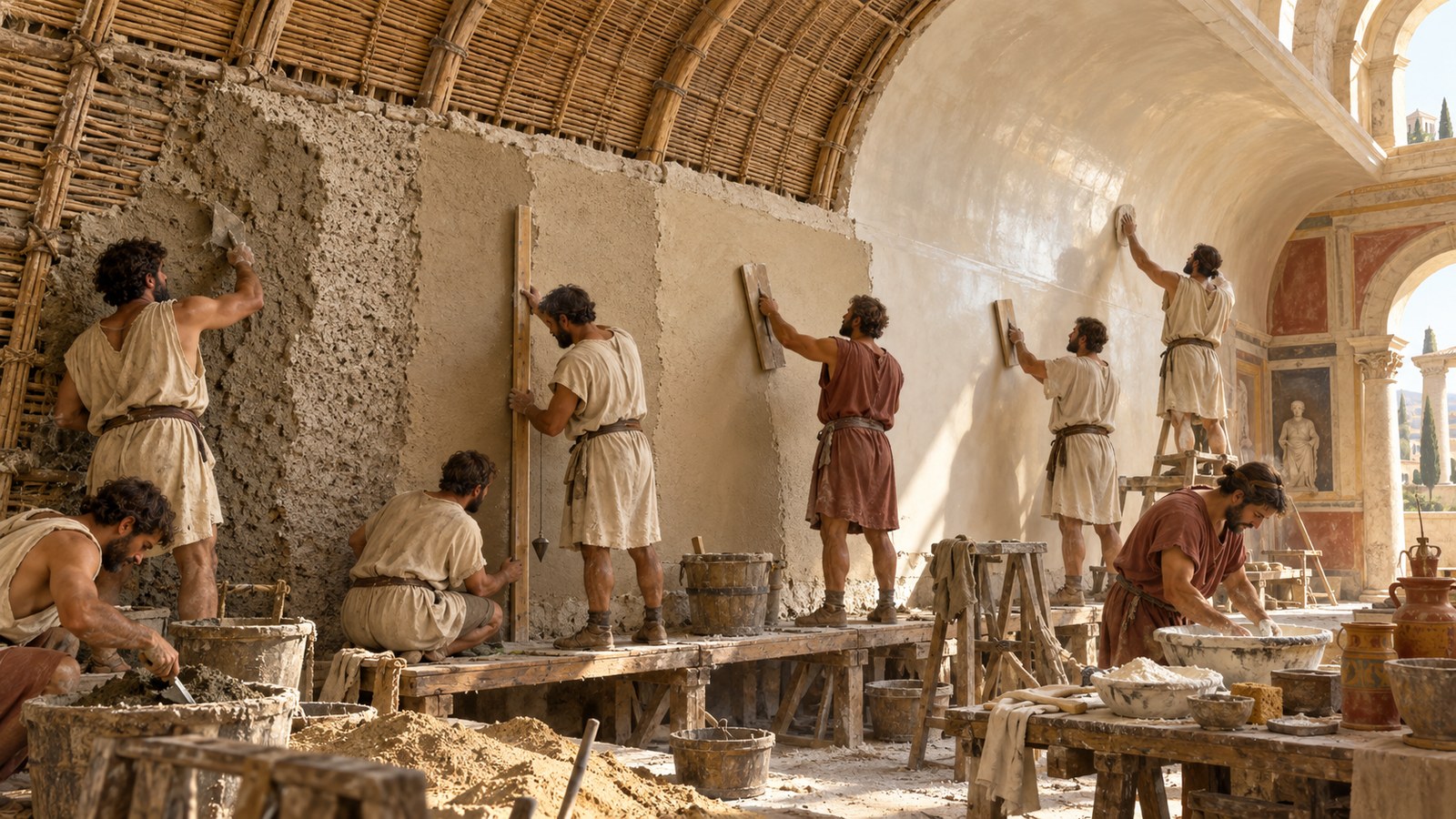
Once the lime passed, it entered a carefully layered system. Vitruvius describes a rough rendering coat followed by sand mortar adjusted in length to the rule, in height to the plummet, and at the corners to the square. Geometry and material preparation met on the same surface.
He calls for no fewer than three coats of sand mortar beyond the rendering. Each coat gave the next one a sounder base and allowed irregularities to be corrected gradually rather than buried beneath one thick application. A rushed foundation would make the final finish carry structural work it was not suited to do.
Powdered marble followed in three stages. The first mixture had to be tempered so that it did not cling to the trowel; the iron should emerge freely and cleanly from this different mortar. The contrast with the hoe test is important. Tools did not have one universal “good” behaviour. Lime in the bed should grip like glue, while a prepared marble finish should release the trowel according to its task.
A medium coat came next, then a finer one. Repeated rubbing compressed and polished the surface. Vitruvius claims that three sand coats and as many marble coats guarded against cracks and produced a brilliance of their own, even before painted colour added another visual layer.
The finished wall described in the hot-coal and wax treatment of vermilion depended on everything underneath it. Colour protection could not rescue stucco already blistering because its lime had been used too soon.
Vaults added reeds, cord, timber, and smoke
Vitruvius extends the process above the vertical wall. Curved furring strips formed vaults, preferably in cypress because he considered fir too vulnerable to decay and age. Ties and nails fixed the frame, while flattened Greek reeds could be bound to it with cord made from Spanish broom.
If Greek reed was unavailable, slender marsh reeds could be bundled to equal thickness and controlled lengths. That substitution shows a specification organized around function rather than one sacred material. The support needed a regular contour and secure attachment so wet mortar could become a continuous underside.
Rooms with fires or many lamps introduced another demand. Mouldings there should remain flat enough to wipe, since smoke and soot would gather on them. In summer rooms and exedrae without that burden, relief could be deeper. Surface form responded to cleaning as well as display.
Every stage had its own failure. Timber could decay, reeds could sit unevenly, heavy mouldings could sag, gypsum could set too fast, coats could dry irregularly, and corners could lose their line. The hoe test did not solve those problems. It protected the sequence from one avoidable defect before all the others were managed in turn.
That is the practical intelligence in Vitruvius’s instructions. A polished wall was not one material made beautiful. It was kiln, water, waiting, adhesion, timber, cord, reed, rule, plummet, sand, marble, rubbing, room use, and cleaning arranged so that no hidden weakness undid the visible whole.
The glue-like lime never appeared as the final image. It disappeared under six coats. Yet its behaviour on iron determined whether the brilliance endured or erupted into blisters. Roman finish work began by learning when an ingredient was still too active to be covered.
Sources
Vitruvius, On Architecture, 7.2–3.