
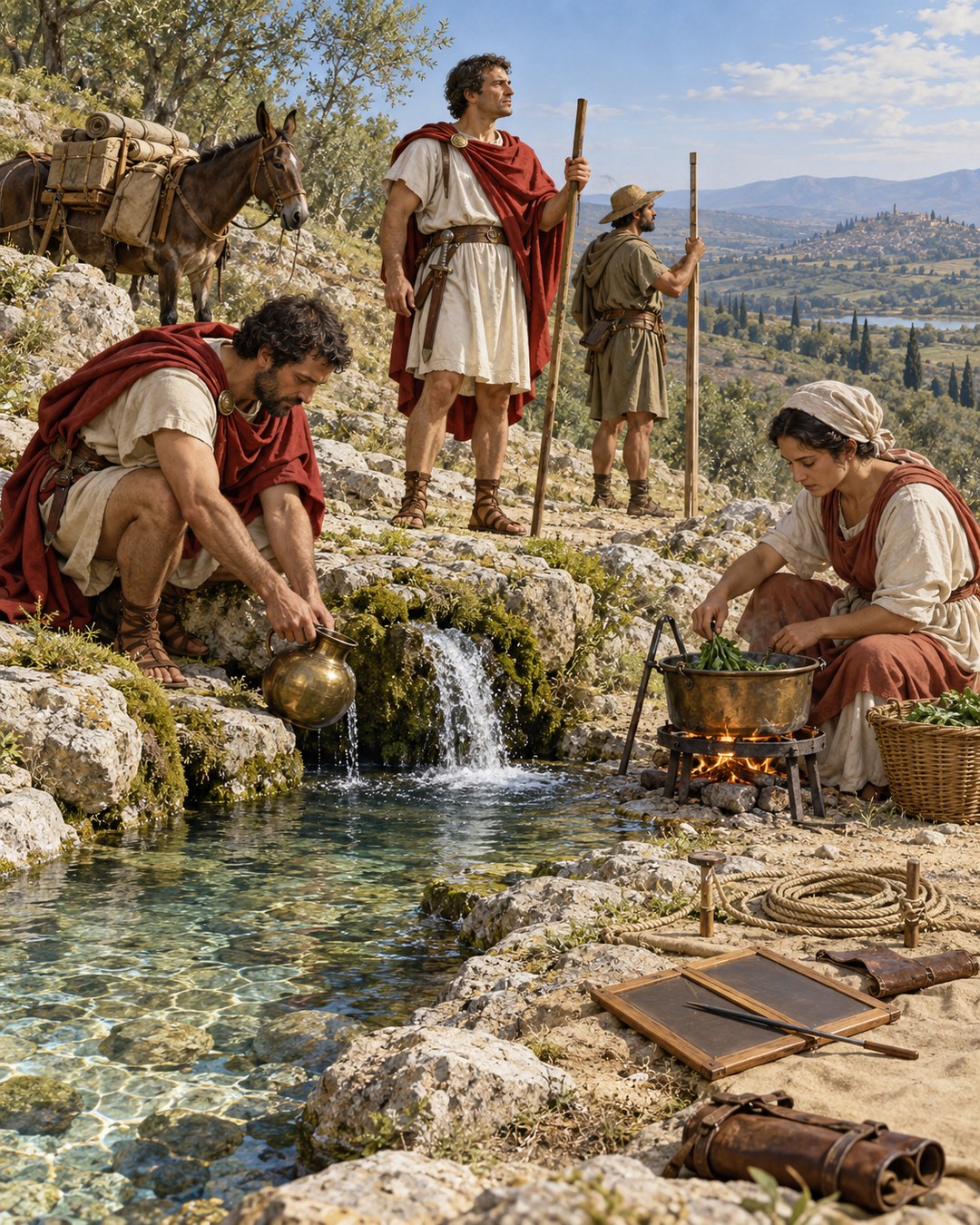
Before builders fixed a spring to a city with channels, arches, and pipes, Vitruvius asked them to cook vegetables. If greens softened quickly in the water, he counted that as evidence that the source was good and wholesome. The test placed a kitchen result before an infrastructure commitment.
It was only one part of a wider inspection. Nearby bodies, a bronze vessel, residue in a cauldron, water clarity, plants at the outlet, and filth on the bed all had to be read together. None required a laboratory. Each converted an invisible question about water into a change that eyes, hands, or a meal could register.
Vitruvius’s method is not modern chemistry, and its assumptions should not be smuggled into present medicine. Its historical importance lies elsewhere. A Roman technical author described source selection as evidence gathered before construction, when rejecting bad water was still cheaper than carrying it into every fountain, bath, and house.
The first sample was the population beside the spring
For a spring already running freely in the open, Vitruvius begins with the people living near it. He tells the surveyor to inspect their physique before starting the work of conveyance. Strong frames, fresh complexions, sound legs, and clear eyes offered what he considered complete approval.
The reasoning turns residence into a long exposure test. A traveller could see clear water and leave after one drink. Local bodies represented repeated use across seasons. Vitruvius therefore treated health in the vicinity as accumulated testimony that a brief visit could not supply.
That judgment was socially and medically crude. Appearance does not isolate water from food, labour, disease, wealth, or age, and people who looked robust could still drink contaminated water. Yet the procedure shows a desire to seek consequences before trusting surface beauty. The spring was judged partly by what had happened around it over time.
The stakes extended beyond thirst. In the preceding chapter, Vitruvius calls water indispensable to animals and to the production, preservation, and preparation of food. Choosing a source meant choosing an ingredient that would circulate through cooking, washing, craft, livestock, and public life.
A city could attempt spectacular water movement, as in the proposed canal between Nicomedia’s lake and the sea. Vitruvius starts earlier. Before scale and route, the source itself had to deserve the expense.
Bronze turned an invisible quality into a stain
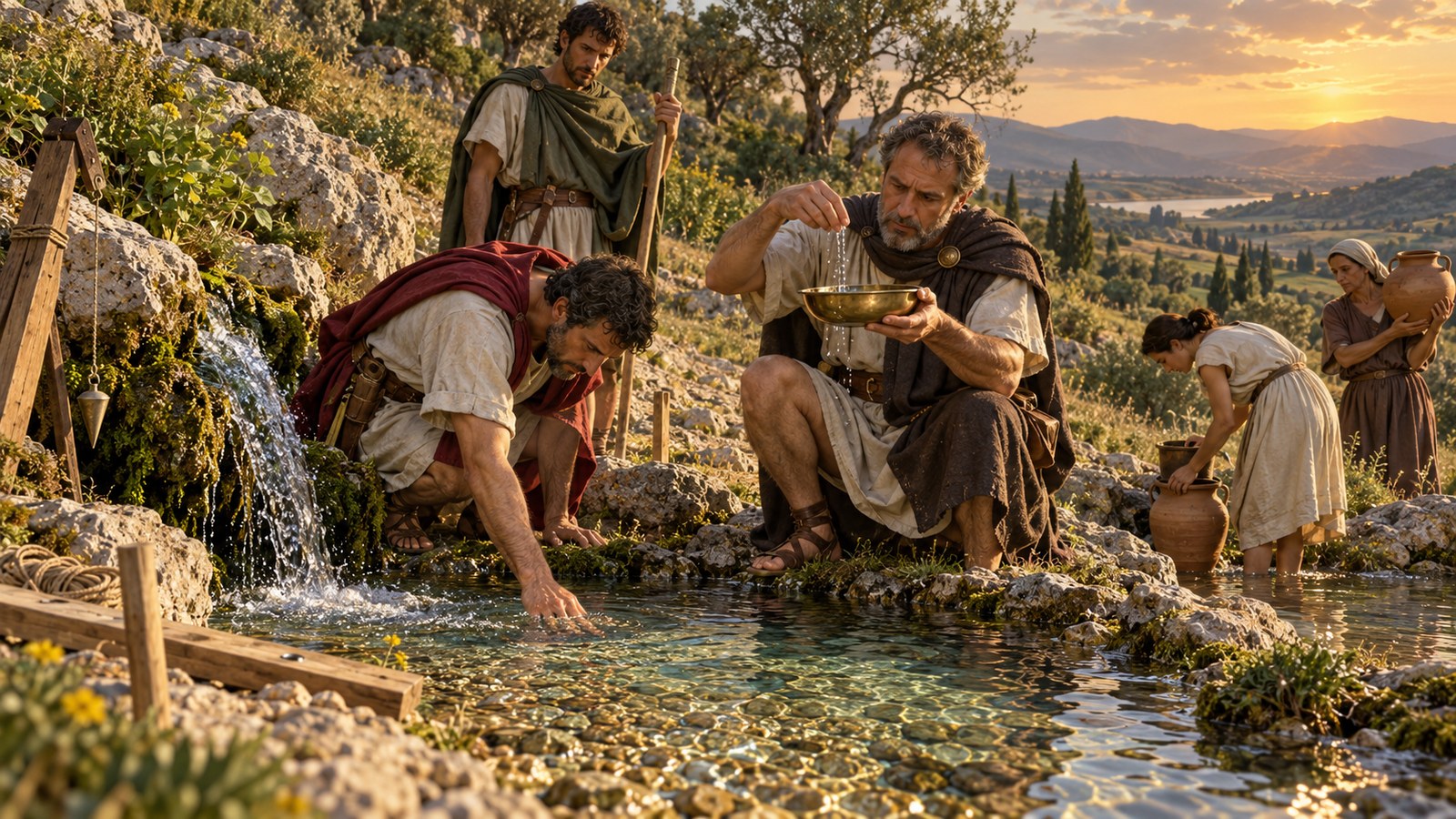
A newly opened spring lacked a settled population from which to draw the same inference. Vitruvius therefore moves to objects. Water could be sprinkled into a Corinthian vessel or another vessel of good bronze. If it dried without leaving a spot, it passed that trial.
The object created a controlled surface. Marks that disappeared against soil or stone would remain visible on polished metal. The bronze did not explain what a deposit contained, but it made the presence of residue easier to compare than an impression formed while looking into moving water.
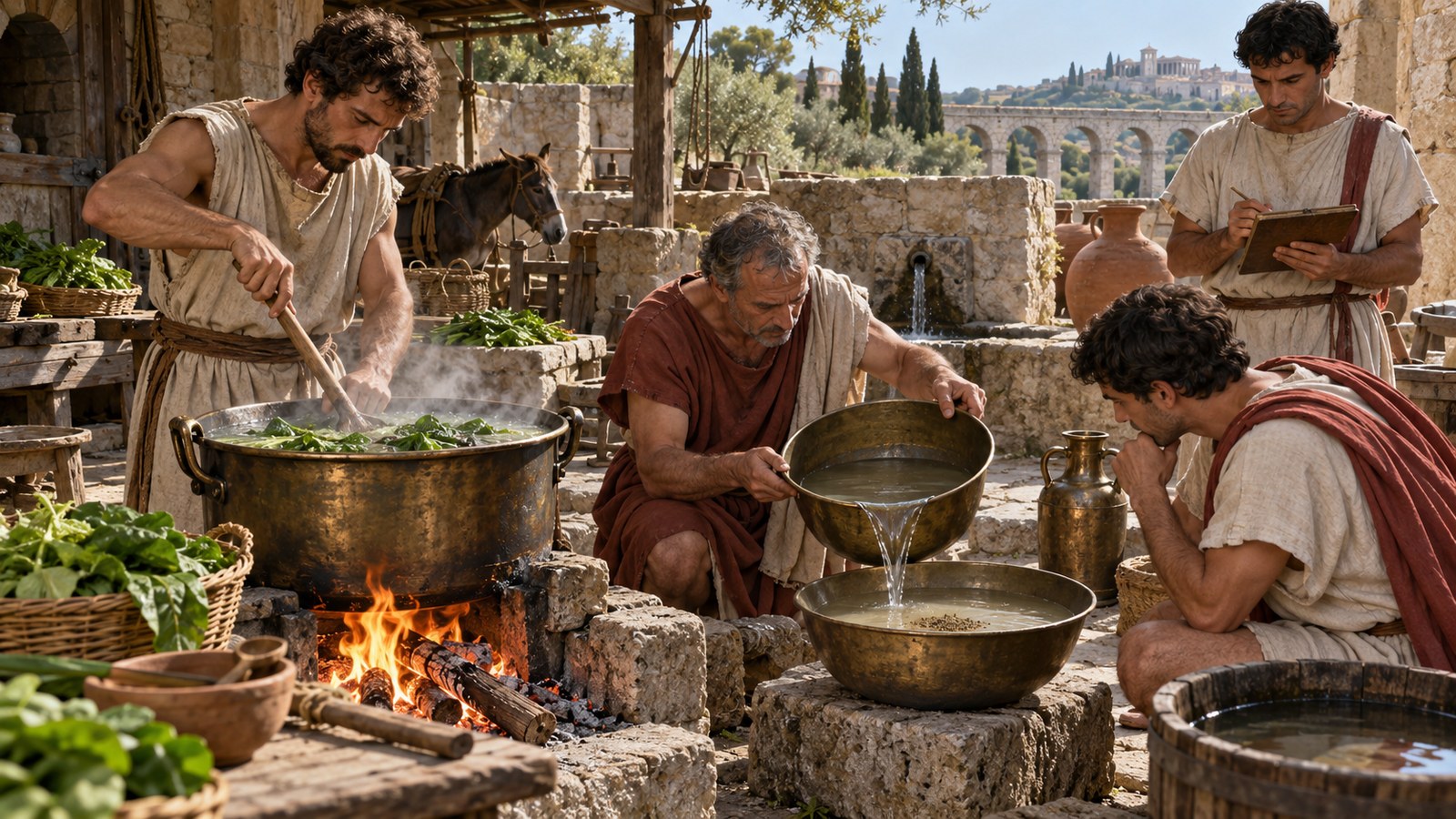
Another trial intensified the contact. Water was boiled in a bronze cauldron, allowed to stand, and poured away. Sand or mud left at the bottom counted against it; a clean vessel supported the claim of excellence. Heating and settling concentrated what the flowing spring might hide.
The sequence mattered. Sprinkling tested the trace left by a thin film. Boiling reduced a larger sample. Rest allowed suspended matter to fall. Pouring removed the water so the vessel bottom could be inspected. A household cauldron became a small apparatus because each ordinary action separated one thing from another.
Vitruvius never claims that bronze reveals every danger. The test answers a narrower material question: does visible matter adhere or settle after treatment? Its value came from repeatability. Different sources could be subjected to the same vessel and the same operations before a route was chosen.
A pot of greens tested the water under heat
The vegetable trial introduced food rather than an empty container. Green vegetables were placed in the water over a fire. If they cooked quickly, Vitruvius accepted the result as proof that the water was good and wholesome.
Speed gave the observer a practical comparison. Water that looked identical at the spring could behave differently in the pot. Fuel, vessel, vegetable, and cut size would all affect the result, so this was not a precise clocked assay. Even so, it tied judgment to a familiar task in which stubborn water announced itself through extra time and firewood.
Cooking also connected civic supply to daily consequence. An aqueduct was not only a monumental line entering a city. Its water met beans, greens, grain, pots, hands, and hearths. The test asked how a proposed public source behaved at that final domestic scale.
The method belongs to a larger Roman habit of making technical choices visible through performance. The bucket chain that lifted water beyond a wheel’s reach solved a mechanical problem by repeated motion. Here repetition served judgment: boil, wait, pour, cook, compare.
Vitruvius’s word “wholesome” gathers several observations under one conclusion. Modern readers should separate them again. Rapid cooking could reflect dissolved minerals without proving safety, while clear water can carry hazards that leave no visible deposit. The ancient test reveals a decision culture, not a substitute for microbiology.
The spring bed had to agree with the pot
After bodies and vessels, Vitruvius returns to the landscape. The water itself should be limpid and clear. Moss or reeds should not crowd the places where it spread and flowed. The bed should show no filth and should present a clean appearance.
These signs widened the sample from a dipped cup to the source system. Growth at the margins, obstruction in the flow, and pollution on the bed recorded conditions over an area. A clean cauldron could not cancel an outlet visibly fouled where water emerged.
That is why the tests work as a chain. Each has a blind spot. Bodies mix many causes. Bronze registers only what marks it. boiling reveals residue but not every harmful substance. Vegetables convert water behaviour into cooking time. The spring bed displays its surroundings but not all that travels invisibly through it. Agreement among them offered confidence greater than any isolated sign.
The next chapter shifts to levelling instruments. Vitruvius describes the dioptra, the water level, and especially the twenty-foot chorobates used to establish a fall. That order is revealing. Quality was considered before gradient. Only after a source passed judgment did the author explain how to carry it.
A route in masonry could outlast the people who approved it. Reservoirs and distribution tanks would spread the result beyond the spring’s neighbours. Testing therefore belonged at the reversible edge of the project, before labour and stone turned one local source into a shared urban dependency.
The procedure also divided responsibility. Residents supplied the evidence of long use, craftspeople handled familiar bronze and hearth equipment, and surveyors translated the accepted source into a route. Source choice was therefore not detached from the community that would drink the result. It moved from lived observation to a deliberately altered sample and only then to construction. Even when the inferences were imperfect, the sequence required reasons that another observer could challenge: a spot was present or absent, sediment remained or did not, greens softened quickly or consumed more time, and the outlet looked clean or visibly contradicted the favourable samples.
The vegetables are memorable because they look humble beside an aqueduct. Vitruvius makes that contrast the point. Monumental supply began with ordinary evidence: clear eyes, clean bronze, an empty cauldron bottom, greens that softened without wasting fuel, and a spring bed that did not contradict the rest.
Sources
Vitruvius, On Architecture, 8.3–5.