
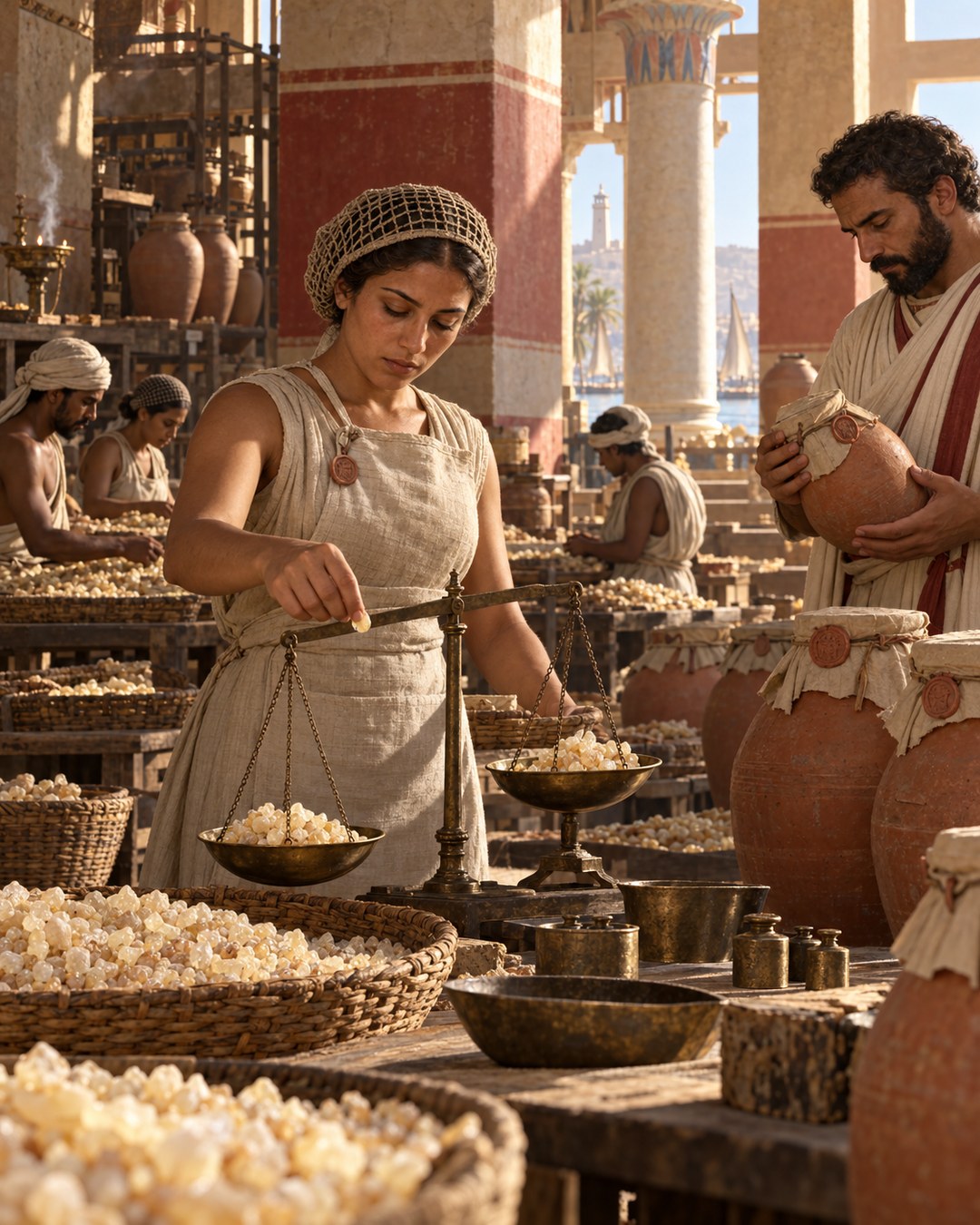
The frankincense trees did not need guards after they were cut. Pliny the Elder says the Arabian forest was divided into recognized portions, and owners trusted one another not to take resin from a neighbour’s trees. The same substance reached Alexandria and entered a very different world. There, workers’ aprons were sealed, their heads covered with masks or close nets, and their clothing removed before they could leave.
The contrast is sharper than a simple moral complaint about honesty. It marks a change in the commodity’s organization. In the groves, rights were local, hereditary, and visible. In a processing centre, resin from elsewhere was concentrated, handled repeatedly, graded, and prepared for sale by workers separated from ownership. Security moved from shared boundaries to control of bodies.
A narrow route began with restricted access to the trees
Pliny places the export route through the territory of the Minaeans and calls it a single narrow track. He credits them with originating and chiefly practising the trade. He also reports that perhaps no more than three thousand families retained a hereditary right to participate.
The cutters were described as sacred while making incisions in the trees. They avoided encounters with women and funeral processions during the work. Pliny treats those restrictions partly as a reason for higher prices, but they also show harvest rights expressed through ritual status. Access to resin was not presented as open labour available to anyone who found a tree.
Even Roman knowledge stopped at the edge of the grove. Pliny says Roman forces had operated in Arabia, yet no Latin author known to him had adequately described the incense tree. Greek accounts disagreed. Some compared its leaves with pear, mastich, terebinth, or bay. King Juba supplied another portrait: a twisted stem, branches resembling Pontic maple, and juice like that of an almond.
Arabian ambassadors and actual sprigs reaching Rome did not settle the matter for Pliny. He could describe processing more confidently than the living source. That imbalance is useful evidence. A commodity might circulate through Roman markets and rituals while the ecology and expertise behind it remained remote, mediated, and contested.
Uncertainty about the tree did not prevent certainty about commercial distinctions. Traders could debate leaves and branches while still recognizing colour, scent, bark fragments, and seasonal lots. Practical grading travelled more readily than full botanical knowledge because buyers needed comparable resin, not a living specimen in every market.
Trade demand cut a second harvest into the calendar
Pliny says frankincense had once been gathered only once a year. Expanded opportunities for sale introduced a second taking. Demand did not merely move more of the same stock. It changed the rhythm imposed on the trees and on the people who cut them.
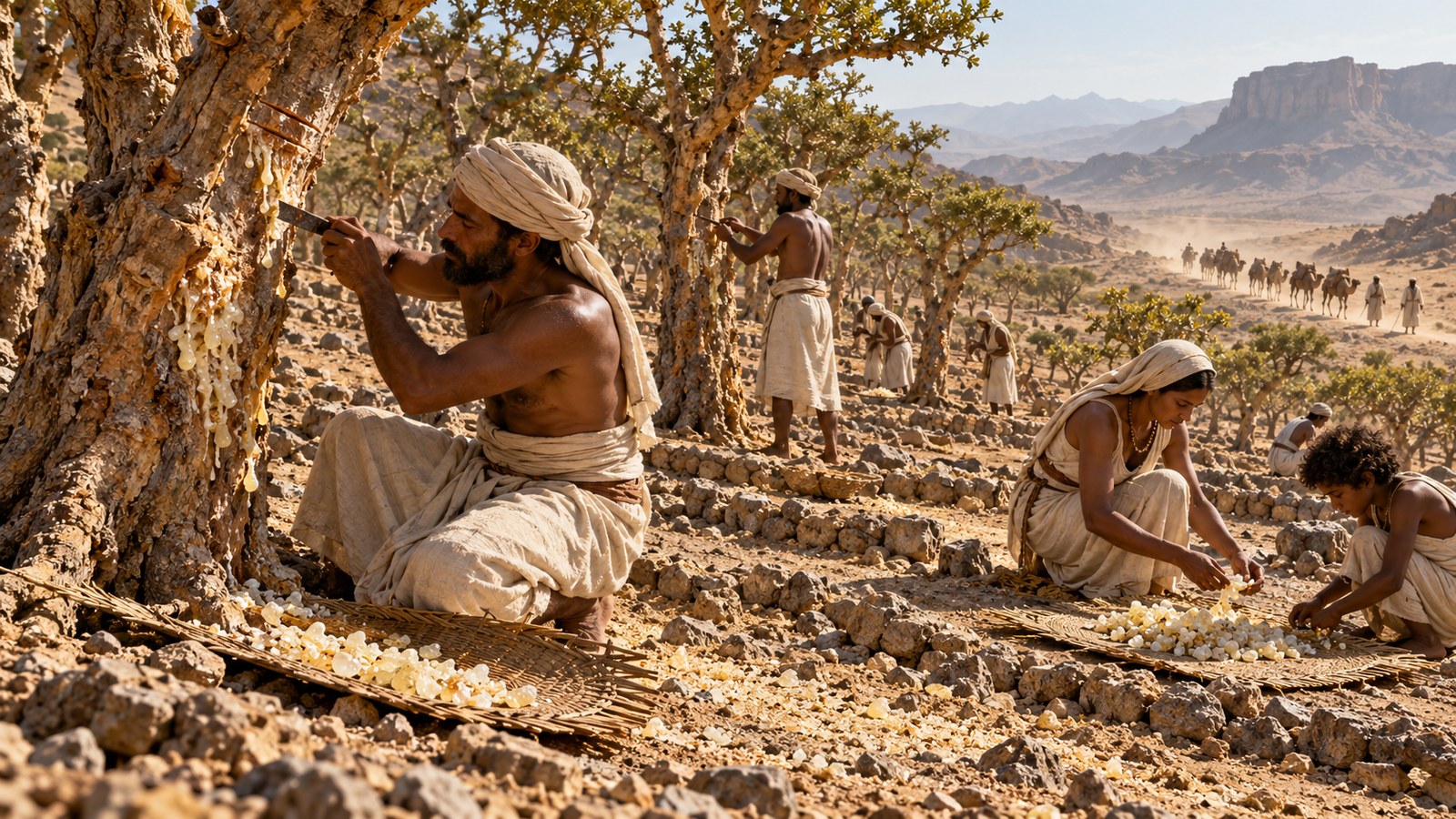
The earlier, “natural” cutting came around the rising of the Dog Star, during intense summer heat. Workers selected places where bark seemed swollen with juice and stretched thin. A blow loosened the bark without removing it. Greasy foam pushed from the incision, then coagulated and thickened.
Collection depended on the ground. Palm-leaf mats received the flow where needed. Elsewhere the earth around a tree was rammed hard enough to serve as a clean surface. Resin from the prepared ground was purer; mats produced greater weight. Scraping residue directly from bark with an iron tool added fragments and lowered cleanliness.
The operation therefore balanced yield and quality before the resin left Arabia. Surface preparation, the position of each cut, and the timing of collection affected what a later buyer saw. The trade’s distant price began in small decisions at the trunk.
Ungarded plots gave way to controlled factory bodies
After incision, according to Pliny, the forest remained unguarded. Defined portions and mutual trust protected the crop. This should not be romanticized into a landscape without ownership. The plots were divided, rights were restricted, and the trade belonged to a small inherited group. Trust worked because the community understood who controlled each tree.
Alexandria concentrated a different set of risks. Frankincense there was “worked up for sale,” implying repeated handling and transformation after long-distance movement. Small losses could be concealed in hair, clothing, folds, or tools. Owners answered not by relying on neighbourhood reputation but by making exit from the factory an inspection point.
A seal on an apron made tampering visible. A mask or close-meshed net over the head closed another hiding place. Requiring workers to remove their clothes before departure extended the search over the whole body. Pliny exclaims at the severity and contrasts it with the unguarded groves.
The measures reveal the resin’s physical character. Frankincense came in small, portable pieces valuable enough to tempt close accounting. It did not require a cart to disappear. Processing created many moments when fragments could move from a communal pile into a private fold.
This Alexandrian checkpoint differs from the chain examined in the tolls imposed on frankincense across Arabia. Route charges made distance expensive through repeated official deductions. Factory controls addressed loss inside one bounded workplace. Both mechanisms raised the cost of turning resin at a tree into incense at a Roman altar, but they acted at different stages and through different forms of power.
Colour and season followed the resin into sale
The summer cuts were gathered in autumn. Pliny ranks this crop highest and describes it as bright white. A second cycle began with winter incisions and a spring collection. That resin was reddish and inferior in his hierarchy.
Tree age complicated the visual scale. Saplings were believed to yield whiter resin, while older trees gave stronger scent. Whiteness, aroma, cleanliness, and weight did not point automatically to one best lot. Merchants and processors had to translate several properties into grades a buyer could understand.
Alexandrian labour belonged at that point of translation. The workshop did not grow the resin or pay the desert tolls, but it helped make lots stable enough to compare and sell. Security protected more than raw material. It protected distinctions between grades and the owner’s ability to claim that a measured quantity still matched its label.
The same pressure to guard concentrated value appears in other Roman industries. The account of murex dye workers turning shellfish into elite colour follows a different material, smell, and coast, yet both trades depended on controlled processing that made ordinary-looking fragments carry extraordinary price.
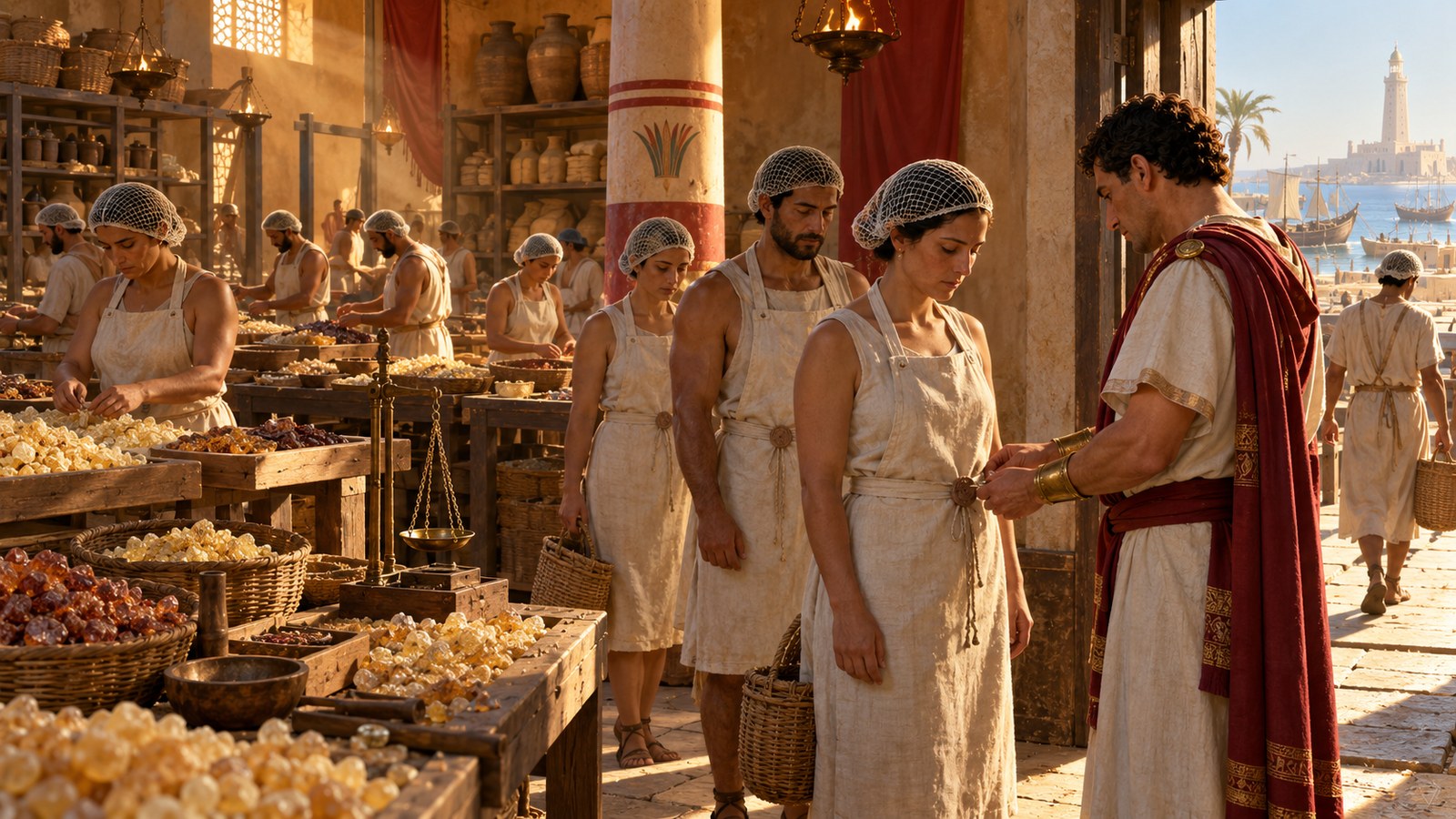
Pliny frames the forest and factory as an ethical paradox: growers could leave valuable trees unwatched, while processors required relentless vigilance. Read materially, the contrast also maps two kinds of custody. The grove joined named families to fixed plots. The factory joined hired hands to portable pieces owned by someone else.
The resin changed state along the way. Foam thickened into tears; clean ground or mats shaped the first grade; scraping added bark; seasonal colour marked separate harvests; Alexandrian processing assembled saleable stock. At each stage, a different institution guarded value. Ritual protected access, boundaries protected trees, tolls protected routes and revenue, and seals protected the workshop owner.
Frankincense could disappear as smoke in a Roman sacrifice, but its journey was anything but weightless. The sealed apron preserves one instant when a fragrant luxury became a problem of labour discipline. The aroma carried Arabia into temples. The security system reveals who bore the scrutiny required to make that journey profitable.
Sources
Pliny the Elder, Natural History, 12.54–60.