
A papyrus sheet could fail at the first stroke of a pen. A strip hidden inside a join might drink the ink and turn a clean line into a spreading stain. A surface made too glossy could look expensive yet refuse the ink meant to preserve a contract or letter. Even the paste had a narrow window: Pliny the Elder says it should be exactly one day old, neither fresher nor older.
Those details pull Roman paper out of the abstract world of “writing materials” and put it back on a workbench. The finished sheet depended on splitting, ranking, crossing, joining, beating, pressing, polishing, smelling, and testing. Papyrus supplied the fibres, but workshop control made them dependable. The craft was a negotiation between qualities that did not naturally agree: smoothness and grip, thinness and strength, brightness and opacity.
The writing surface began in shallow Nile water
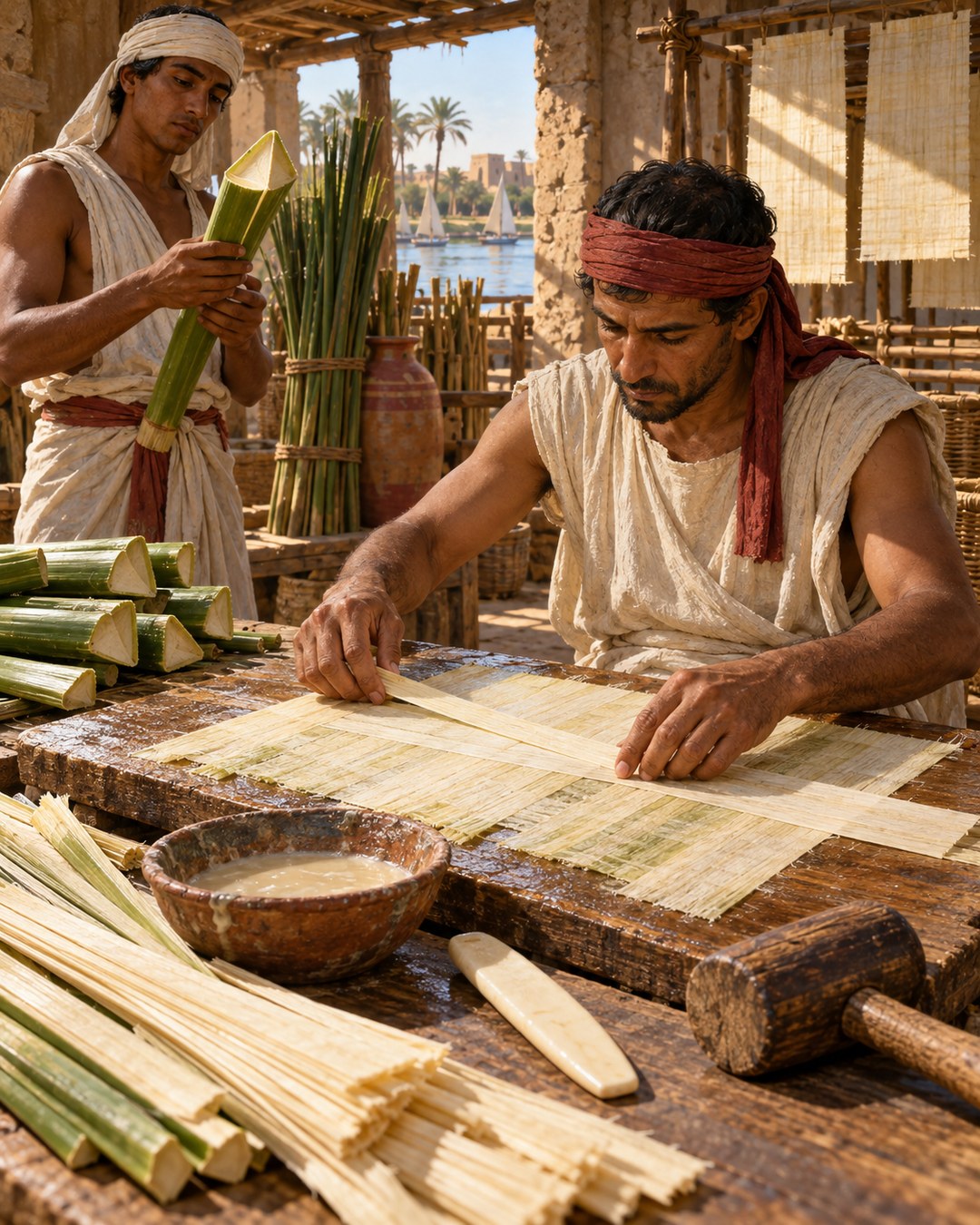
Pliny places papyrus in Egyptian swamps and in pools left by the Nile, where stagnant water stood no more than about three feet deep. The plant rose from a sloping root as thick as a man’s arm. Its triangular stem could reach roughly fifteen feet before ending in a tufted head. Paper therefore began with a large wetland plant, not a ready-made sheet.
Only part of that plant entered the writing trade. The roots served as fuel and as material for utensils and vessels. The stem could be plaited into boats; its inner bark became sailcloth, matting, cloth, blankets, and ropes. Pliny even records it being chewed for its juice. Paper belonged to a broader economy of cutting and weaving a plant whose components answered many household and transport needs.
For writing material, the stalk was split with a needle into strips made as broad as possible. The central material ranked highest, while strips nearer the outside descended through lower grades. That internal geography mattered before a worker laid down a single join. Quality was already being sorted inside the stem.
The process complicates the familiar picture of papyrus as strips simply placed side by side. Makers had to select pieces with compatible width and texture, arrange them, and create a sheet that would survive handling. The surviving surface concealed the plant’s triangular form and the worker’s decisions about where each strip belonged.
Grades turned plant anatomy into a commercial hierarchy
Pliny lists a market crowded with grades and names. The finest central strips once supplied paper reserved for religious books. Later grades acquired names connected with Augustus and Livia. “Amphitheatre” paper took its name from its place of manufacture, while Saitic and Taeneotic papers were associated with places and progressively poorer material.
A Roman workshop linked with Fannius could take ordinary amphitheatre paper and improve its texture by a process Pliny describes as careful insertion. The result moved upward in status and took the workshop’s name. Manufacture did not end when the first maker assembled a sheet in Egypt. Refining, reworking, and branding could add value farther along the route.
At the bottom stood emporitic paper. It was considered unsuitable for writing but useful as document covers and as wrappers for merchandise. That use is revealing. A failed or coarse writing surface was not necessarily waste. Its strength and flexibility could still protect other records or goods. The hierarchy sorted functions as much as prestige.
Buyers and users judged sheets by several linked measures: width, fineness, stoutness, whiteness, and smoothness. Wider did not automatically mean better. Pliny notes an eighteen-inch format whose strips could tear across several pages when one part was damaged. Scale created its own weakness.
Claudius changed the recipe when thin paper failed
Pliny describes an intervention attributed to the emperor Claudius. The prestigious paper of Augustus’s period was thin, but thinness brought practical defects. Friction from the pen could damage it. Writing showed through from the reverse and threatened to smudge. Transparency itself looked unattractive.
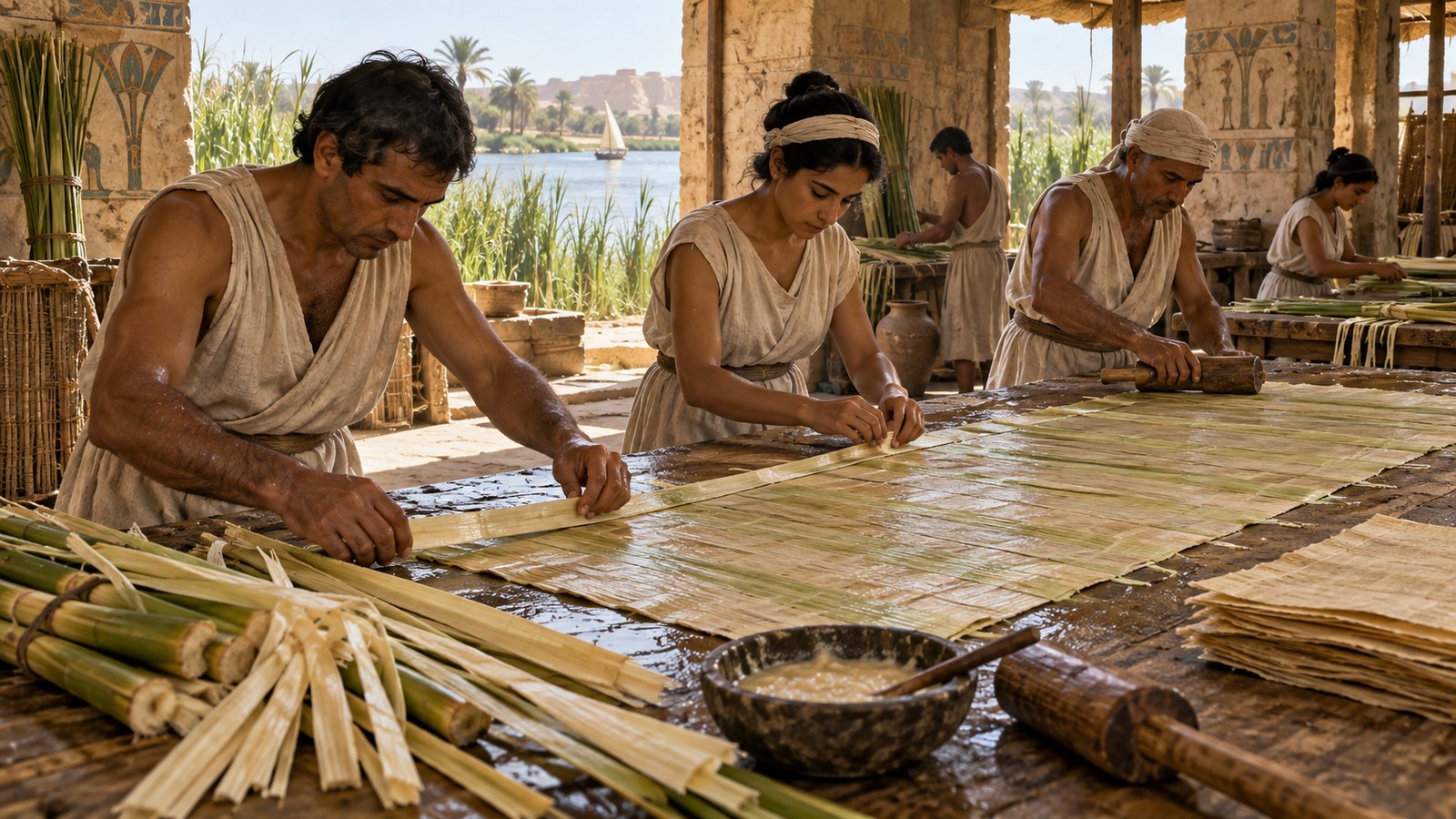
The answer was layered construction. A foundation of second-quality leaves supported a cross layer of first-quality material. Claudius also increased the standard width to a foot. The resulting paper displaced earlier grades for many uses, although Augustan paper remained favoured for correspondence.
The episode is less important as a story about imperial taste than as evidence of diagnosis. Workers and users observed how the surface behaved under pressure, ink, and two-sided writing. They changed the arrangement of the fibres rather than merely making the same sheet thicker. Grain direction and layer quality became tools for correcting failure.
This practical attention belongs beside the habits captured in Pliny’s account of filling writing tablets during a hunt. A Roman author’s speed and portability depended on an entire material system. Wax tablets could receive notes in the field; papyrus sheets could carry the worked text into circulation and storage.
Paste, mallets, shells, and noses exposed bad work
The join depended on paste. Pliny’s common recipe mixed very fine flour with boiling water and a small sprinkle of vinegar. Carpenter’s paste and gum were rejected because they made the compound too brittle. A more careful recipe strained the crumb of leavened bread through boiling water, used less adhesive at the seams, and produced a surface Pliny compares to soft linen.
Age mattered with unusual precision. The paste should be exactly one day old. This was not a decorative preference: too little or too much aging altered the behaviour of the bond. After joining, the paper was beaten thin with a mallet, coated again, pressed to remove creases, and flattened once more. Repeated pressure turned an uneven web into a surface fit for a pen.
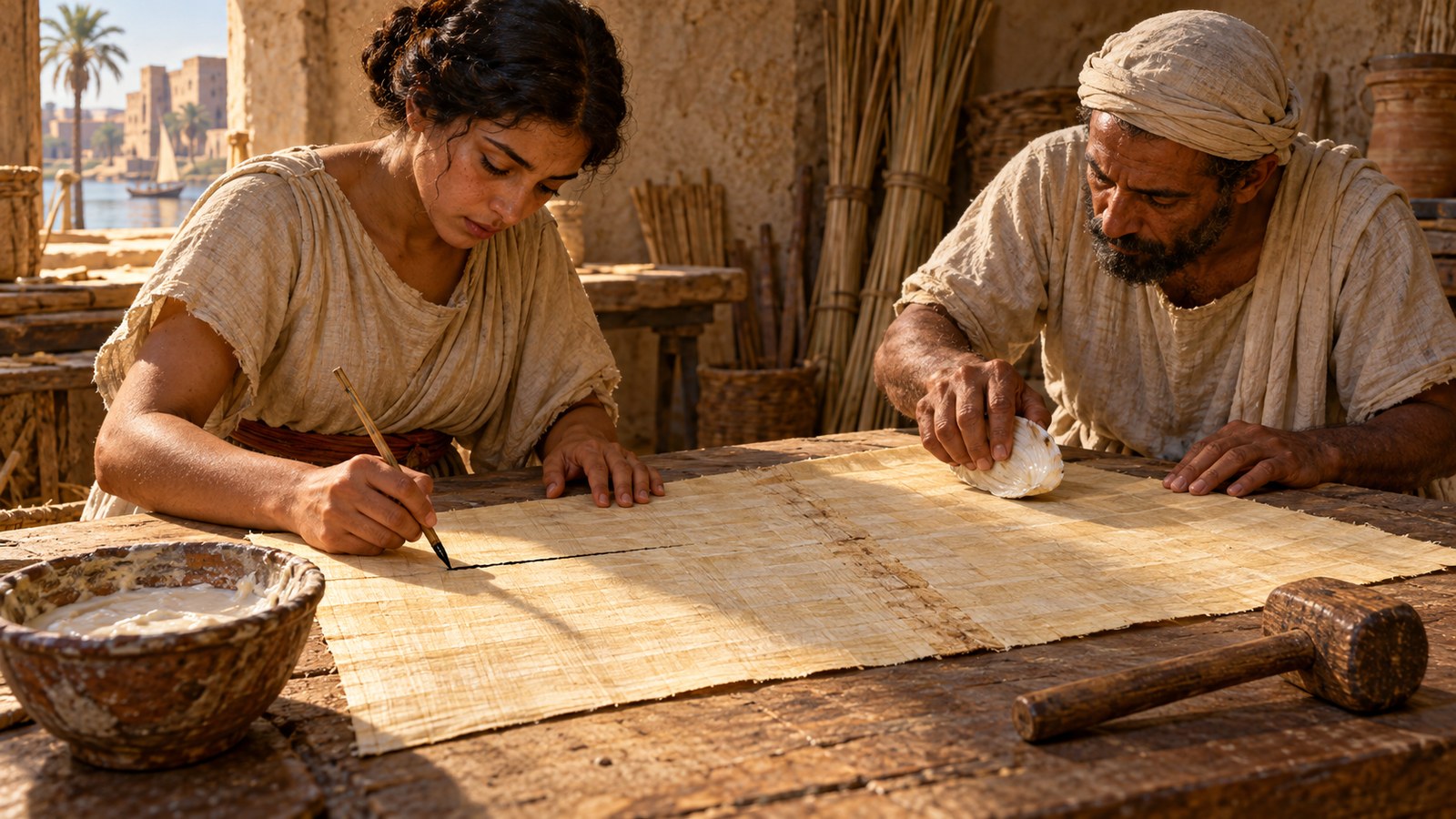
Finishing introduced another trade-off. Ivory or shell could smooth roughness and create shine, but excessive polish made lettering liable to fade because the surface took ink less readily. A maker could improve one visible quality while damaging the sheet’s central function.
Defects recruited several senses. Spottiness appeared to the eye. Poor damping could be detected by a mallet’s blow or by a musty smell. The most treacherous flaw was a porous strip buried inside pasted joins. It absorbed ink and remained invisible until a line ran across it. Pliny calls the added inspection another task in “paper-weaving,” a phrase that catches the craft’s layered logic.
The book trade in Martial’s five-denarius shop copy began long after these workshop choices. Price, shelf position, and authorial reputation could only matter once sheets behaved consistently enough to be copied, rolled, transported, and read.
The named grades also gave buyers a vocabulary for defects. Width could be measured before purchase, but hidden porosity appeared only under ink. Whiteness and shine were immediately visible, while strength emerged through repeated handling. A workshop therefore sold both a surface and confidence that less visible joins had been assembled with care.
Pliny connects careful manufacture with longevity. In the house of Pomponius Secundus, he says, he had seen documents written by Tiberius and Gaius Gracchus nearly two hundred years earlier. He also knew autographs attributed to Cicero, Augustus, and Virgil. Those claims do not prove that every papyrus survived for centuries. They show what a well-made and well-kept sheet could represent to a Roman observer: a physical bridge to an absent hand.
The bridge rested on ordinary controls. A strip came from the right part of the stalk. Layers crossed in the right order. Paste reached the right age. Mallets compressed the joins. Polish stopped before shine became useless. Inspectors looked, struck, smelled, and finally wrote. Roman records endured not because papyrus was magically permanent, but because craft converted a wetland plant into a deliberately tested surface.
Sources
Pliny the Elder, Natural History, 13.21–27.