
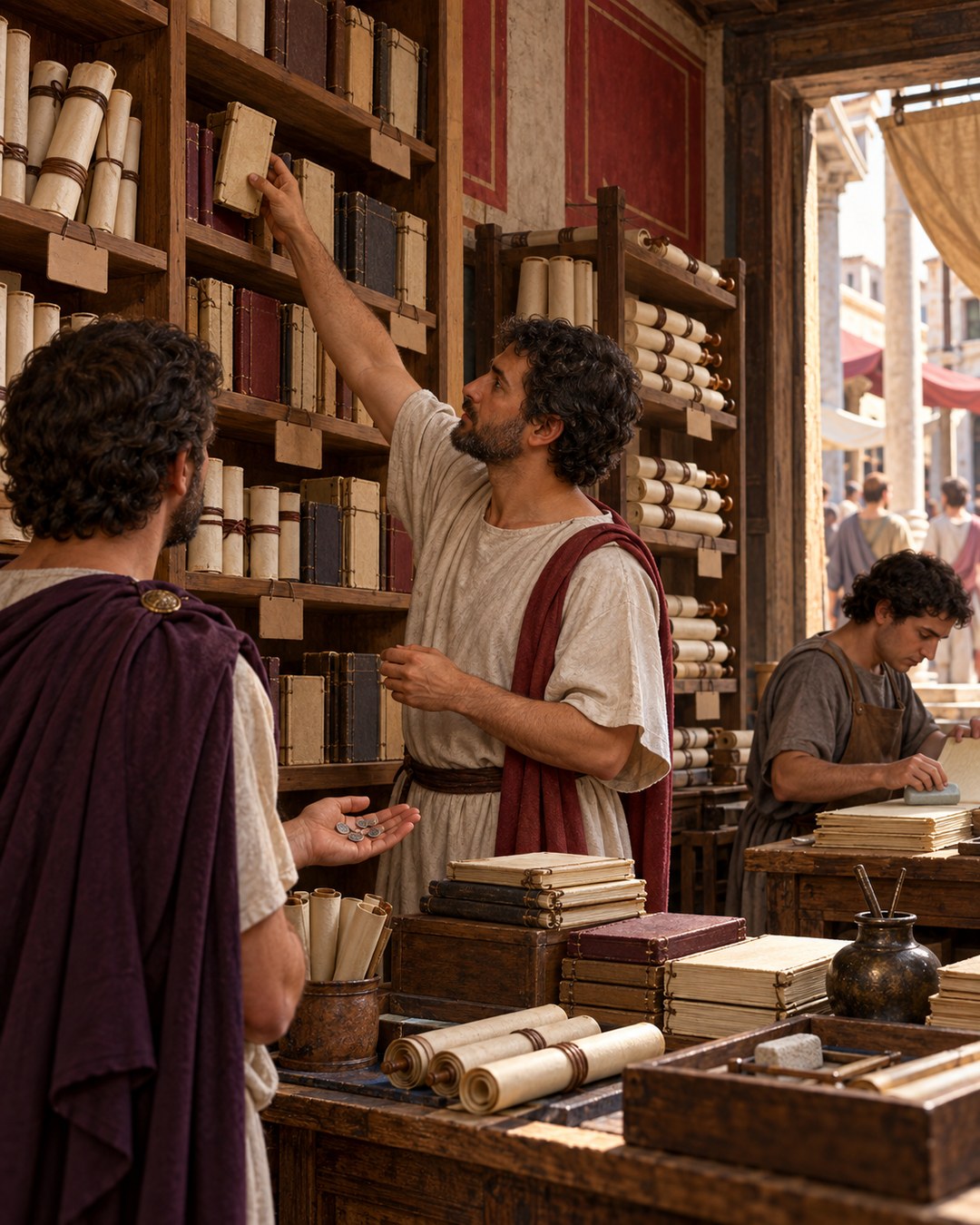
Lupercus wanted Martial’s book without buying it.
His plan was ordinary enough: send a servant to the poet’s home, borrow the copy, read it, and return it.
Martial answered with directions to a shop.
The joke ends with five denarii, but the route to that price runs through streets, shelves, craft work, and a market in which owning paper was not the same as owning a poem.
A Borrowed Copy Began with an Expensive Errand
In Epigram 1.117, Lupercus repeatedly offers to send a servant for Martial’s little book. Martial makes the proposed favour sound inefficient before he makes it sound cheap.
The journey to his home is long. His rooms stand up three pairs of high stairs. A household subordinate would have to cross the city, climb, wait for the author’s own copy, carry it back, and later repeat the route to return it.
No wage or travel time is calculated in the poem. The burden appears through physical detail: distance, a servant, and those stairs.
Martial then changes the problem. Lupercus does not need access to the poet. He needs access to stock.
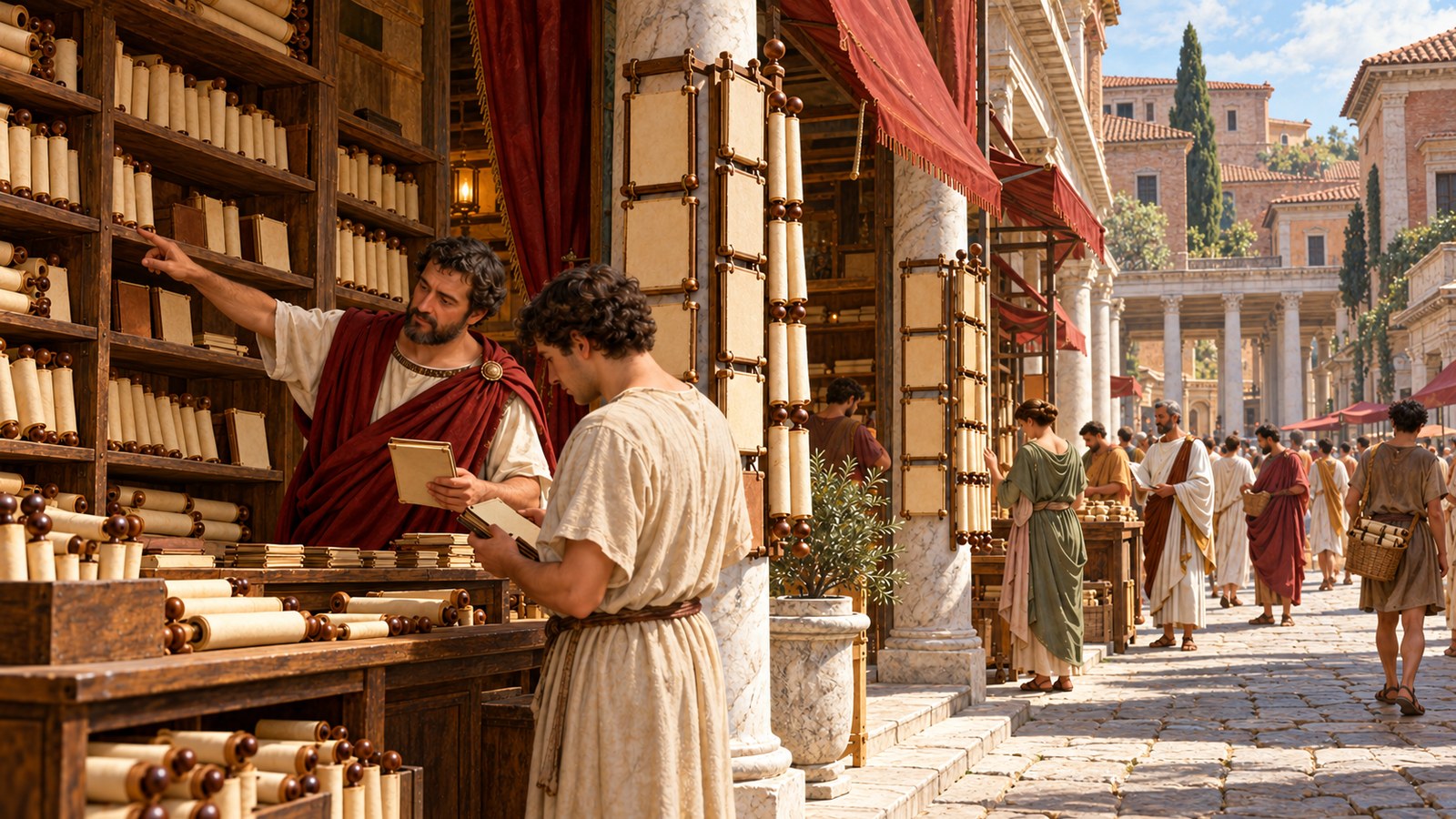
The alternative lies in the Argiletum, a commercial district Lupercus visits often. Opposite Caesar’s forum, a bookshop turns a social request into a retail transaction.
This is not an abstract claim that Romans bought literature. Martial gives the route in the language of someone redirecting a familiar walker. The customer already knows the district. The shop occupies a recognizable position against monumental Rome. Convenience begins with geography.
Another article follows a different kind of urban book hunt. Gellius found cheap old volumes during two nights at Brundisium. Lupercus receives another map: not a lucky stall, but named inventory in a named shop.
Blank Pillars Worked Like a Catalogue
Martial says the shop had pillars covered with the titles of books. A passer-by could run over the names of poets quickly.
The display reduced another cost: search.
A customer did not have to ask whether the shop dealt in verse, open every roll, or remember a chain of recommendations. The names were placed where the street could read them. Monumental architecture framed the shop, while the shop’s own columns carried its searchable surface.
Atrectus is identified as the owner. Once asked, he can produce a Martial from the first or second shelf.
That shelf position matters because it makes the copy sound like ordinary accessible stock rather than a treasure hidden in a storeroom. The poem compresses browsing, asking, retrieval, inspection, and payment into a few lines because the commercial mechanism was recognizable.
Martial had already imagined his book preferring the shops of the Argiletum to the safety of his own bookcase. He warns it that Rome is critical: young men, old men, and boys all sneer. Public availability exposes a text to ridicule as well as purchase.
A shop therefore did more than move an object. It put the poem into circulation among readers who might praise it, reject it, quote it, recite it badly, or claim it.
That exposure helps explain why Martial speaks to his books as if they were reckless dependants. Once outside the portfolio, they enter systems the author can influence with directions and jokes but cannot fully control.
Pumice and Purple Turned Verses into Merchandise
The copy Atrectus hands down is not described only by its words.
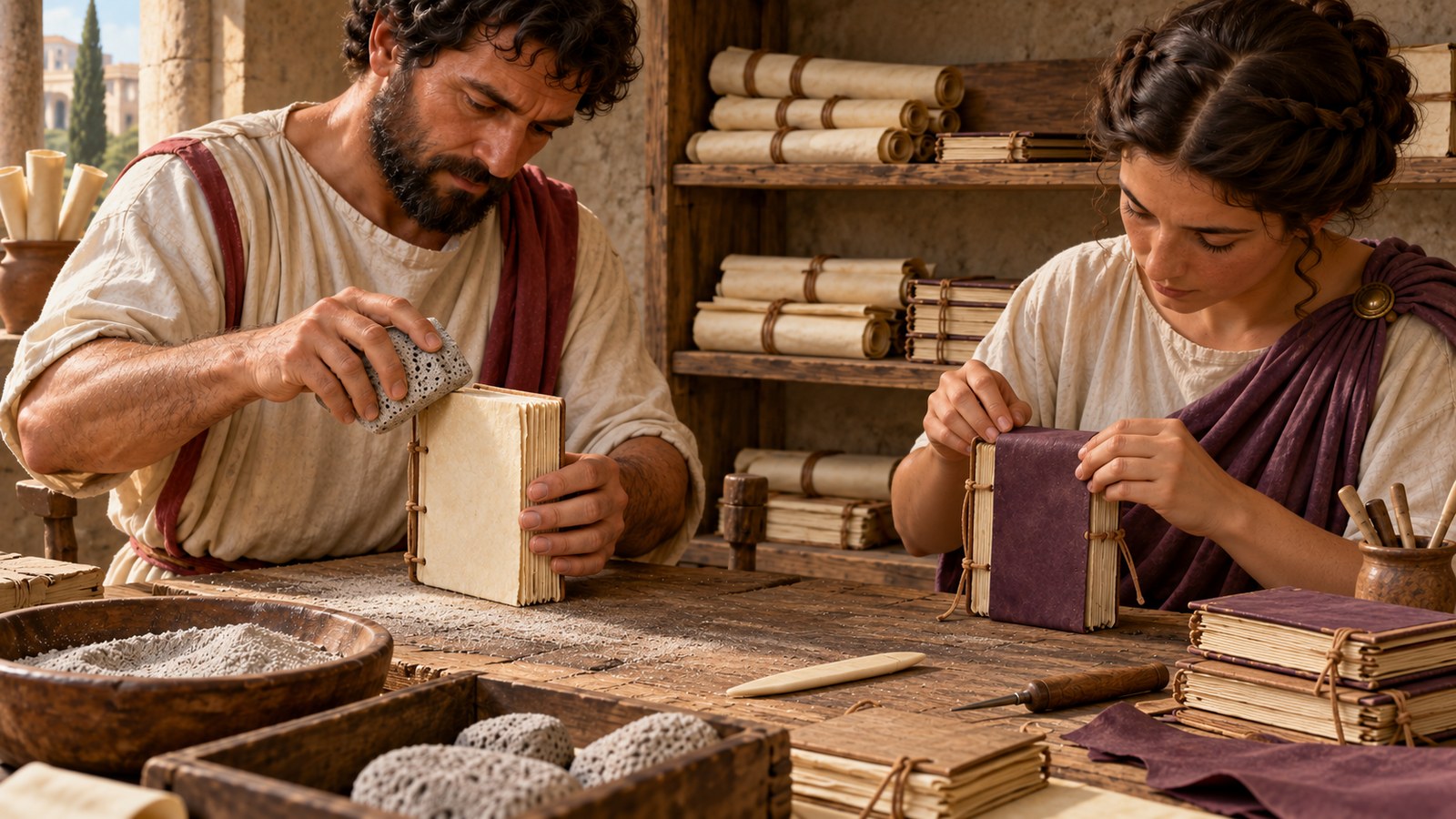
It has been smoothed with pumice and decorated with purple. Before five denarii can be named, material labour has already happened.
Pumice belongs to finishing. Its abrasive surface could regularize an edge and remove roughness. Purple supplies a visible distinction, whether as covering, label, or decorative treatment in the translated phrase. Martial’s point does not require us to reconstruct every workshop motion. It requires us to notice that he sells the copy through touch and appearance.
The customer is offered a finished object.
That distinction is clearer beside Epigram 1.2. There Martial advertises a compact edition with parchment leaves for readers who want his work on a journey. Large volumes need book-cases; the small version fits in one hand.
Format answers use. A travelling reader gets compactness. Lupercus gets a polished and coloured shop copy. The poems are the same author’s work, but their material forms answer different situations.
Martial even names another seller for the portable version: Secundus, a freedman of the learned Lucensis, located behind the Temple of Peace and the Forum of Pallas.
Two epigrams thus preserve two commercial coordinates and two product descriptions. Secundus offers parchment leaves compressed into a small compass. Atrectus supplies a pumice-smoothed, purple-adorned Martial close to a customer’s normal route.
Writing surfaces could vary sharply in cost and durability. Leather, wax, and erasable coatings made ancient writing materially unstable in different ways. Martial’s sales pitch reminds us that form was chosen, made, finished, and marketed rather than passively wrapped around a text.
Five Denarii Replaced a Claim on the Author
Then comes the price: five denarii.
Lupercus objects that Martial is not worth so much. Martial agrees.
The self-insult gives the epigram its snap, but it also makes the transaction measurable. A friendship-based request had hidden its costs in another person’s time, a servant’s walk, and the temporary removal of the author’s copy. Atrectus converts those burdens into a sum paid once at a counter.
The five denarii are not presented as a universal price for books. Martial specifies one finished copy in one shop. Book 13 makes that variability explicit when it advertises a thin collection of gift labels for four small coins, suggests that a buyer might obtain it for two, and jokes that the bookseller Trypho would still profit.
Retail price could be part of the poem’s performance. It could be exaggerated, bargained over, mocked, or used to flatter a cheap object. That makes Martial valuable and dangerous as evidence. His jokes reveal commercial actions, but their figures are designed to land as verse.
Five denarii still anchors the scene. The number tells us that the polished object was neither beyond valuation nor handed over as an undefined favour.
The transaction also keeps author and seller separate. Atrectus owns the shop and delivers the physical copy. Martial supplies the name, words, publicity, directions, and joke. The poem never gives a royalty statement or explains how copies reached the shelf.
What it gives instead is the customer’s path through the last part of the chain.
A Purchased Book Did Not Settle Ownership of the Words
Elsewhere in Book 1, Martial attacks Fidentinus for reciting his compositions publicly as if they were his own.
His solution is another sales joke. Fidentinus may receive the verses free if he calls them Martial’s. If he wants to call them his own, he must buy them so that they cease to belong to Martial.
No workable copyright contract is being drafted. The absurd sale exposes the difference between possessing a copy, performing a text, and claiming authorship.
Martial returns to the distinction when he asks Quinctianus to defend poems against a plagiarist. The works, he says, had been given to the public—imagined as freed from the author’s portfolio. Public release increases access without erasing the poet’s demand for recognition.
Atrectus can sell a Martial. Lupercus can own the finished book. A reciter can speak its lines. None of those acts automatically turns the buyer or speaker into Martial.
That layered ownership is the article’s real mechanism. Material production makes copies separable from the author. Retail display makes them easy to find. Payment transfers an object. Public circulation makes performance possible. Reputation still depends on attaching the words to the right name.
The first or second shelf is therefore not a minor flourish. It is the place where literature becomes reproducible merchandise while authorship remains contested.
Martial mocks his own price, yet his directions are remarkably practical. Walk to the Argiletum. Read the displayed names. Ask Atrectus. Watch him reach to a low shelf. Inspect the smooth, purple-finished copy. Pay five denarii.
The book has travelled farther than Lupercus’s servant ever needed to.
Sources
Martial, Epigrams, Book 1, especially 1.2, 1.3, 1.29, 1.52, and 1.117; Book 13.3.