
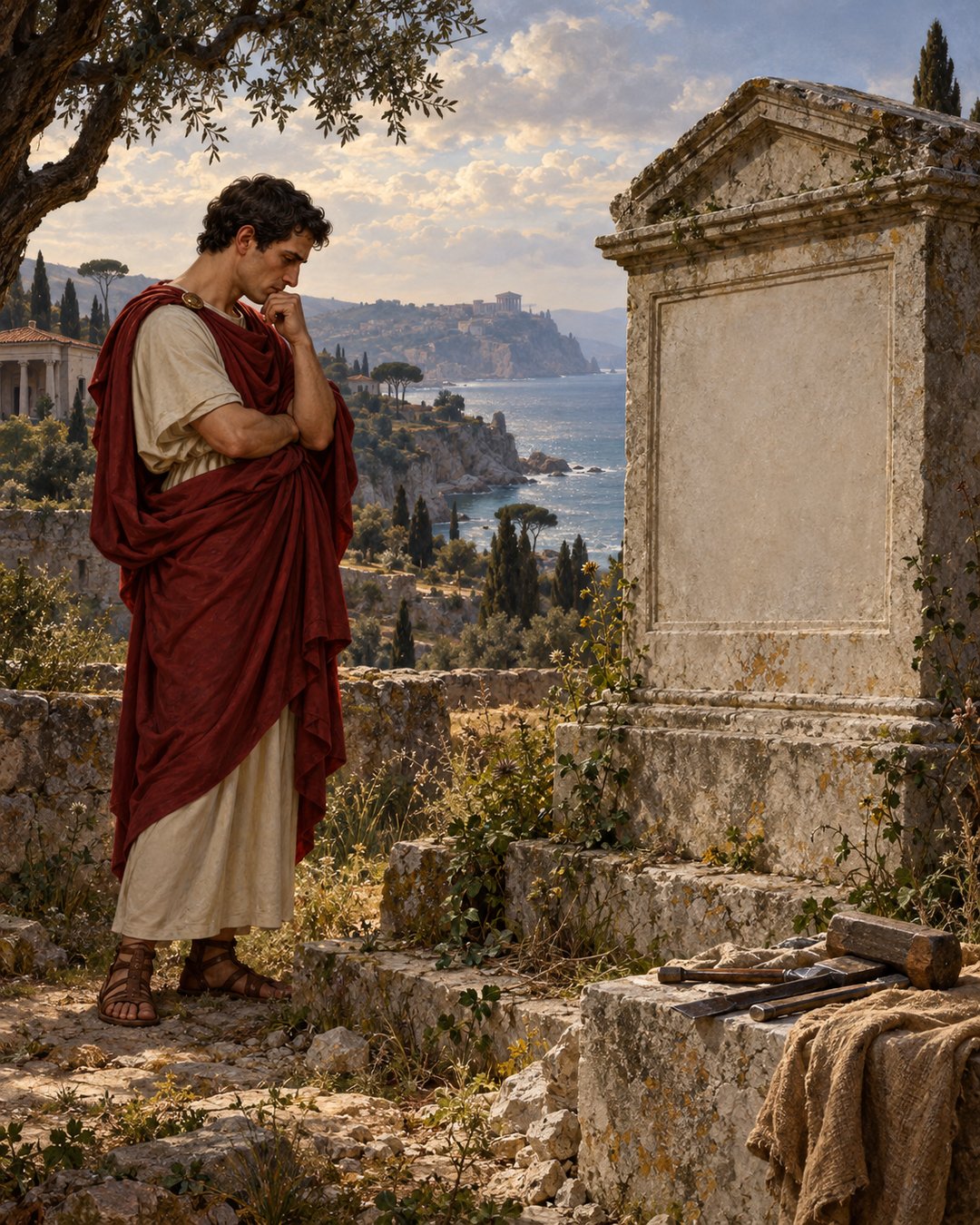
Rome had filled the Forum for Verginius Rufus.
Tacitus delivered the panegyric, the state supplied the funeral, and Pliny believed a great life had passed safely into memory.
Ten years later, a blank piece of stone proved otherwise.
The Funeral Looked Like Memory Made Permanent
Pliny’s first account of Verginius’s death is built at public scale.
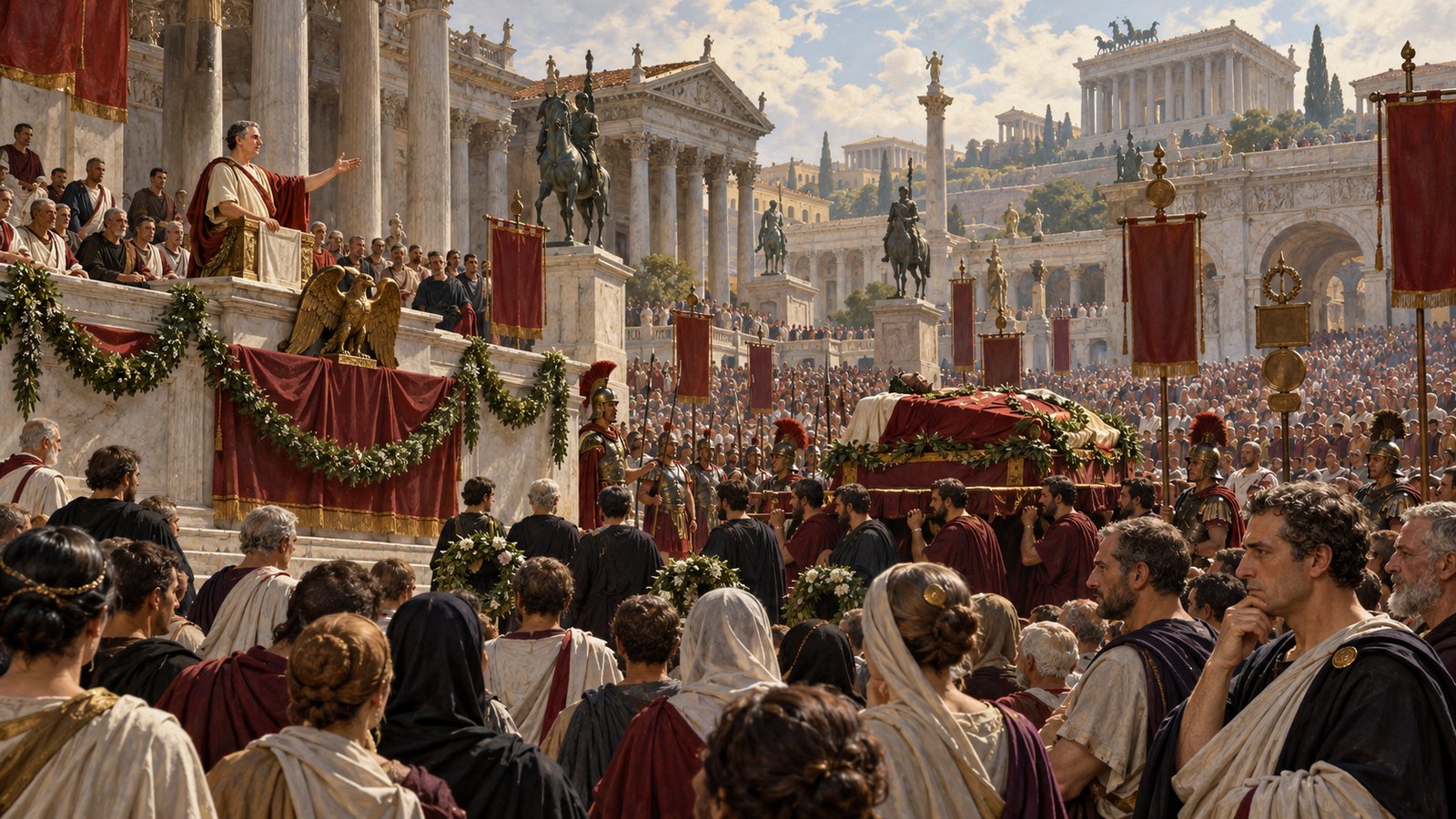
He calls the funeral one of the most striking and memorable spectacles the Roman people had seen for years. The Forum and rostra became the setting in which a private citizen received honours fit for an age defining itself after tyranny.
Verginius had lived in glory for three decades. Poems and histories were written about him while he could still read them, giving him the rare experience of hearing his later reputation rehearsed in his lifetime.
He held three consulships. Pliny measures that achievement against a more dangerous distinction: Verginius had declined to seize sovereign power.
His place in Roman memory rested on what he refused as much as on what he accepted.
After suppressing the revolt of Vindex in 68, Verginius commanded soldiers who might have pushed him toward the throne. The epitaph he later chose made the political claim precise. He had defeated Vindex and bestowed power not on himself but on his country.
Pliny says suspicious emperors hated his virtues, yet Verginius survived them. Under Nerva, whom Pliny praises as the best emperor and Verginius’s friend, the old man returned to the consulship.
He was eighty-three when the final accident came. While preparing a speech of thanks, he lifted a heavy book. It slipped from his hands; when he bent to recover it, his foot slid on a smooth floor and he fell.
The archive has followed that physical chain closely. A ceremonial speech, a heavy book, and a polished floor turned public honour into a fatal injury. Pliny’s later letter asks what happened after the funeral seemed to close the story.
At first, closure looked complete. Cornelius Tacitus spoke the panegyric. Pliny called him the most eloquent man in Rome. A celebrated life had found a celebrated voice.
Pliny Mourned a Guardian, Not Only a Statesman
The scale of the ceremony can obscure why Verginius mattered personally to the writer.
Pliny and Verginius came from the same region. Their municipalities were neighbours, and their estates lay near one another.
Verginius had also been left as Pliny’s guardian. Pliny says the older man treated him with a parent’s affection.
That relationship continued into public life. When Pliny stood for office, Verginius supported him. Though he had withdrawn from routine social obligations, he left retirement to escort Pliny on formal entries into office.
He also put Pliny’s name forward when priests nominated men they considered worthy of priesthood.
Even during his last illness, Verginius chose the younger man as his substitute on a senatorial commission intended to reduce public expenditure. Pliny remembers the sentence that made the trust explicit: even if Verginius had possessed a son, he would have given the commission to Pliny.
The grief in Letter 2.1 therefore moves between civic example and family feeling.
Verginius represented an earlier age, a man who could be offered power and remain a citizen. He was also the absent voice Pliny still imagined hearing and the guardian whose embrace returned in dreams.
Pliny insists that such a man had not simply stopped living. He would continue in the conversation and memory of others.
That confidence did not depend on a tomb alone. Verginius had actions, offices, books written about him, a public funeral, Tacitus’s speech, and younger men who claimed him as a model.
If any Roman could survive a negligent monument, it should have been him.
The later visit to Alsium is powerful because it shows that Pliny no longer considered fame enough.
At Alsium, Absence Became Material
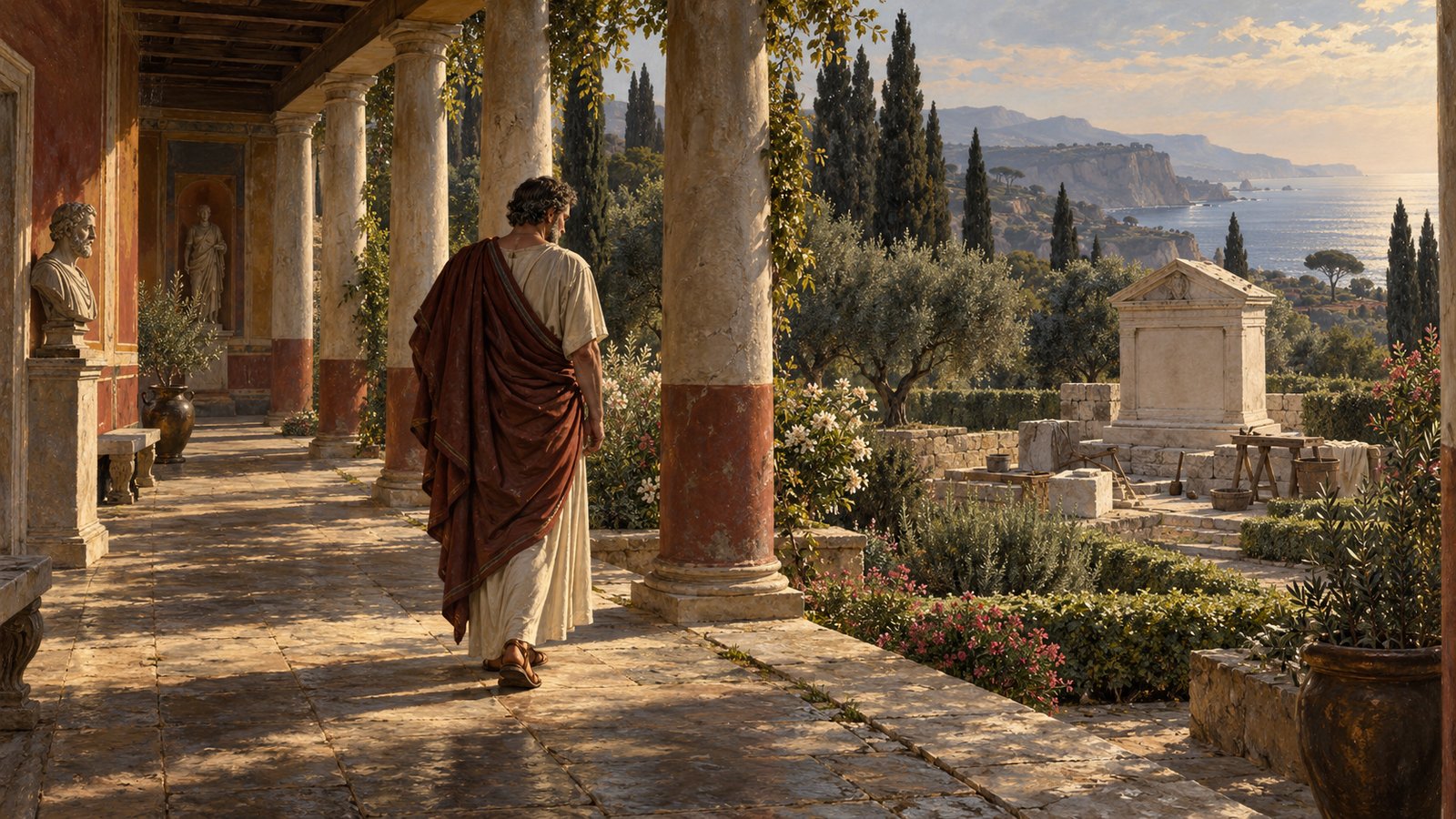
Pliny visited a country estate belonging to his mother-in-law. It had previously belonged to Verginius.
The older man had retired there and called it the nest of his old age.
Rooms and paths revived expectation. Wherever Pliny turned, his mind searched for Verginius and his eyes seemed to look for a body they knew would not appear.
The emotional scene narrows from the Roman Forum to one quiet property.
At the funeral, the dead man was everywhere: on the bier, in Tacitus’s speech, in the crowd’s attention, and in the political meaning Pliny attached to the day.
At Alsium, memory worked through missing routine. The owner was absent from the place he had chosen for old age.
Pliny then saw the monument.
He says the sight gave him pleasure and pain at once. The tomb kept Verginius present enough to be approached, but it also exposed neglect.
The work remained unfinished. Pliny rules out technical difficulty. The design was modest—almost meagre, in his wording.
This was not an imperial mausoleum stalled by an impossible span, rare stone, or vast workforce. A limited task had simply not been completed.
The contrast made delay more offensive. Ten years had passed since the funeral.
The public event had required magistrates, procession, rostra, crowd, and Rome’s leading orator. The private duty needed one entrusted person to finish a small monument.
The larger machine worked. The smaller obligation failed.
One Missing Inscription Changed Pliny’s Advice
Verginius had not left his commemoration undefined.
He supplied the lines he wanted carved: here lay Rufus, who had overthrown Vindex and given imperial power to his country rather than taking it himself.
The epitaph compressed a complicated year into a claim about restraint. It did not present him as a conqueror seeking a crown. It made refusal the final achievement.
Yet after ten years his ashes remained without the inscription and even without the name intended for the stone.
Pliny’s indignation rests on that gap between message and execution. Verginius had written the memory. Someone else had failed to cut it.
The failure also altered Pliny’s general advice. Loyalty among friends was rare, he wrote, and the dead were quickly forgotten. People should therefore raise their own monuments and complete before death the duties normally assigned to heirs.
That is a grim conclusion from a man who had just demonstrated how much living memory surrounded Verginius.
Pliny himself was evidence against total oblivion. He wrote two letters, preserved personal details, repeated the epitaph, and connected private affection with political character.
But literary survival did not excuse physical neglect. The blank monument remained a broken promise visible to every visitor.
The archive has seen Pliny organize work against darkness and limited time. He could dictate, revise, and read through carefully ordered hours. At Alsium, the missing inscription represented the opposite: a task with clear words, modest scale, and a decade available, still left undone.
Verginius’s fame made the neglect more conspicuous, not less. An unknown dead person could disappear behind an unmarked stone. Here the visitor knew exactly whose name should have been present.
The public funeral had promised permanence through collective attention. The tomb revealed that permanence also depends on custody: who owns the next step, who checks it, and who finishes after the ceremony ends.
Tacitus’s speech could carry through literature. Pliny’s grief could renew itself in letters. Stone required a worker and an accountable patron.
Ten years after Rome honoured Verginius, the smallest part of his memorial system was still open.
That unfinished edge is why Pliny’s second account matters. Glory did not vanish, but it could not carve its own name.
Sources
Pliny the Younger, Letters, 2.1 and 6.10.