
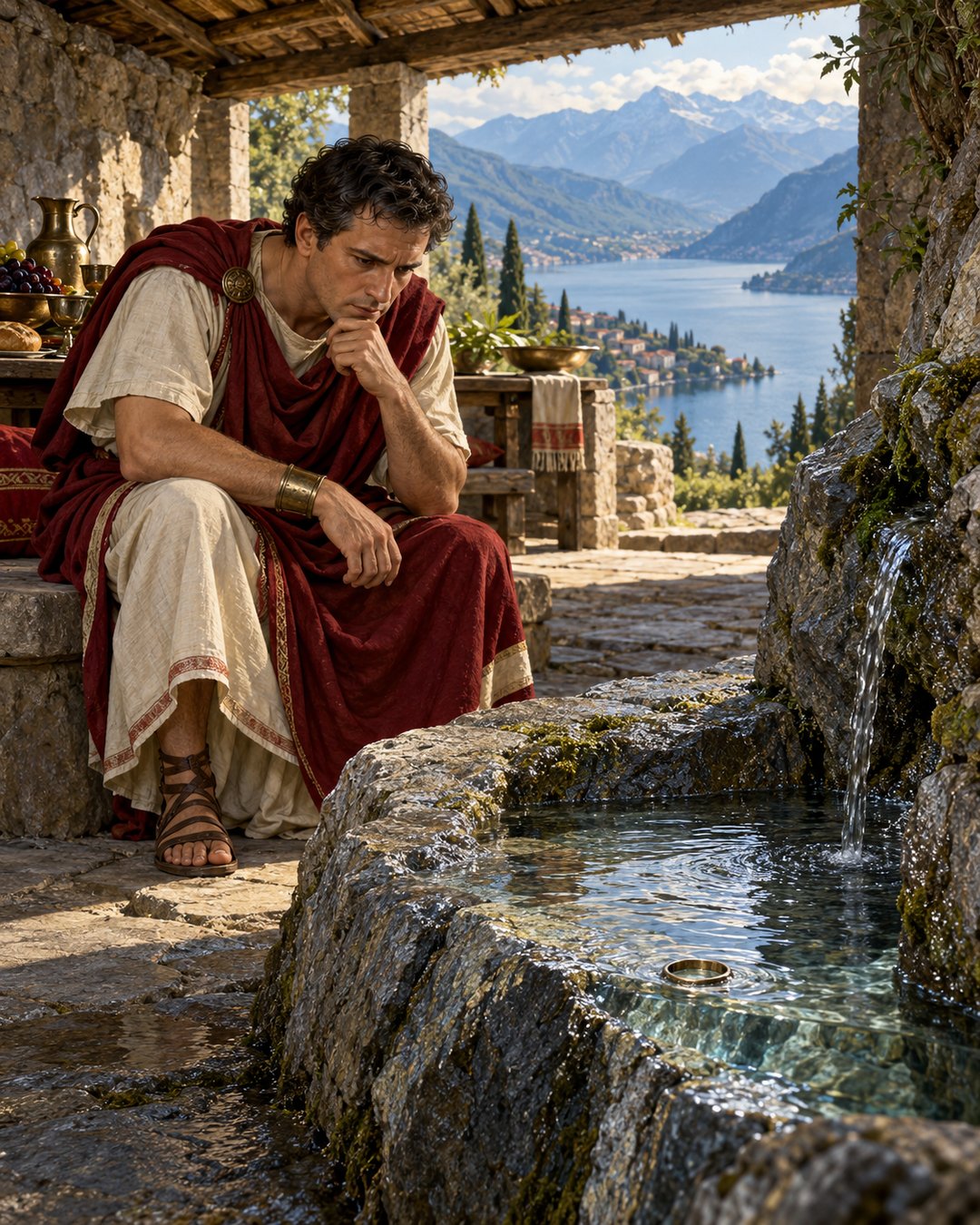
Pliny put a ring beside a spring.
At first the metal lay on a dry patch of stone. Water climbed slowly toward it, covered it, then retreated until the ring was dry again. Stay long enough, he told Licinius Sura, and the sequence would repeat two or three times.
The spring rose and fell three times a day. Pliny did not call that proof of a miracle. He called it a problem.
A Dining Room Turned a Mountain Spring into an Observatory
In Letters 4.30, Pliny sends Sura what he describes as a present from his native district. The gift is not an object. It is a question worthy of a learned correspondent.
He begins by fixing the setting. Water emerges from a mountain-side, follows a rocky channel, enters a small artificial banqueting room, and then drops into the Larian Lake, the great lake beside his home region.
That route matters. The phenomenon does not float free of place as a traveller’s marvel. There is a source, a channel, a built chamber, an outflow and a lake below. Each point suggests a different place where the rhythm might begin.
The dining room also changes who can watch. A visitor may recline, eat and drink directly from the very cool spring while waiting for the level to move. Leisure creates duration. The witness does not glimpse a sudden wonder and hurry on. He can remain through a full rise and recession.
Roman descriptions of strange water often sit between observation and inherited wonder. Pliny’s floating islands on Lake Vadimon similarly begin with a place that can be approached, watched and described. Here the built room makes repeated watching almost part of the attraction.
Pliny gives the cycle a number: three times each day. He also says the volume rises and falls with fixed regularity. He does not provide a clock reading or a measured depth, so the claim has limits. Yet the language insists that this is a recurrence, not a single surge remembered after the fact.
The Ring Separated a Moving Waterline from Memory
The ring is the sharpest piece of the letter because it creates a reference point.
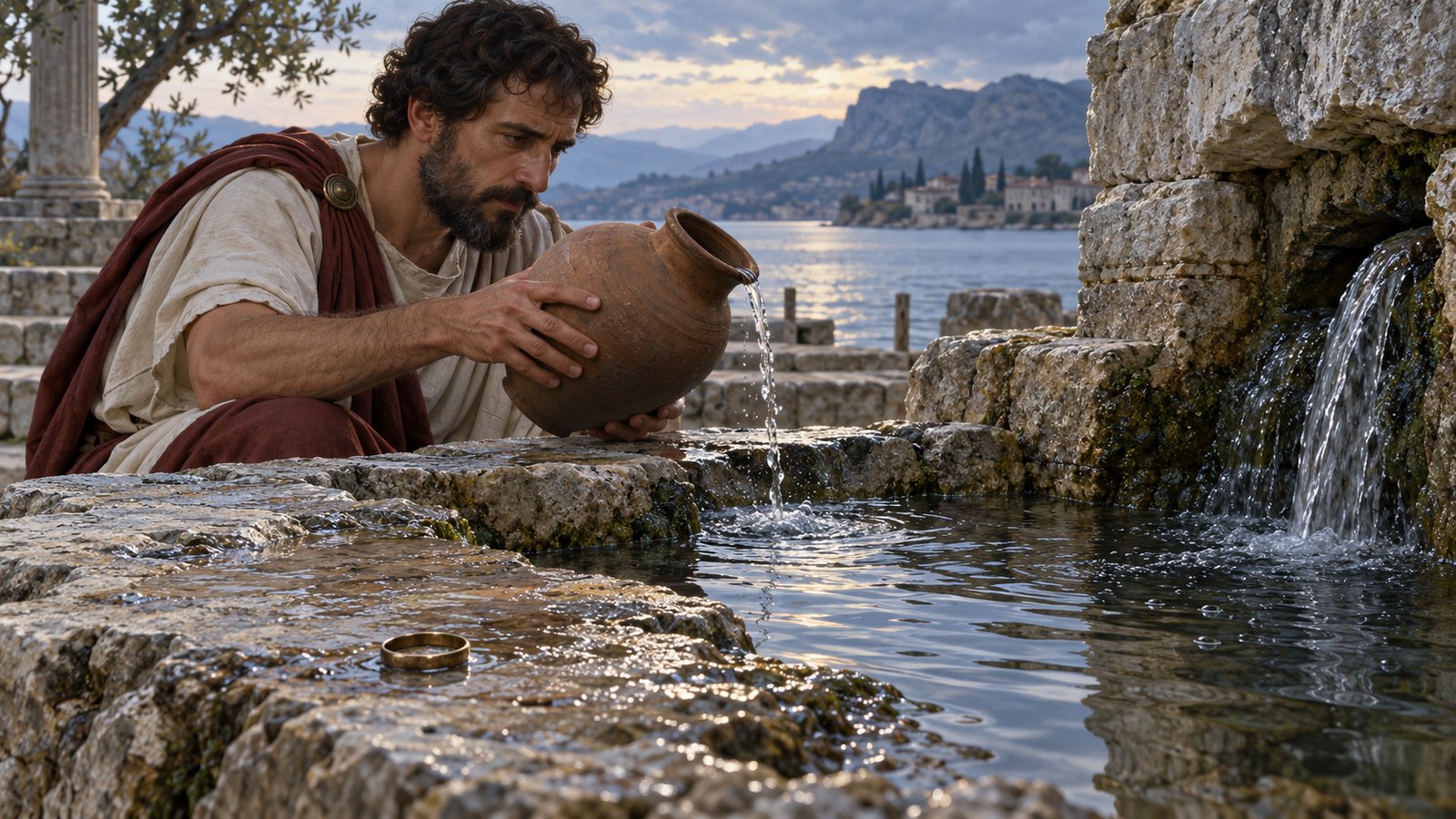
Place it on dry stone near the edge. Watch the water approach. Eventually the ring disappears beneath the surface. Then watch the same water withdraw and leave it exposed. The object remains still while the boundary moves.
No graduated instrument appears. No scale is marked. Pliny’s ring measures neither litres nor finger-breadths. It does something more basic: it prevents an observer from quietly moving the remembered edge.
A waterline against irregular rock can be hard to compare after an hour of conversation and food. A familiar metal object supplies contrast and a fixed location. Covered or uncovered is a simpler distinction than a vague impression that the pool looks fuller.
The method also carries its own check. One covering might be caused by a splash, a gust or an inattentive witness. Pliny asks the visitor to remain until both phases occur two or three times. Repetition turns the ring from a curiosity into a marker.
The position of the marker can be repeated as well. A ring is small enough to place on the same dry patch during another meal, yet visually distinct from the surrounding stone. Pliny never says that he scratched a line or counted elapsed minutes, so we should not modernize the exercise into an instrument survey. Its strength is simpler: any guest can watch the same object cross from air to water and back again.
The coolness of the water contributes another stable observation. It is something a diner can test directly by drinking, unlike the unseen chambers imagined beneath the slope. Pliny keeps that sensory claim beside the visible movement, then postpones causal language until he begins asking questions.
He does not claim the ring reveals the cause. That restraint is crucial. It establishes the pattern that every proposed cause has to explain.
Elsewhere, Roman investigators used bodies, vessels and visible residues to test water. Vitruvius judged springs through health, metal vessels and boiling deposits. Pliny’s test is narrower: not whether water is wholesome, but whether its level truly follows a recurring cycle.

Four Explanations Began with Different Everyday Analogies
Pliny’s first explanation begins with trapped air.
Perhaps unseen air alternately presses against the mouth of the spring and relaxes. When the passage tightens, the flow is checked. When resistance yields, water advances again.
He supports the suggestion with a household comparison. A jar without a direct, free opening does not pour in one smooth stream. Held upright or tilted, it releases liquid in gulps as air and water compete for passage.
The comparison is not proof that a mountain contains a giant jar. It identifies a mechanism capable of producing pulses from a steady supply.
The second explanation moves from a vessel to the sea. Could the spring enlarge and diminish under the same kind of law that governs the tide? Pliny does not say the lake literally pulls it like an ocean. He asks whether periodic water elsewhere offers the right family of cause.
The third possibility concerns resistance from outside. Rivers nearing the sea can be pushed back by contrary winds and an opposing tide. Something might similarly check the spring’s outflow and then release it.
The fourth explanation turns the mountain into storage. A hidden reservoir may fill while retaining the incoming water. Once complete, it may release the collected supply more quickly, then slow while filling again.
Finally Pliny imagines a concealed balance: emptied on one side, it may rise and expose an outlet; filled again, it may descend and block the passage. The precise apparatus remains hypothetical, but the alternation has the logic of a siphon or tipping container.
Each proposal begins from something visible—gulping jars, tides, backed-up rivers, cisterns or balances—and transfers its pattern underground.
Not Knowing Was the Point of Sending the Letter
The letter ends without a verdict.
That is not an unfinished article waiting for a clever final sentence. Pliny has divided the work. Local observation supplies the place, cycle and marker. Sura’s learning is invited to supply a better account.
The distinction protects the evidence. If trapped air is wrong, the ring was still covered and uncovered. If a reservoir is wrong, the route from mountain to lake still deserves explanation. The phenomenon does not disappear with a failed analogy.
Pliny’s sequence is disciplined even when his physics is speculative. First he tells Sura what a visitor can see. Then he lists possible causes as questions. He does not rewrite one guess as an observed fact.
The scene also shows how built leisure and inquiry could overlap. The banqueting room was designed for comfort beside cool water. It became useful for investigation because comfort made waiting possible. A meal lasted long enough to watch the same boundary move more than once.
Sura’s identity deepens the exchange. Pliny’s note addresses a man remembered as a general and a friend of Trajan, not a secluded natural philosopher. The problem could therefore travel through the same elite correspondence that carried legal, political and personal business. Inquiry was not confined to a laboratory or a specialist office; it could begin with a local landscape and move by letter.
There is humility in the closing request. Pliny could have packaged the spring as proof of divine favour for his district or as a secret only he understood. Instead he hands it to a friend with several imperfect models attached.
The ring remains the letter’s quiet centre. It is plain, portable and independent of every theory. Put it down, wait, and let the spring make the next claim.
Sources
Pliny the Younger, Letters, 4.30.