
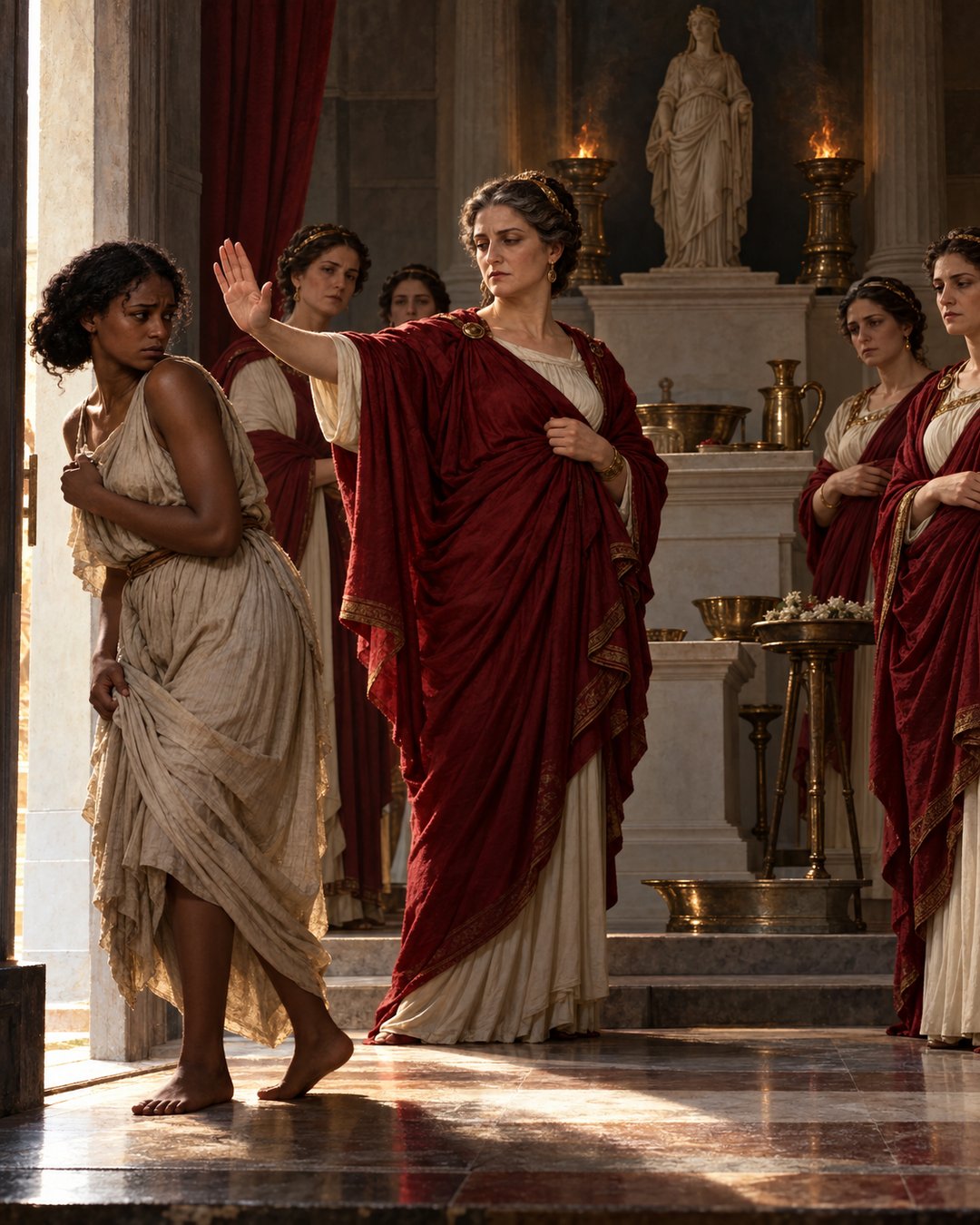
A prohibition entered the shrine in human form.
Enslaved women were not supposed to cross Matuta’s threshold, Plutarch says, yet the matrons brought one inside.
They struck her and drove her out, turning a rule into an action everyone present could see.
The Exception Was Built to Restore the Ban
Roman Question 16 does not begin by describing a whole festival. It isolates a contradiction.
Enslaved women were forbidden to set foot in the shrine of Matuta. The participating women nevertheless admitted one enslaved woman, then slapped her on the head and beat her.
Plutarch immediately asks whether the treatment of the one person was a symbol of the general prohibition.
On that reading, admission did not soften exclusion. It made exclusion performable.
A closed door can leave a rule invisible to everyone already inside. Bringing one forbidden entrant across the boundary and expelling her again allowed the group to enact who belonged and who did not.
The violence in the source should not be softened into harmless pageantry. Plutarch uses verbs of striking. At the same time, he gives no injury report, duration, or evidence that the chosen woman represented herself willingly.
The surviving description comes from an elite male antiquarian interested in explanation. It does not preserve the admitted woman’s name, voice, legal status beyond enslavement, or experience of the rite.
That silence is part of the evidence. The participant most exposed by the ritual appears only as a category needed to make the matrons’ boundary visible.
Roman religion often turned social distinctions into controlled movement: who approached, who spoke, who touched an object, and who remained outside.
The archive has seen another ritual boundary become a test of political intelligence. A Roman priest used an instruction to send a rival away from an altar before taking the sacrifice himself. Matuta’s rule is different, but it too makes access the mechanism through which power acts.
Ino and Antiphera Supplied a Mythic Conflict
Plutarch next offers a story to explain why an enslaved woman would embody the forbidden presence.
Matuta was identified with the Greek figure Ino, also associated with Leucothea. Ino, he says, became violently jealous of an enslaved woman connected with her husband.
The Greek tradition named that woman Antiphera and made her Aetolian.
This story gives the Roman action a household drama. The woman expelled from the shrine can be mapped onto a rival whose presence threatened a marriage.
It does not prove that the rite historically began from that event. Plutarch is comparing a ritual structure with a myth whose characters fit it.
The comparison becomes more explicit when he turns to his own home region.
At Chaeronea, he says, the guardian at Leucothea’s precinct stood before the sacred boundary with a whip and proclaimed that no enslaved person and no Aetolian, man or woman, should enter.
The two exclusions echo the two features assigned to Antiphera: enslaved status and Aetolian origin.
The categories are not interchangeable. Enslavement was a legal and social condition; Aetolian was an origin. Plutarch’s comparison joins them because the myth gives Antiphera both labels and the local proclamation repeats both bans.
That precision limits what can be claimed. The Chaeronean rule supports Plutarch’s own interpretive association, but it does not demonstrate that Roman matrons copied a Greek sanctuary or that one organizer designed both rites.
Plutarch therefore links a Roman women’s rite with a Greek local proclamation. The connection rests not on identical ceremonies but on shared categories generated by the Ino story.
The whip at Chaeronea and the struck entrant at Rome both make the boundary physical. A spoken ban is backed by an object or action capable of enforcing it.
Yet the Roman rite retains its peculiar inversion. The excluded person is not merely stopped outside. She is needed inside briefly so that removal can become the central gesture.
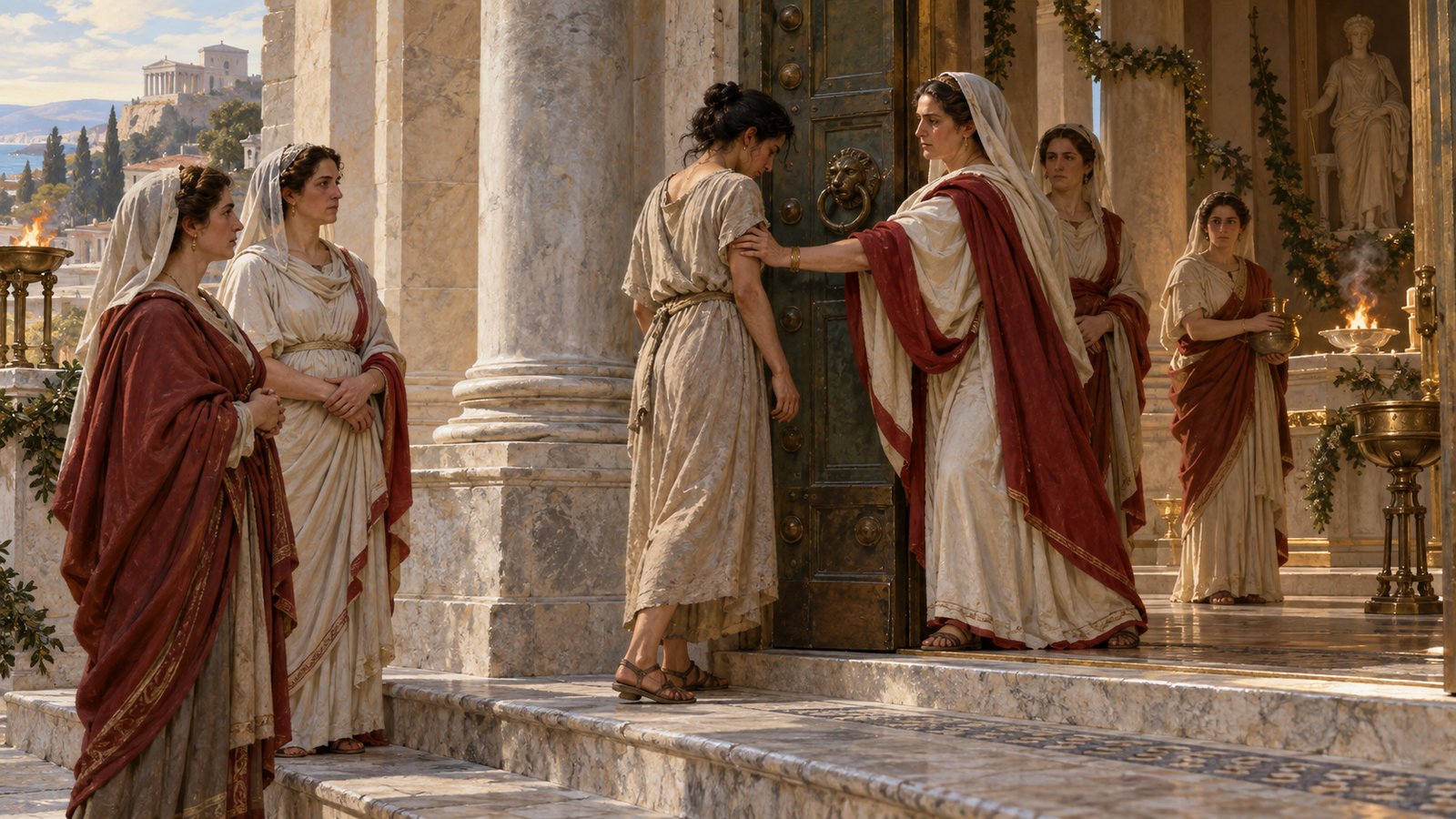
The Next Question Reversed Maternal Prayer
Plutarch pairs the exclusion problem with another unusual custom.
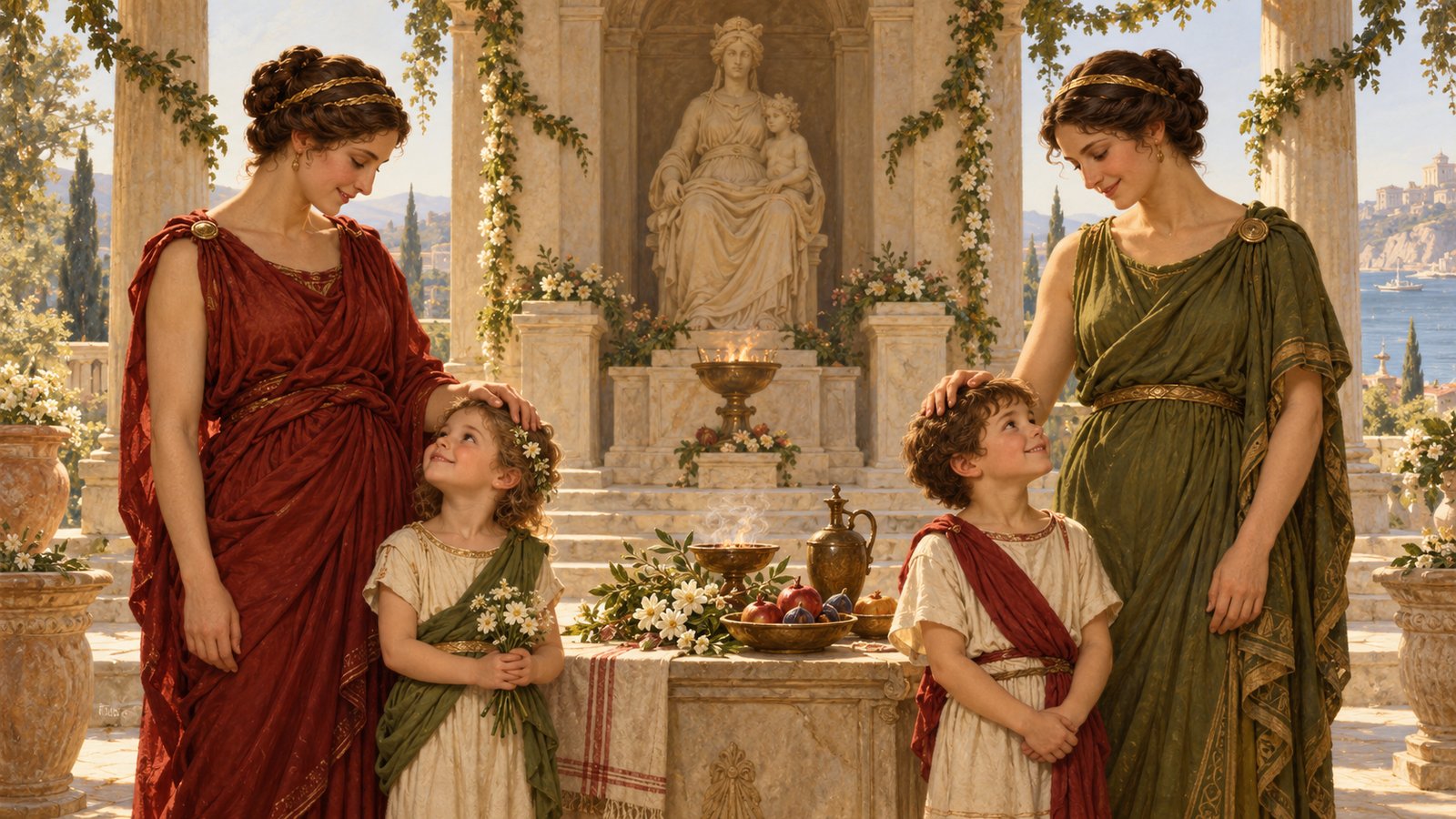
Women in Matuta’s shrine did not pray for blessings on their own children. They prayed for their sisters’ children.
The rule redirected care sideways through a family.
Each mother withheld the expected petition for her own son or daughter and spoke for a niece or nephew instead. If sisters participated together, their prayers could cross: each woman entrusted her children to the other’s religious attention.
Plutarch explains the pattern through Ino’s affection for her sister.
In the mythic account he invokes, Ino loved her sister and suckled her sister’s son. Her care for that child is contrasted with suffering attached to her own son.
The explanation makes the ritual imitate fosterage. A woman temporarily takes responsibility for the child who came through her sister rather than concentrating blessing on her direct descendants.
Plutarch preserves no required prayer formula, list of requested blessings, or rule for women without sisters. The evidence establishes the direction of petition, not a complete liturgy. That boundary matters because later reconstruction can easily make the custom more systematic than the surviving question allows.
That is not the same as saying Roman women cared less for their own children. The custom mattered because it interrupted the obvious prayer, not because it erased ordinary attachment.
Ritual inversion can expose a relationship that daily habit leaves secondary. Sisters become accountable for one another’s households, and nieces and nephews become the named beneficiaries of that bond.
The archive has followed Roman women acting collectively in political space. Women filled streets and approaches to the Forum while pressing for repeal of a wartime restriction. Matuta’s shrine shows a different collective: women organizing belonging, exclusion, and obligation inside a sacred setting.
Two Inversions Organized the Shrine
Questions 16 and 17 work best when read together.
The first admits someone who should remain outside, only to expel her. The second redirects a prayer that should seem most personal, sending it toward another woman’s children.
Both actions unsettle the ordinary direction of care.
The enslaved woman is brought close not to receive solidarity but to embody rejection. The sister’s child receives a blessing precisely because the worshipper does not name her own.
Plutarch uses Ino to connect the inversions. Jealousy toward Antiphera explains hostility to the enslaved entrant. Love for a sister and nursing the sister’s son explains transferred prayer.
The myth supplies opposed relationships around one female deity: the rival driven away and the sister’s child drawn into care.
That symmetry is intellectually neat. Social life was not.
An enslaved woman in Rome did not become Antiphera by entering the shrine, and a Roman niece did not become a mythic child because her aunt prayed. The story gave interpreters a vocabulary for acts whose origins were already uncertain.
Plutarch’s questions preserve interpretation in motion. He asks whether the blow was symbolic, then offers legend; he observes exchanged prayer, then looks for a family precedent in myth.
The rites remain more concrete than the answers. Their choreography survives even where the original reasoning does not.
One woman crossed a threshold and was forced back. Other women addressed blessings away from their own children. A sanctuary rearranged the normal map of household relation for the duration of worship.
Matuta’s ceremony did not dissolve Roman hierarchy. It displayed hierarchy with unusual sharpness, then asked privileged women to practice a limited form of kinship beyond the self.
The result is not a simple festival of motherhood. It is a ritual system in which belonging is demonstrated through an excluded body and sisterhood through a borrowed prayer.
Sources
Plutarch, Roman Questions, 16–17.