
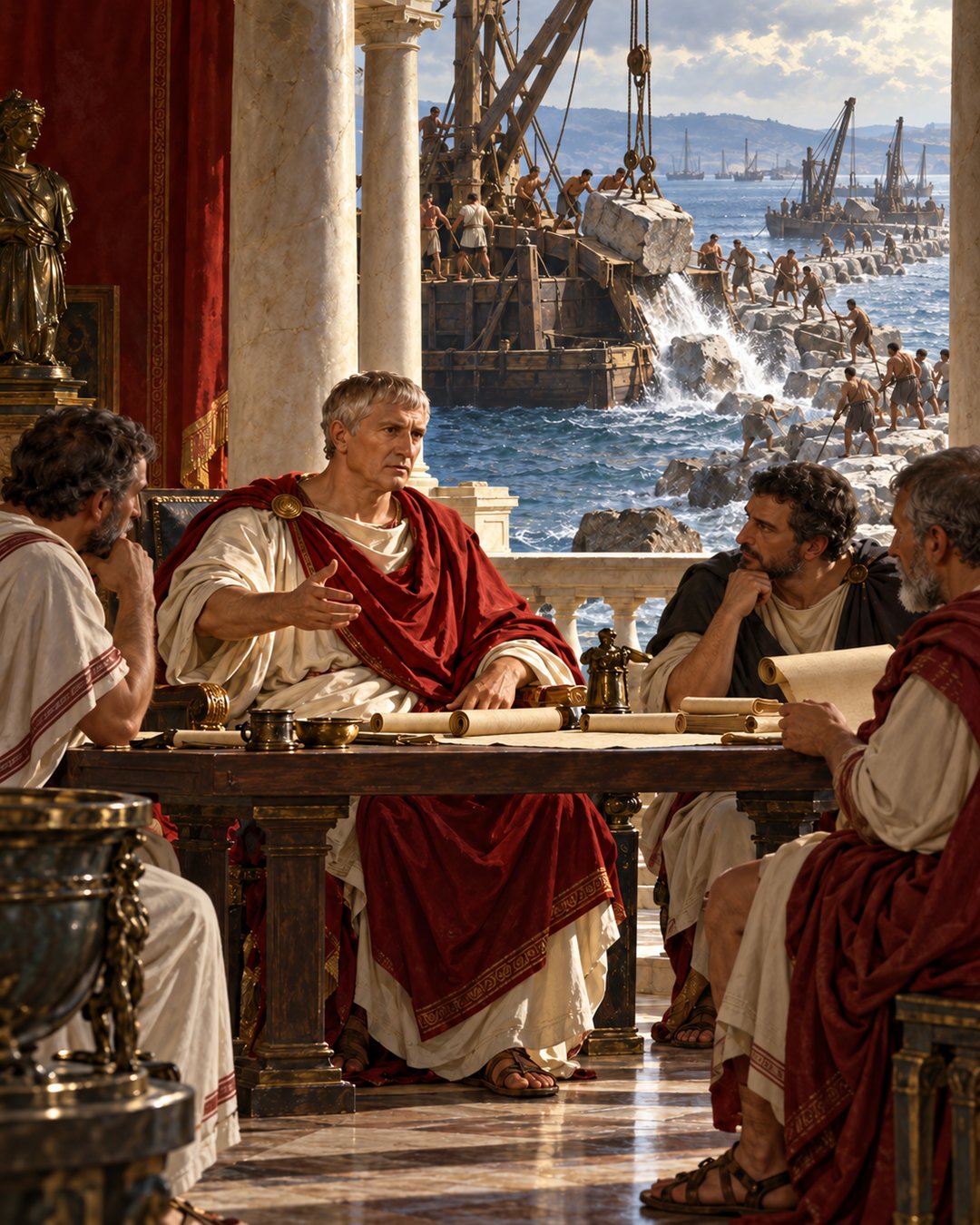
The emperor’s council heard accusations while a new island rose outside.
At Centum Cellae, Pliny moved between a judgment table and a shoreline loud with stone, waves, and labor.
He wanted both scenes to say something about how Trajan ruled.
Three Hearings Tested the Seaside Council
Pliny’s Letter 6.31 begins with an invitation he regarded as an honour. Trajan summoned him to Centum Cellae, on the coast, to sit among the emperor’s advisers.
The retreat did not suspend public business. Pliny emphasizes that the cases were different enough to reveal justice in several forms.
The first concerned Claudius Aristo, a leading citizen of Ephesus. Pliny describes him as generous and popular by innocent means, then says enemies had suborned an informer against him.
Aristo pleaded his own case. He was acquitted, and Pliny presents the verdict as restoration: accusation had endangered both the man and the reputation his civic conduct had built.
The second hearing was more intimate and more coercive. Galitta, wife of a military tribune preparing for public office, had been accused of adultery with a centurion.
The centurion had already been degraded and banished. Galitta’s husband, however, kept her in his house and delayed prosecuting her. Affection resisted the legal sequence after the rival had been removed.
He was summoned to carry the accusation through against his will. Pliny says Galitta was convicted under the Julian law, while Trajan attached the centurion’s name and the rule of military discipline to the decision.
That addition mattered to the emperor’s image. It prevented the case from looking like a claim that every military offence belonged personally before Caesar. The judgment was tied back to an institutional rule.
The third inquiry concerned the will of Julius Tiro, described as genuine in part and forged in part. Among the accused was Eurythmus, an imperial freedman and agent.
That relationship made procedure politically dangerous. If the emperor’s own dependent benefited from hesitation, an ordinary legal question could become proof of favoritism.
An Imperial Freedman Could Not End the Inquiry
The heirs had jointly asked Trajan to investigate while he was in Dacia. By the time of the hearing, some wanted to withdraw.
Pliny records Trajan’s sharp refusal to let the freedman relationship settle the matter. “Eurythmus is not Polyclitus, and I am not Nero,” the emperor said.
The comparison invoked a hated model of palace power: an imperial dependent protected because his patron stood above scrutiny.
Trajan did not answer suspicion merely by pronouncing the accused innocent or guilty. He turned to the council and asked what procedure should follow when accusers no longer wished to prosecute.
The resulting order required the heirs either to continue or appear individually and give sufficient reasons for stopping. Otherwise they risked judgment for bringing false charges.
It was not a gentle escape. Accusation had consequences for the accused, but abandoning it without explanation could also have consequences for the accuser.
Pliny arranges these hearings as a sequence of constraints. Popularity did not protect Aristo from accusation, but evidence could clear him. A husband’s reluctance did not dissolve a public charge. An imperial freedman’s proximity did not close an inquiry.
His praise is interested and selective. Pliny sat on the council, admired Trajan, and wrote for readers who knew the political value of a good emperor. The letter is evidence for that self-presentation, not a neutral transcript.
Yet its concrete decisions show how the praise was constructed. Trajan’s virtue appears in who must answer, which relationship fails to halt proceedings, and when the emperor asks advisers rather than claiming solitary certainty.
The archive has seen the same ruler resist compulsory generosity. Trajan would not force municipal money onto borrowers simply to make idle funds earn interest. In both letters, restraint becomes an imperial accomplishment.
Modest Dinners Closed Arduous Days
After the hearings came dinners with the emperor.
Pliny calls them modest for a man of Trajan’s position. Some evenings offered entertainment; others continued in conversation late into the night.
The contrast is carefully designed. The cases were weighty, the meals controlled, and access to the ruler companionable without becoming disorderly.
On departure the advisers received gifts. Pliny counts that courtesy with the seriousness of the council and the beauty of the place.
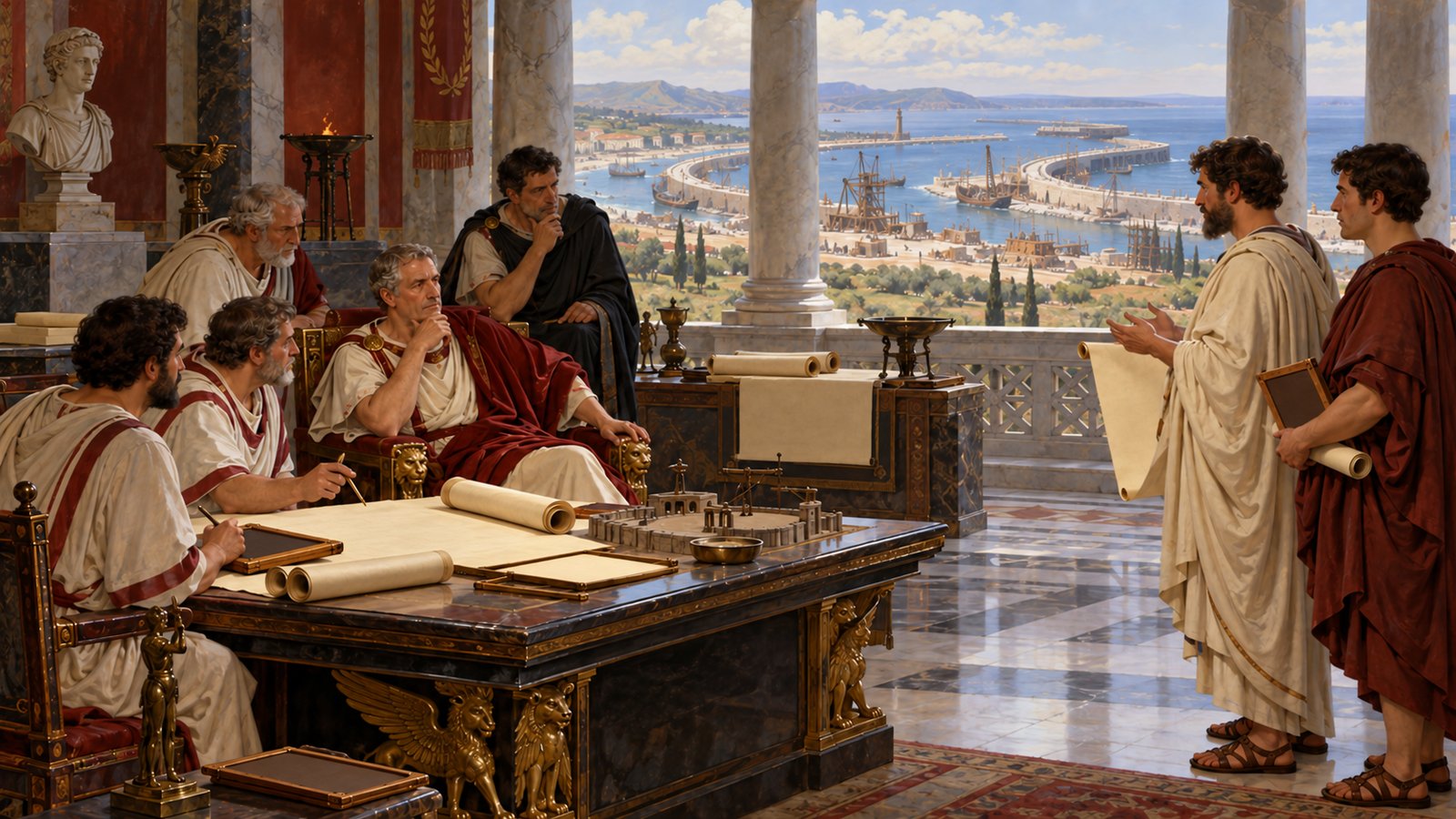
He then turns from the emperor’s conduct to the landscape. Green meadows surrounded the villa. The shore opened directly beside it. In the bight, a harbor was taking shape.
One arm had already been strengthened with substantial masonry. The other was still under construction.
At the entrance stood the feature that held Pliny’s eye: an island that had not existed naturally.
Its position split incoming water and created a safe passage for ships on either side. The intended effect was legible before the work was finished. Stone would make waves break earlier and reduce the force carried into the harbor.
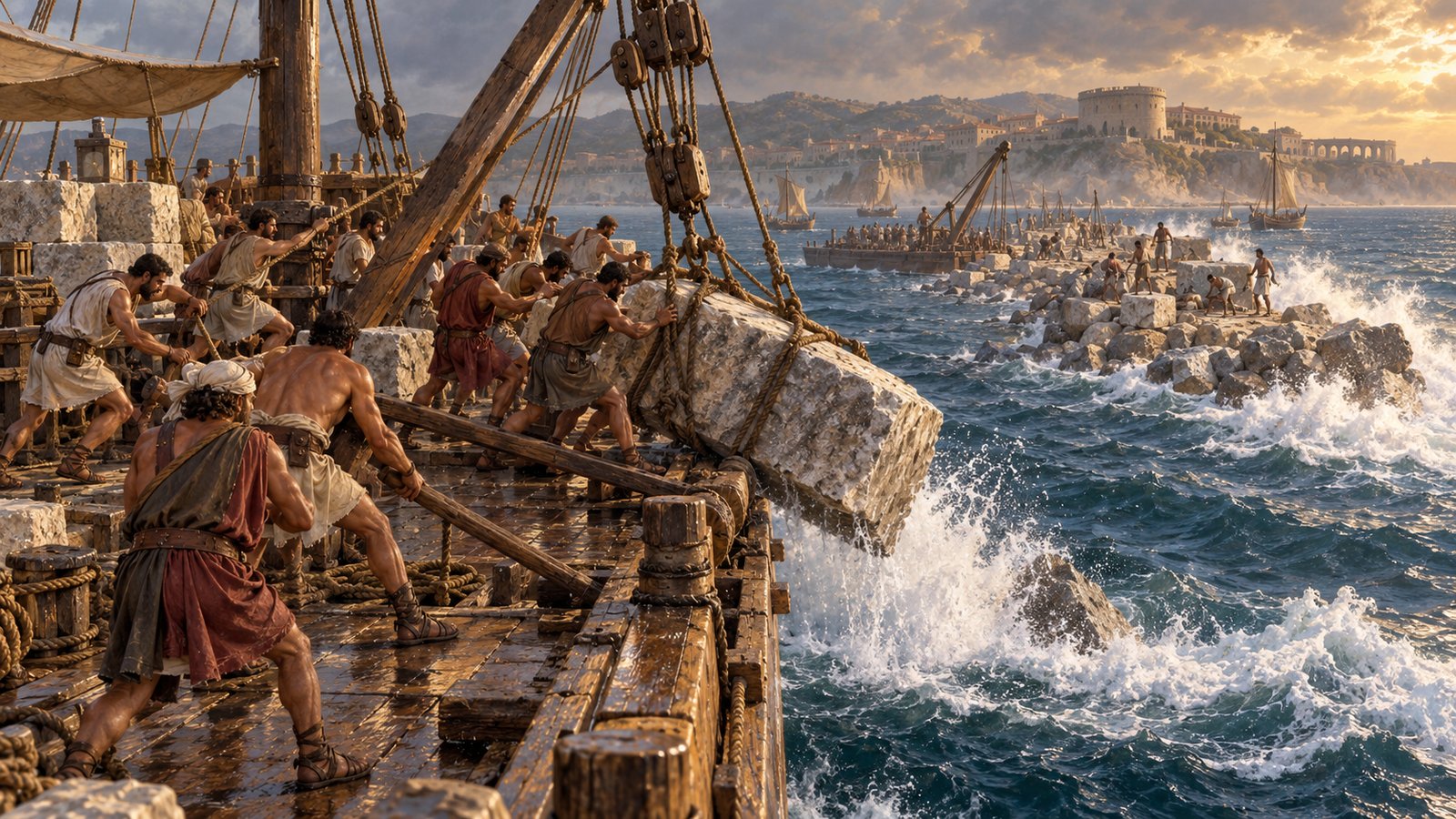
Pliny did not hide the roughness of construction behind an imperial order. He described the machine, material, weight, sound, and spray.
A broad barge brought immense stones. Workers dropped them into the sea one above another. Their own mass kept them in place.
The island emerged through repetition rather than one miraculous placement.
Loose Stones Learned to Behave Like Land
As the ridge climbed, it began to overtop the water.
Waves struck the new obstruction, burst upward, and whitened the surrounding sea with foam. The breakwater announced its function through noise and spray long before landscaping could disguise it.
Later, Pliny says, concrete would be added. Time and finishing work would make the artificial mass look like a natural island.
He therefore records the work in an intermediate state: high enough to alter the sea, rough enough that its human construction was still obvious.
That sequence matters. The core depended first on stones held by accumulated weight. Concrete came afterward to bind, fill, and regularize the structure.
Roman harbor building could use several strategies. Hydraulic material from the Bay of Naples allowed masonry to harden in contact with seawater. Pliny’s view at Centum Cellae catches another phase: a barge building the resistant body that later concrete would complete.
The island also explains the harbor’s geography. Placed at the mouth, it did not simply close the entrance. It broke the direct force of waves while allowing traffic around both sides.
Pliny expected the finished refuge to matter because the surrounding coast lacked harbors over a long distance. Imperial construction inserted safety where the natural shoreline had not supplied it.
He says the harbor already bore the name of its maker. Praise, utility, and landscape were being joined before the final concrete had set.
The letter’s final image can be read beside its opening without pretending that Pliny explicitly called the island a legal metaphor.
Both halves depend on accumulation and boundary. A council takes testimony, prior decisions, relationships, and rules, then tries to make a stable judgment. A work crew drops stone after stone until moving water encounters something that holds.
Both are also vulnerable to imperial display. The court can become favoritism; the harbor can become a monument named for its patron. Pliny counters that suspicion by emphasizing process.
Aristo pleads. The unwilling husband is summoned. The heirs must explain themselves. Advisers are consulted. Barges deliver weight. Waves test the ridge. Concrete is promised only after the stone core rises.
The emperor never appears to command an island into being.
That is the point of Pliny’s praise. Trajan’s seaside court and his unfinished harbor are presented as durable because each is built through ordered stages that even imperial power must respect.
Sources
Pliny the Younger, Letters, 6.31.