
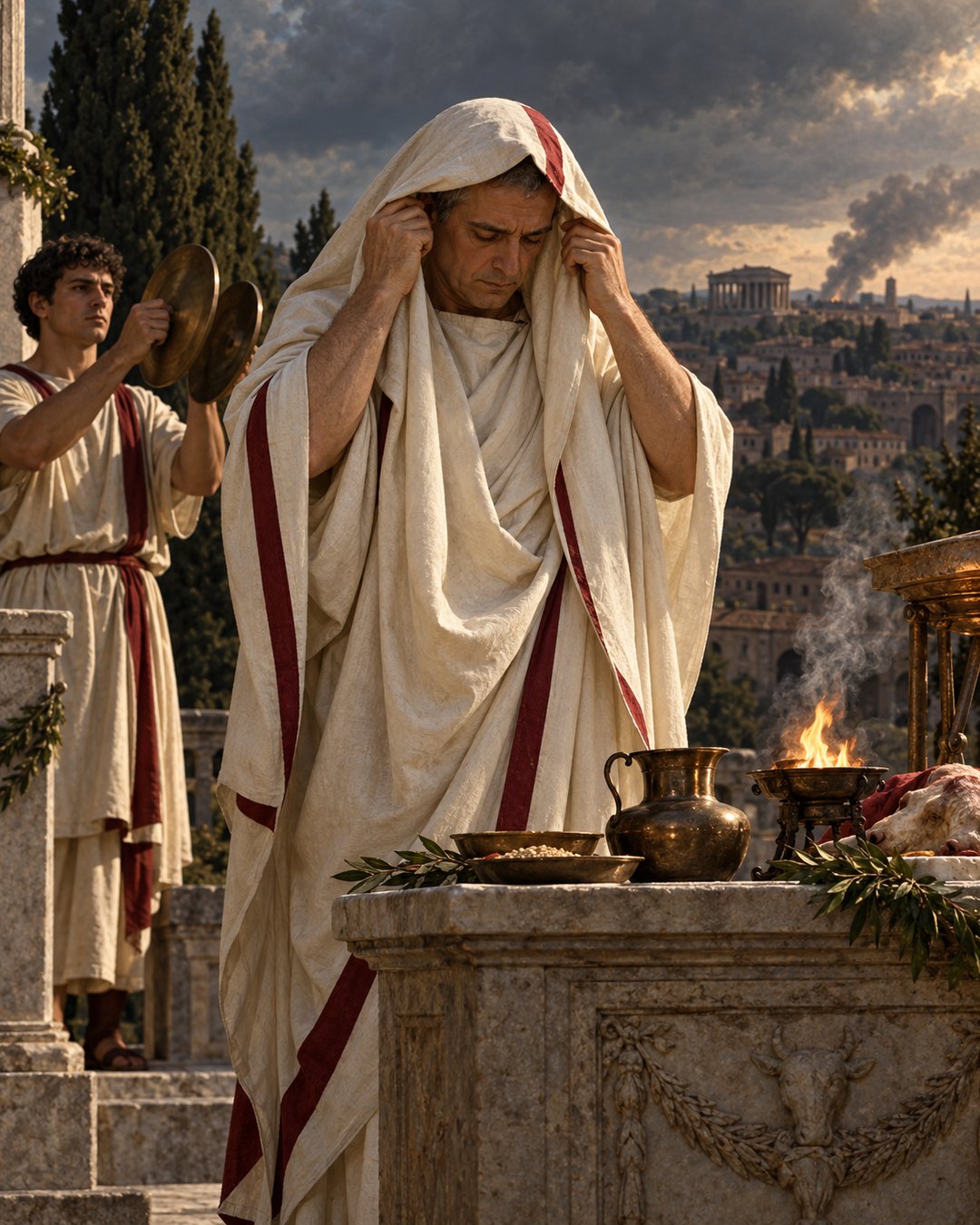
A fold of wool could decide whether a prayer remained intact.
Plutarch watched Roman worshippers cover their heads before the gods, then uncover before a respected person.
His most practical explanation begins not with what the priest saw, but with what he might hear.
The Toga Made a Boundary Around the Spoken Rite
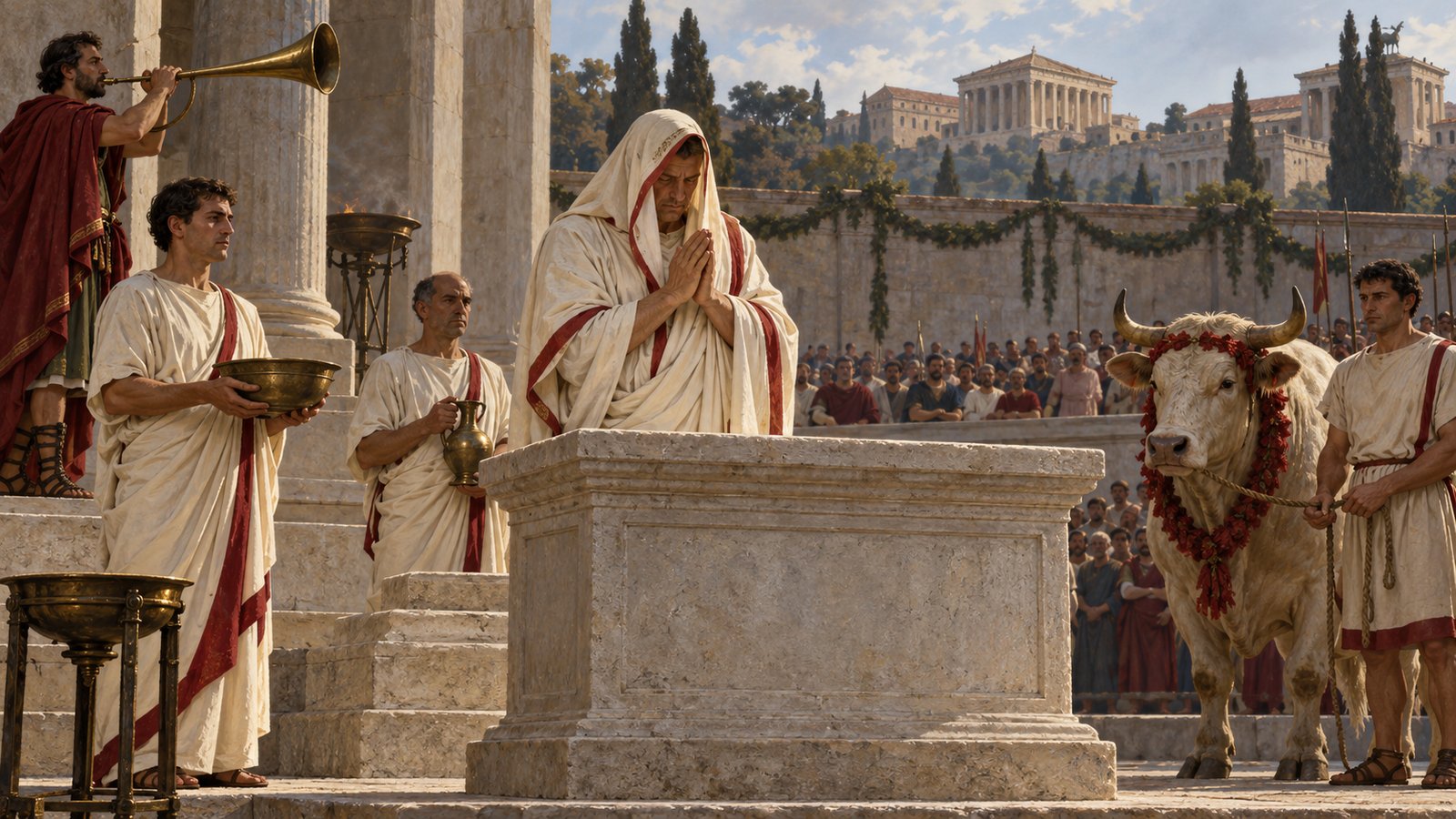
Roman Question 10 starts from a contrast that an observer could recognize at once. A man worshipping the gods drew his toga over his head. If he met a person worthy of honour while already covered, he uncovered.
Plutarch did not treat those gestures as self-explanatory. He supplied possibilities, tested one custom against another, and allowed several interpretations to remain in view.
One possibility made concealment an act of humility. Lowering the visible self before a deity could express the distance between mortal and divine.
Another made the cloth functional. By drawing the toga over his ears, the worshipper guarded the prayer against an ill-omened or baleful sound from outside.
That suggestion changes the architecture of the ritual. The sacred boundary was not only the altar, precinct, or cleared ground. It could be the small pocket of controlled attention formed by fabric around a speaker’s face.
The danger was interruption. A stray cry, unlucky phrase, quarrel, stumble of words, or other disturbing sound could enter at the moment when an exact address was being made to a god.
Plutarch does not give a catalogue of every sound that invalidated a rite. His point is narrower: Roman vigilance about auditory pollution was strong enough to explain why worshippers covered their ears.
The archive has already examined how exact wording could be protected by assigned assistants. Four people could prompt, check, command silence, and provide music around a Roman prayer. The toga fold adds a personal layer to that larger system.
Speech went outward toward the deity while unwanted sound was kept from travelling inward. Clothing became part of the rite’s error control.
Bronze Noise Could Defend Silence
Plutarch supports his auditory explanation with a detail that sounds paradoxical. When Romans went out for divination, he says, they surrounded themselves with the clashing of bronze.
Noise was being used to protect ritual from noise.
The distinction lay between controlled and uncontrolled sound. A deliberate metallic clash could fill the listener’s attention and mask an accidental phrase whose meaning might be taken as ominous.
Silence, in this setting, did not have to mean the absence of vibration. It meant the absence of an unplanned message.
Bronze offered a reliable sound with no ambiguous sentence inside it. Repeated at the proper moment, it created an acoustic screen beyond the smaller screen of cloth.
Plutarch’s evidence is comparative rather than administrative. He does not cite an instruction manual that orders a particular bronze object to sound at a fixed instant. He moves from one observed concern to another: covered ears during worship and deliberate clashing around divination. The connection is his proposed explanation, and the article is strongest when that uncertainty remains visible.
Even so, the pairing is concrete. Cloth changes what reaches one person. Bronze changes the sound field around a group. One defense travels with the worshipper’s body; the other requires attendants, objects, and coordinated action.
This was not casual background music. Plutarch introduces the practice as evidence that Romans were “mightily vigilant” about what reached them during divination.
The logic resembles the guarded formula used when opening a sacred grove. A prayer could specify the work, the offering, and the divine permission required before an axe touched a sacred tree. In both cases, ritual depended on narrowing chance.
The prayer had to say the intended thing. The environment had to be prevented from answering with the wrong thing.
Plutarch also records a more philosophical proposal from Castor. Castor connected Roman custom with Pythagorean teaching and read the covered head as a symbol: the spirit within prayed to gods outside, while the body covered and concealed the soul.
That interpretation does not cancel the acoustic one. It shows how a single fold of cloth could be made to carry practical, historical, and philosophical explanations at once.
Aeneas Supplied a Memory of Danger
A different answer pushed the custom back into heroic time.
Plutarch reports a tale in which Aeneas was sacrificing when Diomedes passed by. Aeneas covered his head and completed the rite.
The gesture could therefore be remembered as concealment in the presence of an enemy. Its resemblance to later covered-head worship would be historical rather than theological: a precaution persisted and became custom.
Plutarch himself marks the problem. Covering before an enemy does not automatically explain why worshippers should cover before gods. The actions look alike, but resemblance may be accidental.
That hesitation is valuable. Ancient explanations of ritual were not always records of an institution’s founding moment. They were arguments built from visible habits, inherited stories, wordplay, and comparison.
The paired act of uncovering before honoured people prompted another argument. Perhaps a mortal superior should not receive the same visible honour as a god.
The direction of honour is easy to misread. In ordinary greeting, uncovering can look like added respect. Plutarch reverses that assumption: removing the divine-style covering keeps the honoured person safely human. The change protects a boundary rather than simply raising or lowering courtesy.
On this reading, uncovering did not add dignity to the powerful man. It protected him from divine jealousy by making the difference between human and divine reception unmistakable.
The worshipper’s clothing thus managed rank in two directions. Covered before a god, he acknowledged superior power. Uncovered before a man, he kept human prestige from appearing to cross that line.
None of these explanations requires every Roman participant to have recited the theory. Plutarch is preserving ways learned observers made a familiar posture intelligible.
Saturn and Honor Refused the Simple Rule
If covered worship were universal, one tidy explanation might have been enough. It was not.
Plutarch’s next question asks why sacrifice to Saturn was performed with the head uncovered.
One answer uses chronology. If Aeneas introduced covered-head sacrifice, Saturn’s rite could remain bareheaded because it was older than that innovation.
Another uses divine geography. Worshippers covered before heavenly gods, while Saturn was treated as a power whose realm lay beneath the earth.
A third turns on Truth. Saturn was called the father of Truth, and Truth should not be covered or overshadowed. Plutarch then asks why Saturn held that title and offers the familiar association of Kronos with Chronos: time discovers truth.
Each answer preserves the exception by rebuilding the category around it. Saturn is earlier, lower, or bound to an uncovered concept.
The god Honor provides another bareheaded case. Plutarch glosses the name through renown or honour, then argues that renown is brilliant, conspicuous, and widespread. A deity of visible reputation should not be hidden.
These explanations are not a single code recovered from an archive. They are interpretive repairs prompted by ritual variety.
That variety is precisely why the toga fold matters. It was visible enough to invite explanation, practical enough to shape attention, and flexible enough to mean humility, concealment, hierarchy, or protection from sound.
The clashing bronze gives the strongest glimpse of operation. Roman ritual did not merely ask participants to be sincere. It tried to engineer the conditions under which the intended words would be the only meaningful words in the moment.
A priest covered his head. An assistant controlled the surrounding sound. A bareheaded exception demanded its own history.
For Plutarch, piety survived not through one universal gesture, but through the repeated work of explaining why this god, this prayer, and this fold of cloth differed from the next.
Sources
Plutarch, Roman Questions, 10–13.