
A dead man’s will had left Vienne an athletic contest. A living magistrate abolished it.
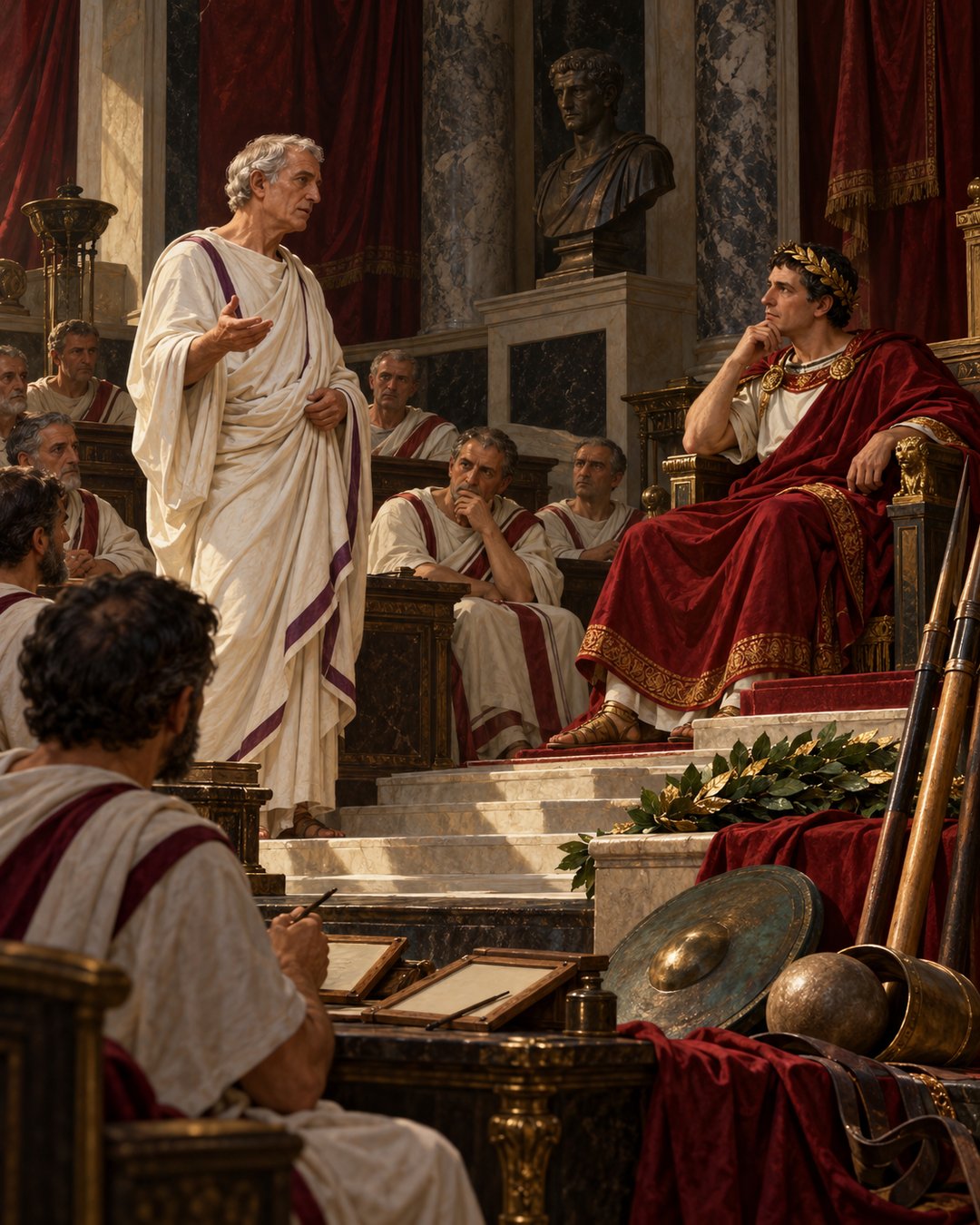
By the time Pliny saw the dispute, local custom, testamentary authority and municipal office had reached an imperial council. Junius Mauricus voted against bringing the games back. Then he went further: he wished Rome could lose its games too.
Pliny calls that bold. To explain what bold meant, he changes emperors and moves the reader to dinner.
A Bequest Made Public Entertainment Hard to Unmake
The first scene in Letters 4.22 begins at Vienne in Roman Gaul.
An unnamed person’s will had established a gymnastic contest. Repetition turned the gift into local custom: the town did not merely receive money or property once; it continued staging an event because the dead donor had instructed it to do so.
Trebonius Rufus stopped the contest while serving as duumvir, one of the local magistrates. His opponents did not need to prove that the games were excellent. Their objection was narrower and potentially stronger: he lacked authority to abolish them.
The case therefore asked who could interrupt a civic practice backed by a will. A magistrate might dislike the event, consider it harmful or see it as a burden. None of those views automatically answered the jurisdictional question.
Pliny had been called by the emperor to advise. He praises Trebonius’s self-defense with unusually procedural language. The man spoke eloquently and effectively, but also discreetly and with dignity. Because the dispute concerned his own conduct, tone mattered alongside argument.
This was not an anonymous vote dropped into a box. Pliny elsewhere worried that secret senatorial ballots encouraged abuse. Here the participants are visible, their positions attributable and their manner open to judgment.
The council had to decide whether stopping the games was an abuse of office or a defensible civic act. Pliny gives no long legal ruling. He preserves the pressure points: inherited purpose, established repetition, official power and public spectacle.
Mauricus Refused the Comfortable Middle Position
Junius Mauricus voted against restoring the contest.
That position alone aligned him with Trebonius’s result. His added sentence revealed a larger judgment: he wished the games at Rome could be abolished as well.
The comment strips away an easy provincial distinction. Mauricus did not condemn Vienne for imitating metropolitan entertainment while protecting Rome’s spectacles. He applied the objection at the centre.
It also changes the scale of the discussion. The council had been asked about one contest created by one will in one town. Mauricus answers at that scale with his vote, then reveals that his principle reaches the capital. The expansion is his own; neither the donor’s instructions nor Trebonius’s municipal office required it.
Pliny does not tell us whether the other advisers welcomed the aside or whether it altered the formal decision. That silence sets a useful limit. We can identify the stance and its audience, but not manufacture a transcript of debate around the sentence.
Pliny calls the line bold and consistent. The pairing matters. Boldness without consistency may be performance—severity aimed at people with less power. Consistency gives the position a cost. Mauricus speaks against something enjoyed by a provincial population and then names the same target at Rome.
He also exceeds the minimum needed to decide the case. An adviser could oppose restoration because the duumvir’s action had already settled matters, because the bequest was impractical, or because the council should defer to local administration. Mauricus instead exposes his substantive dislike of such games.
That candor did not make him legally correct by itself. Pliny does not turn personal austerity into a statute. He uses it to characterize the man making the vote.
The contrast with routine senatorial work is sharp. Augustus tried to organize Senate business around fixed meeting days and attendance rules. Mauricus’s significance lies inside such institutions: a recognizable person attaches a difficult principle to a formal opinion.
Nerva’s Question Made the Past Sound Safely Dead
Pliny then says this frankness was not new. His evidence comes from a dinner under Nerva.
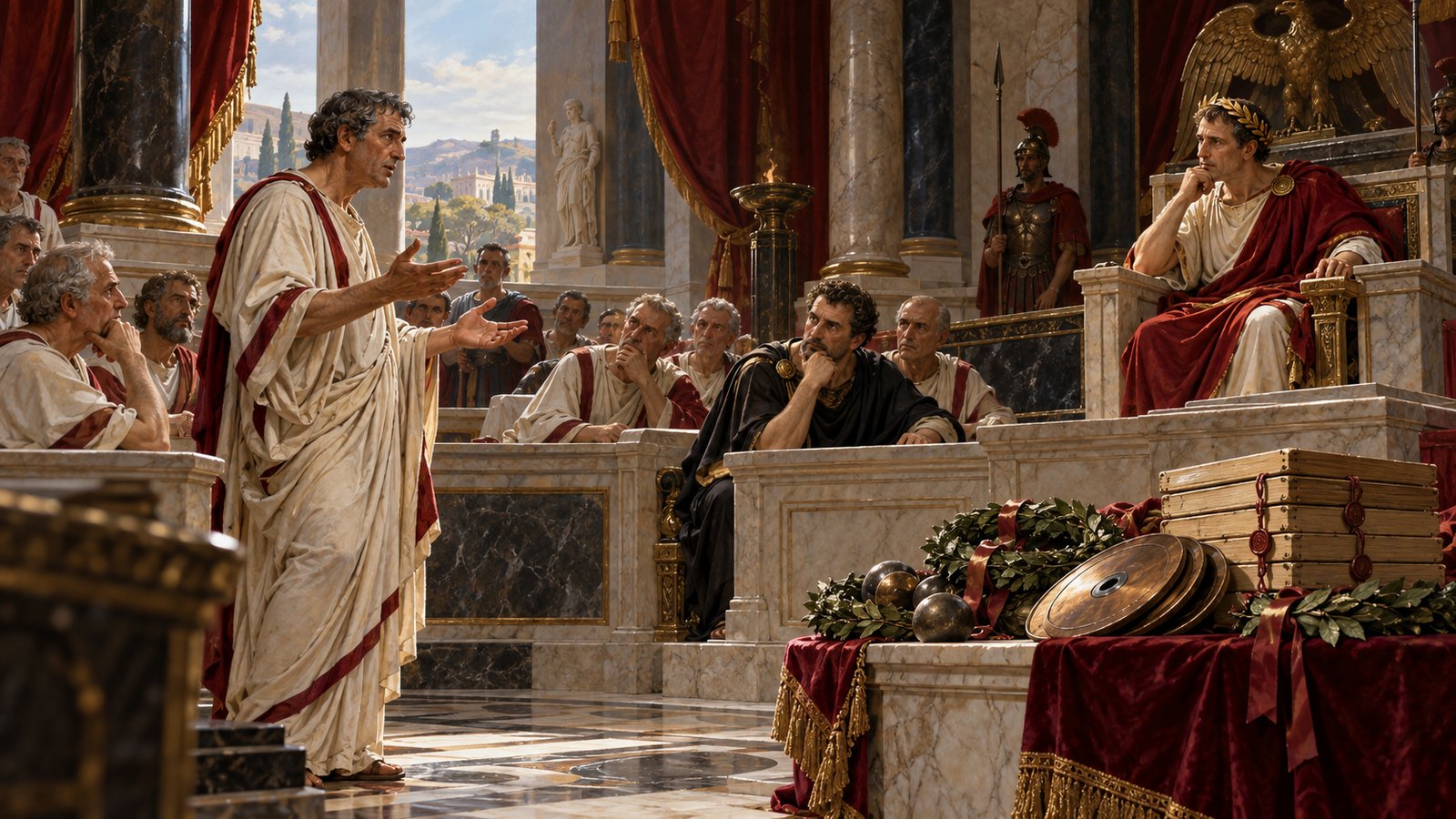
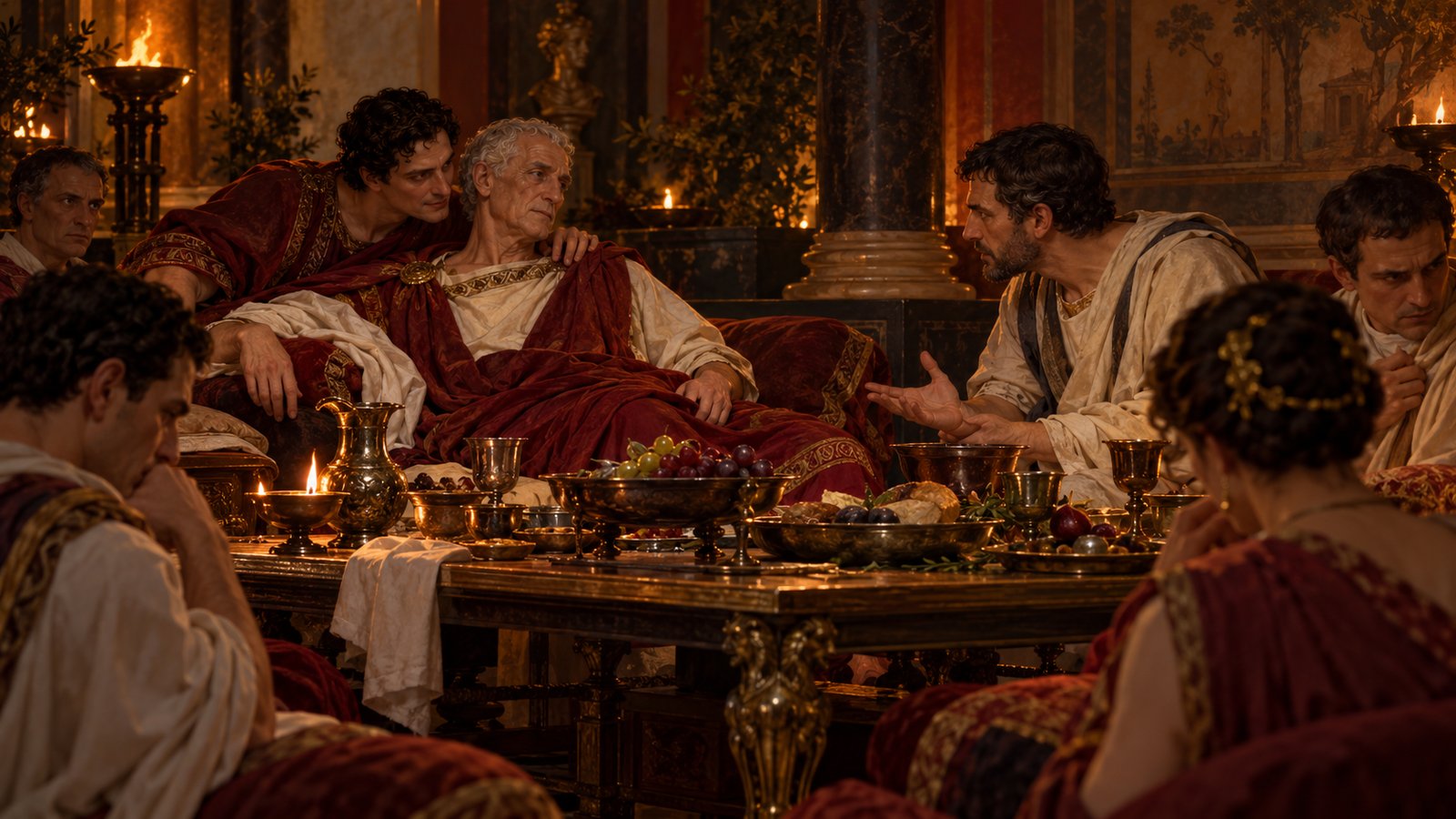
The gathering was small. Veiento sat next to the emperor and leaned against his shoulder. Physical proximity matters before anyone speaks. It shows comfort, access and favour.
Conversation turned to Catullus Messalinus, a blind adviser associated with Domitian’s worst politics. Pliny’s portrait is hostile: Messalinus lacked fear, shame and pity, and Domitian used him against leading men as though he were a weapon sent forward without sight.
Everyone could condemn Messalinus at Nerva’s table. Domitian was dead. The hated adviser was dead. A new regime allowed diners to describe old crimes with apparent courage.
Nerva asked what Messalinus’s fate would be if he were alive.
The expected answers were easy to imagine. Exile, prosecution, obscurity or punishment would flatter the present emperor by contrasting him with Domitian. The hypothetical pushed danger safely into an alternate world.
Mauricus brought it back to the table.
Messalinus, he answered, would be dining with them.
The sentence did not accuse Nerva of reproducing every Domitianic crime. It challenged the confidence that changing emperors had automatically emptied the room of men who served power through accommodation.
Veiento’s position beside Nerva sharpened the reply. Pliny does not need Mauricus to point. The reader has already been shown the courtier leaning on the emperor.
Two Rooms Let Pliny Test a Reputation
Pliny could simply have called Mauricus honest. Instead he supplies two rooms.
In the imperial council, Mauricus opposes restoring a local contest and extends his criticism to Rome. At Nerva’s dinner, he refuses to condemn only a dead villain and makes the question present.
The settings differ in form. One is official advice with a municipal dispute before the emperor. The other is intimate conversation among a few diners. The same habit survives both.
This is why Pliny’s word “consistent” does more work than “bold.” A startling remark may be an accident, a joke or an attempt to attract notice. Two interventions under different emperors make a pattern.
The pattern is not generic opposition. Mauricus does not attack every emperor or reject every institution. He identifies a gap between what powerful people can comfortably say and what their principle requires them to notice.
The dinner line gains force from its economy. Mauricus does not catalogue Veiento’s career or accuse every guest. He answers Nerva’s hypothetical with the immediate social fact of the table. If a man resembling the compromised courtiers of the old regime still enjoys the emperor’s intimacy, then imagining Messalinus among them requires no distant counterfactual.
That economy also gives the emperor room to understand without Pliny recording a confrontation. We are not told that Nerva punished Mauricus, expelled Veiento or ended the meal. The surviving point is narrower: the remark was speakable, memorable and dangerous enough for Pliny to use years later as evidence of character.
At Vienne, the comfortable position would have isolated the provincial games as a local problem. He implicates Rome. At Nerva’s table, the comfortable position would have isolated Messalinus as a Domitianic monster. He implicates the current dinner.
Pliny’s own role deserves notice. He is not a neutral recording device. He admires Mauricus, praises Trebonius and despises Messalinus. The letter arranges its scenes to make moral character legible.
Yet the construction is valuable precisely because it is concrete. We can separate Pliny’s praise from the acts he reports: a vote, a wish and a reply.
The council decided a contest. The letter decided how one senator’s courage would be remembered.
Sources
Pliny the Younger, Letters, 4.22.