
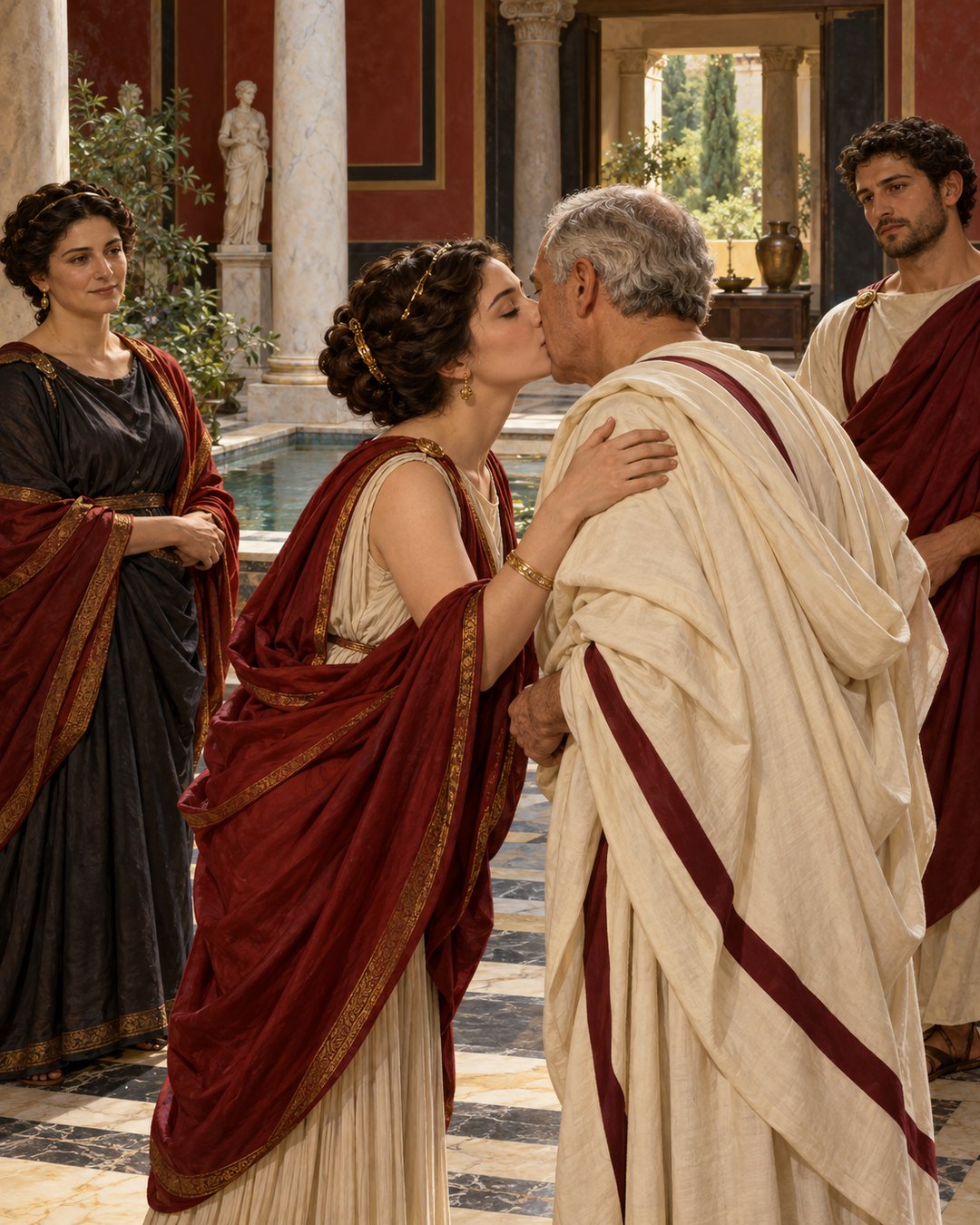
A family greeting could become an inspection before either person spoke.
Plutarch asked why Roman women kissed their male kinsmen on the lips.
His first answer turned breath into household evidence.
The Wine Explanation Made Affection a Test
Plutarch does not announce one settled origin for the custom. Roman Question 6 is constructed as a series of possibilities.
The first is the most intrusive. He says that most authorities connected the kiss with a ban on women drinking wine.
If a woman met a man of her household, the greeting brought their faces close enough for wine to be detected. What looked like affection could therefore operate as a breath test.
The mechanism did not require a guard at a storeroom. It distributed supervision through ordinary encounters with relatives.
A woman did not have to be seen pouring or holding wine. Scent after the act could become the evidence, and the people authorized to notice it were embedded in family life.
Plutarch’s wording matters. He reports an explanation held by others; he does not provide a date, statute, punishment, or observed case in which a kiss exposed a drinker.
The passage is strongest when read as an ancient theory about a custom rather than a complete legal dossier.
Even as theory, it reveals a severe model of the household. Male kin become inspectors, proximity becomes compulsory evidence, and a greeting makes private consumption legible.
Wine carried more than one social meaning. It belonged to sacrifice, dining, status, trade, and medicine. A rule aimed at women did not remove wine from the house. It placed women beside a substance that others could drink and then imagined kinship as the enforcement network.
The theory also depends on repeated contact. One inspection at a feast would catch only one moment; a greeting expected whenever relatives met could extend the test across visits, returns, and ordinary movement through the household. Plutarch does not say how consistently this happened, but the explanation he reports requires custom to do the work that a formal search could not.
The kiss was effective in this account because it looked routine. Surveillance worked best when refusal itself could attract notice.
Burning Ships Produced a Different Memory
Plutarch’s second explanation abandons the wine jar and moves to the coast of Italy.
He associates the story with Aristotle and the wandering Trojan women. After the men disembarked, the women set fire to the ships.
Their reason, in his telling, was exhaustion with wandering and seafaring. They wanted the journey to end even at the price of destroying the means of departure.
The act created an immediate danger inside the group. The women feared their husbands’ response when the men returned.
They met male relatives and members of the household with kisses and warm embraces. Anger softened, reconciliation followed, and the gesture survived as a mark of affection.
This explanation uses exactly the same bodily action as the wine theory but gives it the opposite direction.
In the first, a man reads a woman’s conduct through her breath. In the second, women actively use closeness to prevent retaliation and restore the group after a destructive choice.
The coastal scene also turns the kiss into a miniature peace ritual. It stands between fire behind the women and anger approaching from the shore.
Plutarch acknowledges that the famous ship-burning deed was located in different places by different tellings. That warning keeps the scene in the world of mobile origin stories rather than fixed documentary chronology.
The point was explanatory fit. Burned ships accounted for why a greeting might carry memories of fear, appeasement, and renewed belonging.
Roman wedding customs attracted similar chains of interpretation. Fire, water, and wool at the wedding threshold could each hold several meanings at once. The kiss in Question 6 behaves the same way: one visible act invites rival histories.

A Greeting Could Display a Woman’s Network
Plutarch next offers a social explanation without wine, ships, or danger.
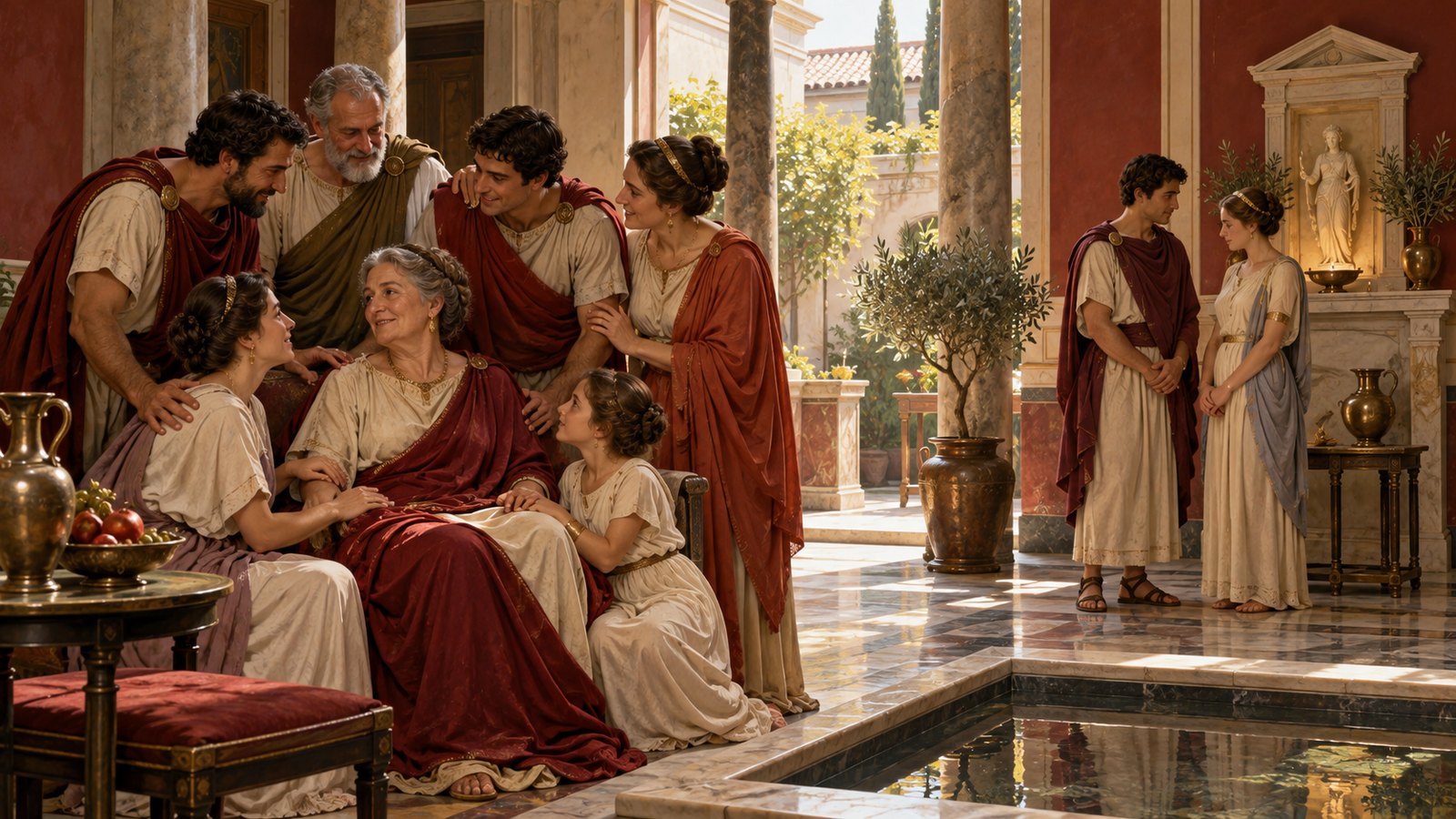
Perhaps the kiss was a privilege, he suggests, one that brought women honour and power when they could be seen to have many good men among their relatives and household.
This version turns the greeting outward.
A woman surrounded by respected kinsmen could make connection visible in public or semi-public encounters. Each greeting marked her place inside a network whose reputation mattered.
The power described here is relational. It does not come from office or military command. It comes from being recognized as connected to men whose standing could reinforce protection and prestige.
The same custom that looked like surveillance under the wine explanation now looks like social credit.
That does not make the system equal. A woman’s honour is still measured through male relatives. Yet she is no longer merely the object inspected. The greeting broadcasts the breadth and quality of her kin.
This may explain why Plutarch pairs honour with power. Repeated acknowledgement could demonstrate that an insult to one person reached a larger family.
It also shows why a small gesture interested an antiquarian writer. Customs organize social boundaries without needing a posted rule. Who may touch, kiss, approach, or refuse can define belonging in seconds.
Plutarch’s alternatives should not be blended into a single invented institution. He is testing different ways the same practice might have acquired meaning.
Wine detection depends on suspicion. The Trojan story depends on remembered reconciliation. The privilege theory depends on visible affiliation.
The fourth possibility depends on where kinship ended and marriage could begin.
The Kiss Stopped Where Marriage Rules Changed
Plutarch finally asks whether affection between blood relations proceeded only as far as a kiss because close kin did not marry.
In this explanation, the greeting marks participation in a family while also defining a boundary. It expresses intimacy without turning that intimacy into courtship.
He then complicates the boundary with a story about cousin marriage.
Formerly, he says, Romans did not marry blood relatives. Even in his own framing, marriage with aunts or sisters remained prohibited.
A later case concerned a man with little property but a strong public reputation. He had married his cousin, an heiress, and was accused of enriching himself through her estate.
The people would not try the charge. Instead, according to Plutarch, they dismissed it and enacted a rule allowing marriage with cousins or more distant relatives while keeping nearer degrees forbidden.
The anecdote does not turn every family kiss into a marriage negotiation. It shows why a neat equation between blood relation and permanent non-marriage needed qualification.
Roman marriage itself could be structured through sharply visible acts. Ten witnesses and a spelt cake made one form of marriage a public ritual. Question 6 instead follows an informal gesture whose meaning depended on who the participants were.
Across the four explanations, Plutarch never gives the reader permission to erase uncertainty.
The wine story is attributed to most authorities. The ship-burning story belongs to a legendary migration told in multiple locations. The prestige theory is a social inference. The kinship theory expands into an anecdote about changing marriage degrees.
That multiplicity is not a flaw to repair. It is the surviving evidence.
An ordinary kiss could be made to explain control inside a household, reconciliation after collective defiance, the public strength of relatives, or the line between family affection and permissible marriage.
Plutarch’s question preserves no neutral gesture. Every answer assigns someone power: the man who detects, the women who appease, the matron whose kin are displayed, or the community that redraws marriage boundaries.
The custom remains uncertain. The structures projected onto it are unmistakable.
Sources
Plutarch, Roman Questions, 6.