
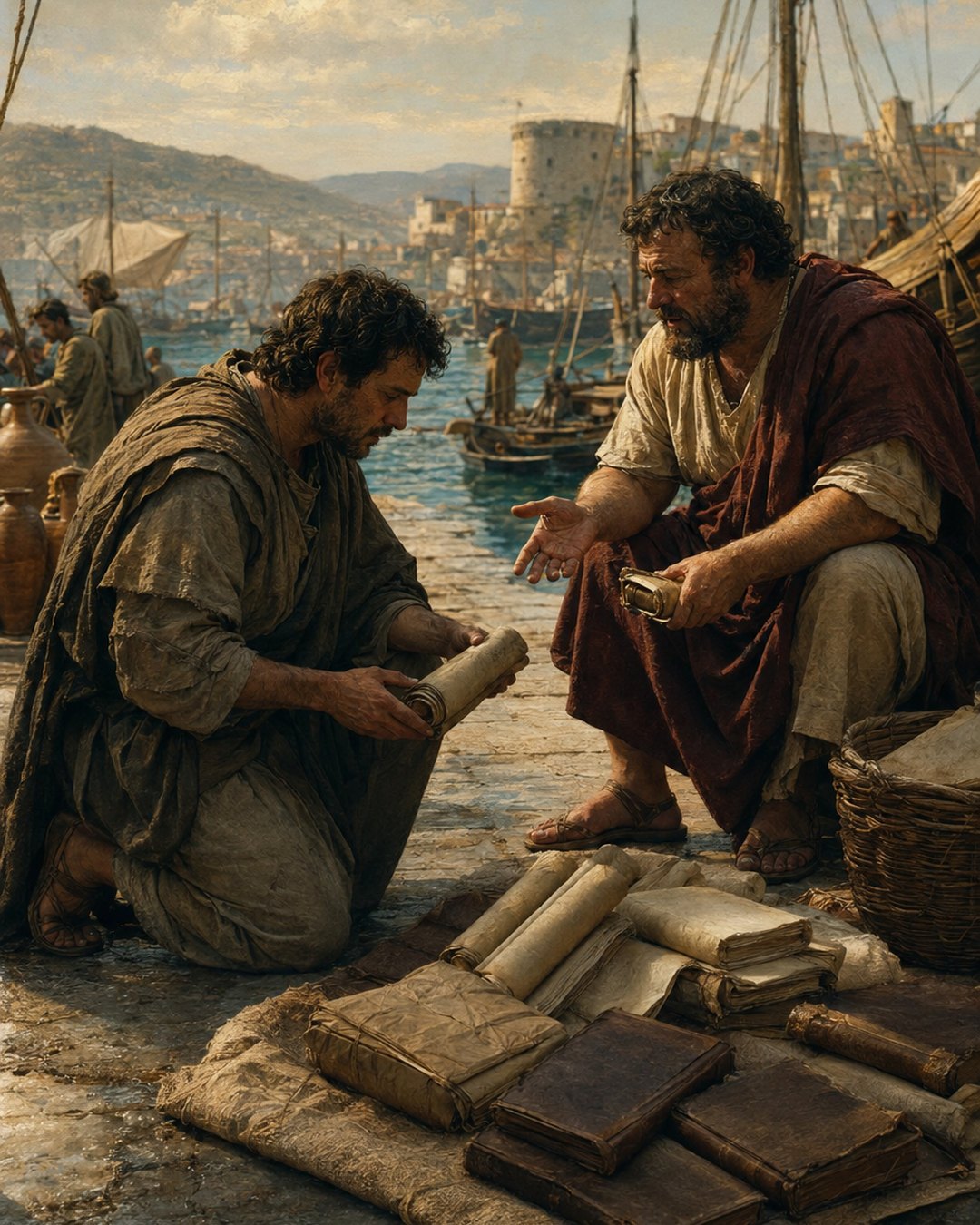
Aulus Gellius came ashore at Brundisium and found a cargo more tempting than the amphorae and rope around it. Bundles of books had been spread out for sale in the port. They were Greek, old, filthy from neglect and physically unattractive. Their price was unexpectedly low.
Gellius bought a large number for a small sum. During the next two nights, he hurried through every volume, pulled out claims that struck him as remarkable, and copied selections into his own notes. The battered lot did not survive merely because a collector rescued it. It survived selectively because a reader processed it.
The episode in Attic Nights 9.4 gives ancient scholarship a marketplace, a smell and a deadline. Learning moved through a port bookstall, damaged stock, bargain pricing, lamplight and the decisions of one tired traveler about what deserved another page.
Brundisium Put Books Beside Ordinary Cargo
Gellius was returning from Greece to Italy when he disembarked at Brundisium. He calls it a famous port and pauses over an epithet used by the poet Ennius, who had described the place as praepes, “propitious.” Gellius thought the expression unusual but fitting.
That setting matters. Brundisium connected sea routes with the roads of Italy, so travelers, goods and information repeatedly changed transport there. Gellius did not visit a formal library in the passage. He was strolling after landing when the bundles caught his eye among the transactions of a working harbor.
The books were exposed for sale, and he rushed toward them. His reaction marks him as the sort of buyer a dealer needed: someone who could recognize names and value content beneath a poor surface. No catalogue or polished shop intervenes in his account. The physical bundle itself was the invitation.
Ports could turn unwanted possessions into opportunities because sellers and buyers arrived with different knowledge and urgency. The books may have been old, but Gellius gives no provenance and does not identify their previous owner. We know only the condition in which the market delivered them to him.
Neglect Made Ancient Authority Look Worthless
All the volumes were Greek and full of tales Gellius labels marvelous, unheard-of and incredible. Their authors included Aristeas of Proconnesus, Isigonus of Nicaea, Ctesias, Onesicritus, Philostephanus and Hegesias. He considered the writers ancient and not without authority even while warning readers about their extraordinary claims.
The contrast between intellectual pedigree and physical condition drives the purchase. The books were filthy after long neglect, damaged and ugly. A prestigious name did not guarantee a prestigious object. Texts could reach the market in a state that made them look closer to refuse than treasure.
That vulnerability helps explain why ancient reading often survives through quotation rather than complete books. Gellius’s own article on how beans returned to Pythagoras’s table likewise preserves an argument by selecting among earlier authorities. A later reader’s excerpt could outlive the volume from which it came.
Gellius does not claim that grime proved authenticity. He valued the combination of age, named authors and unfamiliar matter, not dirt by itself. The neglected appearance changed the price; his education changed what the low-priced objects could become.
A Small Sum Bought Two Nights of Work
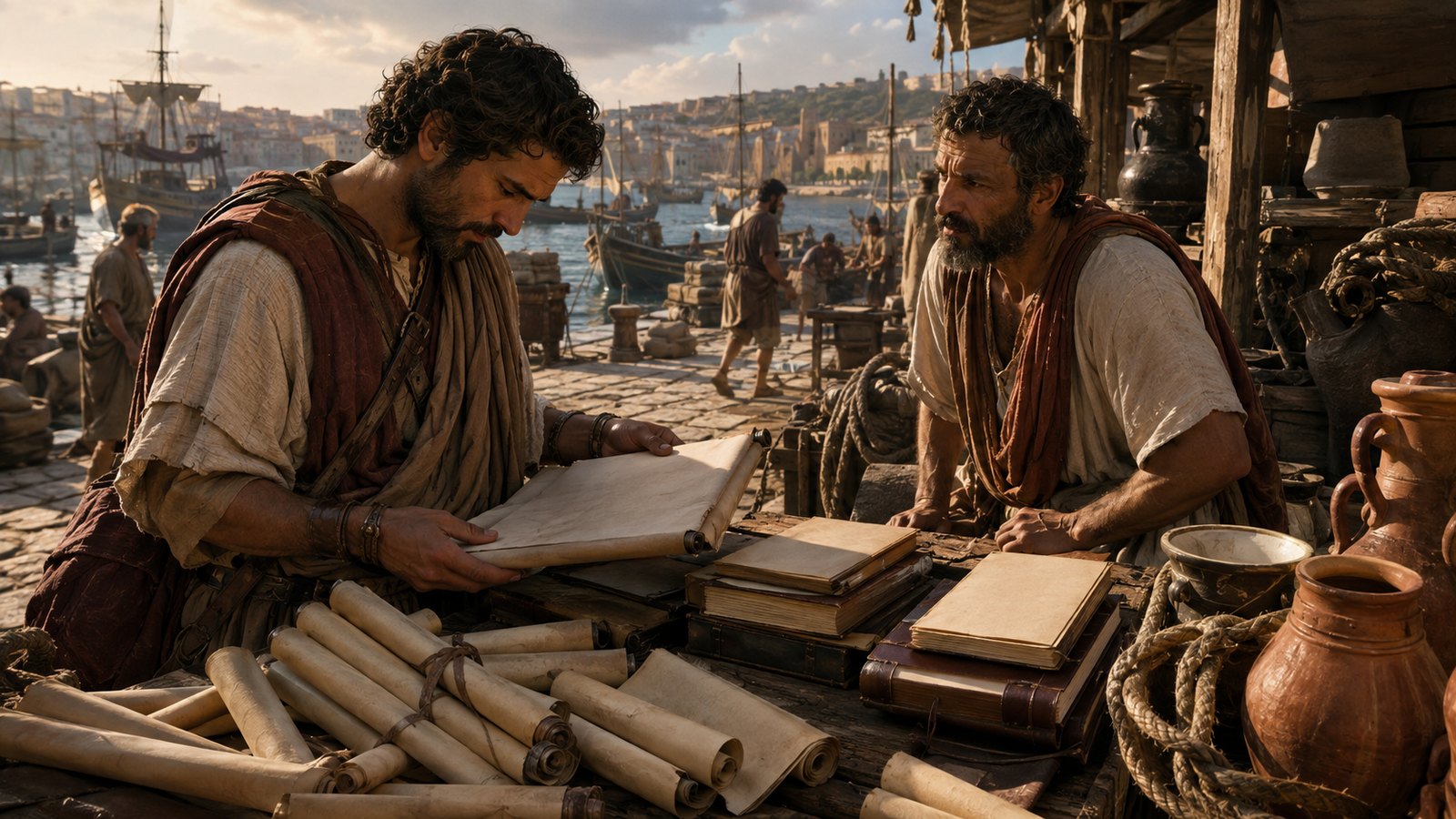
After asking the price, Gellius was drawn by its extraordinary and unexpected cheapness. He bought many books for little money. The wording makes the bargain relative rather than giving coins we could convert. Any precise modern price would be invented.
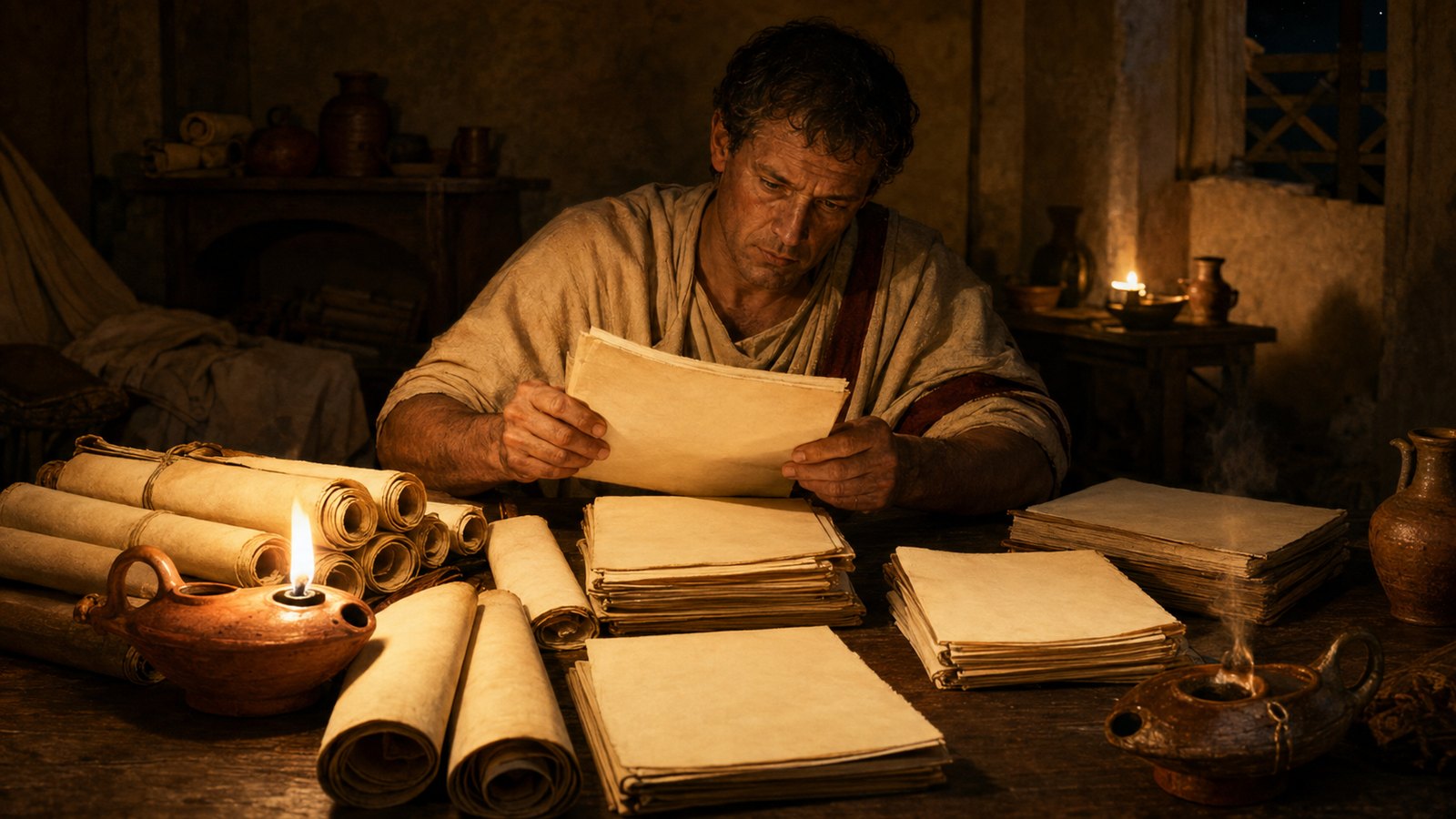
Low cost did not mean low effort. Gellius says he ran rapidly through all the volumes during the following two nights. The phrase suggests triage rather than leisurely mastery. A large, uneven purchase had to be inspected while it was still fresh and perhaps before onward travel resumed.
The named writers also made the task harder than simply checking one familiar author. Ctesias and Onesicritus belonged to traditions of describing distant places, while Aristeas and the others offered their own stores of marvels. Gellius had purchased a mixed archive in miniature. To move through it in two nights, he had to compare unfamiliar claims across multiple voices without the aid of a modern index.
Two oil-lit nights are the hidden labor behind the anecdote’s monsters and marvels. He had to keep moving, decide what was new to him, distinguish a notable claim from repetition, and transfer enough information for later use. The bookseller sold objects; the reader manufactured retrieval.
Pliny’s household used a different reading machine. In the routine where a reader followed Pliny through bath and dinner, spoken text protected study time inside a planned day. Gellius’s Brundisium sprint was irregular and opportunistic, but both episodes show reading organized by bodies, hours and supporting material rather than floating free of them.
Selection Turned Damaged Volumes into Notes
Gellius did not copy everything. As he read, he culled and wrote down items he considered remarkable and mostly unmentioned by native Latin authors. Those decisions created a filter between the Greek bundles and his eventual audience.
The filter had at least three parts. A claim needed to catch his attention, seem uncommon in Latin writing and fit the miscellaneous notebook he was building. Material that failed any of those tests could vanish from his account even if it occupied pages in the purchased books.
His reference to “native writers” reveals the comparison guiding the selection. Greek language alone did not make an item useful; novelty within the Latin reading world did. The port purchase supplied matter that could cross both a sea route and a language boundary, but Gellius controlled the crossing by deciding what his Roman audience was unlikely to have encountered.
He then inserted the chosen items “here and there” in his notes. That phrase describes the architecture of Attic Nights: learning arranged in varied entries rather than one continuous argument. The port purchase became distributed raw material, resurfacing where the compiler thought it would surprise or equip a reader.
Gellius states an educational purpose with a trace of humor. He wanted readers not to be wholly ignorant or to have never heard of the strange matters he recorded. The promise was limited. His excerpts would make them acquainted with claims, not certify every marvel as fact.
The Compiler Survived the Books He Bought
We cannot reconstruct the entire Brundisium bundle from Gellius’s selections. His list of authors identifies the intellectual neighborhood, while his own chapter admits that he skimmed quickly and chose selectively. The original order, omissions and physical forms remain beyond recovery.
That loss is precisely what makes the anecdote valuable. It shows one path by which ancient information crossed a survival bottleneck. Books reached a port damaged; cheapness moved them to a knowledgeable buyer; concentrated reading reduced them to excerpts; a new composition carried some of those excerpts forward.
The process also complicates the idea of authority. Gellius respected the antiquity of the authors but openly called their stories incredible. Preservation did not require belief. A compiler could save a claim as something worth knowing about while withholding confidence in its truth.
Brundisium’s dealer could not know which sentence would travel farthest. The battered books were merchandise for a moment, then working material for two nights, then sources scattered through another book. Their cheapest sale became their longest voyage.
Sources
Aulus Gellius, Attic Nights 9.4.