
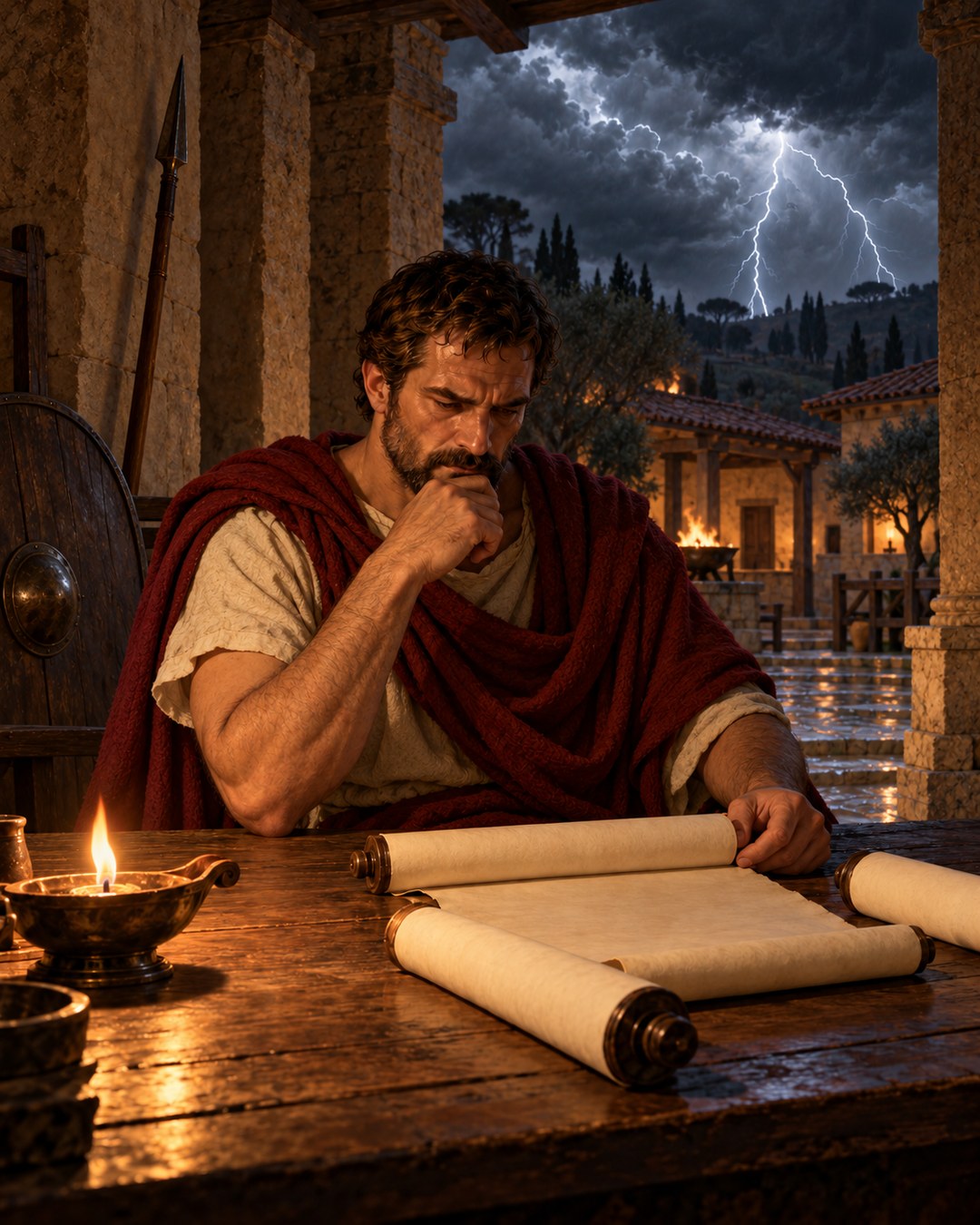
A king who had spent his reign treating war as the healthiest work for Roman bodies eventually locked himself indoors with another king’s ritual instructions. Livy says Tullus Hostilius found a secret ceremony for Jupiter Elicius in the commentaries of Numa. He attempted it, performed it incorrectly and burned with his house when lightning struck.
The ending is violent, but the story reaches it through several changes of scale. Stones fall on a mountain. A voice recalls displaced Albans to forgotten rites. Rome establishes a nine-day observance. Disease enters the city and then the king’s own body. Only after public signs and public sickness does Tullus try to make religious knowledge serve him in private.
A stone shower demanded witnesses
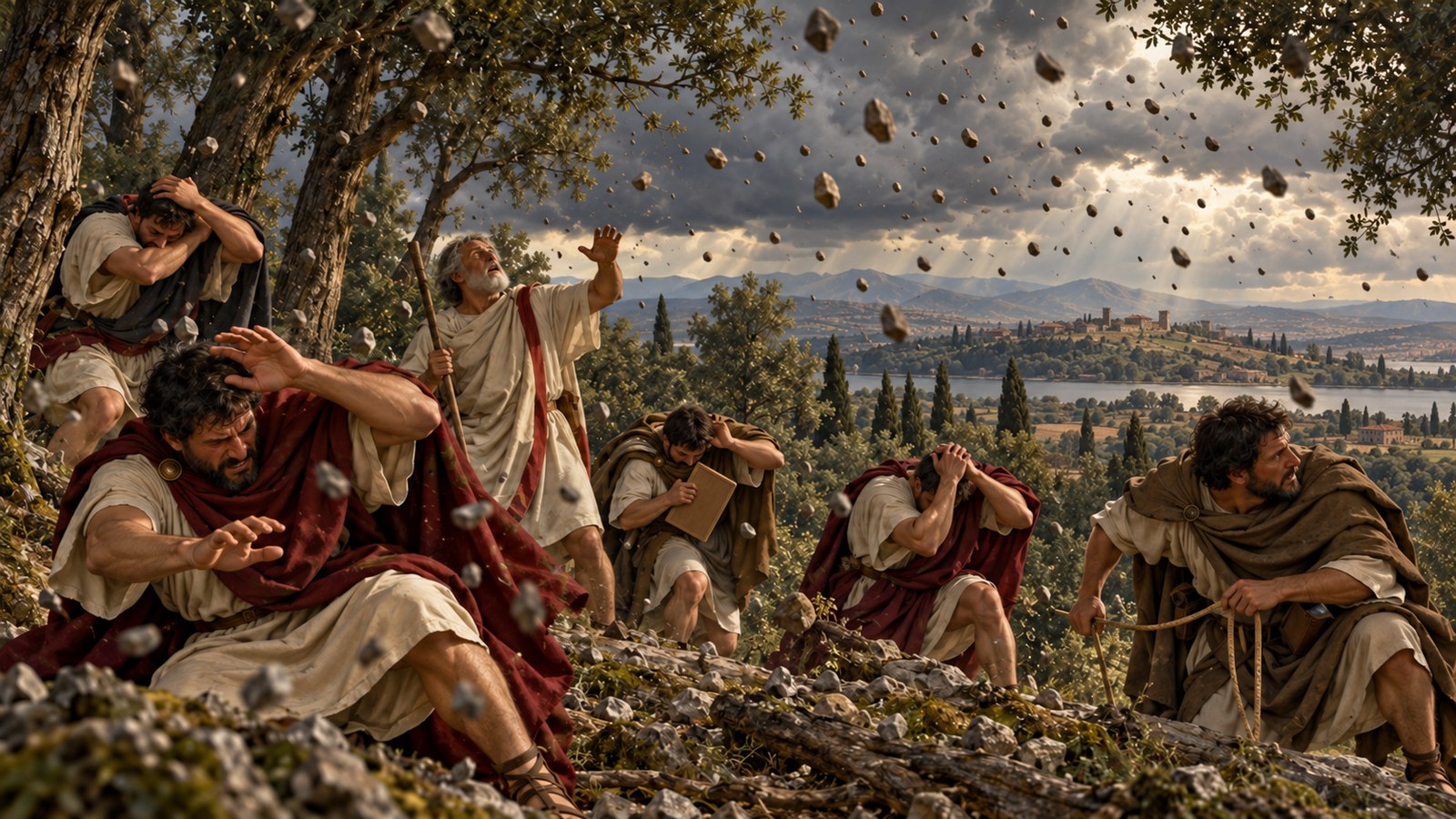
Livy places the first report after Tullus had defeated the Sabines and raised both his own reputation and Rome’s. Word reached the king and senate that it had rained stones on the Alban Mount. The claim was strange enough that officials did not accept it at once.
People were sent to investigate. In their presence, Livy says, a thick shower of stones fell from the sky like hail driven into hard balls by the wind. The verification matters inside the narrative. A rumour from a conquered landscape became a witnessed prodigy that Roman government had to classify.
The mountain was not an empty backdrop. Alba Longa had been destroyed under Tullus, and its people had been transferred to Rome. A voice believed to come from the grove at the summit ordered the Albans to perform the religious service of their native country. Livy explains the rebuke: the rites had fallen into oblivion as though gods and homeland had been abandoned together.
That command made memory a civic obligation. Moving people did not automatically move every practice that had held their old community together. The story of the blood-tipped spear used to formalize a Roman declaration of war shows ritual controlling action across a boundary. Here a voice from a former homeland accused a transferred population of letting its own boundary disappear.
Nine days turned alarm into procedure
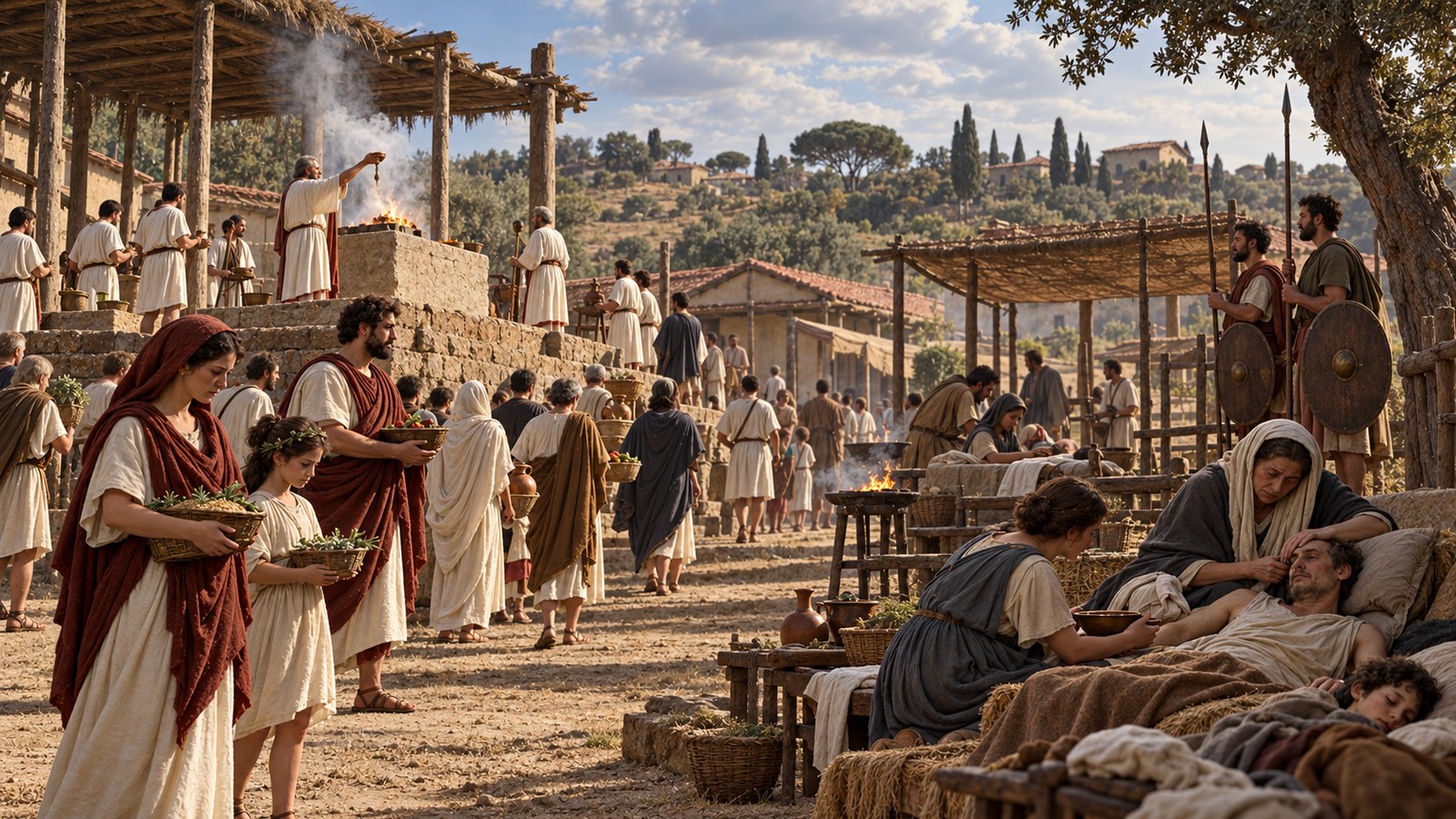
Rome answered the prodigy with a public festival lasting nine days. Livy leaves two explanations in view. The observance may have followed the heavenly voice from the Alban Mount, or it may have been established on the advice of diviners. He refuses to close the uncertainty.
What he does present as certain is repetition. Whenever the same prodigy was announced, a nine-day festival was observed. A singular shower therefore produced a reusable civic response. The calendar absorbed the shock.
This is different from knowing which god had acted. In another Roman response preserved by Aulus Gellius, officials left the deity unnamed after an earthquake so an incorrect dedication would not create a second fault. Both episodes value procedure under uncertainty. The stone shower receives measured time even though Livy preserves competing accounts of who advised it.
The nine days also separate collective action from the king’s later experiment. Rome did not begin with Tullus alone summoning a god. It began with witnesses, advice and a public observance capable of being repeated. The city’s response had form before the king’s private fear had a remedy.
Pestilence broke the warlike answer
Not long afterward, Livy says, a pestilence struck. Young men became reluctant to serve, but Tullus granted no respite from arms. He believed their bodies were healthier abroad than at home. The claim fits the portrait of a ruler who trusted campaigning more readily than religious attention.
Disease then reached the king. Livy describes a lingering illness that broke his fierce spirit together with his body. The reversal is deliberately sharp. Tullus had once considered nothing less worthy of a king than devoting his mind to religion; now he became absorbed in every kind of religious concern, great and small.
Livy’s vocabulary makes this a political change as well as a personal one. The king filled the people’s minds with scruples too. A ruler’s altered fear did not stay inside his sickroom. It changed the emotional weather of the city.
Romans around him looked back to Numa’s reign. They imagined that peace and divine pardon might offer the only relief left to sick bodies. The contrast between kings became a contrast between governing methods: Tullus had pursued health through deployment, while memory now pointed toward the ceremonies of Rome’s peaceful lawgiver.
Numa’s book did not transfer Numa’s control
Tullus turned over Numa’s commentaries and found instructions for secret and solemn sacrifices to Jupiter Elicius. Written preservation gave him access to a rite associated with his predecessor. It did not give him mastery of the rite.
Livy says the king shut himself away and began the ceremony. This is the most compressed scene in the chapter. No assistants, implements or spoken formulae are safely described. Supplying them would create a ritual that Livy does not preserve. The essential fact is failure of performance: the rite was not duly undertaken or conducted.
The distinction is severe. Tullus could locate the text, identify the god and decide to act. None of those steps guaranteed correctness. Roman ritual in this story was not a charm activated by ownership of a book. Sequence, competence and exact observance remained decisive even when the performer wore a crown.
That makes the commentaries an instrument with limits. They preserve knowledge, but they cannot replace formation. Numa’s authority had rested in institutions and habits built across a reign. Tullus approached the record only when disease made a quick answer desirable.
Lightning made the failed rite the verdict
No heavenly notification appeared. Instead, Livy says, Jupiter’s anger at the faulty ceremony brought lightning upon Tullus. The king and his house burned to ashes. The hoped-for sign arrived as destruction rather than confirmation.
The tale is not evidence that historians can reconstruct an actual divine encounter. Livy is narrating Rome’s regal past, where prodigy and political character explain one another. Its historical value lies partly in the logic Romans gave ritual failure: a ceremony could be dangerous precisely because it was thought effective enough to demand accuracy.
Livy closes by giving Tullus thirty-two years of rule and great military renown. That praise keeps the ending from erasing his achievements. It also refuses to let achievement excuse incompetence in another sphere. A successful war king could still fail at the act he chose when war no longer answered his fear.
The sequence leaves a disciplined warning. The Alban sign had been witnessed, discussed and converted into a recurring public observance. Tullus’s own response narrowed everything to a sick ruler, a borrowed book and a secret attempt. He wanted Numa’s access to Jupiter without first acquiring Numa’s command of the rite. In Livy’s architecture, the house burns at the point where written memory is mistaken for practiced authority.
The order of the chapter also keeps public and private evidence apart. The mountain prodigy is investigated by people sent out to see it. The king’s final ceremony happens after he shuts himself away. Readers receive the official response to the first event, but they can know the second only through the catastrophic result Livy assigns it. Secrecy narrows the opportunity for correction before the error becomes irreversible.
Nor does the story let renewed religiosity count automatically as wisdom. Tullus becomes intensely observant only after his own prolonged illness. Fear can change behavior without supplying competence. The king’s zeal expands, but the discipline needed to enact the recovered ritual does not appear with it. That gap between urgency and preparation drives the final scene.
Sources
Livy, History of Rome, 1.31.