
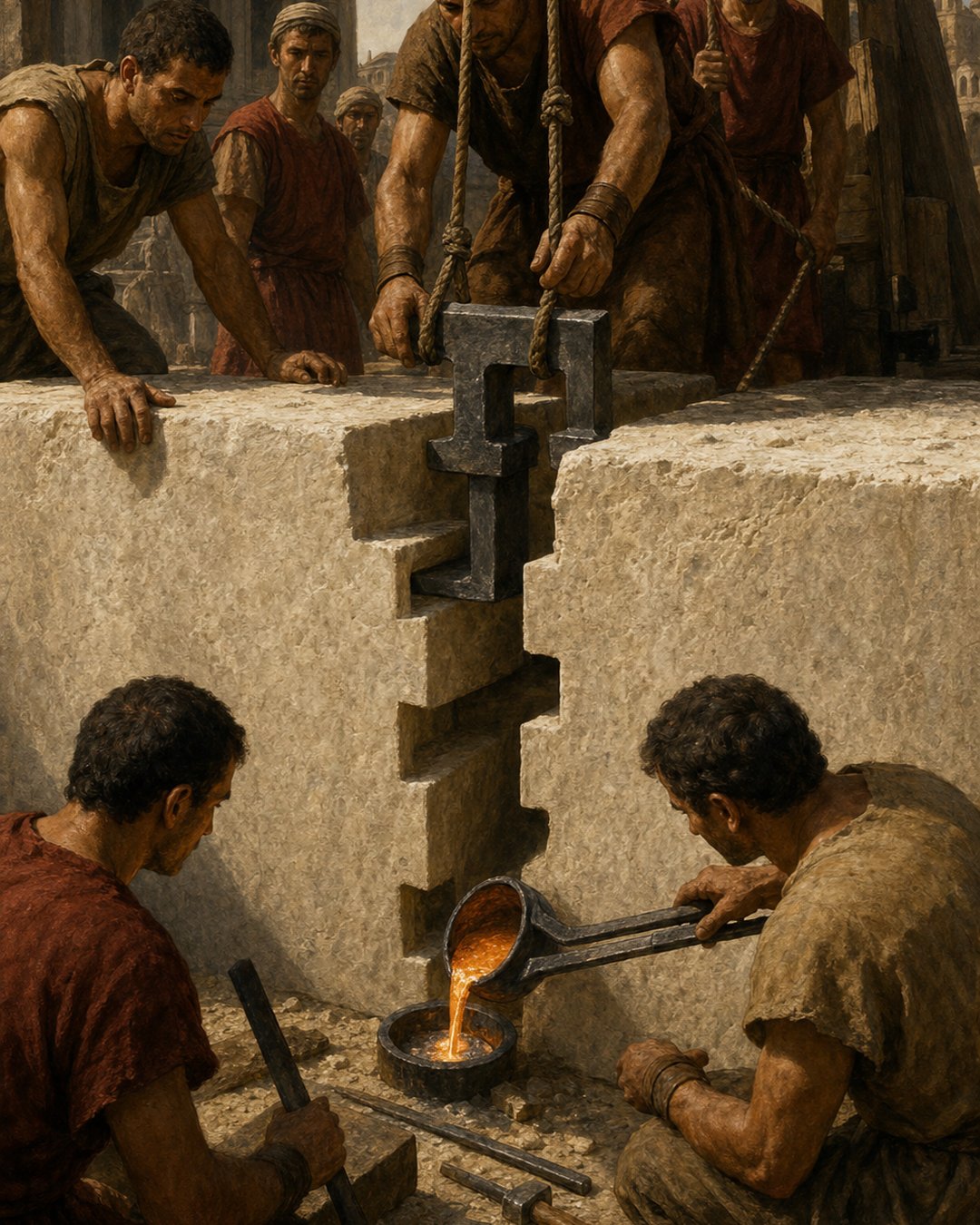
A Roman monument could look as if gravity alone had persuaded every block to stay. Inside many joints, however, iron crossed from one stone to the next. The Art of Making project says most blocks in large Roman monuments were fixed to neighbors with metal clamps and pins, usually iron protected and secured with lead.
The fastening system was deliberately hidden. Masons cut sockets, placed the metal tie, wrapped iron in lead to limit rusting, and set it in molten lead. Once the next course and finished surfaces concealed the joint, viewers saw uninterrupted stone rather than the small pieces of metal that helped it behave as one structure.
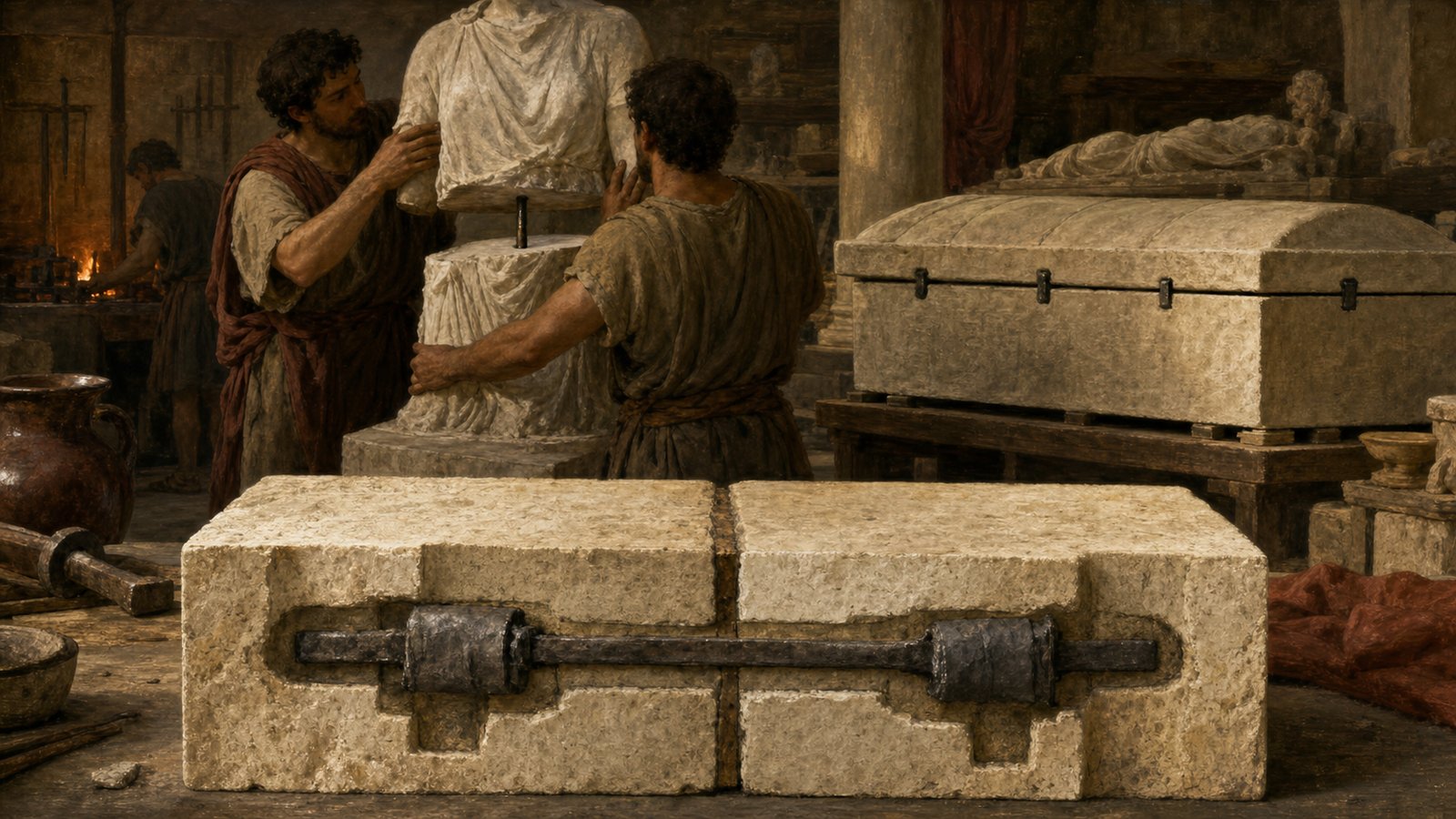
The same logic served different objects. Clamps and pins joined separate blocks in statues, while sarcophagus lids could be secured against robbery. Monument, image and coffin all relied on a controlled boundary: stone met stone, and a concealed metal connection made that meeting harder to undo.
Large Blocks Needed More Than Their Own Weight
Heavy masonry resists movement, but mass does not abolish joints. Blocks can slide, edges can lift, and repeated loads can exploit a narrow discontinuity. A clamp crossing the meeting line gives two stones a shared resistance that neither surface contact nor downward weight provides by itself.
Art of Making describes this as normal rather than exceptional: most blocks in large monuments were fixed to neighbors using a combination of clamps and pins. The wording places metal fastening inside the standard grammar of Roman monumental building.
A clamp primarily links across a joint, while a pin can register or secure pieces through another orientation. Their combined use answers several directions of movement. The exact arrangement changes with the block, but the principle remains that the connection must pass through prepared stone on both sides.
This extends the sequence in Roman quarry work. Extraction creates movable units. Hidden fastening solves the later problem of making those units surrender some independence after they reach the monument.
The location of a socket also had consequences for future stonework. It needed enough surrounding material to resist the pull without splitting an exposed edge, yet it had to align with its partner across the seam. Fastening therefore began as a decision about stone geometry before any iron or lead entered the recess. The apparently minor hollow belonged to the monument’s load path.
Lead Stood Between Useful Iron and Destructive Rust
The project notes that iron clamps were usual, but that they tended to be wrapped in lead to prevent rusting. Iron supplies tensile strength; lead provides a barrier and a fitting medium. One metal performs the structural tie while the other protects and beds it.
This protection mattered because rust expands and can damage surrounding stone. A clamp intended to preserve a joint can become a wedge if corrosion increases its volume inside a tight socket. Isolating the iron reduces the chance that the fastener creates the fracture it was meant to prevent.
Lead also conforms. Wrapped around an irregular iron shape, it can occupy small gaps that a rigid clamp cannot. The soft metal distributes contact rather than forcing every load through one sharp corner of a carved recess.
The result is a layered component hidden inside the monument: stone socket, lead envelope and iron core. Roman builders did not ask one material to provide every property. They combined hard strength, soft fit and massive masonry at the point where their different weaknesses met.
Molten Lead Turned a Carved Socket into a Tight Seat
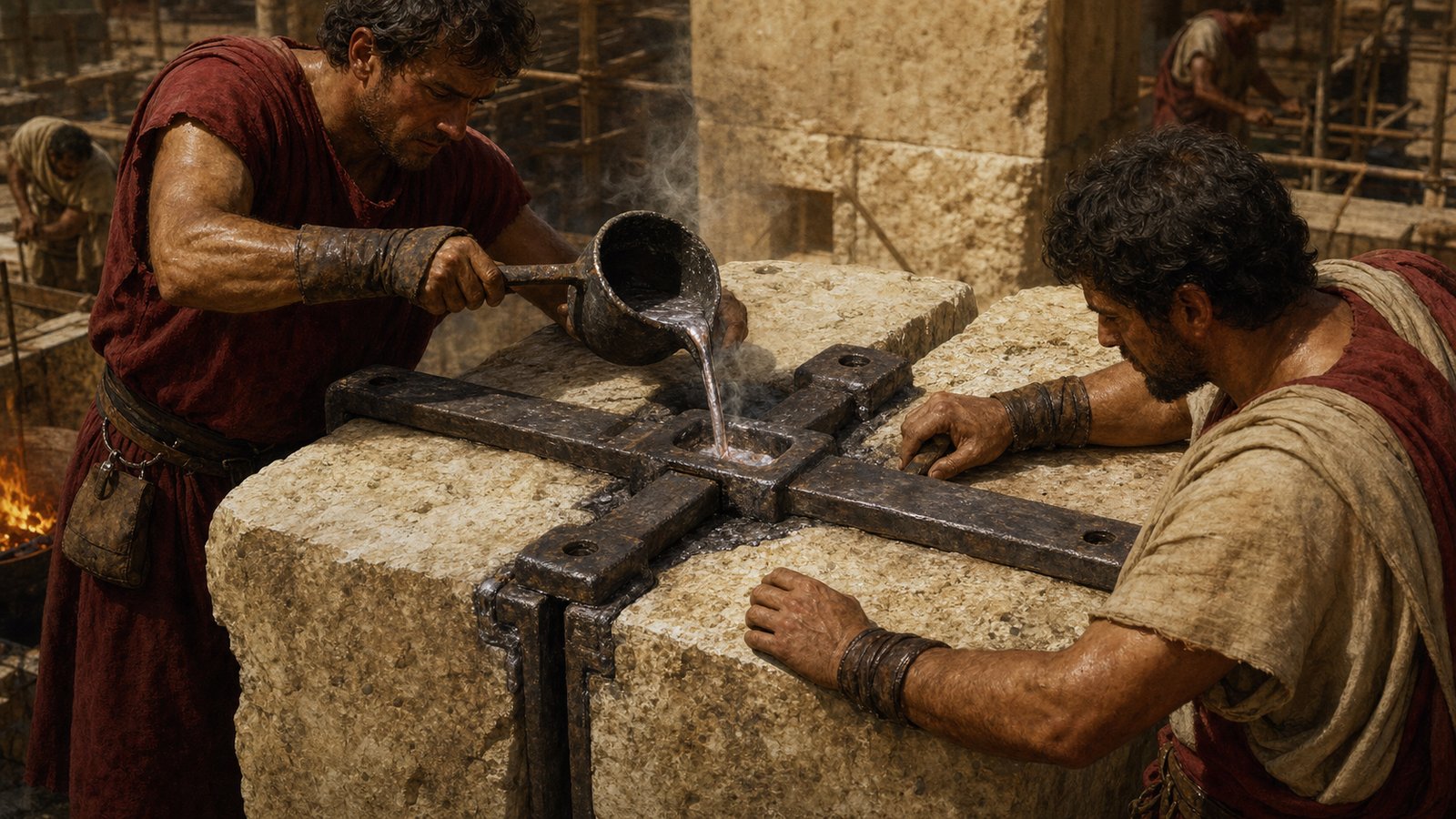
Art of Making adds that clamps were set in molten lead to hold them in place. The liquid could enter the prepared space around the iron and then solidify, locking the tie into a seat fitted to both metal and stone.
The operation required order. The sockets and connecting channel had to exist before the clamp was fixed. Alignment had to let the metal reach both blocks. Lead then had to be placed without leaving the tie loose or spilling across a finished face.
Once cooled, the setting reduced play. A clamp that rattles inside an oversized recess only begins resisting after movement has already occurred. Filled lead brings the parts into closer mechanical cooperation from the start.
The hidden pour resembles other Roman uses of fluid material to solve irregular geometry, but it is not ordinary mortar. Here a metal setting secures a discrete iron fastener inside shaped stone. The joint is local, engineered and meant to disappear beneath later assembly.
Multipart Statues Were Joined Before They Looked Whole
Metal clamps and pins also pieced together statues made from different blocks, according to the source. A viewer may read one body or draped figure, yet production, stone availability or assembly could require several pieces that met behind folds and attachments.
Joining blocks expands what can be made and repaired. A projecting limb or separate element need not emerge from the same massive stone as the torso. The price is a joint that must carry weight and resist rotation without drawing attention away from the image.
Pins locate one part against another while clamps can resist separation across a seam. Surface finishing then suppresses the evidence. Successful fastening lets the eye follow anatomy or cloth rather than hardware.
This connects to the callipers used to preserve sculptural proportion, scheduled earlier. Callipers govern relationships while material is removed; pins and clamps preserve relationships after separately carved pieces are brought together.
A Sarcophagus Lid Turned Fastening into Security
Art of Making records another use: clamps and pins secured sarcophagus lids and helped prevent contents from being robbed. The joint now had a human adversary. Its purpose was not only to survive settling but to make deliberate opening slower and harder.
A stone lid is already heavy, yet weight can be defeated with leverage and several people. A concealed metal connection changes the problem. Raising the lid requires breaking or extracting fasteners whose positions may not be obvious from outside.
This practical defense stood beside inscriptions, imagery and ritual claims. A sarcophagus could proclaim identity and memory while its hardware quietly protected the physical remains and offerings enclosed within.
Roman funerary inscriptions show how stone made a life publicly legible. Clamps served the opposite visual role. They guarded the container precisely by remaining unreadable.
The Strongest Part of the Joint Was Meant to Vanish
Finished monumental architecture encourages the fiction that stone is naturally continuous. Clamps expose the construction behind that effect. Blocks remained blocks, but hidden ties made their boundaries less mechanically decisive.
The system also records maintenance risk. If water reached the iron and lead protection failed, corrosion could betray the joint. Ancient fastening was not magical permanence; it was a calculated defense against known directions of movement and material decay.
What survives may show clamp sockets after metal was removed, robbed or corroded away. An empty recess can therefore reveal a connection more clearly than the completed monument did. Absence maps where strength once crossed the seam.
Roman monuments hid an iron skeleton because the visual claim belonged to stone. Lead-wrapped clamps, poured settings and pins performed their labor beneath that claim. The larger and more seamless the masonry appeared, the easier it was to overlook the small metal bridges holding neighboring pieces in agreement.
Sources & Further Reading
- Art of Making, “Tool: Metal clamp/pin”
- Wikipedia, “Lewis (lifting appliance)”