
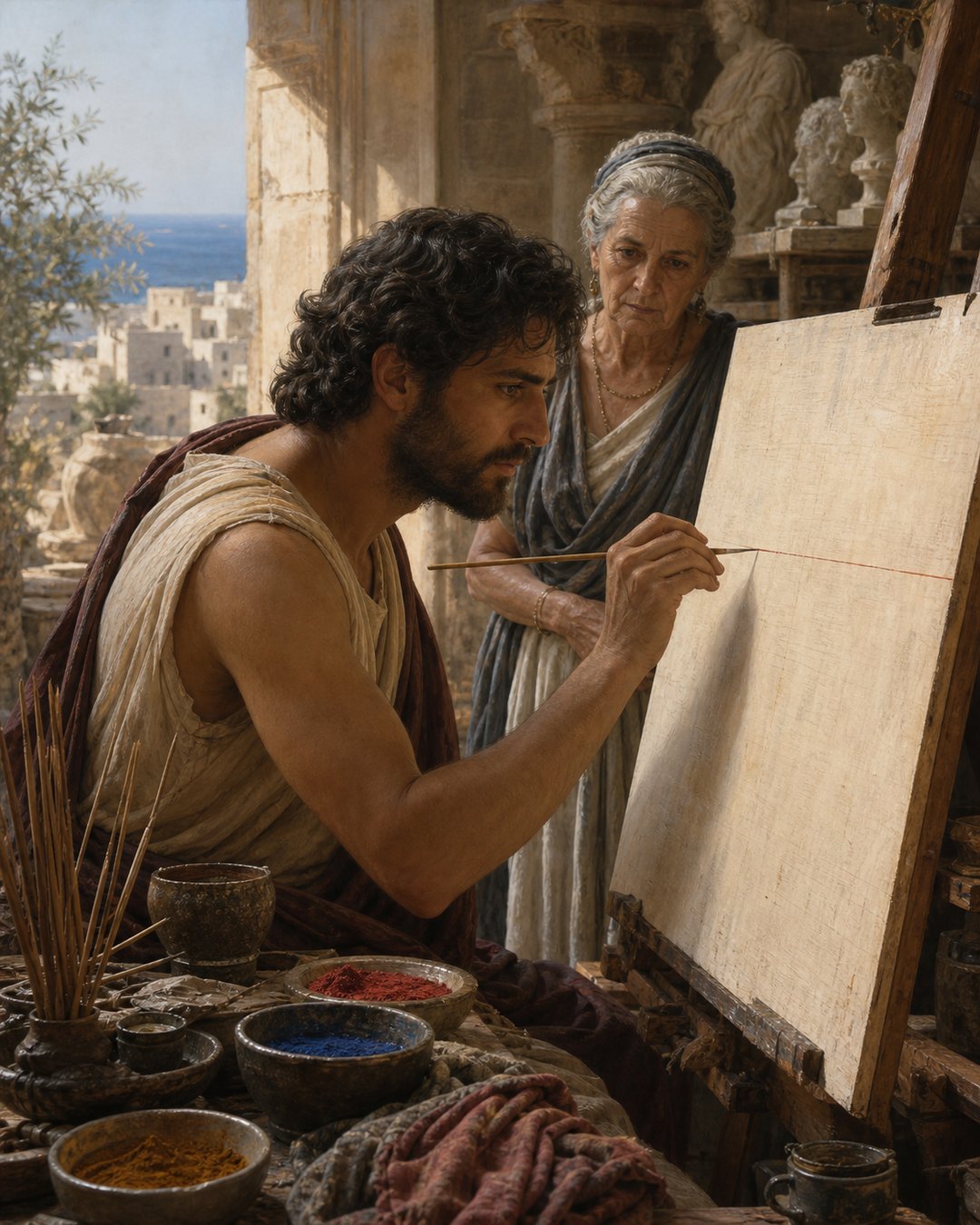
Apelles reached the workshop on Rhodes and found the painter absent. An old woman guarded a large prepared panel resting on an easel. She asked whom she should name when Protogenes returned.
Apelles did not give her a name. He took a brush and drew one extraordinarily fine colored line across the panel. When Protogenes came home, he looked at the stroke and said the visitor could only have been Apelles.
Then he answered it.
Pliny the Elder’s story proceeds through three lines, three colors and two artists who do not initially share the room. Protogenes places a finer line over the first. Apelles returns, sees the reply and adds a third so fine that no space remains for another improvement. The almost empty panel becomes a contest, a signature and eventually a celebrated object in its own right.
An absent painter received a technical calling card
Apelles and Protogenes belonged to the highest level of Greek painting remembered by Roman writers. Apelles was linked with Alexander the Great; Protogenes with Rhodes. None of the famous easel paintings described by ancient authors survives securely for us in its original form, so Pliny’s words carry unusual weight.
His encounter begins with delay. Apelles had sailed to Rhodes because he wanted to see Protogenes and his work, but the visit did not produce an immediate conversation between masters. The elderly keeper and the prepared panel were all he found.
That absence gives the first line its function. A written name would merely report identity. The stroke demonstrates it. Protogenes can infer the visitor because the hand has achieved a degree of control associated with one rival alone.
The scene belongs to a world in which painting could announce status publicly, as Fabius Pictor’s signature in a Roman temple would do in a different civic setting. Here there is no temple audience and no inscription. Recognition happens inside the workshop through craft evidence.
The old woman’s role is easy to miss. She cannot identify the visitor through court rank or an announced entourage, but she can preserve his mark and report the circumstances. The panel lets an encounter survive the missed appointment. Material, witness and technique together carry a message that spoken introduction never did.
Apelles also chooses a test suited to another painter rather than to a patron. A patron might ask for recognizable figures, costly color or an impressive subject. The visitor leaves the smallest unit from which all those things depend: a controlled stroke. His economy assumes that Protogenes will know what difficulty has been compressed into it.
Protogenes answered in another color
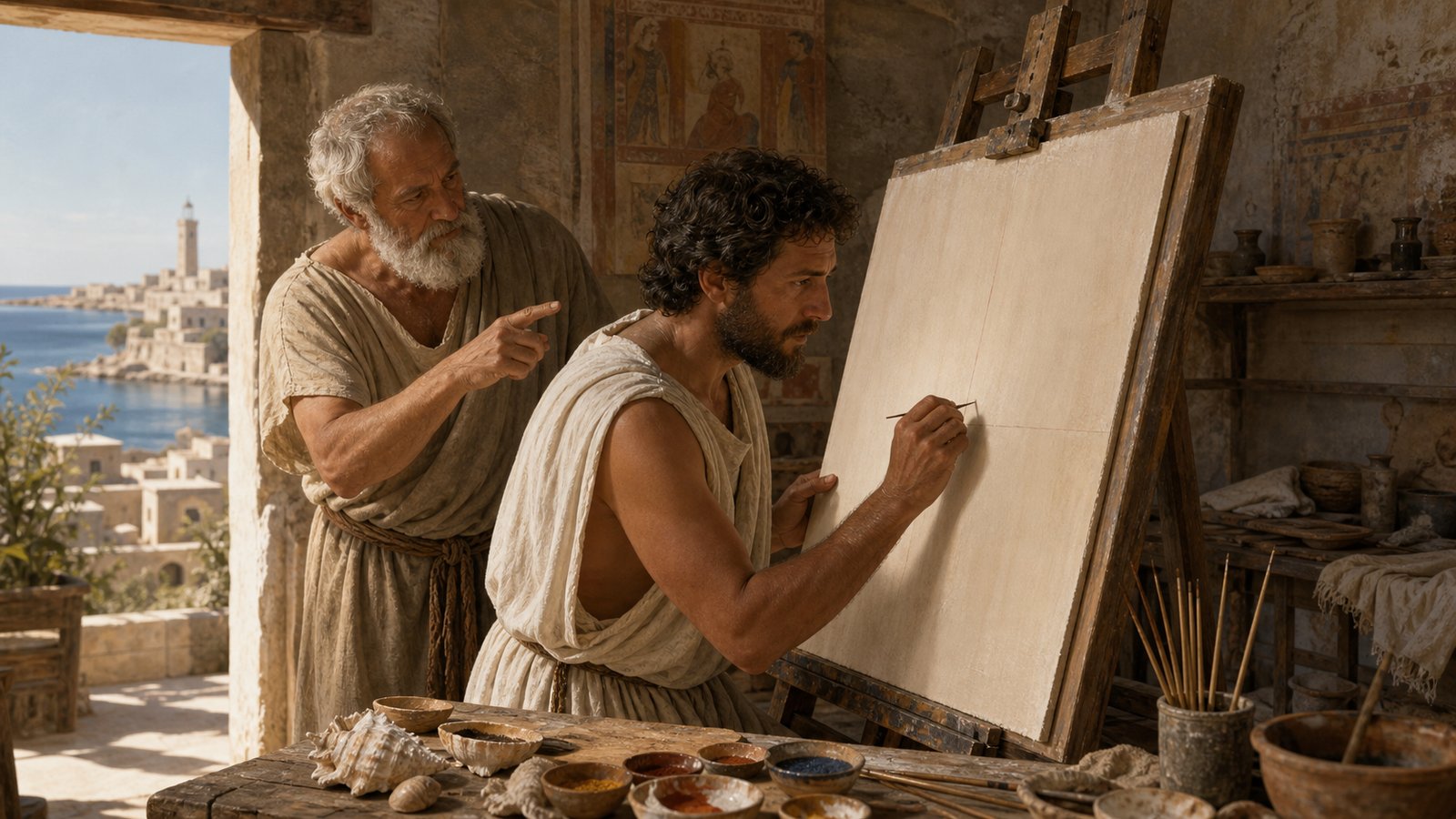
Protogenes does not accept the line as an unanswerable marvel. According to Pliny, he takes another color and draws an even finer line. Color separates response from challenge. Without that distinction, the eye could not easily assign the strokes or understand the sequence.
The reply is both welcome and resistance. Protogenes knows who has visited, admires the achievement and still insists that his own hand can go further. He tells the keeper to show the new line if Apelles returns. The panel has become correspondence conducted through pressure, width and placement.
No messenger needs to explain the stakes. Each painter understands that the relevant measure is not the area covered or the number of figures completed. It is control at the edge of visibility. A large composition can hide uncertainty inside detail. A single line exposes every tremor, change of pressure and failure of the brush.
Pliny’s language pushes the feat toward the superlative, and modern readers cannot test the lost panel. The story is not a laboratory record of line widths. It is evidence for what Roman art writing wanted mastery to look like: confidence compressed into the least possible mark.
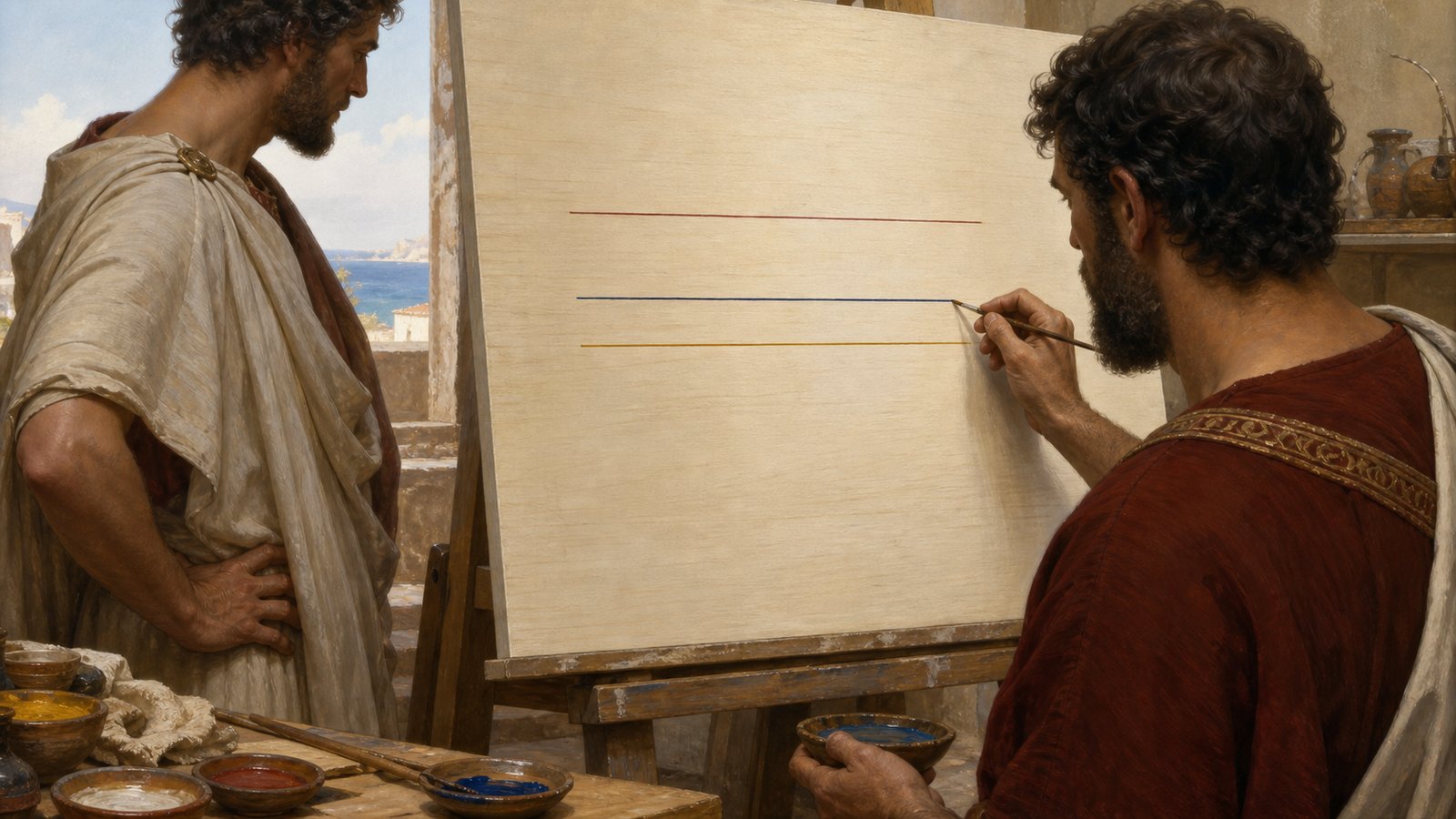
Different colors made time visible. The panel did not merely hold three marks at once; it preserved an order of moves. A viewer could follow the first claim, the reply and the final intervention without having watched any of them being made. In that sense the surface functioned like a record of performance, with pigment separating each speaker.
The third stroke closed the available space
Apelles returns and finds Protogenes’ answer. He chooses a third color and draws again. Pliny says the new stroke leaves no room for further refinement. Protogenes concedes and goes to meet him.
The geometry is difficult to reconstruct from translation alone. The lines may have run within or across one another, and later retellings often make the visual arrangement sound more certain than the text allows. The essential sequence is secure: first challenge, finer reply, final stroke, no possible continuation.
That ending matters because the contest has no judge standing beside the easel. Protogenes judges the third line himself. Defeat is not imposed by a crowd choosing a favorite scene. It is acknowledged by the only viewer whose skill makes the result fully legible.
The exchange therefore differs from the portraits explored in painted faces attached to Egyptian mummies. Those images connect representation to identity and burial. The line panel represents almost nothing beyond the act of painting. Its subject is trained control.
Protogenes’ concession gives the contest an ethical shape as well as a technical ending. Pliny does not need a third authority to rank the men. The defeated painter is expert enough to recognize the limit and secure enough to meet the rival who reached it. Professional judgment closes what professional rivalry began.
Artists saw abundance in an almost empty panel
Pliny says the panel was handed down and admired, particularly by artists. That qualification is the heart of the anecdote. An uninstructed visitor might see three colored lines and wonder why a bare surface survived among finished pictures. A painter could see the difficulty, sequence and professional conversation stored in them.
The object tested connoisseurship. To value it was to claim an eye capable of distinguishing excellence where narrative, expensive pigment and monumental scale offered no help. The less the panel displayed to ordinary sight, the more status attached to understanding it.
Preservation changed the contest again. What began as a temporary message in a working studio became an object carried, displayed and explained to later viewers. Its story was inseparable from its appearance: without the account of who drew each color, the marks would lose the sequence that made them famous. Craft and narrative had to travel together.
Its later setting deepened the irony. Pliny reports that the work eventually stood in Caesar’s palace on the Palatine, where it was destroyed by fire. A portable workshop challenge had traveled into the center of Roman imperial display. The palace collected not a grand battle or divine procession but the material remainder of two absent Greek masters measuring one another.
Fire erased the evidence, leaving Pliny’s description to do what the panel had once done: ask readers to imagine precision finer than they can verify. We should resist converting literary admiration into exact technical data. Yet the survival of the story shows that Romans could build an entire history of art around gesture, rivalry and the educated eye.
The first line announced Apelles without letters. The second made Protogenes present while Apelles was away. The third ended the exchange before the men finally met. Three strokes turned absence into dialogue and blank space into a record of reputation.
Sources
Pliny the Elder, Natural History 35.81–83
Apelles art-historical reference
Protogenes art-historical reference