
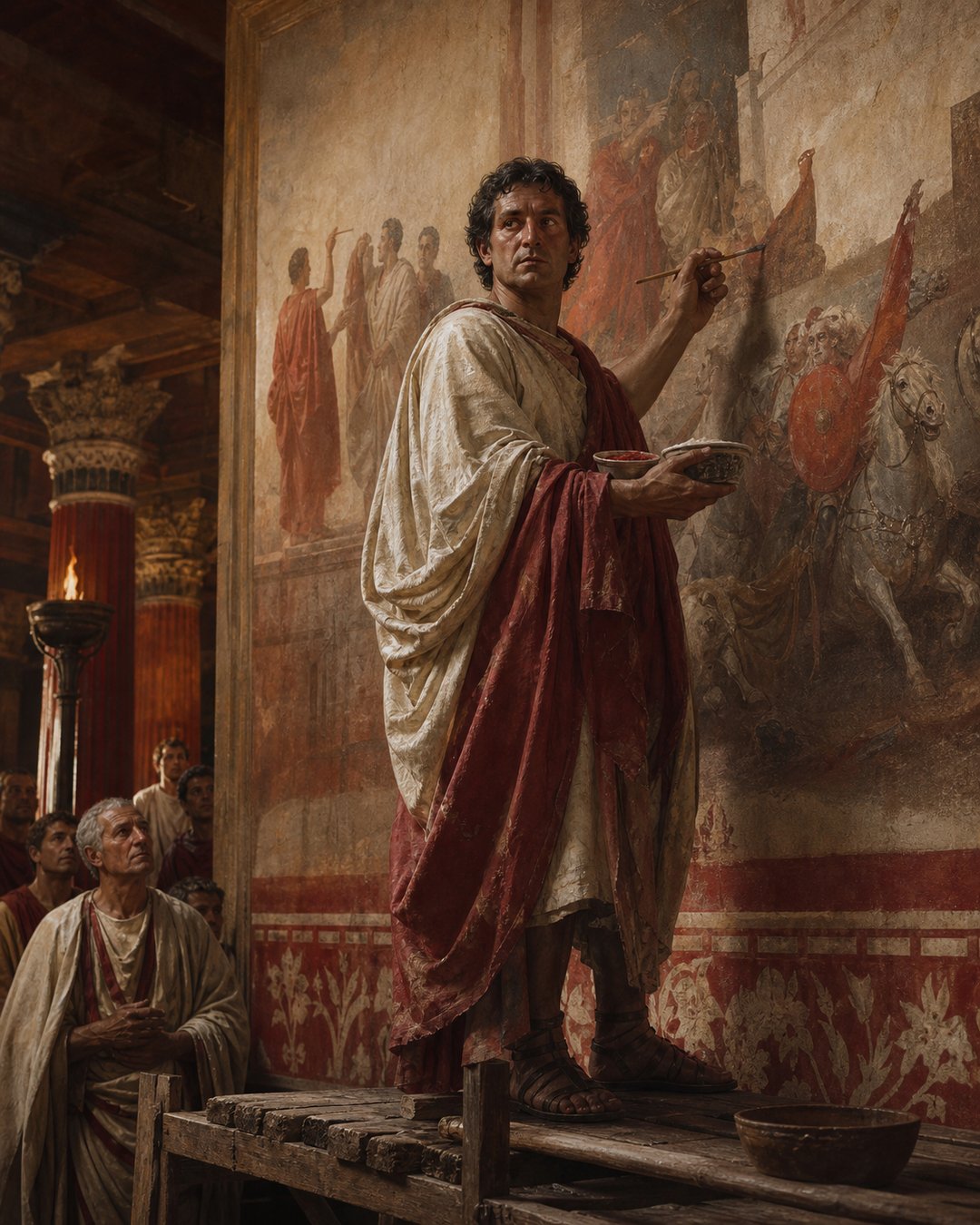
In 304 BC, a Roman aristocrat climbed into the role of a painter. Gaius Fabius decorated the Temple of Salus, placed his name on the work and left his descendants a surname: Pictor, the painter.
Pliny the Elder considered the choice remarkable. Painting was not an obvious occupation for a man from a leading family, yet Fabius did not hide the labor behind anonymous craftsmen. His signature made authorship public.
The walls lasted for centuries before fire destroyed the temple under Claudius. Their loss leaves no secure image to inspect, but the surviving notices reveal something important: early Roman monumental art joined brushwork, religious dedication and aristocratic memory long before imperial marble dominated the city.
A Vowed Temple Created the Public Surface
The Temple of Salus grew from war and a vow. The consul Gaius Junius Bubulcus Brutus vowed a temple to Salus during the Samnite conflicts, later contracted it as censor and dedicated it in 302 BC according to Livy’s sequence.
Salus carried ideas of safety, welfare and the health of the Roman state. A temple to her could transform military success into a permanent civic relationship with divine protection.
The building stood on the Quirinal, where worshippers and political actors could encounter its decoration repeatedly. Unlike a panel kept in a private house, temple painting occupied a public ritual route.
Chronology in ancient notices requires care. Pliny associates Fabius’s painting with 304 BC, while Livy dates the temple’s dedication to 302. The work may have belonged to the building process before formal dedication, and modern summaries sometimes compress those stages.
That uncertainty does not weaken the central connection. Fabius painted a temple created from a magistrate’s vow and public funds. His wall was embedded in a political monument rather than produced as an isolated studio exercise.
Fresco Required Labor Before Prestige
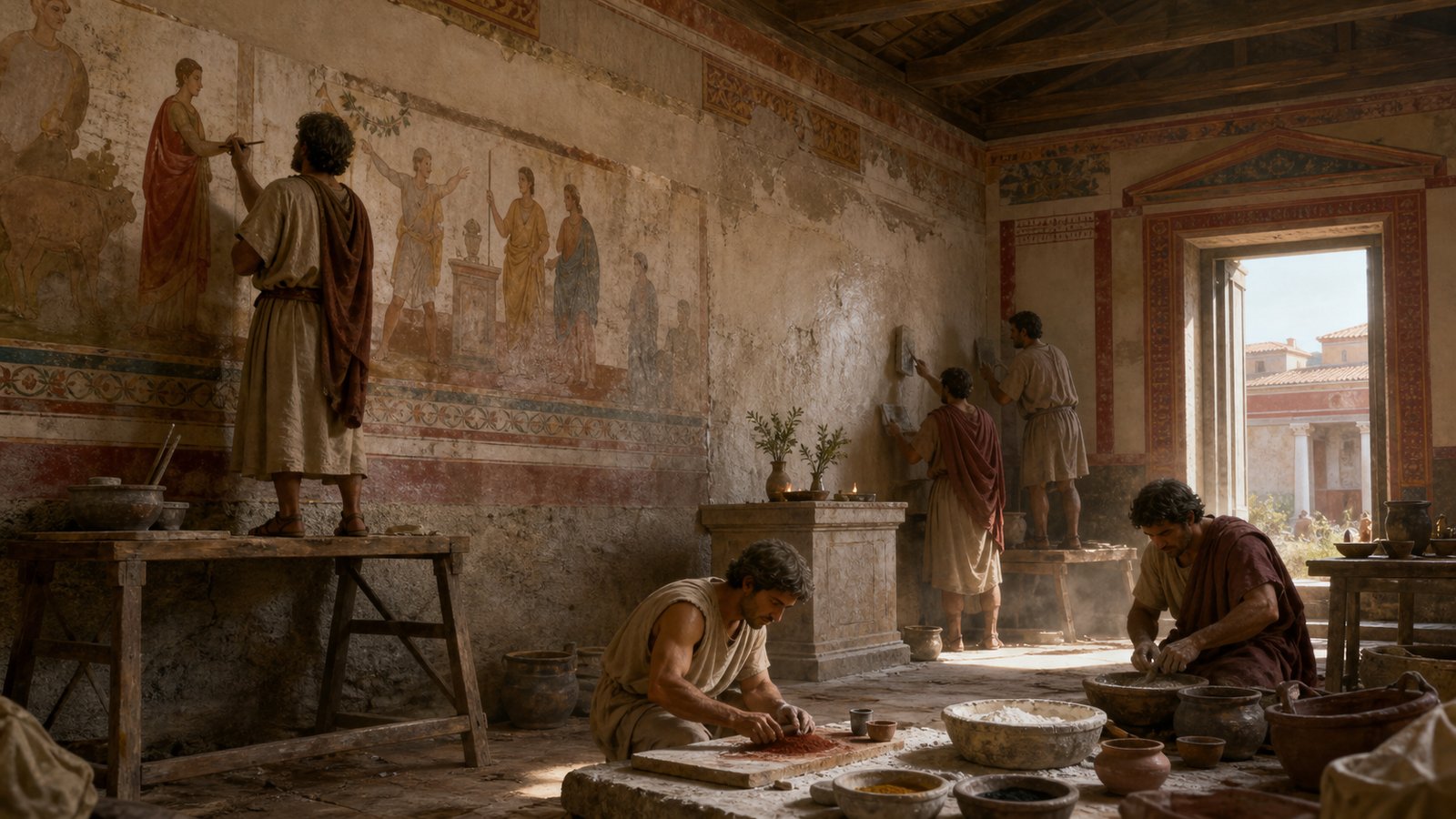
Roman wall painting began with surfaces, plaster and timing. Assistants prepared walls, mixed lime layers and ground mineral colors. The painter needed sections ready while plaster could still receive pigment.
Wooden scaffolding placed bodies close to the wall. Bowls of red ochre, yellow earth, black and white had to remain usable as the composition expanded across architectural space.
No ancient description securely identifies every scene Fabius painted in Salus. It is tempting to invent a battle panorama because the temple followed war, but the surviving evidence does not grant that detail. What can be recovered is the public scale, authorship and durability of the work.
The physical process matters because Pliny’s surprise depends on status. A noble name was attached to manual, technical production. Fabius’s signature refused to let elite viewers imagine that pictures appeared without a practitioner.
An article on purple dye’s days in salt follows another prestigious surface back into difficult craft. Roman visual authority repeatedly rested on workers, timed transformations and materials that disappeared behind the finished effect.
The Signature Turned Craft into a Family Name
Pliny says Fabius gained the cognomen Pictor from the work. The name continued in the Fabian family and is especially familiar through Quintus Fabius Pictor, one of Rome’s earliest historians.
A cognomen could preserve an ancestor’s body, office, victory or peculiarity. “Pictor” preserved an action. Every later bearer carried the memory that a Fabius had painted.
The signature was therefore more than a modern artist’s claim to originality. It joined a prestigious lineage to a public object. Worshippers entering the temple could connect image, building and maker.
Pliny contrasts Fabius with later attitudes that treated painting as less honorable for elites. His history of art uses names to chart changing status. Fabius stands near the beginning as evidence that the craft once admitted a prominent Roman participant.
The act also complicates a simple division between patron and maker. Roman aristocrats normally acquired glory by commissioning monuments, dedicating spoils or holding office. Fabius claimed a place through execution itself.
Temple Walls Organized Civic Memory
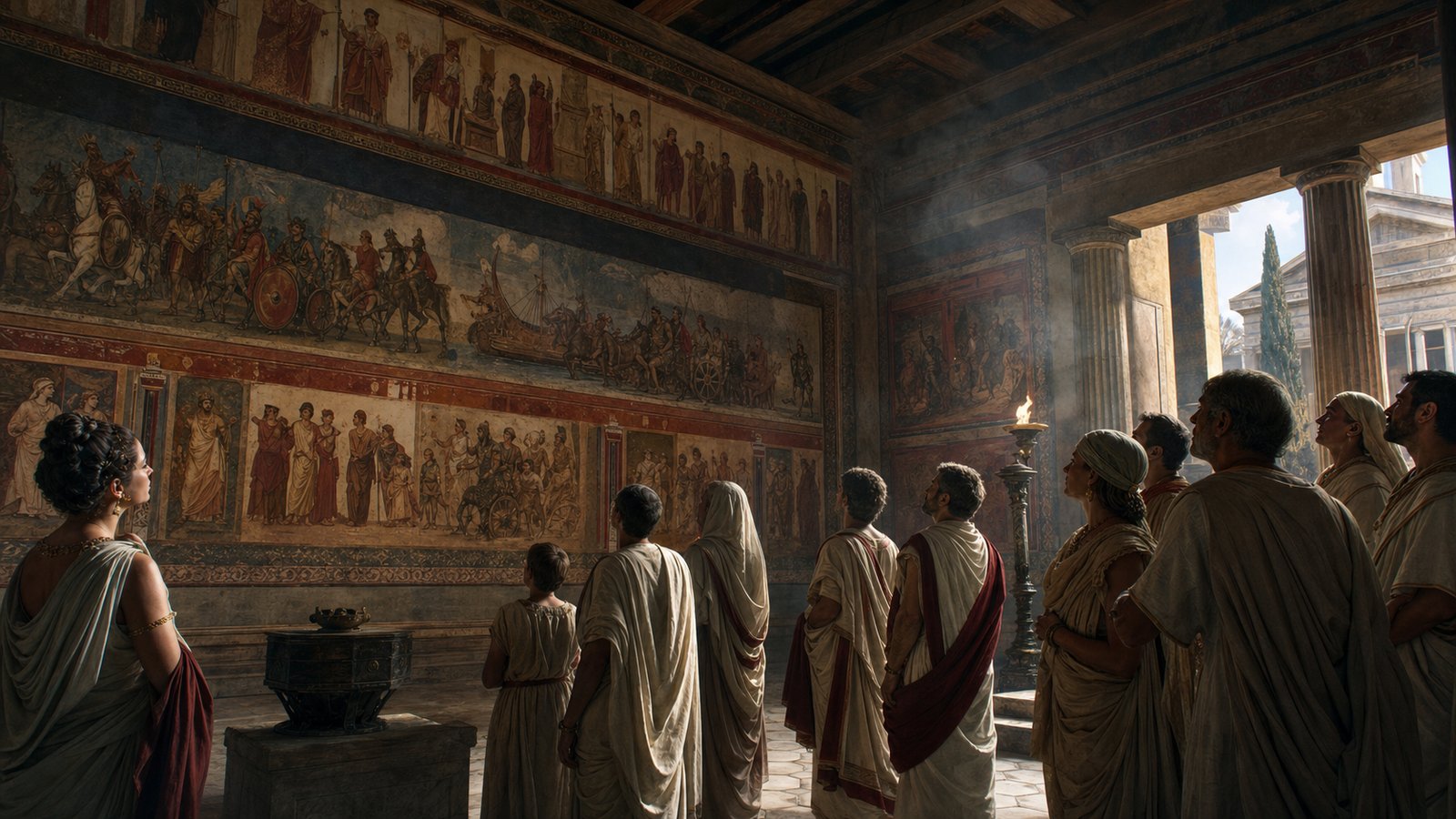
A painted temple taught through repetition. Citizens did not encounter it once as readers encounter a page. They saw images during festivals, vows, political business and ordinary movement through the city.
Color could organize a sacred interior, distinguish figures and connect the worshipper’s present to a remembered past. Even without knowing the exact program at Salus, its long fame shows that Romans treated the painting as more than background.
Public images also selected what deserved continuity. A temple born from Samnite-war victory translated temporary command into lasting welfare. Fabius’s named labor inserted family memory inside that civic claim.
A comparable mechanism appears in Marcus Aurelius’s palace auction, where objects moved between imperial need and public interpretation. Material things acquired political meaning through where they appeared and who authorized their display.
At Salus, architecture, deity, victorious magistrate and painter all competed gently for remembrance. The temple belonged to the goddess and the state, but ancient authors still knew who painted it.
Fire Erased the Image but Not Its Attribution
Pliny says the painting survived until the temple burned in the reign of Claudius. More than three centuries separated Fabius from that destruction.
Longevity changed the work’s meaning. What began as contemporary decoration became evidence of early Roman painting, a relic from a Republic transformed by conquest and civil war.
Its destruction also explains why literary testimony carries unusual weight. Archaeology preserves Roman pigments and walls elsewhere, but it cannot restore this exact composition. Pliny’s notice supplies author, location, status and fate where the image itself is absent.
The loss should enforce restraint. We cannot describe faces, weapons or narrative sequence as though photographs survived. Responsible reconstruction stops at process and institutional setting when the sources stop.
Yet the signature achieved precisely what signatures are meant to do. The wall vanished, the temple vanished, and Fabius’s authorship remained readable in Roman cultural history.
His brush did not make him less aristocratic in memory. It created the name by which memory kept him.
The commission also reveals how a public monument accumulated authors rather than possessing only one. Bubulcus supplied vow, office and dedication; builders raised the temple; plasterers made a paintable skin; Fabius gave the interior a named pictorial form. Roman memory selected several of those contributions and attached different kinds of prestige to each.
For Fabius, visibility carried risk as well as reward. A signed public picture could be praised, judged or remembered as unbecoming to his rank. Pliny’s later discussion suggests that the social position of painting was never neutral. Claiming the work meant claiming whatever honor or embarrassment viewers assigned to the craft.
The cognomen settled that argument in a particularly Roman fashion. Instead of separating artist from aristocrat, it fused them. Descendants who did not paint still carried Pictor into histories, offices and diplomatic encounters.
The destroyed wall therefore had an afterlife in language. Pigment fell, plaster burned and architectural context vanished, but the name continued to point backward to a physical act performed before witnesses in a sacred building.
That survival makes the Temple of Salus a useful limit case for writing art history. We know almost nothing secure about the picture’s iconography, yet we know the maker’s name, approximate date, location, social rank and the work’s extraordinary longevity. Attribution outlived appearance.
Viewers across those centuries also changed. The first audience could connect the new paint with living participants in recent wars; later Republicans saw an ancestral object; people under Claudius confronted a work older than the political order around them. Its age became another layer of meaning.
When fire removed it, Rome lost not simply decoration but a continuously visible bridge to early Republican craft. Literary memory could preserve the attribution, but not scale, color, brushwork or the bodily experience of standing beneath the painted wall.
Sources
Pliny the Elder, Natural History 35.19. Livy, History of Rome 9.43.