
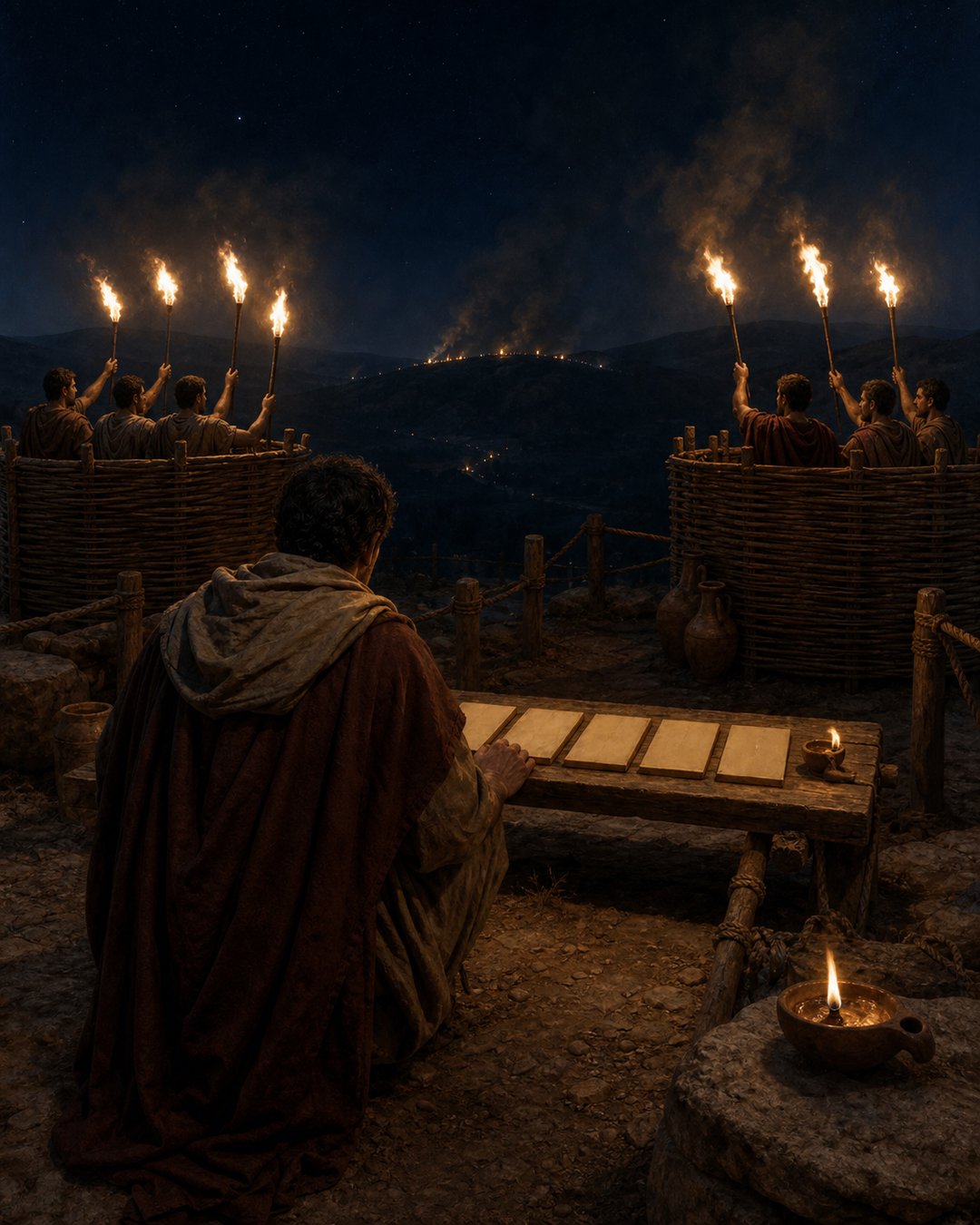
A fire on a ridge can say something happened. It struggles to say what.
That distinction irritated Polybius. A commander who saw one agreed beacon might learn that a fleet had arrived, but not its size, destination or condition. If citizens betrayed a town or soldiers deserted unexpectedly, no lamp in a short prearranged code necessarily had a meaning ready for the news.
Polybius’s answer was not a brighter flame. It was an alphabet divided among five tablets and transmitted through two groups of torches. The count on the left chose a tablet. The count on the right chose a letter within that tablet. Repeated coordinate by coordinate, light could spell a report that nobody had known to prepare.
The design made fire slower than a single alarm and vastly more articulate. Its real target was uncertainty.
A beacon code failed at the first unforeseen event
Simple fire signals depended on agreement. One beacon could mean enemy ships at a named harbor; two could mean infantry approaching a pass. For a small set of expected situations, that was useful. The receiver needed only to recognize the pattern and consult memory.
War refused to stay inside the list. Polybius names treachery and massacre as examples of developments that could demand immediate help without having been predicted. Even a familiar event might arrive in an unfamiliar quantity or place. “Ships” was not enough if the commander needed to know how many ships, whose ships and where they had landed.
The weakness lay in vocabulary. Every extra contingency required another prior agreement, yet no agreement could enumerate everything that might happen. A code of whole messages grew cumbersome while remaining incomplete.
This problem differed from the wooden tablet that circulated a Roman camp password. A password was short, expected and distributed through a controlled chain. A distant report had to preserve new information across darkness and space. The message itself could not be fixed before the event.
Polybius valued timing because command depended on acting while a situation could still be changed. Distance cost days to a runner. Fire crossed the visible interval quickly. But speed without specificity could leave the receiving commander watching an urgent light and guessing what response it required.
Matched water jars still trapped news inside a list
Before presenting the alphabet method, Polybius examines a more ingenious design associated with Aeneas the Tactician. Sender and receiver prepared equal earthenware vessels filled with water. Each held a floating cork and a graduated rod labeled with possible military events: cavalry, infantry, ships, grain and other common developments.
When both stations raised torches, they opened matching holes. Water escaped, the floats sank and the rods descended. At the desired line, the sender raised the torch again. The receiver stopped the flow and read the event aligned with the vessel’s mouth.
The device transformed elapsed water into selection. It also demanded exact physical synchronization. Vessel dimensions, holes and starting levels had to match closely enough for the same label to arrive at both mouths together.
Polybius’s deeper objection was not mechanical. However well the vessels ran, the rod still contained a finite menu. It might transmit “ships,” but not easily how many or to which coast. It could carry only what somebody had written before the campaign made its surprise.
The water clock improved range without solving expression. Polybius wanted the remote station to receive language rather than choose a heading. Letters supplied reusable components from which details could be constructed after the event.
Left and right flames became a letter coordinate
The newer method, which Polybius credits to Cleoxenus and Democleitus before claiming his own refinements, began by dividing the Greek alphabet into five groups. Each group appeared on its own tablet. The last held one fewer letter, a minor irregularity in an otherwise five-by-five arrangement.
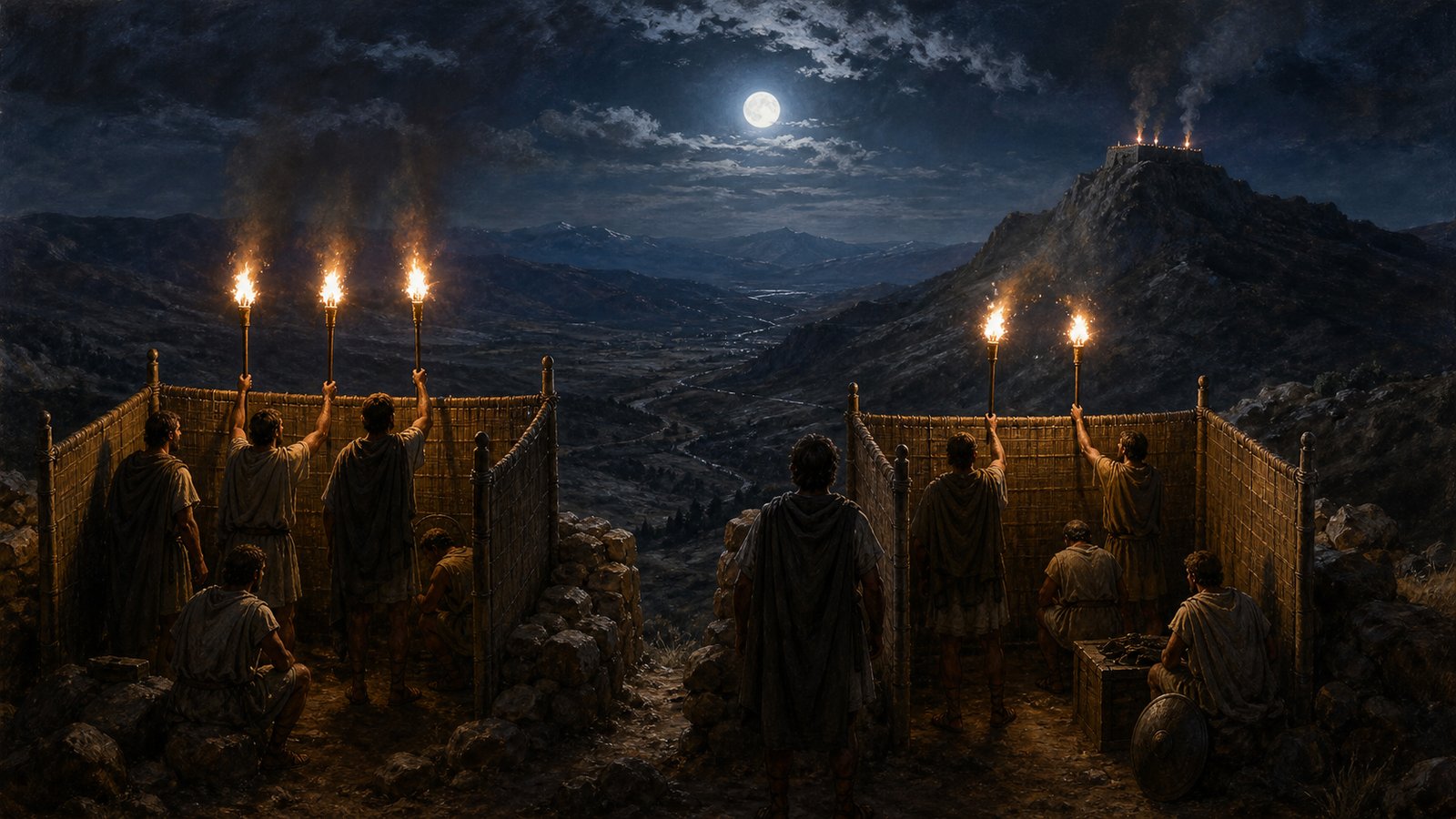
Both stations possessed the same tablets. Before a message started, the sender raised two torches and waited until the receiver answered with two. This handshake mattered. A coordinate shown to an inattentive observer would vanish without record, so communication began by confirming that both parties were watching.
After lowering the alert flames, the sender worked between two screened spaces. Torches raised on the left indicated which tablet to consult: one for the first group, two for the second, up to five. Torches on the right then gave the letter’s position on that tablet.
A receiver watched the two sides separately through paired sighting tubes and wrote each result on a tablet. Polybius’s worked example begins with kappa. Because kappa occupied the fifth position in the second group, the sender displayed two torches on the left and five on the right. The next letter required another pair of counts.
Ten torches did not all need to burn at once for every character. They defined the maximum vocabulary of the apparatus: five possible counts on either side. Position, not flame color or shape, separated the two numbers.
The coordinate had a crucial advantage over a bank of twenty-four dedicated lamps. The same limited equipment represented every letter. Once operators shared the table, combinations generated vocabulary far larger than the physical signal set.
Compression and practice decided whether the system worked
Spelling created freedom and cost time. Each letter required a double signal, and a long sentence demanded many careful raises and lowers. Polybius therefore instructs the sender to choose the fewest words that preserve the necessary sense.
His example concerns roughly one hundred deserters. Instead of transmitting a fuller sentence, the operator reduces it to the equivalent of “Cretans a hundred deserted us.” The compression is not decorative brevity. It lowers the number of coordinates and therefore the opportunities for fatigue, smoke, bad sight or transcription error.
Operators also needed practice. Polybius compares the learned skill to reading: an experienced reader processes forms and sounds with a fluency that looks impossible to someone confronting letters individually. Signallers likewise had to turn flame counts into groups, positions and written characters without losing the sequence.
That human requirement places the system beside the standards that organized soldiers through visible signs. Hardware alone did not create reliable command. Shared conventions and repeated training made a signal legible under pressure.
Weather, terrain and line of sight still imposed limits. The method required prepared stations, screens, tablets, sufficient torches and observers able to distinguish both bays. Polybius never presents it as effortless. He argues that difficulty at first use should not cause armies to abandon a technique on which preservation could depend.
His achievement was conceptual as much as practical. The fire no longer stood for one predetermined event. It selected elements of writing. That change allowed a distant commander to receive the detail most crude beacons erased: the unexpected fact that made this emergency different from the last one.
The sequence also separated three tasks that a single beacon confused. The opening exchange established attention. The coordinate pair identified a character. The sender’s shortened wording controlled the total burden. A failure in one stage could be diagnosed differently from a failure in another: no reply meant the receiving station was not ready, a mistaken count corrupted one letter, and an overlong sentence exhausted time and concentration. Polybius had not merely attached an alphabet to fire. He had outlined a communication procedure with setup, encoding, transmission and recording, all disciplined by the same shared table.
That procedure explains why he placed the discussion inside military history. For Polybius, history should preserve useful systems, not only dramatic outcomes. A battle report tells readers who won once. The torch method asks how a commander might know enough, soon enough, to choose before the result existed.

Sources
Polybius, Histories 10.43–47
Polybius square communications reference