
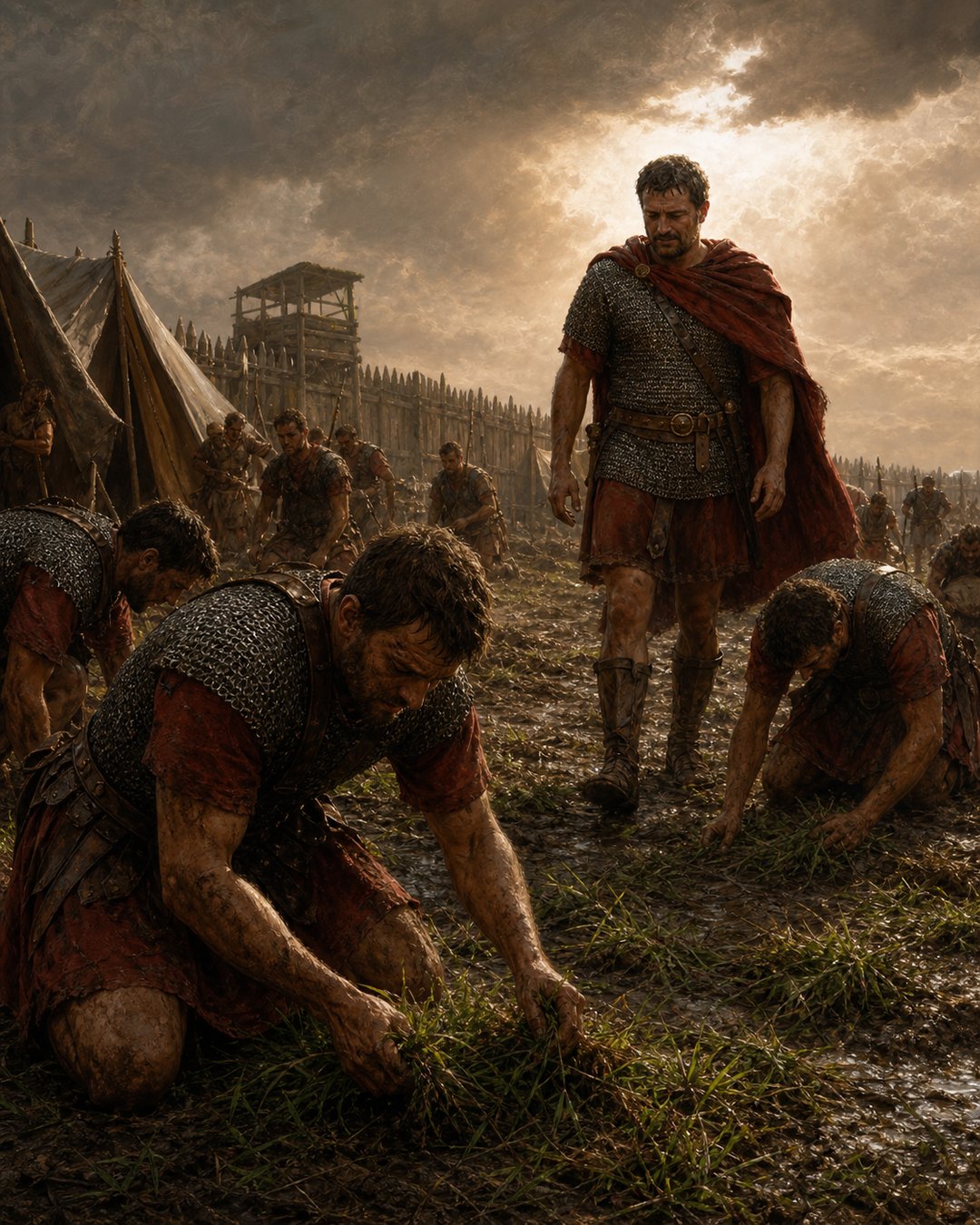
Rome’s most highly regarded military crown was not gold. It was grass gathered from inside a place that had nearly fallen.
Aulus Gellius calls it the siege crown. The people delivered from encirclement presented it to the general who had saved them, and custom required the plants to come from the ground on which the besieged had been confined. The award carried a location inside its weave.
Gold could be prepared before a campaign and stored for the next recipient. The grass crown could not. Its material existed only where a particular group had waited behind walls or ramparts, watched supplies diminish and hoped that relief would break through.
That local origin explains the crown’s force. The recipients of rescue chose the rescuer, and the endangered ground supplied the object. Rome turned ordinary vegetation into a record of survival that glittering metal could not imitate.
Roman crowns mapped different kinds of courage
Gellius opens with a catalogue. Among the most esteemed military crowns he names the triumphal, siege, civic, mural, camp and naval crowns. He adds the crowns of ovation and olive, each connected to a different kind of victory or ceremonial entry.
The list was not a single ladder built from price. Material, giver and action all mattered. The triumphal crown, once laurel and later gold, honored a commander’s triumph. The mural crown marked the first man over an enemy wall. The camp crown recognized the first into a hostile camp. The naval crown belonged to the armed man first to board an enemy ship.
Their designs made feats visible. Battlements ornamented the mural crown. A palisade appeared on the camp crown. Ship beaks decorated the naval award. These three were regularly made of gold, but the metal carried an image of the obstacle overcome.
Gellius’s catalogue resembles the fire-signal system that translated letters into visible combinations. Both systems turned military information into forms an informed observer could read. A crown announced not merely that someone had excelled, but how.
The siege crown followed the same logic without an emblem. Its substance was the sign. Grass from inside the enclosure told spectators that the bearer had delivered everyone trapped upon that ground.
The besieged chose the person who had delivered them
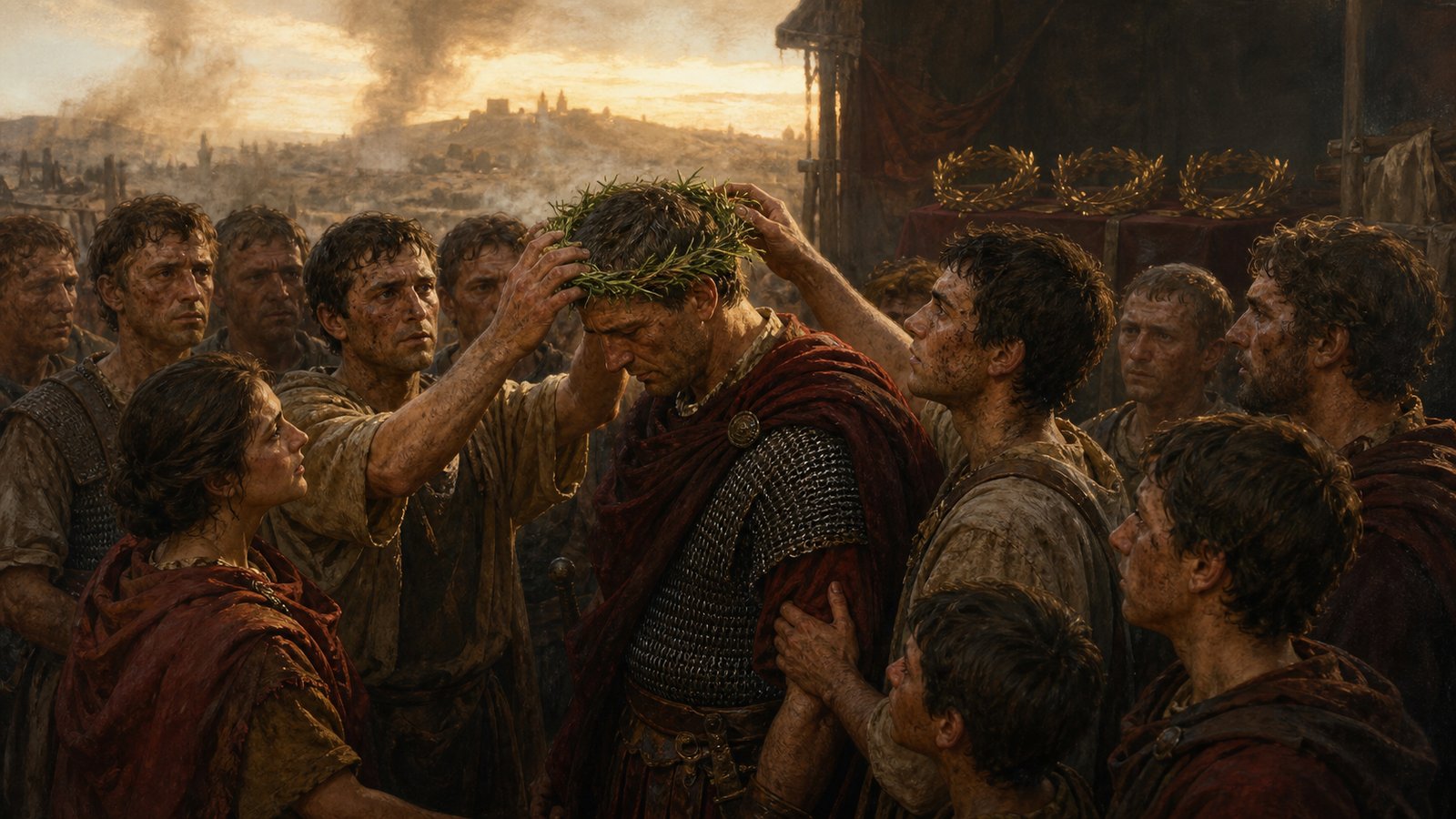
Gellius defines the award through the relationship between givers and recipient. Those delivered from siege presented it to the general who delivered them. The wording places the rescued community at the center of recognition.
A commander could claim success in a dispatch. The senate could vote honors far from the battlefield. A grass crown required acknowledgment from those who had experienced the danger. They knew whether relief had arrived before surrender, starvation or assault ended their defense.
The award was collective in scale. A civic crown could begin with one life saved in battle. The siege crown represented an enclosure full of people released from a common threat. Its prestige reflected the magnitude of what had been preserved.
That makes the crown a fitting counterpart to the two-hundred-foot clear zone inside a Roman camp. The camp article follows the space designed to keep defenders ready and movement open. The grass crown begins when such an enclosed space has survived its greatest test and the people inside can finally look outward.
The rescued did not need imported laurel or a goldsmith. The crown could be assembled from what lay underfoot. That immediacy gave survivors control of the ceremony. Their confinement furnished the proof of their release.
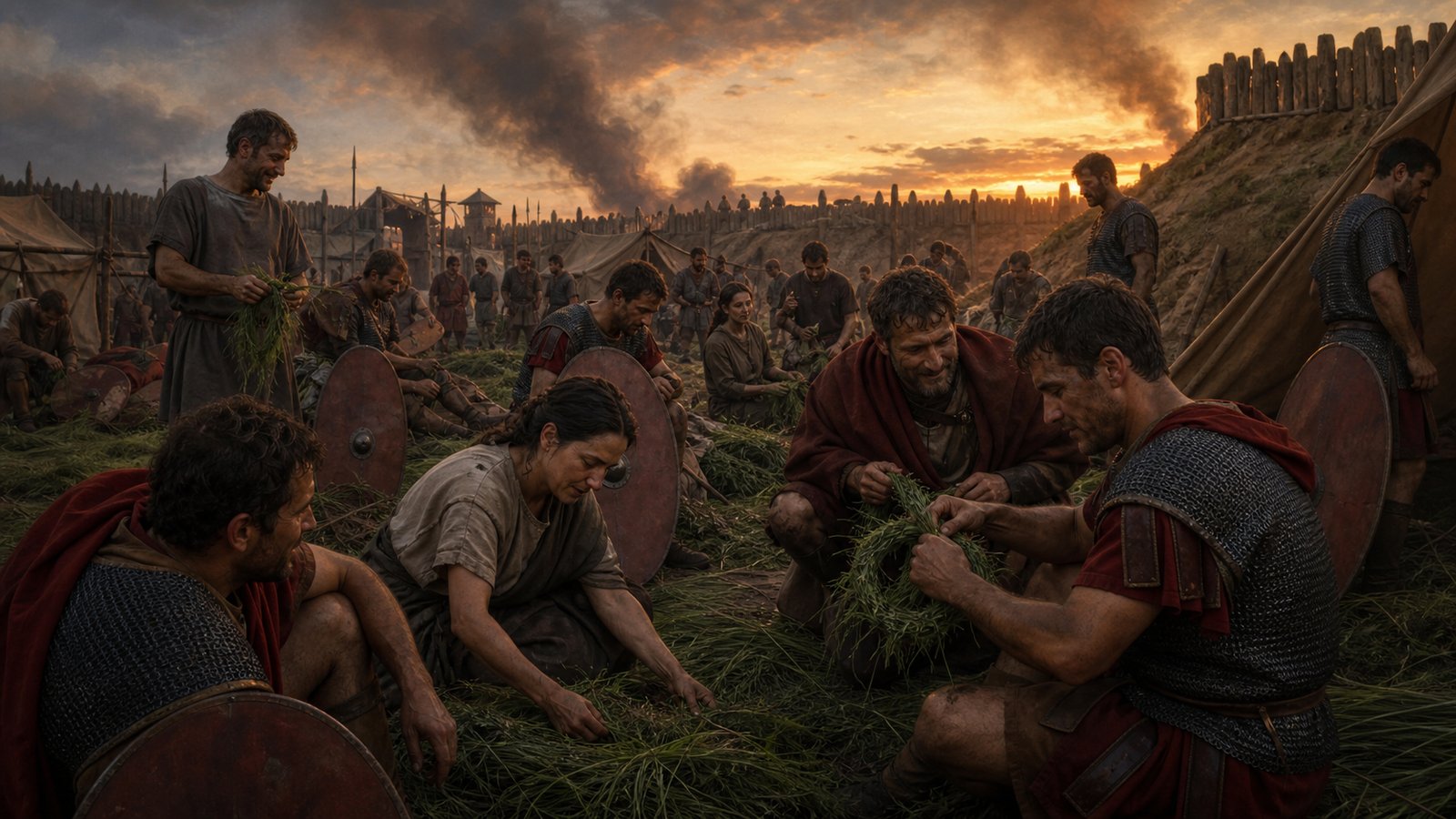
Grass made one dangerous place impossible to forget
Custom specified that the grass had to grow within the place where the besieged had been confined. Grass from another field might look identical, but it would not carry the same claim.
The rule bound honor to evidence. Each stem came from the threatened perimeter. The crown’s fragility also suited the event: it was not valuable because it would outlast bronze or resist decay. It was valuable because nobody could separate its material from the crisis that produced it.
Gellius gives one famous Roman example. During the Second Punic War, the senate and people presented a grass crown to Quintus Fabius Maximus because, in his account, Fabius had freed the city from siege by the enemy. The city itself became the grateful community.
The statement belongs to Gellius’s description of the crown; it should not be expanded into an invented ceremony or a claim that every Roman understood Fabius’s strategy in one way. What his evidence preserves is the fit between award and remembered service. Rome imagined itself as the relieved enclosure and selected the crown whose material represented deliverance.
Fabius’s grass crown also complicates the expectation that the greatest honor must be the most expensive. Gold advertised resources and permanence. Grass advertised proximity. It said that the rescued people had taken the object from the exact terrain where danger had held them.
Other crowns rewarded a narrower, witnessed act
The civic crown shows how carefully Romans could define another kind of rescue. One citizen gave it to another who had saved his life in battle. It was made from the leaves of the esculent oak, which Gellius links with the earliest food and support of human life.
Masurius Sabinus supplied strict conditions. The rescuer normally had to save the citizen, kill the enemy threatening him and avoid giving ground. Under Tiberius, however, a difficult case reached the emperor: a soldier had saved a citizen and killed two enemies, but the enemy took the position. Tiberius allowed the honor because the place had been too perilous even for brave men to hold.
The example shows that crown rules could be interpreted rather than applied mechanically. Criteria preserved the meaning of an award, while exceptional circumstances tested whether literal compliance captured the courage involved.
Marcus Cato feared movement in the opposite direction. He accused Marcus Fulvius Nobilior of granting crowns for trivial reasons to win popularity. His examples were industry in building a rampart or digging a well. Both tasks could be essential, but Cato’s complaint was that honor lost force when a commander distributed it too freely.
Scarcity was part of the language. If every useful action received a crown, the object no longer isolated the feat it was designed to announce. The grass crown avoided that dilution through its own production rule: no real siege and relief, no authentic ground from which to gather it.
The crown therefore linked survival, witness and place. Its givers had shared the danger. Its recipient had changed their situation. Its material came from within the boundary that once trapped them.
Rome’s gold crowns could depict walls, palisades and ships. The siege crown needed no miniature obstacle. A handful of grass already contained the battlefield’s geography. Woven around a commander’s head, it made the humblest material in the camp carry the largest collective debt.
Gellius preserves military culture through these distinctions. He does not treat “a crown” as a generic decoration. He asks who gave it, what it was made from, which act justified it and what image it bore. The answers made honor legible and also made careless awards open to criticism.
The siege crown was powerful because every answer pointed to the same event. Survivors gave it. Relief justified it. Confined ground supplied it. Grass was not a cheaper substitute for gold; it was the only material that could tell that exact story.
Sources
Aulus Gellius, Attic Nights 5.6