
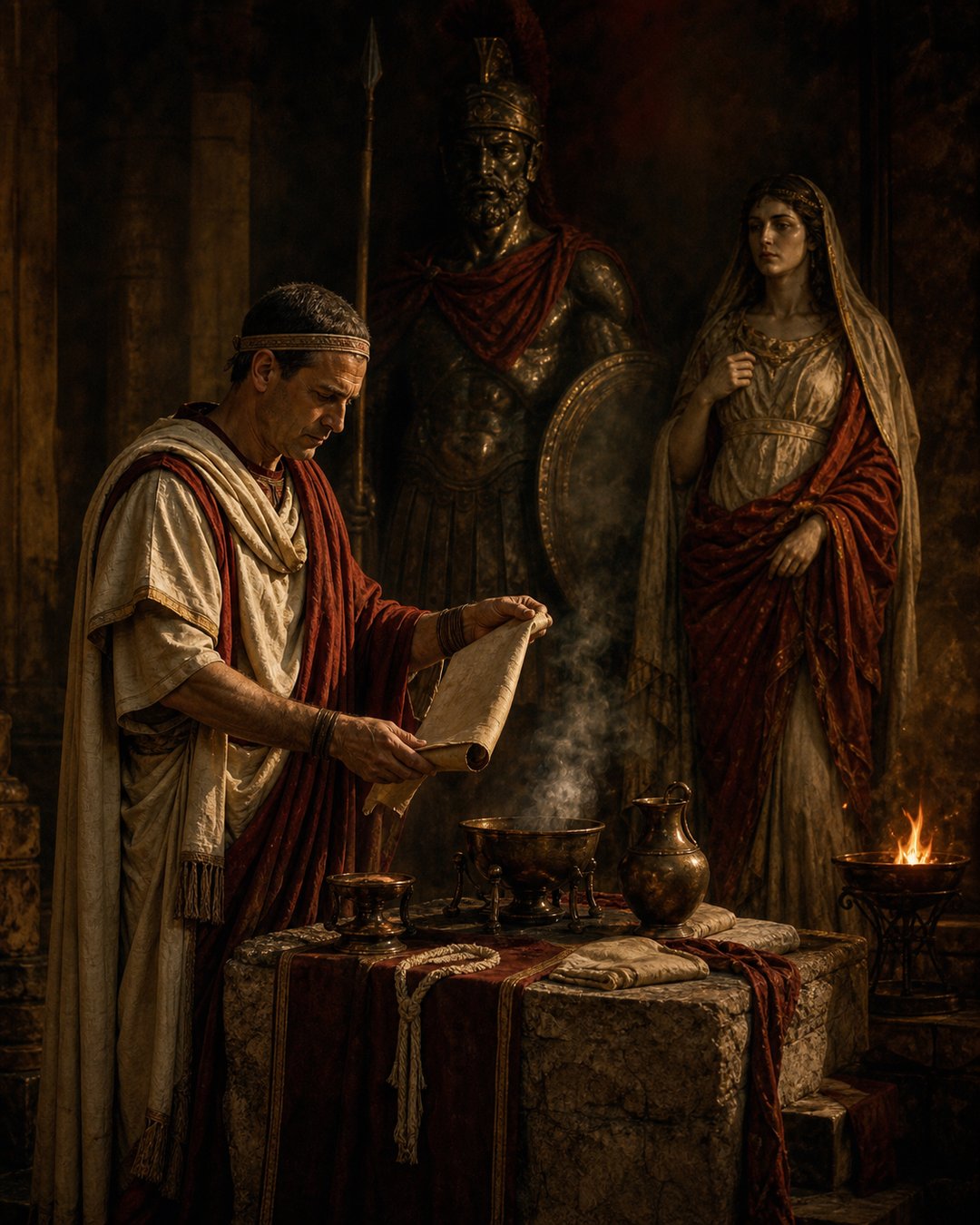
An old Roman prayer name could change identity without changing its place beside Mars. For one antiquarian explanation, Nerio meant the war god’s courage, strength and majesty. In comedy and annalistic tradition, Nerio—or Neria or Nerienes—was his wife.
Aulus Gellius did not solve the contradiction by choosing one clean definition. He compared priestly prayer books, pronunciation, Sabine vocabulary, Greek etymology, comic verse, early annals and grammatical speculation. Each kind of evidence pulled the name in a different direction.
The result is not a tidy portrait of a forgotten goddess. It is a case study in how Roman ritual language survived. A name remained inside formulas and quotations while speakers disagreed about its sound, grammar, origin and divine relationship. Repetition preserved the word; interpretation kept remaking what the word meant.
Nerio’s story therefore begins not on a battlefield but in an archive of prayers. Mars’s power, a wife’s appeal for peace and a scholar’s attempt to calm an angry god all gathered around the same unstable syllables.
Priestly books preserved a chain of divine pairings
Gellius opens with the infrastructure of ritual memory. Prayers offered to the immortal gods according to Roman practice, he says, were set down in books belonging to the priests of the Roman people and in many early collections of prayers. Worship had an archive.
From those books he quotes a compact series: Lua of Saturn; Salacia of Neptune; Hora of Quirinus; the Virites of Quirinus; Maia of Vulcan; Heries of Juno; Moles of Mars; and Nerio of Mars. The repeated “of” is important. These names appear through association with larger divine figures, but the list itself does not pause to define every relationship.
A ritual list can outlive the shared knowledge that once made it transparent. Priests may continue to recite a paired name after ordinary speakers have lost confidence about whether it describes a quality, a power, an attendant or a spouse. The formula survives more securely than its explanation.
Roman rites repeatedly depended on exact material and verbal forms. a treaty oath used a flint stone and a spoken conditional curse to bind public action. Gellius’s prayer books show the other side of that precision: exact words may be guarded so long that later readers need antiquarian work to recover what they once conveyed.
Nerio stands at the end of Gellius’s list and becomes his test case. Mars already has Moles paired with him, then Nerio. The sequence offers no simple family tree. It gives a ritual arrangement and asks language, literature and history to explain it.
Pronunciation turned worship into a grammatical problem
Before discussing divine identity, Gellius listens to syllables. Most people, he says, pronounced the first syllable of Nerio long, in a way he compares with the Greek pronunciation of Nereids. Those who spoke correctly shortened the first syllable and lengthened the third.
He then investigates the name’s grammatical forms. Early writers supplied the nominative Nerio. Marcus Varro used the vocative Nerienes in a verse that invoked Anna and Peranna, Panda, Pales, Minerva, Fortune and Ceres. For Gellius, the case ending helped establish how the name should be understood and declined.
This may look remote from religion, but a prayer is spoken language. Vowel length affects metre, inherited sound and recognition. A worshipper or performer who changes the quantity of a syllable may not create another deity, yet the variation reveals that ordinary pronunciation has drifted away from the learned tradition.
Gellius compares the declension with Anio and follows the forms through early usage. Later in the chapter he returns to metre because quoted poets do not agree. Licinius Imbrex and Ennius appear to lengthen and shorten different syllables. The evidence refuses to remain consistent even under technical inspection.
That inconsistency matters more than one reconstructed vowel. It shows an old ritual name moving among prayer, comedy, epic and scholarship. Each setting has its own pressures: inherited formula, intelligible dialogue, poetic metre and grammatical regularity. Nerio’s sound changed because the word had several lives.
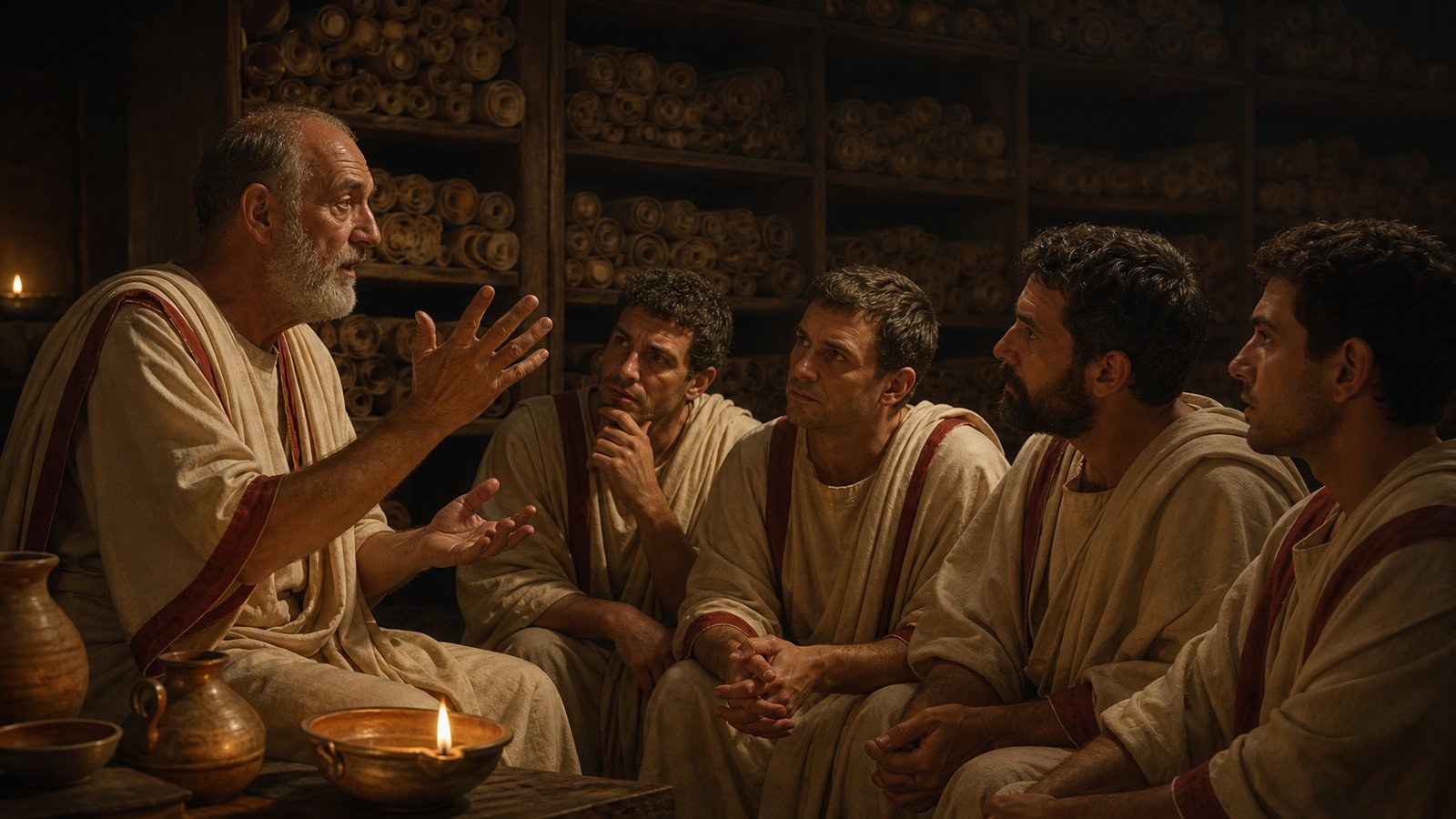
Courage made Nerio the power inside Mars
Gellius’s first semantic explanation is Sabine. Nerio or Nerienes, he says, signifies valour and courage. He connects the word with the Claudii, a family believed to have Sabine origins, among whom a person of outstanding courage could be called Nero.
He then proposes a deeper linguistic route. The Sabines, he suggests, may have taken the word from Greek terms for sinews and ligaments. Latin nervi enters the comparison. Sinew supplies a physical image for strength: the binding and pulling tissue that lets force move through a limb.
On this reading, Nerio designates the strength and power of Mars and a particular majesty belonging to the war god. The paired name is not necessarily a separate woman standing beside him. It can be a personified capacity within his divine sphere.
Roman religion often made functions concrete. A divine power might be addressed under a name that isolates one operation or quality. Gellius’s list—Salacia with Neptune, Maia with Vulcan, Moles with Mars—encouraged ancient scholars to ask whether each pairing named a person, an aspect or a relation.
The priest of Jupiter offers a useful comparison. a dense set of restrictions turned Jupiter’s priesthood into daily physical practice. Knots, food, hair and thresholds gave religious office a material shape. Nerio gives Mars’s strength a verbal shape, if Gellius’s Sabine explanation is accepted.
Yet etymology is not a transparent window into early worship. Gellius reports an ancient learned argument, not a modern linguistic verdict. His chain from Sabine courage to Greek sinews and Latin nerves demonstrates how Roman scholarship made sense of inherited words. It does not erase other traditions that treated Nerio as a divine woman.
A wife of Mars could ask the war god for peace
Plautus supplies the sharpest reversal. In the Truculentus, a soldier says that Mars, coming home, greets his wife Nerio. A critic whom Gellius had heard dismissed this as comic characterization: an ignorant, rough soldier had supposedly invented the strange idea because Plautus wanted a joke.
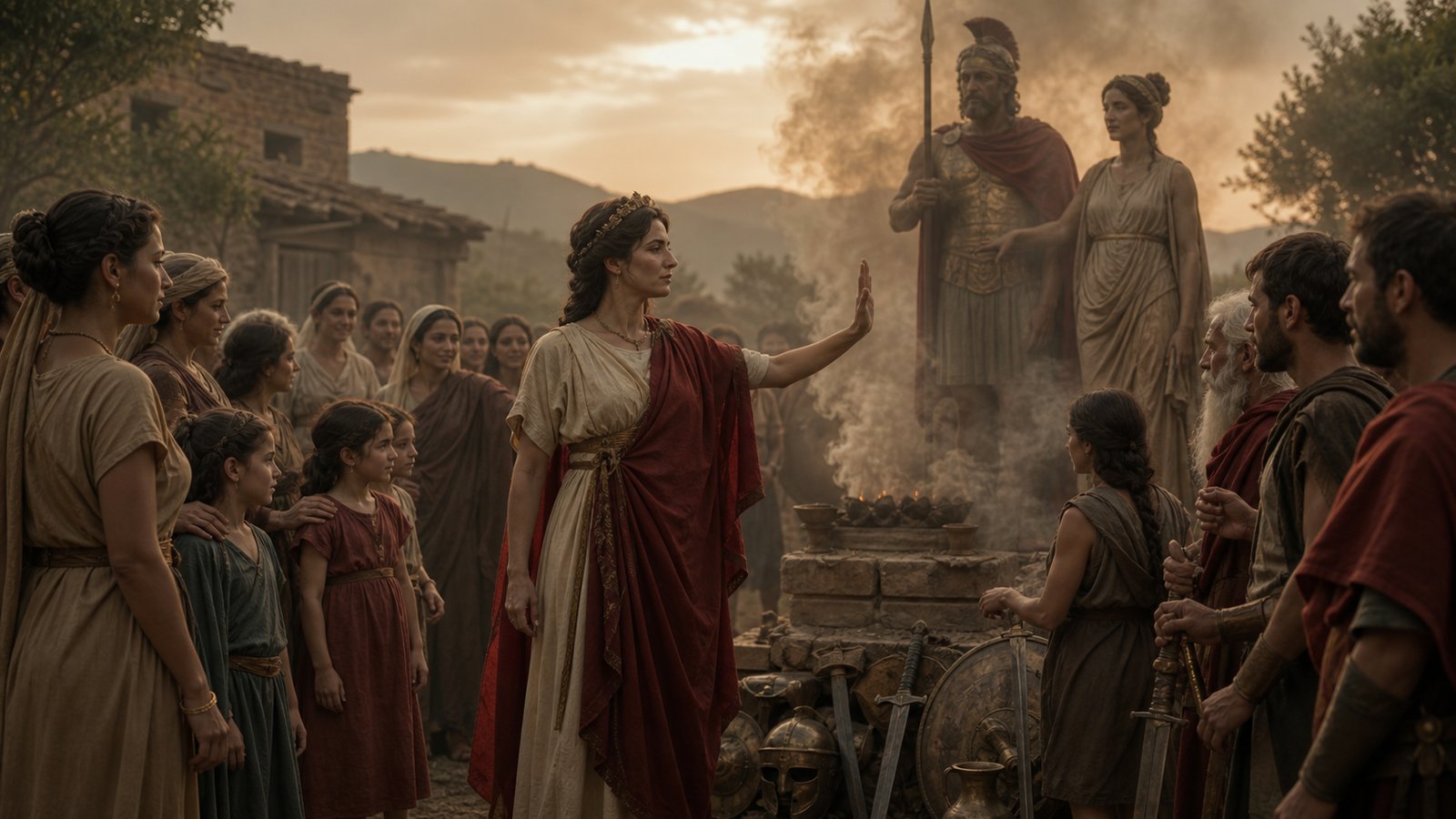
Gellius refuses that easy dismissal. He turns to the third book of the Annals of Gnaeus Gellius. There Hersilia pleads before Titus Tatius and invokes “Neria of Mars.” She asks for peace and for lasting, happy marriages.
The prayer ties marriage to the foundational story of abducted women. Hersilia says that by the advice of Neria’s lord the maidens had been carried off so that they could bear children, descendants for the men and their people, and posterity for the country. The passage preserves the violence and patriarchal logic of the tradition; it should not be softened into a modern romance.
Within that old narrative, however, the wife of Mars becomes an addressee for peace. A divine relationship associated with the war god is used to negotiate an end to conflict and secure marriages between communities. Nerio does not simply duplicate Mars’s aggression. As wife, she can connect his authority to the domestic and civic settlement that follows fighting.
Gellius notices spelling as well as story: the annalist writes Neria with an a, not Nerio or Nerienes. Licinius Imbrex, another early comic writer, also calls Neriene the wife of Mars. Ennius supplies another poetic form. Multiple authors therefore prevent the marital interpretation from being blamed on one careless joke.
Finally, Servius Claudius offers a third route. He treats Nerio as though the word meant “without anger,” using a privative particle, so that the worshipper prays for Mars to become mild and calm. Gellius reports the suggestion cautiously, “whatever it amounts to.” The explanation is ingenious precisely because it turns a war god’s paired name into a request that warlike anger subside.
Nerio ends the chapter as strength, wife and calmness without being reduced to any one of them. Priestly books preserved her position. Poets changed her vowels. Scholars supplied origins. An annalist placed her in Hersilia’s peace plea. Gellius’s achievement is to keep the evidence visibly plural.
Roman ritual memory was durable enough to carry an old name for centuries, but durability did not guarantee a single meaning. Every recitation crossed the gap between formula and understanding. Nerio survived beside Mars; what worshippers and readers saw beside him depended on which prayer, story or argument they brought to the name.
Sources
Aulus Gellius, Attic Nights 13.23