
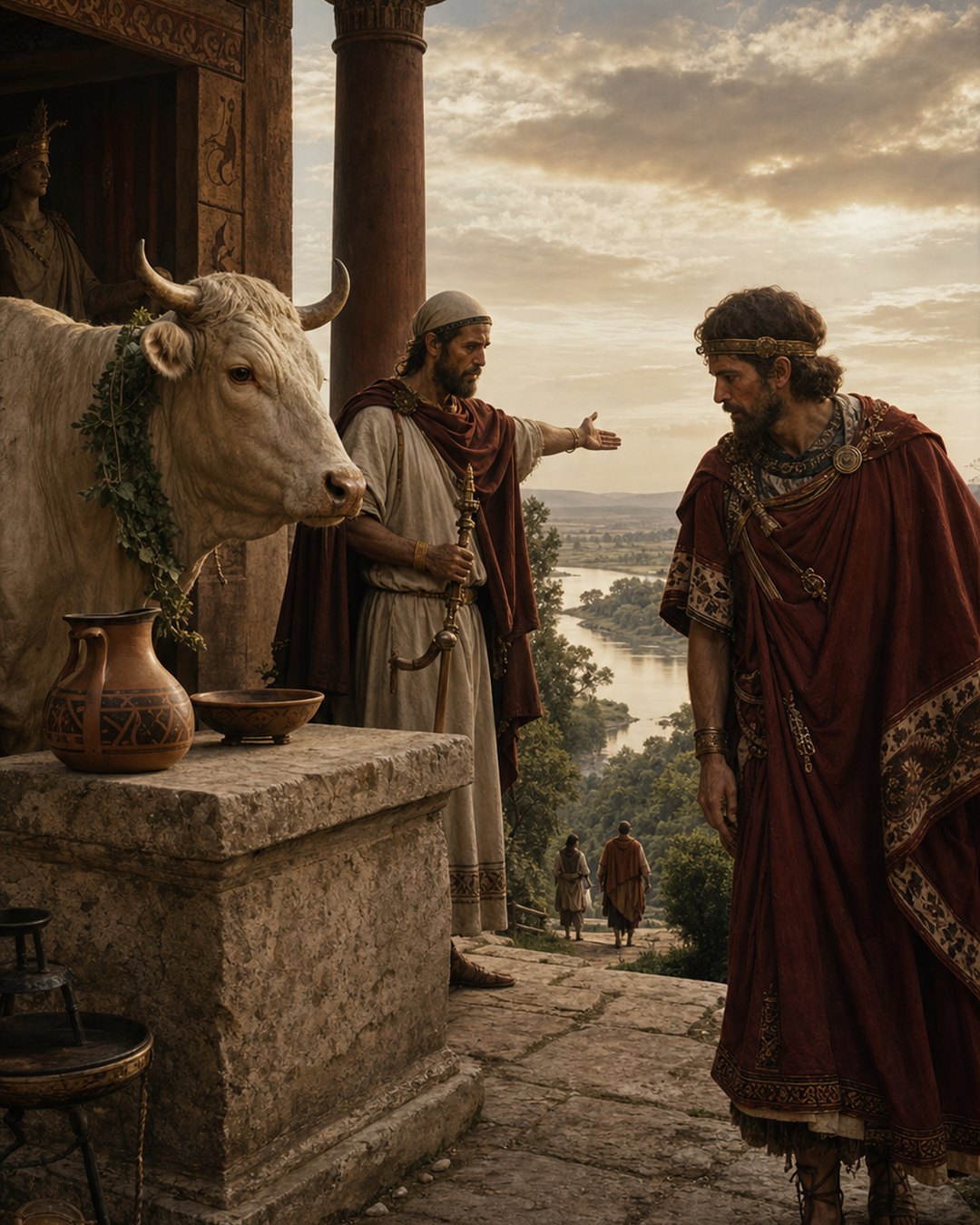
The cow was at the altar. The prophecy had reached Rome before she did.
Livy says a Sabine head of household owned an animal of astonishing size and beauty. Soothsayers had declared that sovereignty would belong to the state whose citizen sacrificed her to Diana. The owner drove the cow into Rome, brought her to the goddess’s temple and prepared to claim the promise for his own people.
A Roman priest stopped him with a question about purity. How could a stranger offer sacrifice with unwashed hands? The Tiber, he pointed out, ran below. The Sabine accepted the correction and descended to the river. While he was gone, the priest sacrificed the cow himself.
The scene is compact enough to read as a trick, but Livy places it inside a larger contest over how Rome could become leader without winning another battle. The temple, the purification rule and the sacrifice all looked religious. Each also moved power.
Servius built agreement before the cow arrived
Livy introduces the episode through Servius Tullius’s foreign policy. Rome had grown, and the king wanted acquisition to depend on policy as well as force. His model was the renowned temple of Diana at Ephesus, a sanctuary said to have been built jointly by the cities of Asia.
Servius praised that cooperation to leading Latins. Livy says he had cultivated ties of hospitality and friendship with them, and he returned to the proposal often enough to secure agreement. The Latin states and Roman people would build a temple to Diana together at Rome.
Shared construction did not mean neutral construction. Livy interprets the agreement as an acknowledgement that Rome stood at the head of the two peoples. What could not be settled repeatedly by arms appeared in sacred architecture as consensus. The temple made hierarchy look like participation.
This political setting distinguishes the story from a free-floating folktale about a clever priest. Before the cow appeared, Servius had already converted a religious project into a claim of precedence. The sacrifice would test whether a rival community could reverse that claim using the very sanctuary that expressed it.
Roman religion moved through public space rather than remaining sealed inside belief. On the Aventine, diplomacy moved into worship as well. The building gathered communities together, but it gathered them on Roman ground.
A pair of horns made the prophecy durable
The rival opportunity came from Sabine territory. Livy describes the owner as head of a household and the cow as remarkable in both size and beauty. The animal’s body made the prodigy visible before anyone interpreted it. This was not a subtle mark that required private inspection.
Soothsayers supplied the political meaning. Whichever state furnished the citizen who sacrificed the cow to Diana would possess sovereignty. The prediction reduced a broad competition among peoples to three controllable elements: one animal, one altar and the civic identity of one sacrificer.
Livy adds that the cow’s horns remained for many ages in the porch of Diana’s temple. Whether a modern reader treats that display as proof of the whole episode or as part of its memorial tradition, the detail shows how Romans made the wonder last. The perishable victim disappeared; the horns remained attached to place.
Displayed remains could turn a spoken account into something visitors encountered physically. Roman altars made exchange with the gods publicly legible; the horns added an aftermath. They did not simply say that a sacrifice had occurred. In Livy’s narrative, they recalled which community had captured its promised result.
The Sabine owner understood the stakes. He did not wait for the cow to wander into Roman hands. He drove her to the city himself, led her into the sanctuary and set her before the altar. His plan depended on acting inside Rome while preserving his own civic authorship of the rite.
Purification removed the rival without breaking the ritual
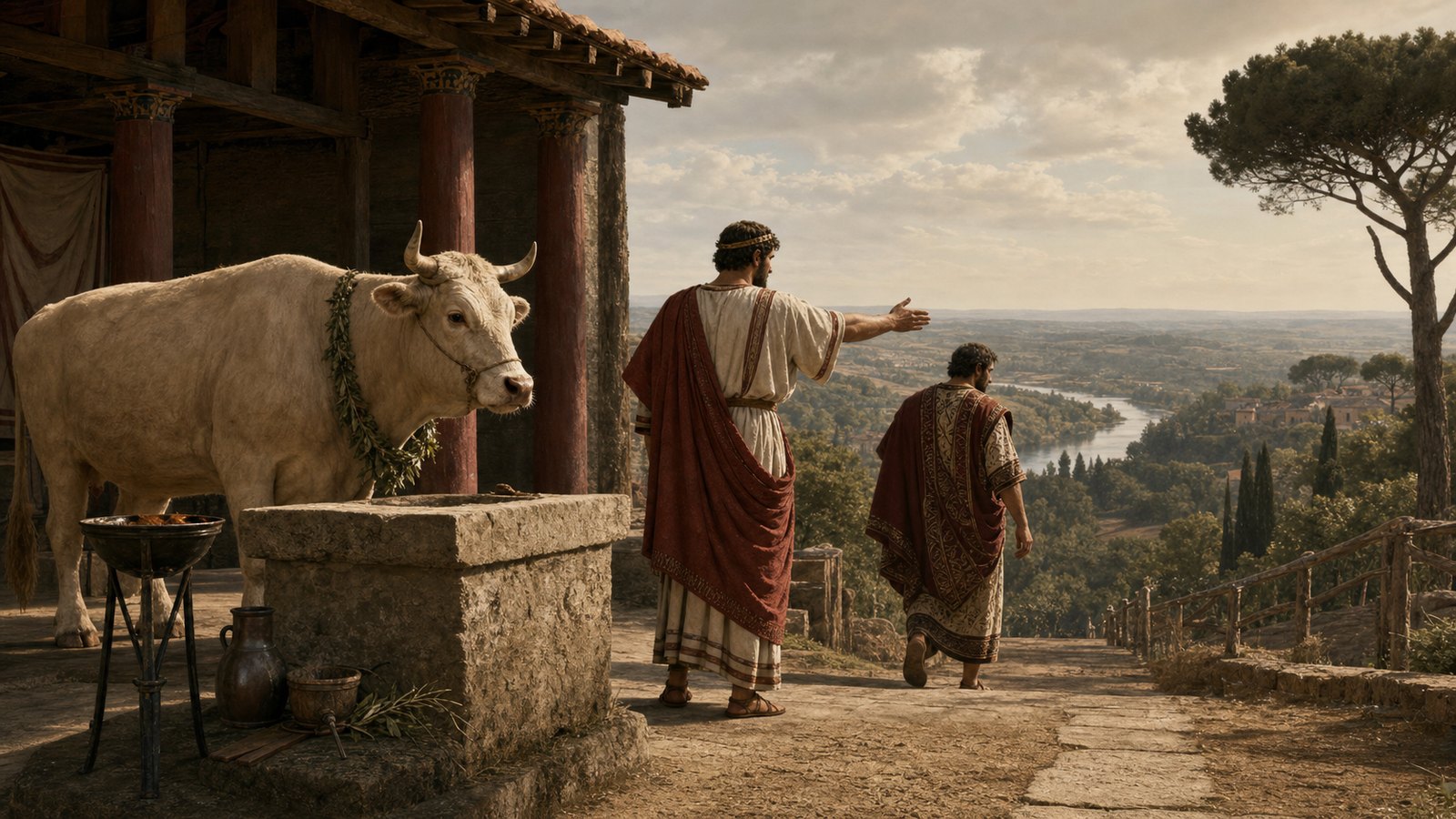
The Roman priest did not seize the rope by force. He questioned the condition of the sacrificer. Would the stranger really approach Diana with impure hands? Running water was available in the Tiber below, and ritual scruple supplied a reason to leave.
Livy says the Sabine wanted everything performed correctly so that the outcome would answer the prophecy. That desire made him vulnerable. Ignoring the priest might invalidate the act he had travelled to perform. Obedience protected the ritual in principle while surrendering control of it in practice.
The geography sharpened the opportunity. The temple stood above the river. Washing was not a gesture completed beside the altar; it required a descent into the valley and an absence long enough for another person to act. The priest’s instruction turned topography into timing.
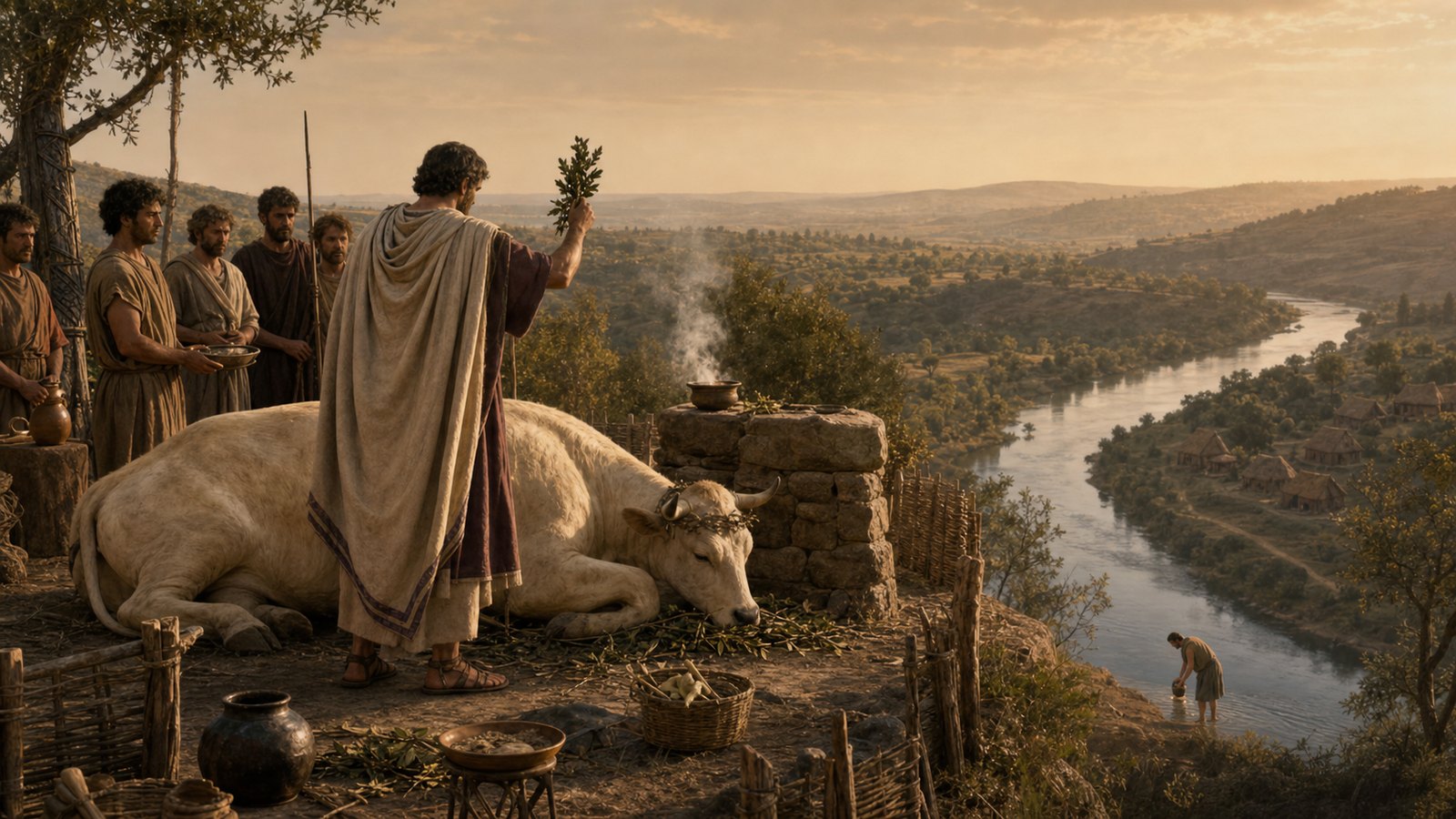
Nothing in Livy’s paragraph suggests an open debate over ownership once the man departed. The Roman priest sacrificed the cow to Diana. The act was complete before the Sabine could return, and sacrifice could not be repeated with the same victim.
This is why the episode resists a simple division between sincere ritual and cynical politics. The demand for clean hands may have been religiously intelligible. It was also delivered by the interested community’s priest, at the decisive moment, with the rival’s extraordinary victim already present. Correctness and advantage occupied the same sentence.
Rome won by controlling sequence
Livy says the result pleased Servius and the whole Roman state. The satisfaction links the altar directly back to the king’s diplomatic project. Rome had not merely obtained an animal. It had prevented a Sabine from using Diana’s Roman sanctuary to claim regional supremacy.
The mechanism was sequence rather than superior force. First came the shared temple, then the prophecy, then the arrival of the victim, then the purity objection, then the trip to the river, and finally the Roman sacrifice. Remove any one step and the result becomes less secure.
The story also shows why priests mattered to civic competition. A priest controlled not only prayers and offerings but access to valid performance. Knowledge of the rite could identify a defect, demand a correction and determine when an action counted as finished.
Livy wrote long after Rome’s regal period, and his narrative should not be mistaken for a contemporary record of Servius’s reign. Its historical value includes the way a Roman author imagined early expansion: warfare mattered, but so did hospitality, common cult, memorable objects and procedural intelligence.
The Sabine arrived with the prophecy’s most obvious asset, the cow. Rome possessed the less visible assets: the temple, the priest, the river’s relationship to the sanctuary and the authority to say what purity required. Power belonged to the side able to arrange those pieces before the knife fell.
The horns in the porch completed the victory in memory. Visitors did not see the walk that removed the owner or hear the priest’s exact tone. They saw the remains of the victim inside Rome’s temple. A disputed future had been compressed into a Roman object.
Livy’s final note of collective satisfaction also prevents the priest from becoming a lone rogue in the story. The king and community accepted the result as Rome’s gain. Ritual initiative had produced a civic outcome, and public approval folded the questionable timing into a foundation narrative about intelligent expansion. The cow did not conquer territory. Her sacrifice explained why Roman leadership could look favoured, procedurally valid and materially commemorated all at once.
Sources
Livy, History of Rome 1.45