
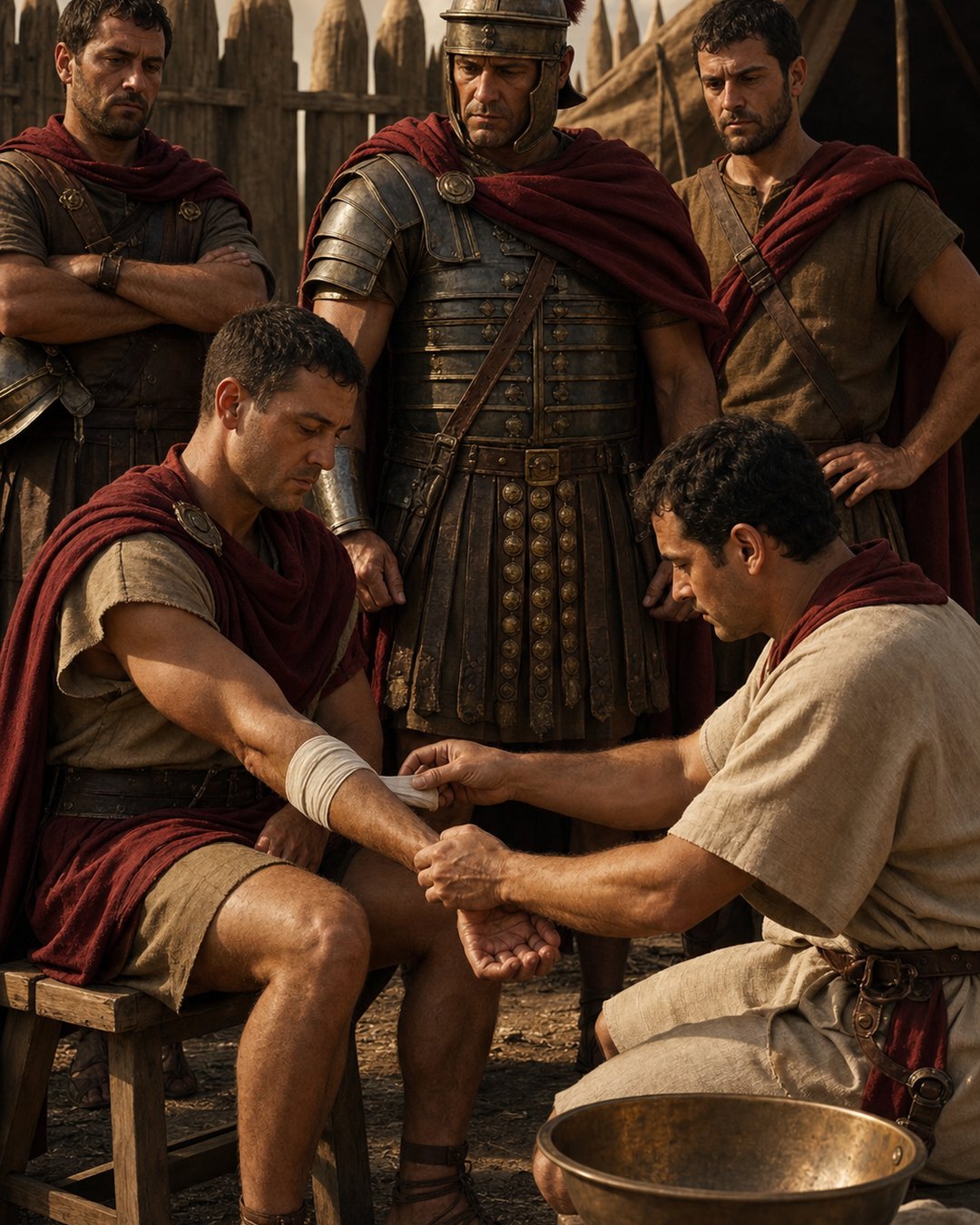
The order did not send a Roman soldier to the whipping post or the execution ground. It sent him to have a vein opened.
Aulus Gellius preserves the punishment in a chapter only a few sentences long. He calls it an old military penalty and says its purpose was disgrace. Blood was deliberately let from the soldier’s body, yet Gellius could not find an old explanation for why the army had chosen this particular act.
That gap makes the custom more revealing, not less. Gellius watched an inherited rule whose practical origin had faded and tried to reconstruct its logic. He guessed that treatment for a disturbed mind had migrated into discipline for misconduct. The guess is not evidence for the penalty’s beginning, but it shows a Roman reader trying to make medicine, reason and military shame fit together.
Celsus, writing about medicine, helps recover the physical weight of the act. Opening a vein was a controlled procedure with choices about the patient’s strength, the cutting site, the quantity removed and the moment to stop. In camp, the same sequence could carry a different social meaning. Technique made the act possible; authority made it punishment.
Gellius found the penalty but not its original explanation
Gellius states the rule plainly. Among the punishments that brought dishonour upon soldiers was an order to open a vein and let blood. His wording separates this from an accidental wound and from therapeutic care freely sought. A military superior imposed the procedure, and the result was not merely physical depletion but public loss of standing.
The source does not identify an offence, a commander, a legion or a standard quantity of blood. It does not describe a ceremony, instrument or audience. Those absences matter. A vivid reconstruction of a particular condemned man, a cheering unit or a measured bowl would turn silence into invention.
What Gellius does reveal is his own research problem. He says that, as far as he could discover, the old records supplied no reason for the practice. The custom had survived more clearly than its rationale. A later writer could name the punishment while admitting that the chain of explanation had broken.
This differs from the collective sentence in the camp punishment begun by a tribune’s cudgel. There, a touch launched a lethal sequence carried out by comrades. The opened vein belonged to another register. It used a skilled bodily procedure and aimed, in Gellius’s description, at ignominy rather than death.
That contrast prevents a flat picture of Roman discipline. The army possessed more than one way to turn authority into bodily consequence. A penalty could destroy, strike, expel, deprive or shame. Venesection made the soldier submit to an action also found in the physician’s repertoire.
A lost rationale invited a treatment-to-punishment story
After admitting that the records had failed him, Gellius offers an inference. He imagines that opening a vein was first used on soldiers whose minds were affected and who were not in a normal condition. In that beginning, he says, the act would have looked more like treatment than punishment.
He then proposes a second step. The same penalty could have spread to other offences because people who did wrong were treated as if they were not of sound mind. Therapy became a disciplinary analogy: misconduct was framed as a kind of disorder, and a remedy associated with disorder was imposed upon the offender.
Gellius marks this reasoning as supposition. He does not cite a law, medical manual or commander who made the change. His chapter preserves two different kinds of information that should not be fused. The existence and disgraceful character of the penalty are reported as old practice. The path from mental treatment to general punishment is his attempt to explain it.
That distinction sharpens the historical question. The important point is not that Rome certainly invented the penalty in a hospital and transferred it to a camp. We cannot know that from this chapter. The point is that Gellius found medical logic plausible enough to bridge a missing institutional memory.
His explanation also turns wrongdoing into a problem of rational control. A sound soldier obeyed; an offender behaved as if sound judgment had deserted him. Opening the vein made that metaphor physical. Whether or not this was the original rationale, it was a rationale a learned Roman could use to domesticate a strange old rule.
Celsus shows that opening a vein was no symbolic pinprick
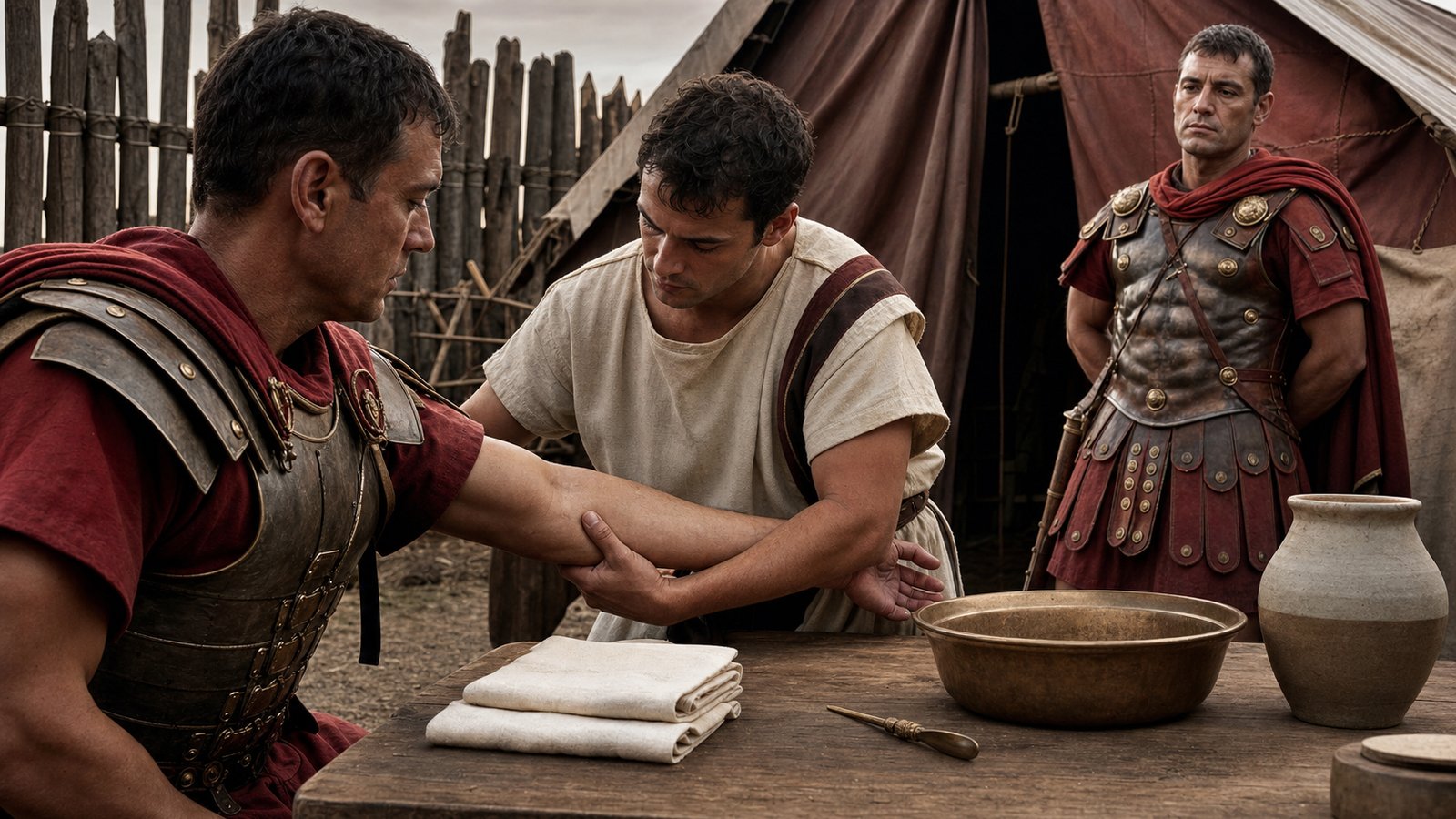
Celsus describes venesection from the medical side. Incising a vein, he says, was not new. What had changed was the enormous expansion of conditions for which practitioners considered it. His discussion assumes a real intervention with genuine risks, not a theatrical scratch made only to produce a sign.
Older practice, according to Celsus, avoided children, elderly people and pregnant women. Later experience shifted attention from category to strength. A robust patient in one of those groups might endure the procedure, while a weak young adult might not. Remove blood from someone already depleted, he warns, and the remaining strength can die away.
This judgment made observation essential. Age or status could not replace an assessment of the body in front of the practitioner. The decision required an estimate of resilience, illness and timing. Celsus repeatedly balances possible benefit against the danger of further weakening the patient.
He names the temples, arms and areas near the ankles as places from which blood could be drawn. When the whole body was affected, the arm was the usual site. He also enters a technical dispute over whether to bleed near or far from the damaged part, rejecting a simple rule that distance always diverted harmful material.
The practical craft belongs beside Celsus’s ideal of the surgeon’s trained hand. An incision demanded steadiness and anatomical caution. Celsus warns that the knife might strike an artery, tendon or nerve while seeking the vein. A punishment built from this procedure depended on controlled expertise even when its purpose was disciplinary.
Colour, faintness and a cold pad set the procedure’s limits
Once blood began to flow, the practitioner still had decisions to make. Celsus discusses its appearance and change as evidence. The aim was not simply to remove as much as possible. Flow, colour and the patient’s condition helped determine whether the intervention should continue.
His clearest boundary is fainting. The bloodletting must stop before the patient loses consciousness. That instruction places a hard practical limit between deliberate depletion and uncontrolled collapse. It also makes the opened-vein penalty unlike a wound delivered in the confusion of combat. Someone had to watch, judge and stop.
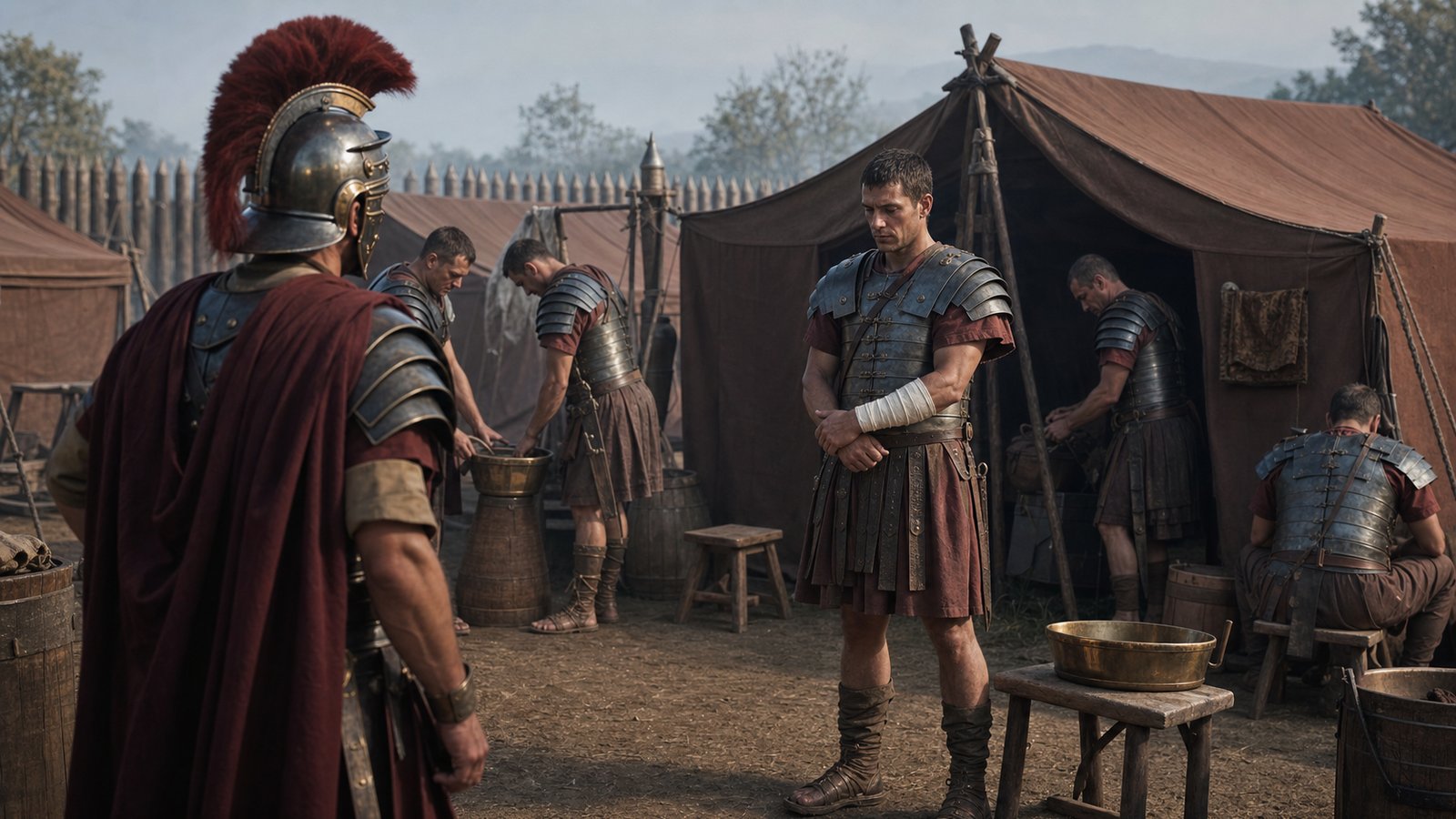
Afterward came closure and care. Celsus tells the practitioner to place a pad squeezed from cold water over the site and bandage the arm. The small scar firmed quickly, but the process did not end at the cut. Pressure, cooling and binding turned an opened vessel back into a closed wound.
None of these medical details can be assigned automatically to every punished soldier. Gellius does not say that a camp attendant followed Celsus line by line. Celsus instead establishes what competent Roman venesection could involve. It gives scale to Gellius’s terse phrase and explains why the order required more than a blade and a threat.
The material setting would have reinforced submission. The soldier had to expose part of the body, remain still and allow another person to control the incision and its end. Even without a surviving description of spectators, a military command transformed the patient’s usual dependence into an offender’s obedience.
Military authority changed the meaning of a medical act
The same physical action can acquire different meanings from who orders it, where it occurs and what status follows. In a sickroom, opening a vein could be offered as a remedy. Under military authority, Gellius says, it disgraced. The cut did not carry one timeless meaning inside itself.
That flexibility helps explain why the penalty could remain intelligible after its origin was forgotten. The army did not need every soldier to know the custom’s first rationale. An authoritative order, a recognized procedure and a shared understanding of ignominy were enough to keep it functioning.
Gellius’s uncertainty is therefore part of the evidence. Roman institutions could preserve actions more faithfully than explanations. Writers then repaired the gap with analogy, etymology, moral reasoning or conjecture. Here the repair joined unsound conduct to an intervention associated with an unsound body or mind.
The chapter also warns against reducing Roman punishment to spectacular violence. Disgrace could be administered through a measured act that stopped before fainting and left a bandaged arm. Restraint did not make the act benign. The absence of a death sentence sharpened its social purpose: the soldier had to return to a community that knew authority had marked him.
What survives is an unsettling overlap. Medical knowledge supplied a technique for opening and safely closing the body. Military hierarchy supplied compulsion and shame. Gellius supplied a hypothesis about how one realm had crossed into the other—and enough honesty to say that the old records had not given him the answer.
Sources
Aulus Gellius, Attic Nights 10.8; Celsus, De Medicina 2.10