
First came the failure: a flame intended to endure had gone dark. The practical answer was close at hand. Every kitchen, lamp and brazier could offer fire. Plutarch says that answer was unacceptable.
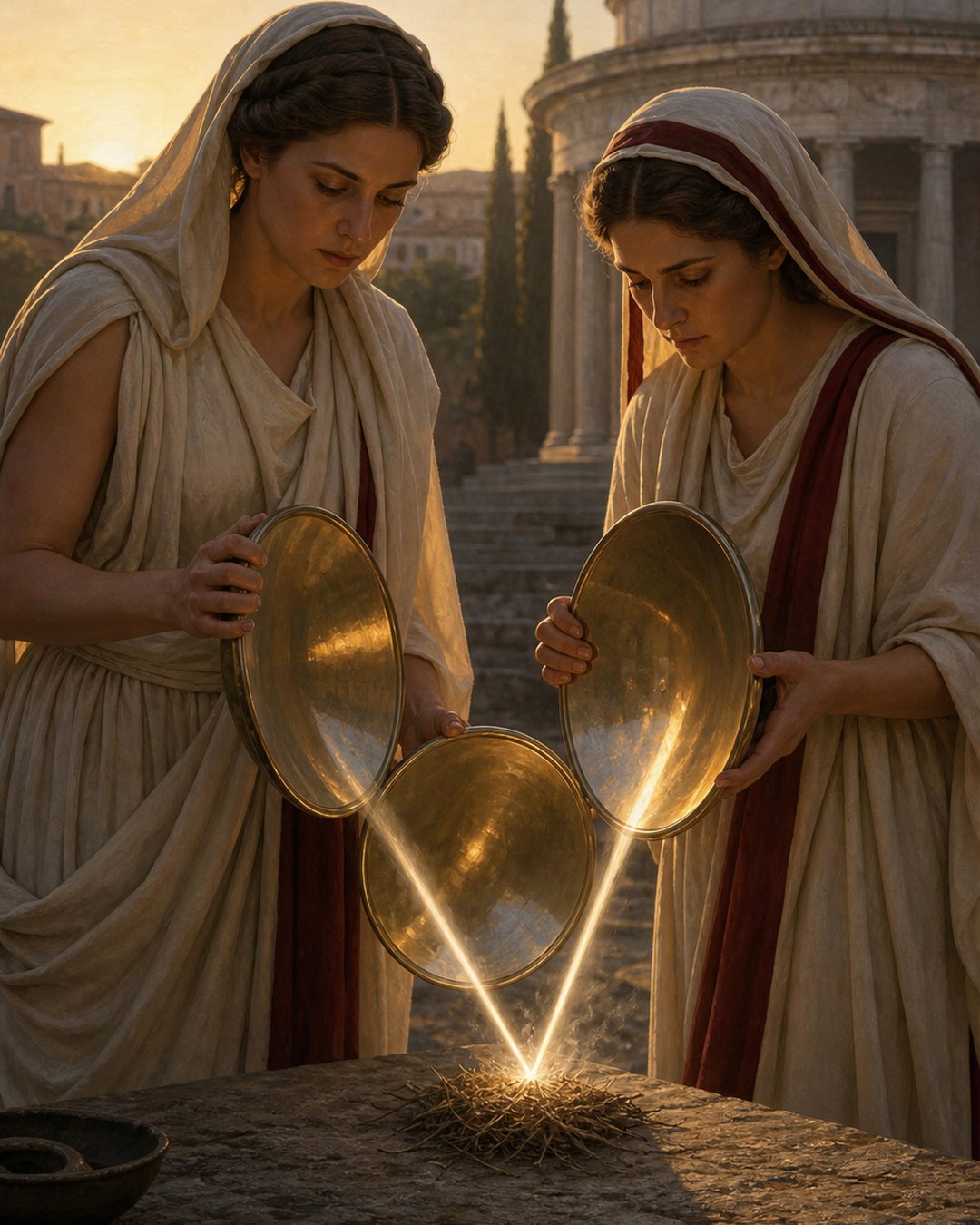
The extinguished sacred fire was not to be relit from another flame. Its replacement had to be “fresh and new,” drawn from the rays of the sun. To make that origin visible, attendants faced shaped metal toward daylight and placed the lightest dry material at the point where the reflected rays met.
This was a restart without borrowing. A household ember would have restored heat quickly, but it would also have carried an ordinary history into a ritual that required a clean beginning. The mirror procedure made the source of the new flame part of the act.
Plutarch’s account joins theology to technique. Purity did not remain an abstract quality spoken over an altar. It determined which fuel was acceptable, where ignition could come from, what tools were prepared and whether the sky allowed the work to proceed.
A perpetual flame made extinction a special kind of break
In his life of Numa, Plutarch places the perpetual fire under the care of the Vestal virgins. He attributes both their consecration and the cult’s organization to Rome’s second king. The account is written centuries after the period it describes, and Plutarch openly preserves explanations rather than pretending that only one survived.
One explanation linked virgin guardians to fire because fire was thought pure and uncorrupted. Another treated it as unfruitful and barren, making virginity the appropriate human counterpart. Plutarch then widens the comparison beyond Rome. At Delphi and Athens, he says, perpetual fires were entrusted not to virgins but to widows past the age of marriage.
The contrast matters because it separates the continuous flame from one uniquely Roman staffing arrangement. Different communities could preserve lasting sacred fire through different custodians. What joined them was not identical personnel but the demand that the flame’s continuity be guarded.
Plutarch knew that continuity could fail. He lists disruptions rather than describing an impossible ideal. The sacred lamp at Athens was said to have gone out during the tyranny of Aristion. At Delphi, the temple burned during the Persian invasion. Altars were demolished and sacred fires extinguished during the Mithridatic conflict and the Roman civil wars.
War, fire and political disorder could therefore reach the ritual centre. An extinguished flame marked more than a cold wick. It made visible a breach between the community’s claim of continuity and the material fact of an altar that no longer burned.
The new fire could not inherit an ordinary hearth’s past
Once a perpetual fire had vanished, any convenient ember posed a problem. It could produce the right physical result while carrying the wrong ritual origin. Plutarch states the rule sharply: the fire was not to be kindled again from other fire.
That restriction transformed relighting into renewal. A borrowed flame would continue some unrelated domestic or workshop fire. Sunlight offered a source that had not passed through another human hearth. The new blaze could begin from rays rather than from a chain of previous burnings.
The logic resembles the care invested in the Vestals’ pointed water vessel. There, an awkward container prevented sacred water from being set casually on the ground. Here, an awkward ignition method prevented sacred fire from being replaced casually from a neighbour’s coals. In both cases, the object made a religious distinction difficult to ignore.
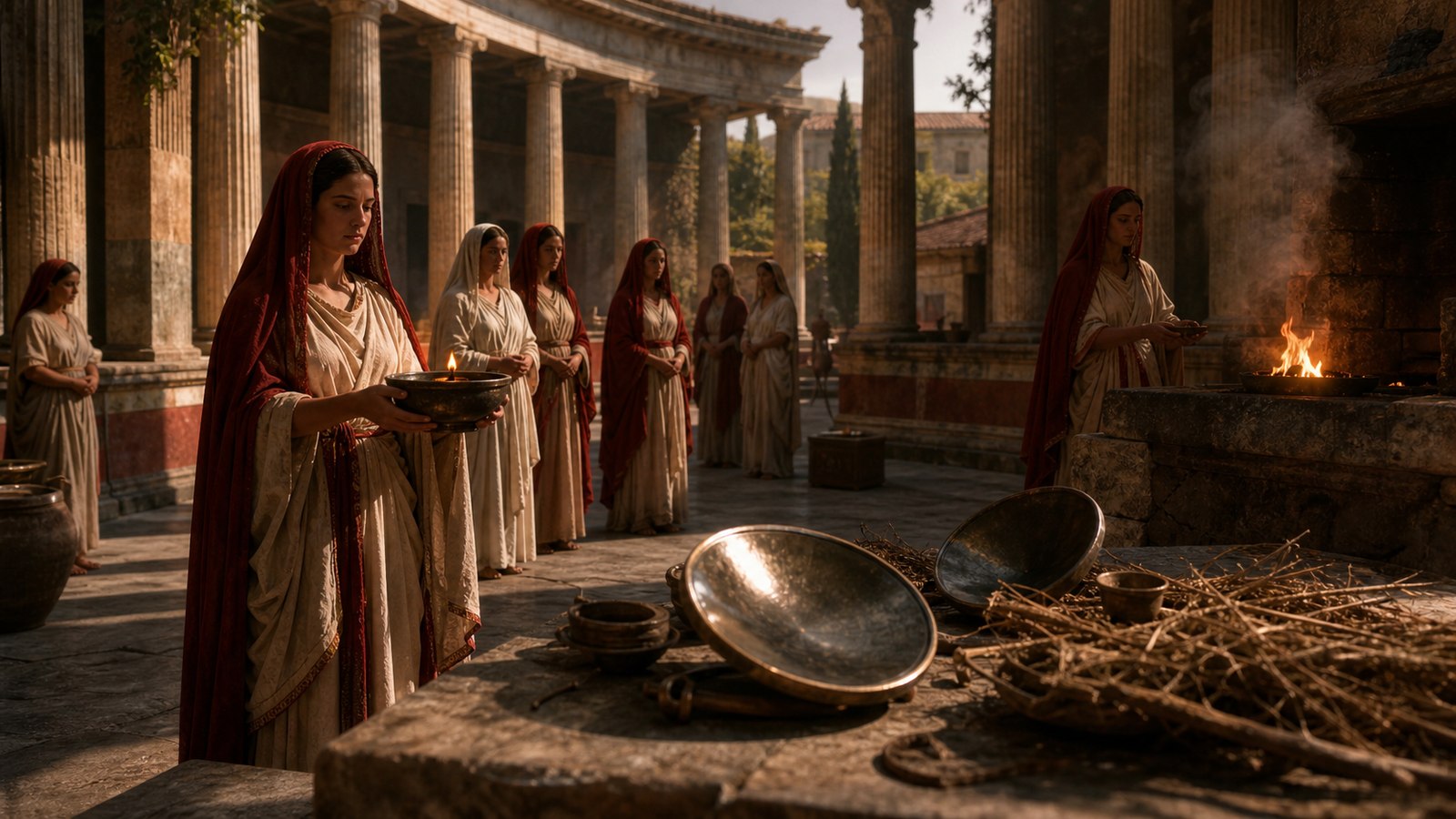
Difficulty was useful. It forced attention onto procedure. Someone had to keep suitable reflective metal ready, select dry tinder, judge the sun and hold the apparatus in the correct relation to the light. Renewal became observable work rather than a hidden substitution.
Plutarch calls the desired result a pure and unpolluted flame. His description does not prove that every Roman rekindling followed one standardized workshop manual, nor does it allow a modern reconstruction to be read backward into every detail. It does show what his account considered an intelligible solution: the flame’s acceptable status depended on how it began.
Curved metal gathered scattered rays at one centre
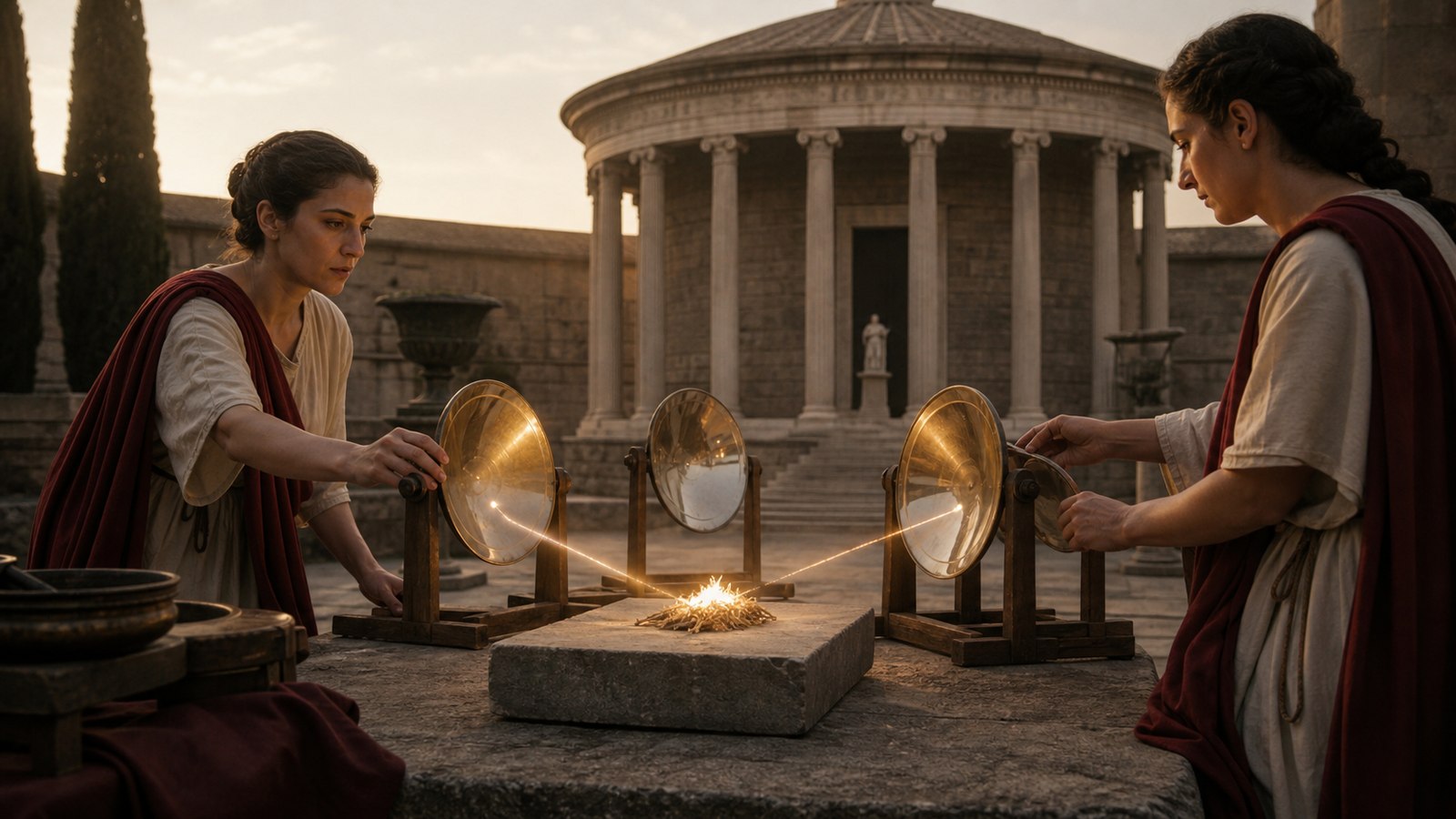
The mirrors in Plutarch’s description were metallic, not modern glass backed with silver. Their useful feature was concavity. He explains the curve through an isosceles right triangle and says the surface converged from its circumference toward a single point in the centre.
Placed opposite the sun, the mirrors received rays across their wider area. Their shape redirected those rays toward the centre. Broad daylight that was warm but harmless on an open hand became intense at one small region because many reflected paths ended together.
The tinder had to suit that concentration. Plutarch specifies substances that were very light and dry. Damp or heavy material would demand more energy and more time. Fine dry fibre offered the concentrated rays a responsive first fuel.
His physical explanation uses the language available to him. The air at the centre becomes rarefied, and the sun’s rays acquire the substance and force of fire. A modern account would describe reflection, focus, heat transfer and ignition differently. Flattening Plutarch into modern optics would erase the historical texture of the passage; dismissing it because its vocabulary differs would miss the controlled observation behind it.
Material, shape and placement formed one mechanism. A polished surface without the right curve scattered the opportunity. A concave mirror pointed away from the sun gathered nothing useful. Correct alignment without dry tinder failed at the last step. The flame emerged only when all three conditions met.
This makes the episode unlike the famous tale of mirrors used as a weapon. The goal here was not to burn a distant ship or magnify destruction. It was to produce one small, legitimate beginning under supervision. Precision served restoration.
Thirty years of custody turned technique into memory
Plutarch moves from the fire to the women entrusted with it. He names Gegania and Verenia as the first pair said to have been consecrated by Numa, followed by Canuleia and Tarpeia. Two more were added later under Servius, producing the number known in Plutarch’s day.
The Vestals’ thirty-year term gave their service a deliberate internal rhythm. The first ten years were spent learning duties, the second ten performing what had been learned, and the final ten teaching the next generation. Ritual knowledge was therefore designed to move through people as carefully as flame moved through time.
That sequence is crucial to the mirror scene even though Plutarch does not pause to give us a named operator. A rarely needed emergency procedure could not depend on improvisation after the altar went dark. Its materials, restrictions and handling had to remain available within an institution that trained successors.
The annual world of Vesta also reached beyond the shrine. During the Vestalia, millstones were garlanded and working donkeys rested. Such observances connected sacred fire and the goddess’s protection to the labour that turned grain into food. The perpetual flame stood inside a larger network of households, mills, storage and ritual time.
Plutarch even records uncertainty about what the Vestals guarded. Some believed only the perpetual fire lay in their care. Others said secret sacred objects, unseen by outsiders, were concealed with them. The disagreement strengthens the sense that custody itself mattered: knowledge, objects and flame were separated from ordinary access.
The mirrors reveal how that custody handled rupture. Continuity did not mean pretending extinction could never happen. It meant possessing a rule for beginning again without making the new flame indistinguishable from a borrowed ember. Sunlight, curved bronze and dry fibre turned recovery into a ceremony of origin.
At the centre of Plutarch’s scene is almost nothing: a small pale bundle, a bright point and the first catch of flame. Around it stand centuries of explanation, institutional memory and the fear of a broken sequence. The apparatus mattered because it made renewal both physically possible and religiously recognizable.
The explanation preserved technique without fixing its date
Plutarch wrote centuries after the kings traditionally assigned to early Rome. His optical explanation therefore cannot by itself prove that Numa or the first Vestals used mirrors built to the geometry he describes. The biography joins an old sacred institution to technical language available to a later author and audience.
That gap does not make the mechanism decorative. Concave reflectors really can concentrate incoming sunlight, and Plutarch gives enough parts to reconstruct the logic: direct sun, a shaped reflective surface, convergence and light dry fuel. What remains uncertain is when this precise procedure entered Roman ritual practice.
The distinction keeps the article’s strongest evidence intact. Plutarch preserves a detailed ancient account of how a ritually clean flame could be made without borrowing another hearth’s fire. He does not give an archaeological history of every mirror, repair or change in Vestal equipment.
Sources
- Plutarch passage at LacusCurtius
- Plutarch in the Project Gutenberg translation
Plutarch, Life of Numa 9.5–10.1