
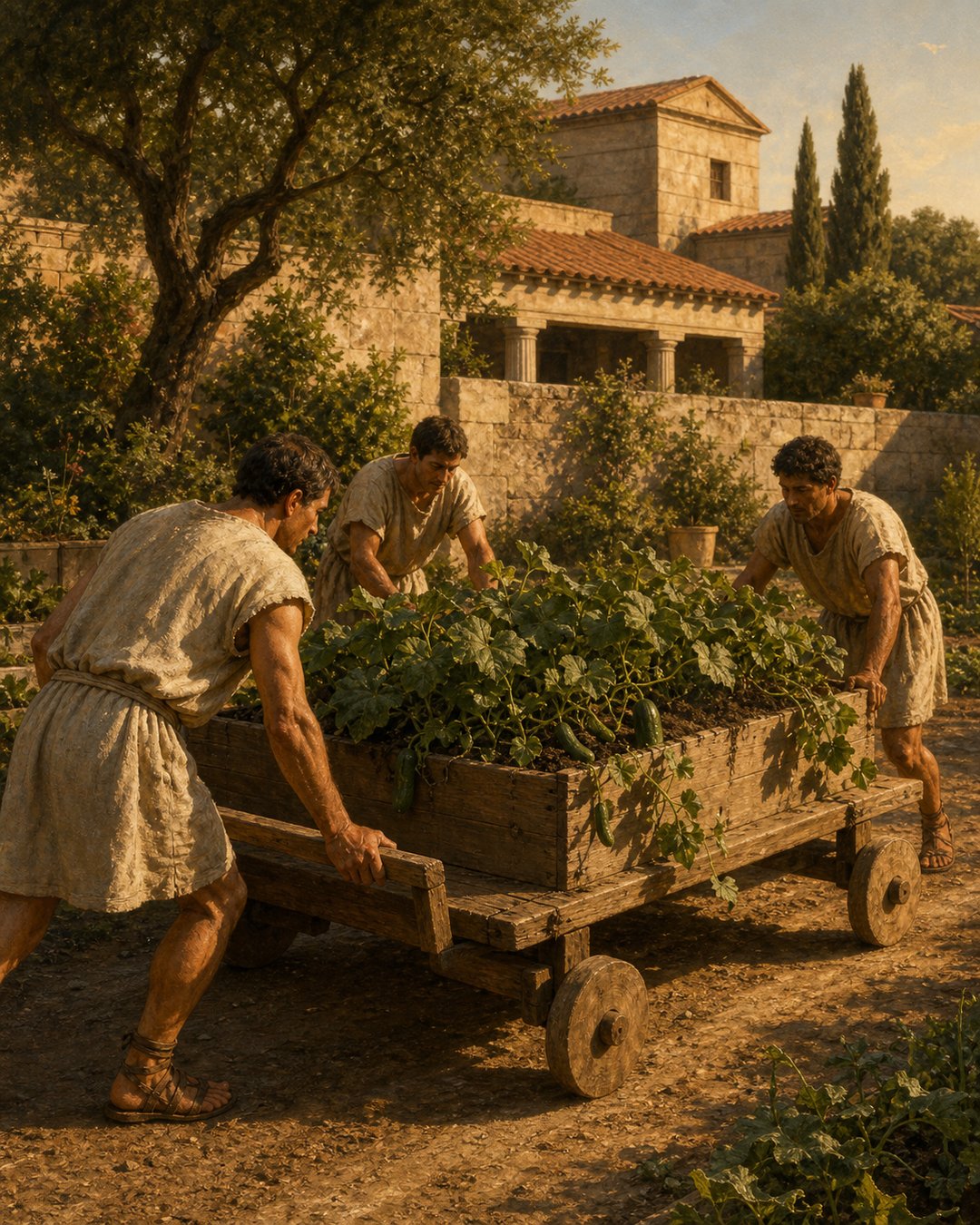
Tiberius wanted a cucumber every day. Pliny the Elder gives that preference only a few lines, yet those lines open an entire working garden. Soil-filled beds stood in frames. Wheels carried them toward the sun. When winter threatened, gardeners drew them back behind pale sheets of mirror-stone.
No single object solved the problem. The crop still required soil, water, attention, and warmth. Mobility changed which patch of ground received the plants. Translucent shelter changed how long they could remain protected without losing daylight. Human labor connected every stage, moving the beds whenever weather and season demanded it.
The result was not a modern greenhouse appearing centuries early. It was a Roman answer to an imperial service requirement: keep a preferred vegetable available beyond its easy season. Pliny’s compact description shows appetite translated into frames, wheels, shelter, and a daily routine.
One Daily Preference Became a Supply Obligation
Pliny begins with the plant before he reaches the emperor. He places the cucumber among plants of a cartilaginous nature whose fruit grows above ground. The classification is ancient rather than botanical in the modern sense, but it fixes his subject as a cultivated body with flesh, texture, and a visible place in the garden.
Then Tiberius enters. The emperor, Pliny says, took wonderful pleasure in cucumbers and was never without one. “Never” gives the anecdote its pressure. A seasonal abundance would not be enough. The household had to bridge dull days, short days, and winter days while maintaining access to a crop that preferred warmth.
An emperor’s table could draw rare goods across long distances, but this solution was local and mechanical. The text does not send couriers toward a warmer province whenever Rome cooled. It places gardeners beside movable beds. Their task was to manipulate exposure around living plants whose growth could not simply be ordered into existence.
The episode belongs beside other stories in which elite taste activated chains of practical work. Apicius crossing the sea in search of exceptional prawns turned appetite into travel and disappointment. Tiberius’s cucumber habit turned appetite into a repeated schedule inside the garden. One was a journey after rumored abundance; the other was an attempt to make supply predictable.
Wheels Moved the Garden Instead of the Season
Pliny describes raised beds made in frames and mounted upon wheels. The crucial unit was therefore larger than a pot and more manageable than a permanent plot. Soil, roots, stems, and supports could move together rather than forcing gardeners to transplant the crop whenever conditions changed.
The frames were rolled into the full heat of the sun. That phrase explains why mobility mattered. A fixed bed accepts whatever shadow falls across it from walls, trees, roofs, and the low seasonal arc of daylight. A wheeled bed can be advanced into an open warm position, then shifted again as the useful exposure changes.
Movement also made the plants a daily responsibility in a literal sense. Someone had to judge where the light was strongest, whether cold or wind outweighed the benefit, and when the beds should be returned. The emperor may be the famous consumer, but Pliny’s mechanism depends on unnamed gardeners reading conditions and handling weight.
The frames did not conquer winter. They rearranged the garden’s choices. Instead of placing the cucumber permanently in either an exposed bed or a protected enclosure, the system could alternate between them. The wheels allowed warmth and shelter to become positions along a route.
That route is the article’s real machine. Axles and frames mattered, but so did clear ground, a reachable shelter, and workers available at the right moment. The beds made cultivation portable enough to follow a changing environment without pretending that environment had ceased to matter.
Mirror-Stone Offered Light Without Open Air
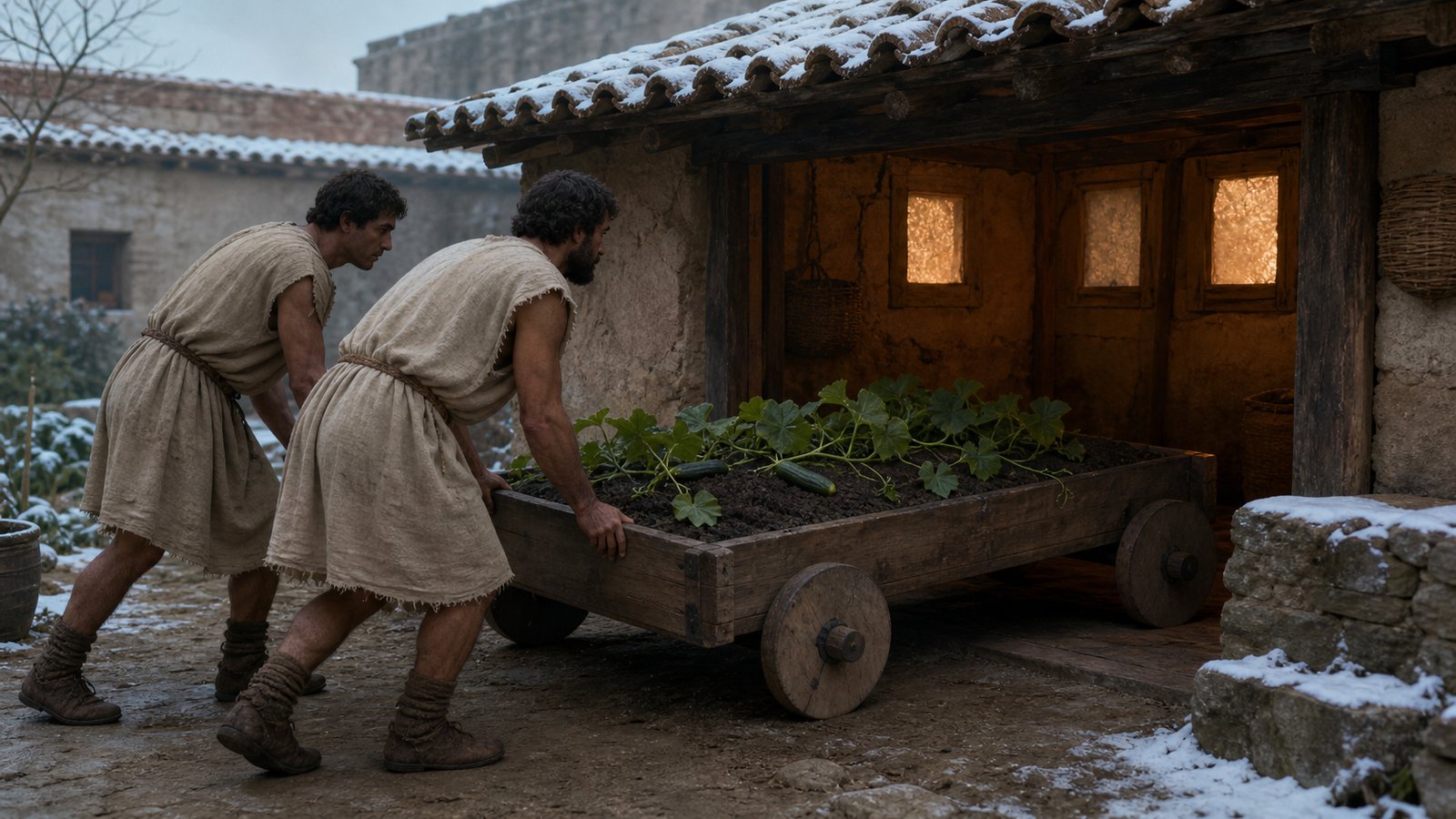
On winter days, Pliny says, the beds were withdrawn and placed behind the protection of mirror-stone. The material is often associated with translucent mineral sheets rather than modern window glass. It admitted light while creating a barrier between the crop and exposed winter air.
That distinction keeps the scene historically grounded. A clear, sealed glasshouse with standardized panes would import a later visual language. Pliny gives us frames and specularia: pale translucent protection whose performance depended on material thinness, placement, and the shelter around it.
The winter enclosure worked together with the wheels. Protection that remained permanently closed could reduce useful sun and warmth when conditions improved. Exposure that remained permanently open could lose the crop to cold. Mobile beds let gardeners choose between the two imperfect environments.
Roman readers knew reflective and translucent materials through a different set of objects than ours. Obsidian mirrors that returned dark reflections show how varied ancient surfaces could be. The cucumber shelter used “mirror-stone” for another property: not a crisp reflected face, but enough admitted light to protect growing plants behind a physical screen.
The material did not make weather disappear. It moderated exposure. Cold still shaped the day’s decisions, and limited winter light still had to be gathered. The most plausible reading is therefore not effortless abundance but managed vulnerability.
Pliny Put Court Horticulture Beside Garden Lore
After the imperial beds, Pliny moves into advice attributed to ancient Greek writers. Cucumber seed, they said, should be steeped for two days in milk and honey so that the fruit would taste sweeter. He also reports that a growing cucumber could be trained into a desired shape.
These details should not be treated as controlled modern trials. They show the mixture characteristic of ancient agricultural writing: direct observation, inherited practice, regional comparison, and claims repeated from earlier authorities. The same chapter can preserve a practical frame on wheels and a flavor-making seed treatment without ranking their evidence as we would.
Pliny also distinguishes cucumbers by place and appearance. Italian examples are green and very small. Some provincial crops are remarkably large, wax-colored, or black. The imperial favorite therefore sat within a broader map of variation rather than representing one uniform vegetable known everywhere in the same form.
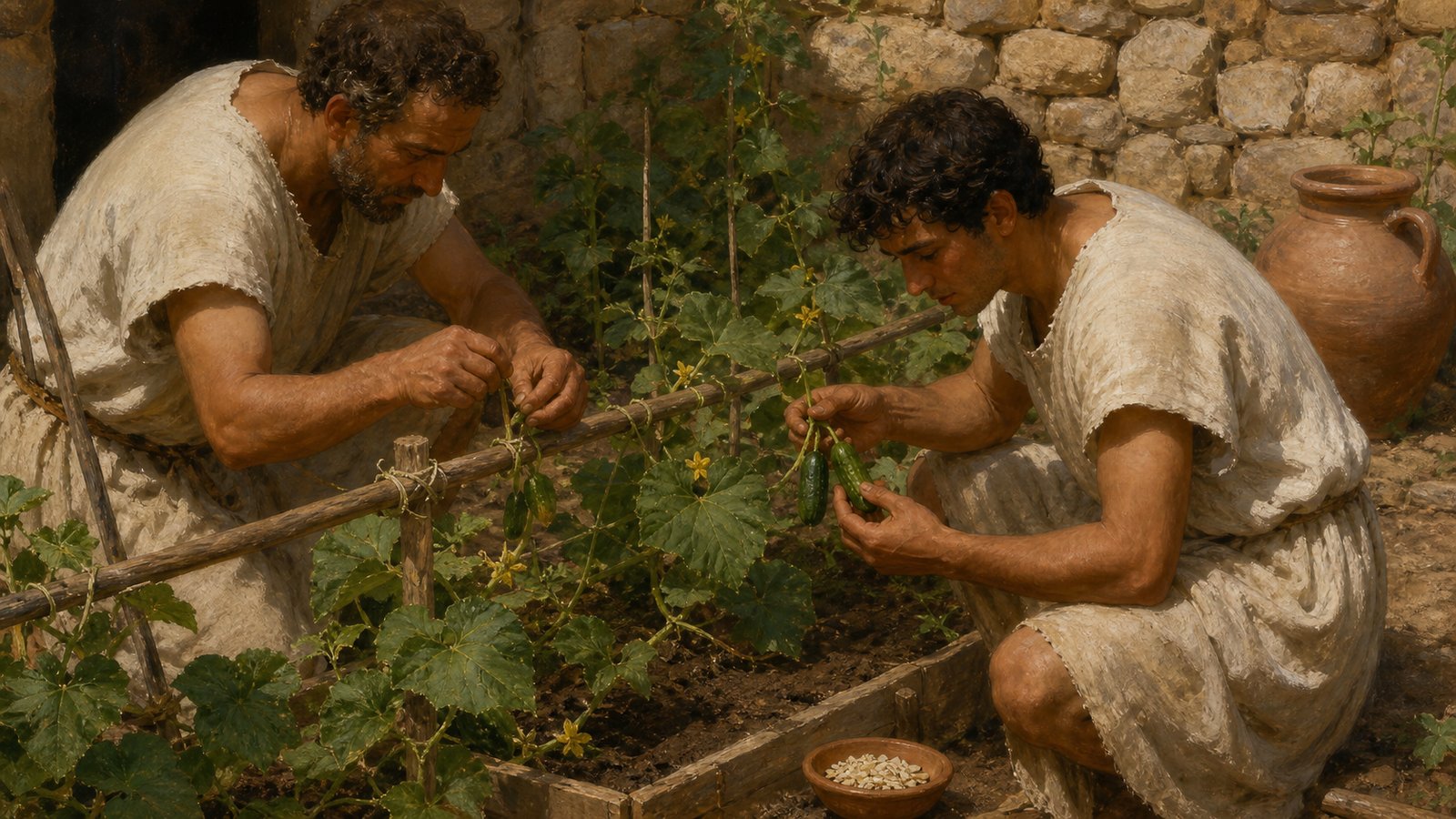
Shape mattered too. The claim that a cucumber could be trained while growing reflects close attention to the plasticity of a fruit attached to a creeping plant. It brings cultivation back from palace supply to touch: gardeners guided stems, watched swelling fruit, and adjusted the physical conditions around it.
That practical intimacy resembles the knife, bark, and clay involved in Roman grafting. Neither process reduces agriculture to a grand invention. Both show outcomes assembled through small interventions made at the correct stage of growth.
The Luxury Was Reliable Attention, Not Just the Vegetable
A cucumber is an ordinary object, which is precisely why Pliny’s anecdote is so useful. The emperor’s distinction did not lie in possessing an unimaginable substance. It lay in receiving a familiar crop every day, including when season and weather made that regularity costly.
The hidden luxury was coordinated attention. Gardeners prepared soil-filled frames sturdy enough to move. They watched the sun. They rolled living beds across the garden. They maintained a winter shelter and shifted the crop behind translucent stone. They repeated these actions for a consumer who expected continuity.
This reading also changes the meaning of the wheels. They were not a novelty displayed once for wonder. Their value came from reuse. A wheel that moved one frame on one bright afternoon was less important than a system capable of moving beds whenever the thermal and seasonal balance changed.
Pliny does not tell us who designed the arrangement, how many workers moved it, or what yield it achieved. Those blanks should remain blank. What he does preserve is enough to identify the operating logic: seek sunlight when it helps, retreat under protection when cold dominates, and keep roots undisturbed by moving their bed with them.
Tiberius’s daily cucumber therefore belongs to the history of service as much as to the history of gardening. Imperial preference created the deadline. Plant biology set the limits. Materials and wheels widened the gardeners’ options. Labor closed the gap, one movement at a time.
Sources
Pliny the Elder, Natural History, Book 19, chapter 23 (English translation); Book 19, chapter 5 in the Mayhoff Latin numbering.