
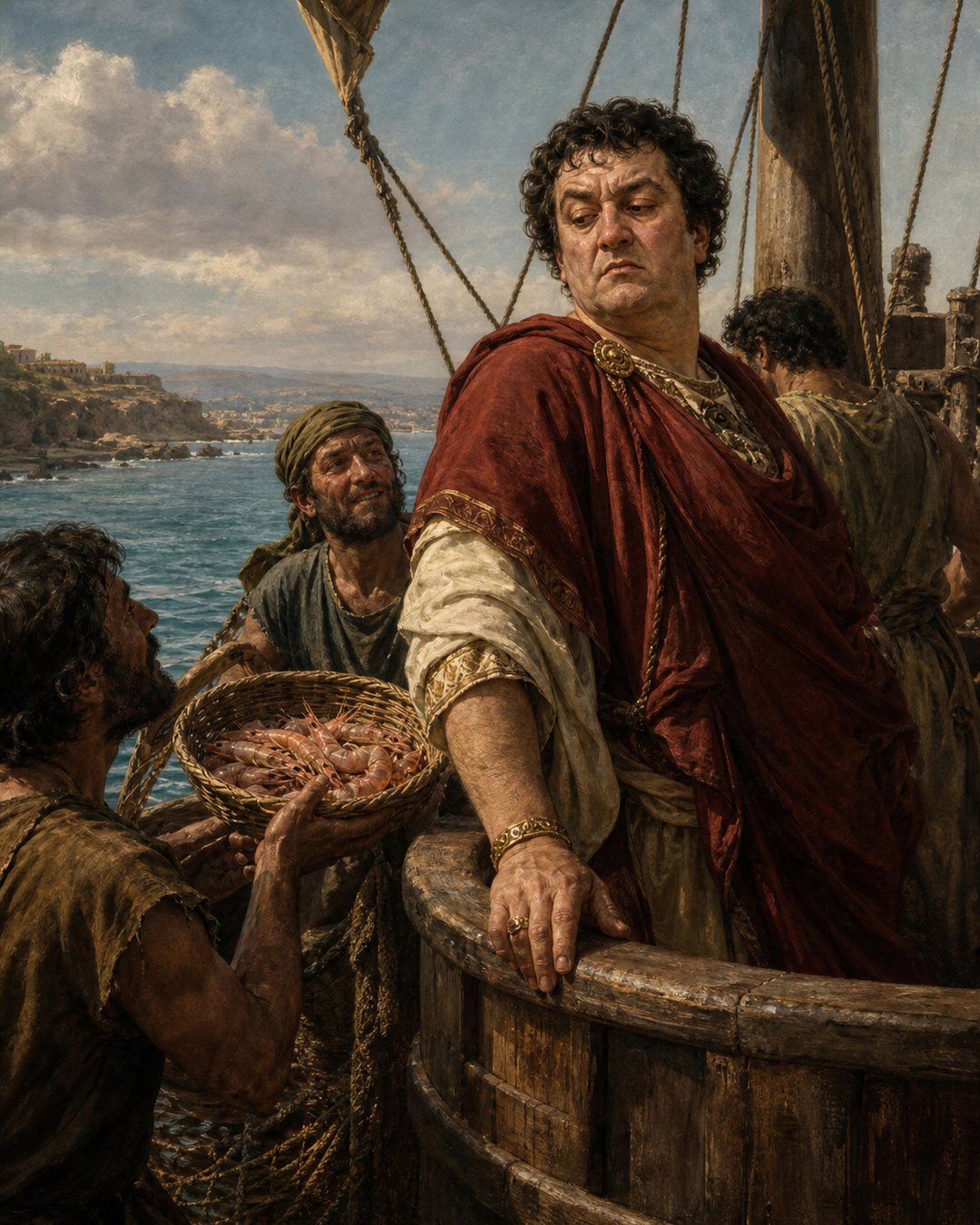
Apicius heard that enormous prawns lived off Libya. The report was enough to launch a voyage. He crossed the Mediterranean in search of a specimen larger than anything available near his Italian home.
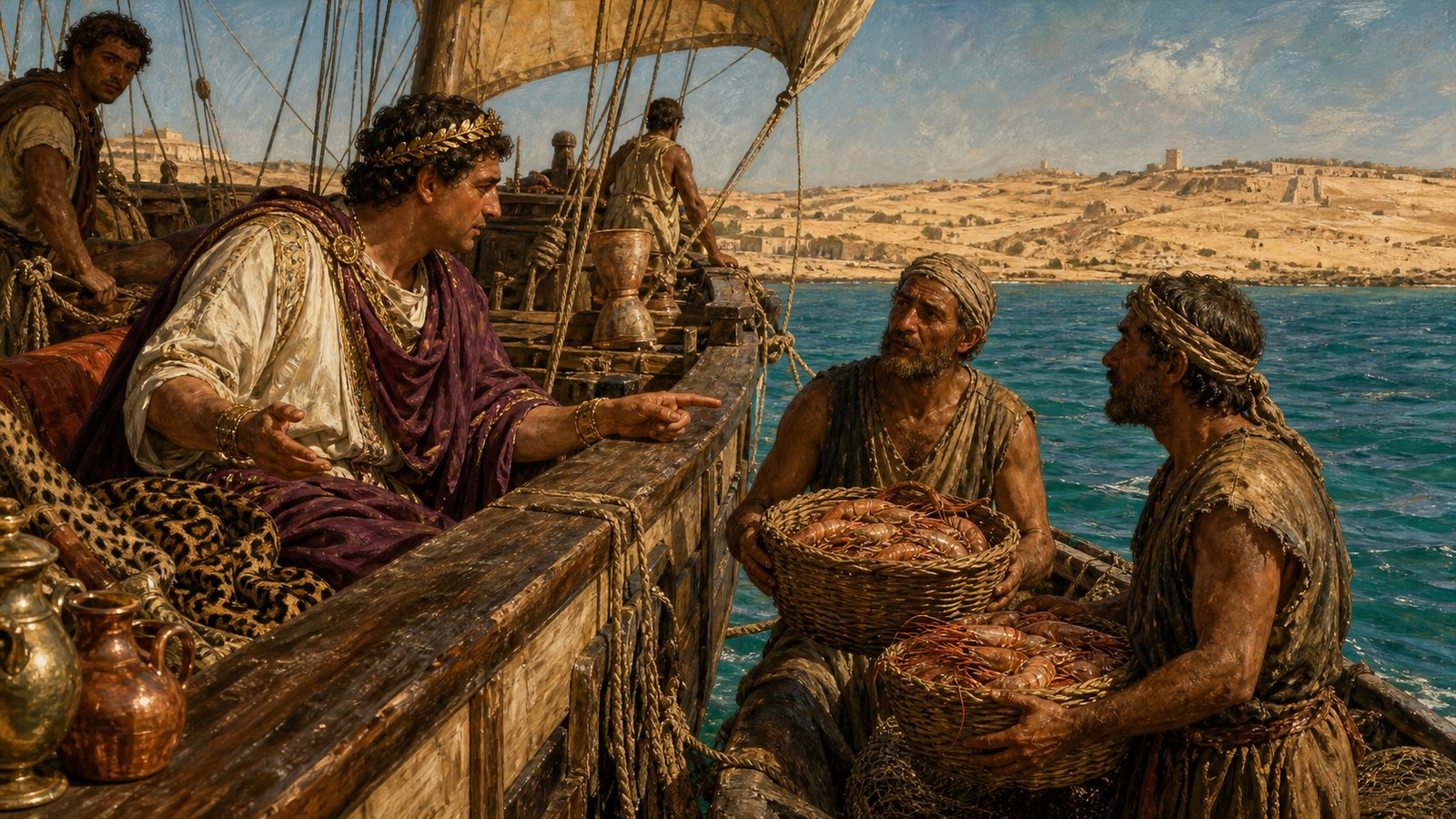
Fishermen came out to meet the arriving ship. Apicius asked whether they possessed prawns greater than the celebrated catch of Campania. They said no.
He did not go ashore. According to the story preserved by Athenaeus, he ordered the helmsman to turn around. An entire coast had failed a comparison before the traveller touched it.
A Rumor Could Mobilize a Mediterranean Household
The anecdote begins with information rather than appetite. Someone carried a report that Libyan waters produced unusually large prawns. For a famous gourmet, size and remoteness transformed seafood into a test worth pursuing.
Travel required a vessel, crew, provisions and time. Even if Apicius joined a ship already moving through commercial routes, his search depended on sailors and the infrastructure linking Italian ports to North Africa.
That scale separates luxury from ordinary hunger. A hungry person buys available food. Apicius pursued the possibility that somewhere else held a superior version of something he already knew.
Roman elite dining encouraged such comparisons. Guests judged freshness, provenance, season and rarity. Hosts turned distant ingredients into evidence of reach. A creature’s journey could matter almost as much as its taste.
An account of Domitian’s enormous turbot shows one fish growing into a court problem because size made it imperial. Apicius reverses the direction: instead of bringing the marvel to power, power sails toward the rumored marvel.
Campania Set the Standard Libya Had to Beat
Campanian coasts and markets supplied wealthy Roman diners with familiar seafood. The fishermen’s answer only makes sense if Apicius had a benchmark in mind: prawns he considered excellent and against which foreign claims had to be tested.
The question therefore was not whether Libya had prawns. It was whether Libya could exceed an established hierarchy. Ordinary quality would not justify the journey after rarity had been promised.
Athenaeus preserves the episode through Apion, and the chain of transmission warns against treating it as a captain’s log. Ancient authors collected memorable food stories because appetite revealed character. Every detail is arranged to make extravagance visible.
Yet the comparison is economically plausible. Roman markets distinguished origin and quality, while fast sea routes moved perishable luxury goods when weather allowed. Elite demand rewarded anyone who could attach a convincing place-name to exceptional food.
The fishermen approaching the ship become involuntary inspectors. Their local knowledge punctures a rumor generated elsewhere. They do not flatter the rich visitor with a convenient lie; in the story, they admit their prawns are not larger.
Turning Back Was the Most Expensive Gesture
Apicius’s refusal to land is the anecdote’s point. Once the prize failed the test, Libya itself held no interest. People, towns and landscapes vanish behind the single culinary purpose of the voyage.
Disappointment becomes performance. He could have rested, traded or eaten the local catch. Instead he orders immediate reversal, proving that the trip was never ordinary travel. Only the superlative object could complete it.
The command also transferred his preference into other people’s labor. Sailors who had crossed the sea now had to turn the vessel. Cooks, attendants and suppliers participated in a decision whose benefit was a possibility of larger shellfish.
Ancient moralists repeatedly made luxury legible by measuring the labor hidden inside it. A delicacy from far away gathers ships, roads, ice, containers, merchants and servants around one plate.
Apicius’s empty return sharpened that critique. Consumption usually leaves bones, shells or an invoice. This expedition produced nothing except distance, because anything less than the rumor was rejected.
The Gourmet Became a Character Larger Than His Recipes
The name Apicius became closely associated with extravagant Roman eating. Several people carried it, and the surviving cookery collection was assembled through a complicated tradition rather than written as one simple authorial book by the famous gourmand.
The prawn traveller is usually identified with Marcus Gavius Apicius of the age of Tiberius. Other anecdotes connect him with costly ingredients and relentless culinary experiment. Seneca uses his end as a moral example of wealth consumed by appetite.
Such sources are hostile witnesses. They want Apicius to embody excess. That does not make every detail useless, but it means the voyage should be read as crafted character evidence rather than neutral biography.
The story’s economy helps it survive. Report, voyage, question, refusal: four movements produce a complete portrait. Apicius is not condemned by a narrator’s abstract lecture. He condemns himself by treating Africa as a disappointing pantry.
A separate Roman food system could turn dormice into managed villa livestock. That process sought repeatable supply. Apicius’s voyage sought the opposite quality—the singular specimen valuable because normal supply could not guarantee it.
Rarity Had to Survive Inspection
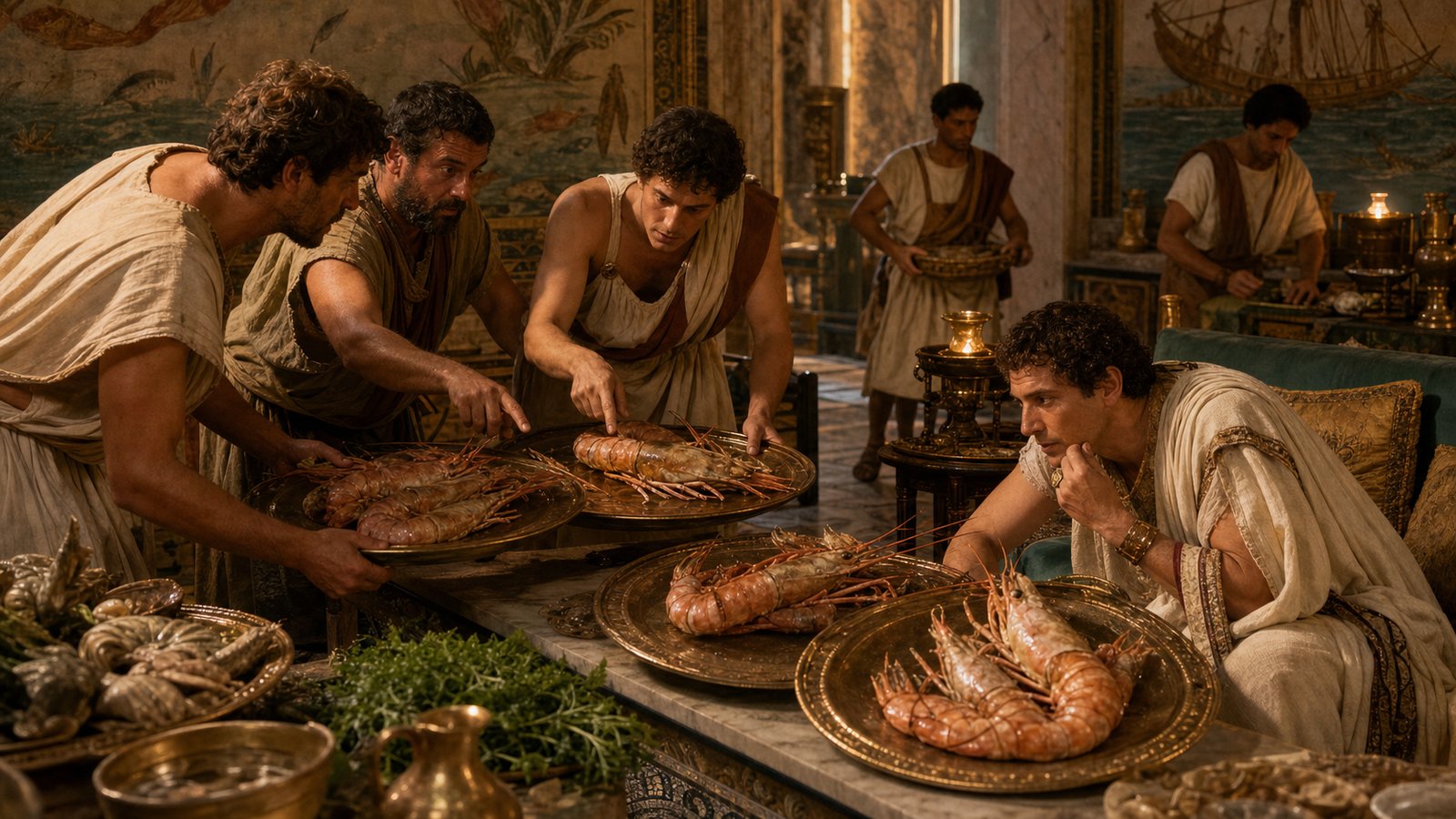
The anecdote is also a warning about luxury information. A distant claim grows easily because few diners can inspect its source. “Libyan” and “enormous” reinforce one another until someone spends enough to test them.
Apicius does test the claim, though in the strangest possible manner. He asks local fishermen before landing and accepts their answer. His standards are extravagant, but the episode does not portray him as unable to compare evidence.
That moment gives the fishermen unusual authority. They end a wealthy Roman’s project with practical knowledge. The sea may contain excellent food, but excellence is not the same as the promised record.
The return journey then converts failed verification into legend. Had Apicius eaten a good dinner and continued travelling, there would be little story. Turning around preserved the purity of the obsession.
Roman readers could laugh at the scale while recognizing the mechanism. Markets still magnify distant goods through reputation, and connoisseurs still chase marginal differences across unreasonable distances.
Apicius crossed a sea because “larger” had become a destination. When the adjective failed, the destination disappeared.
The voyage also depended on a chain of trust. The first report persuaded Apicius to spend time and transport; the fishermen’s answer persuaded him to abandon that investment. Luxury could be credulous at the start and brutally empirical at the end.
Between those decisions stood a shipboard household. A helmsman chose courses, sailors handled sail and rigging, attendants managed the traveller’s needs, and provisions occupied space. The prawn itself never came aboard, but its reputation organized every hand on the vessel.
The episode therefore measures appetite through opportunity cost. Apicius did not merely pay a high market price. He committed days of movement and the labor of others to testing whether one regional catch surpassed another.
Roman moral criticism loved this conversion because it made excess countable. Distance, manpower and wasted time became evidence that taste had escaped proportion. The missing meal was more accusatory than a laden banquet table.
Still, the fishermen retain the story’s quiet dignity. They could have offered smaller prawns as wonders to a rich stranger. Instead their plain comparison ended the fantasy. Local expertise proved stronger than a travelling rumor, even if the visitor responded by erasing the place from his itinerary.
The sea crossing also made freshness part of the paradox. Seafood gained value from immediacy, but the eater had travelled away from his established supply in order to find a larger specimen. Every mile increased the prestige of origin while complicating the practical problem of delivering the catch at its best.
That tension is why the shipboard meeting is narratively perfect. Apicius reaches the source rather than waiting for merchants, yet even arrival cannot manufacture superiority. Geography offers access, not a guarantee.
Sources
Athenaeus, Deipnosophists 1.7, citing Apion. Seneca, Consolation to Helvia 10.