
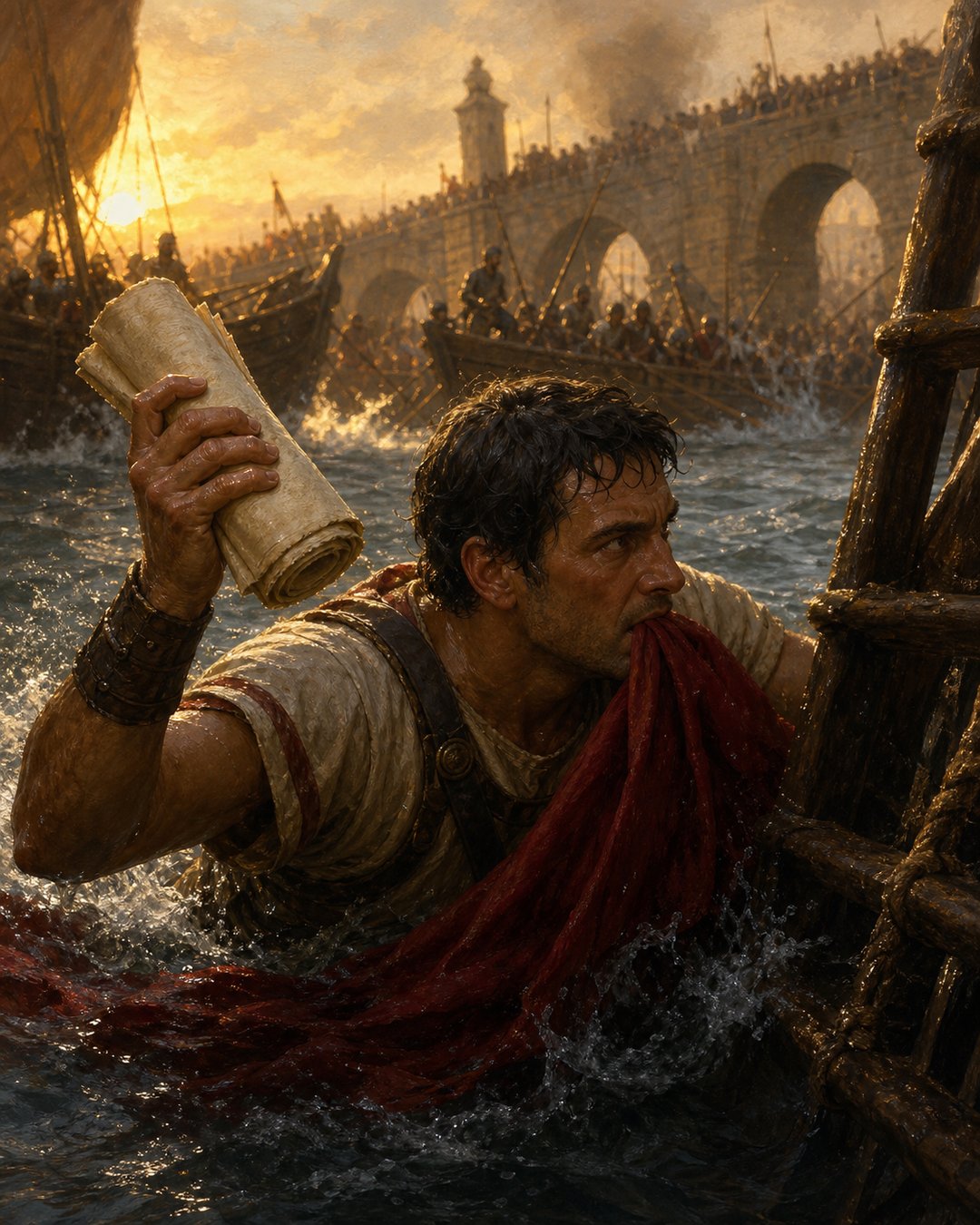
A boat at Alexandria filled with men as enemy troops surged toward a bridge. Julius Caesar chose the water. He swam toward another ship roughly two hundred paces away, but he did not enter the sea empty-handed.
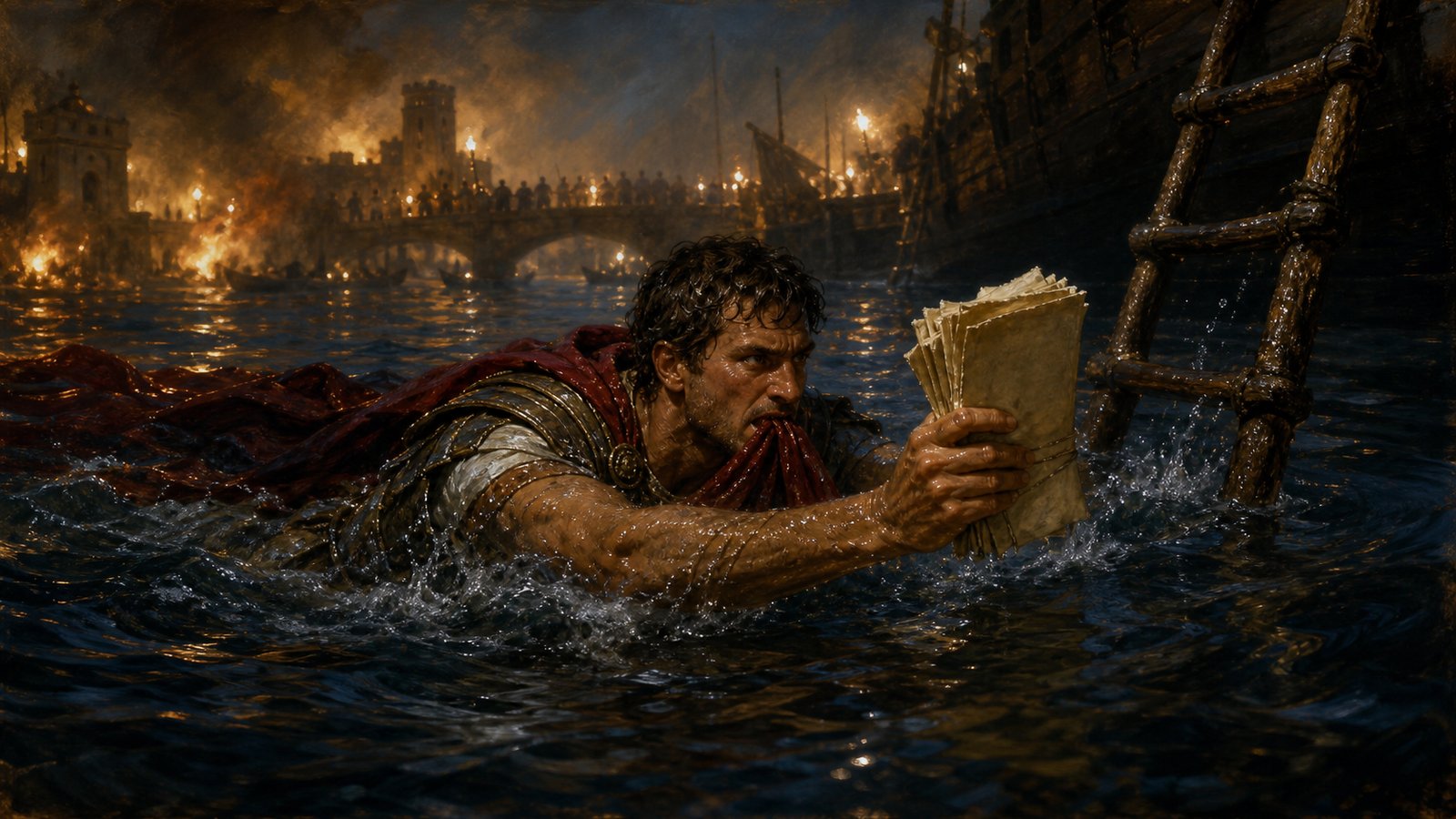
Suetonius says Caesar held papers above the surface with his left hand. He dragged his commander’s cloak behind him with his teeth so it would not become an enemy trophy. One arm, his mouth and the water around him each carried a different part of the escape.
The scene is too carefully arranged to read like an ordinary swimming report. It turns a retreat into a portrait of command under pressure: body, information and symbol had to reach safety together.
An Alexandrian Bridge Became a Trap
The episode belongs to Caesar’s fighting at Alexandria, where streets, harbour water, ships and causeways forced Roman soldiers into a battlefield unlike an open Italian plain. Control of crossings mattered because water divided positions and limited movement.
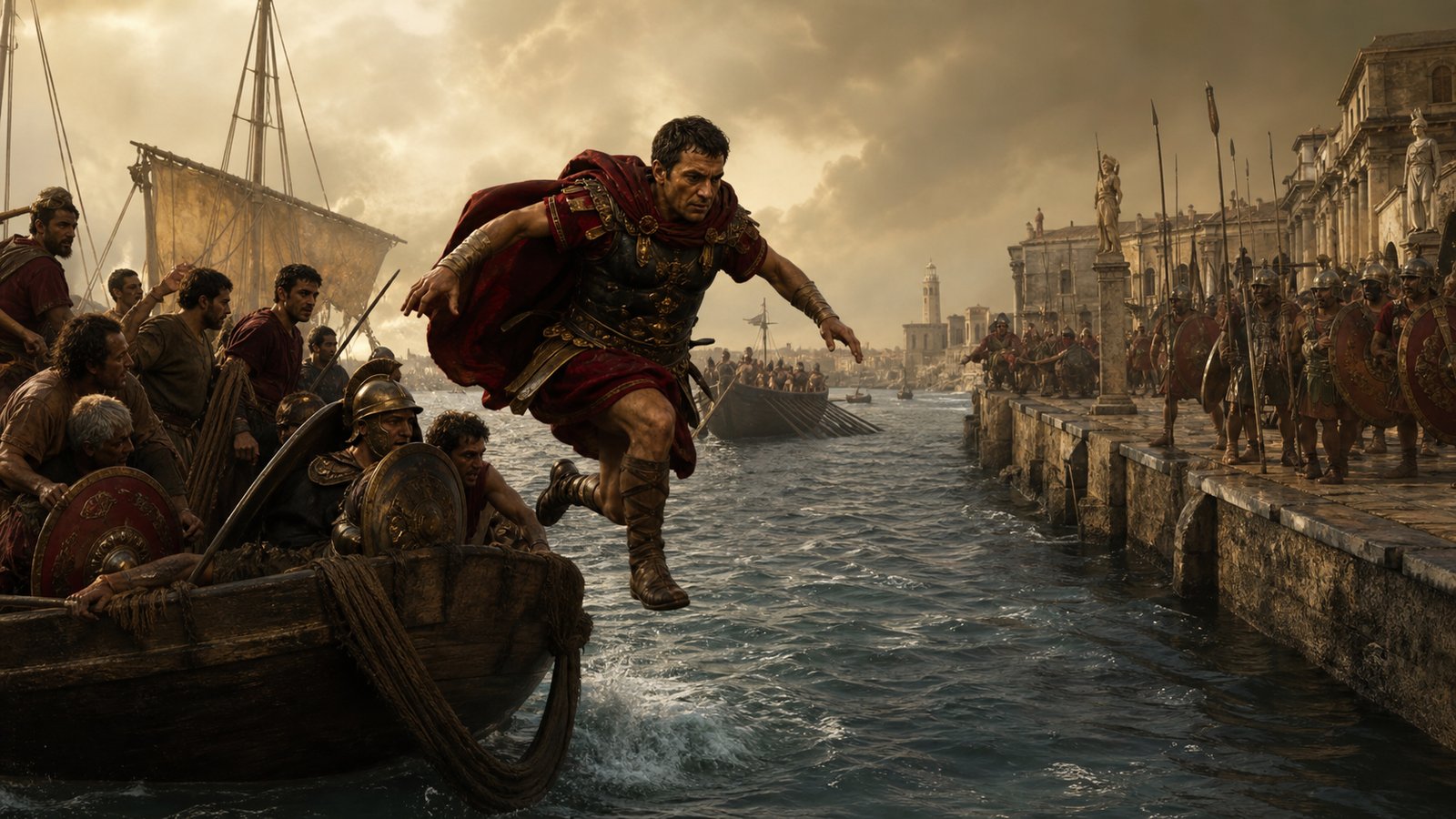
Suetonius locates the crisis during an attack on a bridge. A sudden enemy sally forced Caesar into a boat. Others crowded in with him, making the vessel a bad refuge precisely when speed mattered most.
A commander in such a boat faced two dangers. Remaining aboard concentrated men in a vulnerable target, while entering the water surrendered armour, footing and the protection of formation. Caesar chose the second risk because it still allowed individual movement.
The distance in Suetonius is two hundred paces to the next ship. Ancient measurements should not be converted with false precision, but the number makes the exertion substantial rather than ceremonial. This was not a step from quay to ladder.
The episode of Pullo and Vorenus beyond the rampart follows soldiers whose rivalry collapsed into mutual rescue. Alexandria presented a different command problem: Caesar had to improvise alone while the objects of office became liabilities.
One Hand Carried Information Above the Water
Suetonius does not identify the papers. Calling them secret battle plans would add a fact the source does not supply. Their exact contents remain unknown.
What the biographer does specify is Caesar’s decision to keep them dry. A wet document could become unreadable, damaged or useless at the moment when orders and records mattered. Releasing it might also leave material for an opponent to recover.
Holding one hand above water changes the mechanics of swimming. The choice reduced the limbs available for propulsion and balance. Caesar accepted that handicap rather than treat the papers as disposable baggage.
Written command in a Roman campaign moved through notes, lists, reports and letters. Not every order depended on paper, but armies larger than a commander’s voice required portable memory. Suetonius turns that administrative reality into a visible gesture.
The raised hand also separates this episode from a simple tale of athletic strength. The point is coordination. Caesar must keep moving, keep the packet clear of spray and orient himself toward the next vessel while danger remains behind him.
His Teeth Saved the Cloak from Becoming a Trophy
The cloak posed a different problem. It was not protected from water. Caesar pulled it after him with his teeth because, Suetonius says, he did not want it to fall into enemy hands.
A commander’s garment made rank visible to allies and opponents. Once captured, such an object could become proof, boast or spectacle. Losing it would magnify a narrow escape into a public sign of defeat.
Yet wearing a heavy soaked cloak could interfere with swimming. The story solves that contradiction by placing the cloth behind the swimmer. Caesar neither abandons the symbol nor lets it wrap his limbs.
The image is undignified in a productive way. Roman command normally relied on posture, attendants and controlled appearance. Here the general grips cloth in his mouth. The awkwardness makes the decision feel immediate rather than staged on a reviewing platform.
A related episode about Caesar raising his own pirate ransom also survives because he manipulates a dangerous situation into a statement about status. At Alexandria there was no time for speech. The cloak itself carried the claim.
Suetonius Built Character from Selected Objects
Suetonius wrote biography, not an engineering report on swimming. His chapters group actions that reveal courage, endurance, discipline and the relationship between Caesar and his soldiers.
The papers and cloak make the anecdote memorable because they divide authority into two portable forms. One preserves information. The other preserves visible office. Caesar’s body becomes the device that transports both.
The arrangement also flatters mental control. Panic scatters possessions and narrows attention to survival. Suetonius’s Caesar appears able to rank risks while already in motion: leave the crowded boat, protect the papers, deny the cloak and reach the next ship.
That literary polish calls for restraint. We cannot know the papers’ contents, the exact stroke he used or every movement around the bridge. We can say that a Roman biographer considered these details suitable evidence for Caesar’s battlefield presence.
Ancient readers did not need the scene to be comfortable. Its force comes from forcing public command into an exposed body. A general who controlled legions now had to control breath, grip and balance.
The Escape Preserved More Than a Life
If Caesar had simply reached the ship, the episode would still demonstrate stamina. By carrying the two objects, he made survival look continuous with command rather than a temporary flight from it.
The papers could resume their work once dry. The cloak could resume its work once recovered. Neither had to be reconstructed from enemy possession or explained away as a trophy.
The story therefore joins logistics to reputation. Documents are fragile because water can destroy their function. Symbols are fragile because capture can reverse their meaning. Caesar’s improvised posture answers both kinds of fragility at once.
For the soldiers watching from vessels or shore, the return of the commander mattered immediately. For Suetonius’s readers, the manner of that return mattered just as much. Caesar arrives not stripped of office but towing its signs with him.
The most revealing detail is not that a Roman aristocrat could swim. It is that the biographer imagined him calculating what authority weighed when everything he carried threatened to pull him under.
The two hundred paces close the scene with a measure of duration. Every stroke extended the period in which the raised papers, trailing cloth and exposed swimmer could fail. Distance turned a quick leap into sustained improvisation.
Caesar’s escape was still a retreat from immediate pressure. Suetonius does not erase that fact; he transforms its meaning. The commander yielded one position without surrendering the materials through which command could continue.
The overloaded boat is the first failed tool in the story. A vessel designed to carry people stopped serving escape once too many bodies entered it. Caesar’s leap exchanged collective buoyancy for individual skill, then made that skill carry the group’s most portable forms of continuity.
Water tested each object differently. The papers had to remain above it, the cloak could trail through it, and Caesar had to move within it. Suetonius’s compact arrangement assigns a separate solution to each problem without interrupting the swimmer’s progress.
The mouth-held cloak also prevented either hand from being sacrificed to cloth. However polished the retelling became, that distribution of work gives the scene its practical logic: one hand protected writing, the other could aid propulsion, and the teeth controlled the garment that could not safely be worn.
Sources
Suetonius, Julius Caesar 64.