
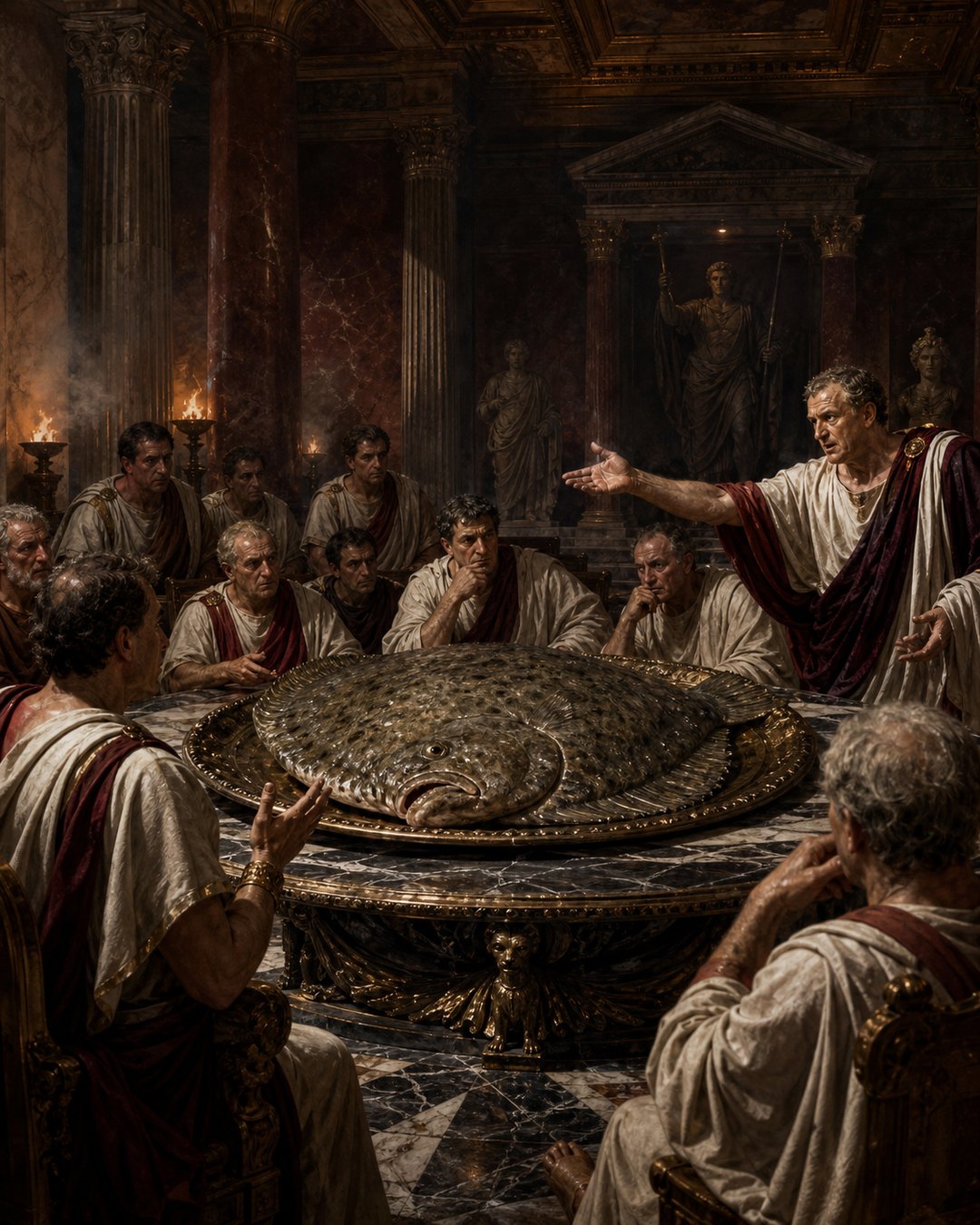
An Adriatic fisherman caught a turbot so large that selling it was dangerous. Juvenal imagines informers waiting to claim any remarkable creature for Domitian. The safest market was therefore the emperor himself.
The fish reached the imperial villa, but the kitchen had no dish large enough to hold it. A ruler with armies, courts and provinces suddenly required advice on cookware. Domitian summoned his leading councillors.
Juvenal’s fourth satire turns that consultation into a miniature of autocracy. Experienced men hurry through cold weather to debate one fish. Nobody can call the problem ridiculous because the emperor’s appetite has made ridicule dangerous.
A Fisherman’s Prize Became Imperial Property
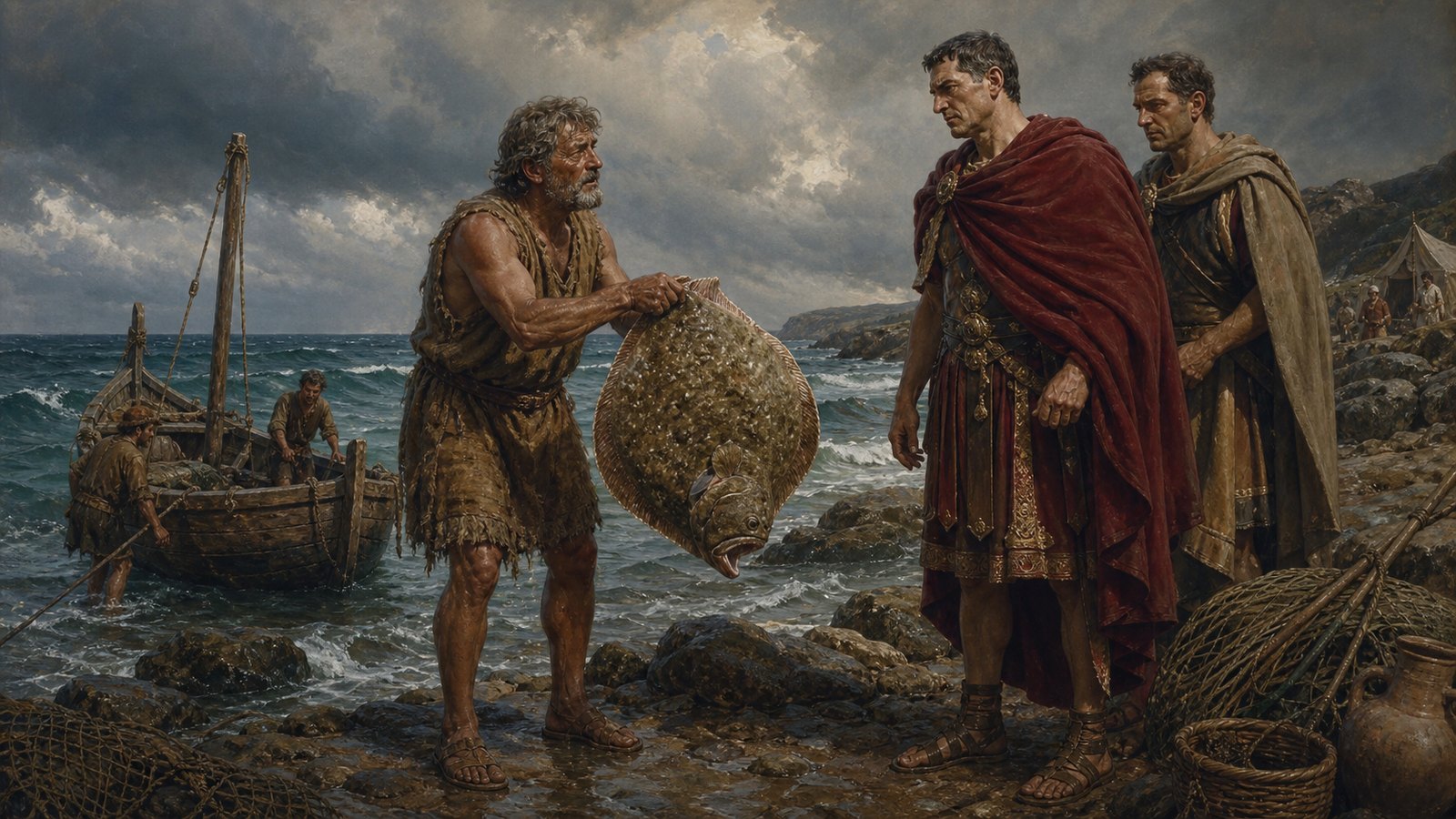
The episode begins near Ancona in the Adriatic. A turbot fills the fisherman’s net, and its extraordinary size creates a problem before it creates a meal. In an ordinary market, rarity raises price. Under a suspicious ruler, rarity may attract accusation.
Juvenal says inspectors watched shores and argued that exceptional fish belonged to the imperial household. His satire exaggerates the reach of informers, but the anxiety is recognizable. Domitian’s court had a reputation in later literature for surveillance, confiscation and prosecution.
The fisherman chooses submission over profit. He carries the turbot to Alba Longa, where Domitian is staying. The gift is framed as voluntary, yet fear determines the route. That ambiguity is central to patronage: what looks like generosity from below may be protection against power from above.
His journey also reverses the normal direction of provision. Instead of the palace purchasing a luxury through merchants, a producer delivers it under the pressure of anticipated confiscation. The emperor receives abundance while the fisherman absorbs uncertainty.
The fish also arrives at the edge of winter. Juvenal jokes that it presents itself as a creature caught for the emperor. Flattery begins before the council because the fisherman must narrate surrender as destiny.
The court accepts the marvel without asking whether one man should own every remarkable thing. Appetite converts size into title. The turbot becomes imperial because everyone behaves as though imperial desire is a category of law.
The Kitchen Discovered a Constitutional Crisis
The obstacle is brutally simple: no dish fits the fish. Cutting it would destroy the spectacle of serving it whole. The kitchen therefore cannot proceed without deciding how much absurdity the court is prepared to organize around one meal.
Domitian responds by summoning the imperial council. Men associated with war, law, administration and aristocratic lineage must abandon other business and hurry to the palace. Juvenal treats their arrival like an emergency session.
The joke works because councils are supposed to distribute judgment. An emperor asks informed advisers to test options, expose risk and restrain impulse. Here the institution is preserved in form while emptied in purpose.
No councillor can answer, “Use two dishes,” without challenging the premise that the fish must remain an undivided monument to appetite. The technical question has a political boundary around it: advice is welcome only if it magnifies the ruler.
Roman dining already turned food into rank. An account of Vedius Pollio’s lamprey pool and crystal cups shows Augustus interrupting a host’s violent domestic theatre. Juvenal reverses the relation. In Domitian’s chamber, the ruler produces the theatre and every guest must sustain it.
Each Councillor Carried a Different Kind of Fear
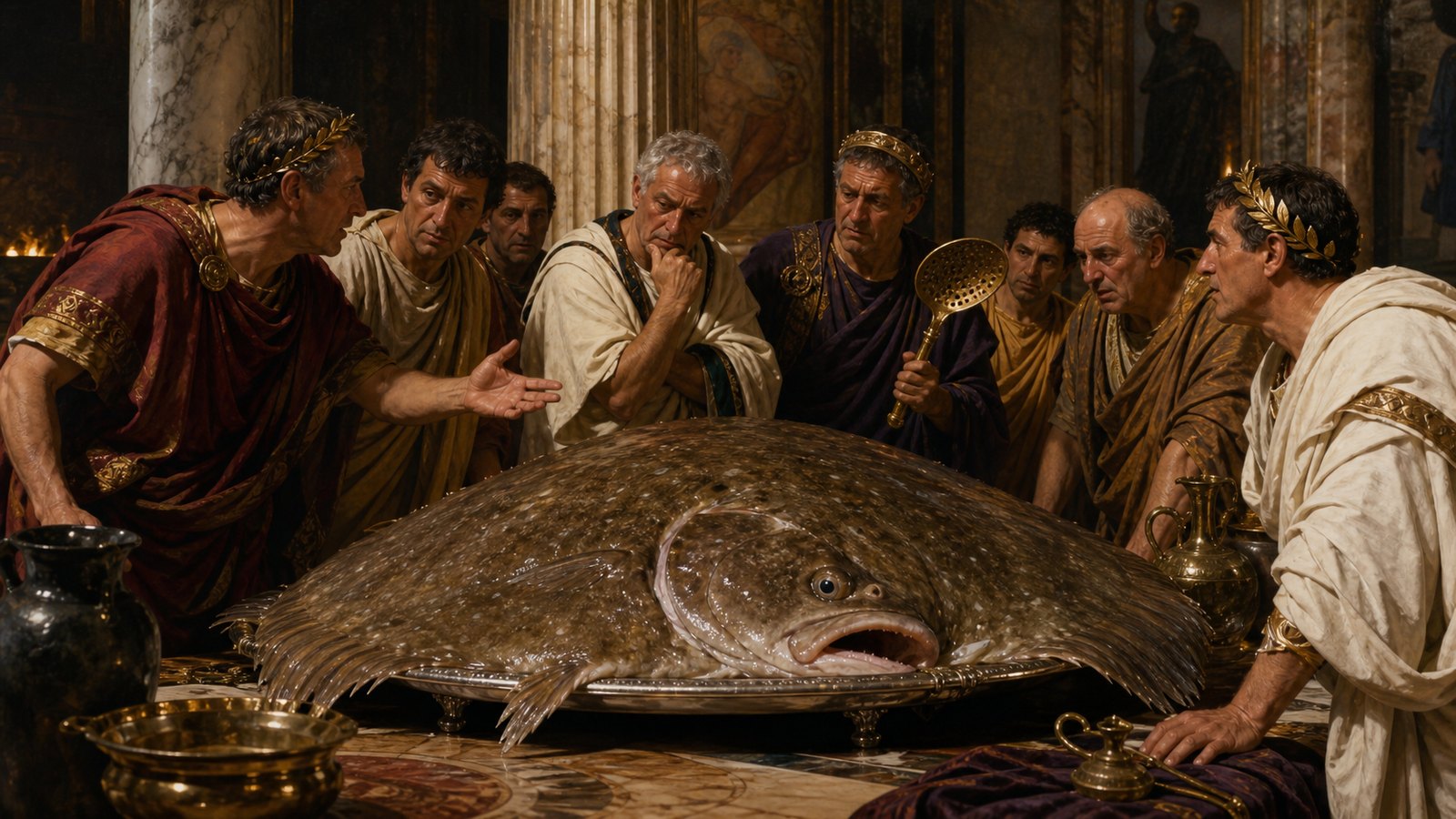
Juvenal introduces the advisers as a gallery of compromised talent. Montanus is a connoisseur able to identify the fish’s origin and condition. Crispus is amiable and prudent, but his survival depends on never speaking with dangerous freedom.
Acilius arrives with his young son. Juvenal darkens the comic meeting by recalling the risks that noble families faced. Catullus Messalinus is blind, yet the satire portrays him as an eager informer capable of directing suspicion without sight.
These portraits are literary attacks, not neutral personnel files. Juvenal arranges names to make the council represent an entire political ecology: expertise diverted, decency muted, nobility frightened and accusation rewarded.
The men are not fools. That is why the scene bites. A foolish council debating a fish would be a farce about incompetence. Capable men debating it under compulsion become a satire about wasted capacity.
Age, office, family and proximity to accusation gave each adviser something to lose. Juvenal does not need Domitian to threaten anyone during the meeting. The councillors arrive already trained by the consequences attached to an unwelcome answer.
Crispus embodies the limit most clearly. Juvenal calls him useful in character, but says he could not safely tell Domitian the truth. Survival under the emperor requires advice stripped of contradiction.
Montanus Solved Everything with a Larger Dish
The decisive proposal comes from Montanus: make a dish large enough for the turbot. Potters should be summoned, and future imperial campaigns should travel with cooks and suitable cookware.
His answer accepts every premise. The fish must stay whole, the emperor’s desire must be honored, and the state must reorganize production around the event. It is perfect court advice because it transforms appetite into infrastructure.
Juvenal gives Montanus culinary authority. He can discuss the fish as though reading its history from flesh. That expertise sounds impressive, but it serves no public necessity. Knowledge becomes flattery when the ruler controls which problems deserve attention.
The proposed dish is also a monument. Once fired, it would preserve the scale of the emperor’s meal even after the fish vanished. Craftsmen, fuel and clay would materialize deference.
Pottery normally answered repeatable demand: storage jars, lamps, cups and cooking vessels. An unprecedented dish reverses that economy. Production bends to a single creature and a single appetite, while the council dignifies the exception as policy.
Roman rulers often used objects to stage command. Vespasian could make a coin answer an objection, while Augustus could smash goblets to stop cruelty. Domitian’s giant dish, as Juvenal imagines it, would do the opposite: it would make everyone else’s compliance visible.
The Fish Exposed What the Council Could Not Discuss
Juvenal ends by wishing Domitian had devoted his time to such trifles instead of cruelty. The line supplies the satire’s payoff. A council occupied with fish is wasteful, but citizens might prefer waste to political violence.
The turbot episode therefore balances comedy and threat. The object is harmless. The behavior around it shows why harmlessness cannot protect anyone at court. Every answer is a test of tone, loyalty and willingness to enlarge the emperor’s importance.
The satire does not prove that a historical meeting occurred exactly as written. Juvenal shapes a set piece, names hostile caricatures and writes after Domitian’s death. Its value lies in political imagination rather than minutes of a cabinet session.
That imagination depends on recognizable mechanisms: informers, compulsory gifts, hurried summons, advisers who understand the safe answer and an emperor whose private appetite redirects public office.
Domitian’s earlier order concerning provincial vines could make agricultural abundance a problem for government. The turbot creates the inverse spectacle: one excessive animal becomes important enough to mobilize government.
The fish is enormous, but the council is made small. Men who might debate war, taxation or justice are reduced to finding a vessel for a ruler’s dinner. Their solution succeeds in the kitchen and fails as government.
Juvenal makes the institutional waste measurable by lingering over entrances, reputations and cautious speeches. Time spent identifying important men weighs against the trivial result. The scene consumes attention in exactly the way Domitian’s appetite consumes public authority, leaving expertise intact but pointed toward nothing citizens need.
Juvenal lets the turbot remain silent at the center. Everyone else supplies the fear. The larger the fish becomes in their speeches, the clearer the absence of honest counsel appears.
Sources
Juvenal, Satire 4.