
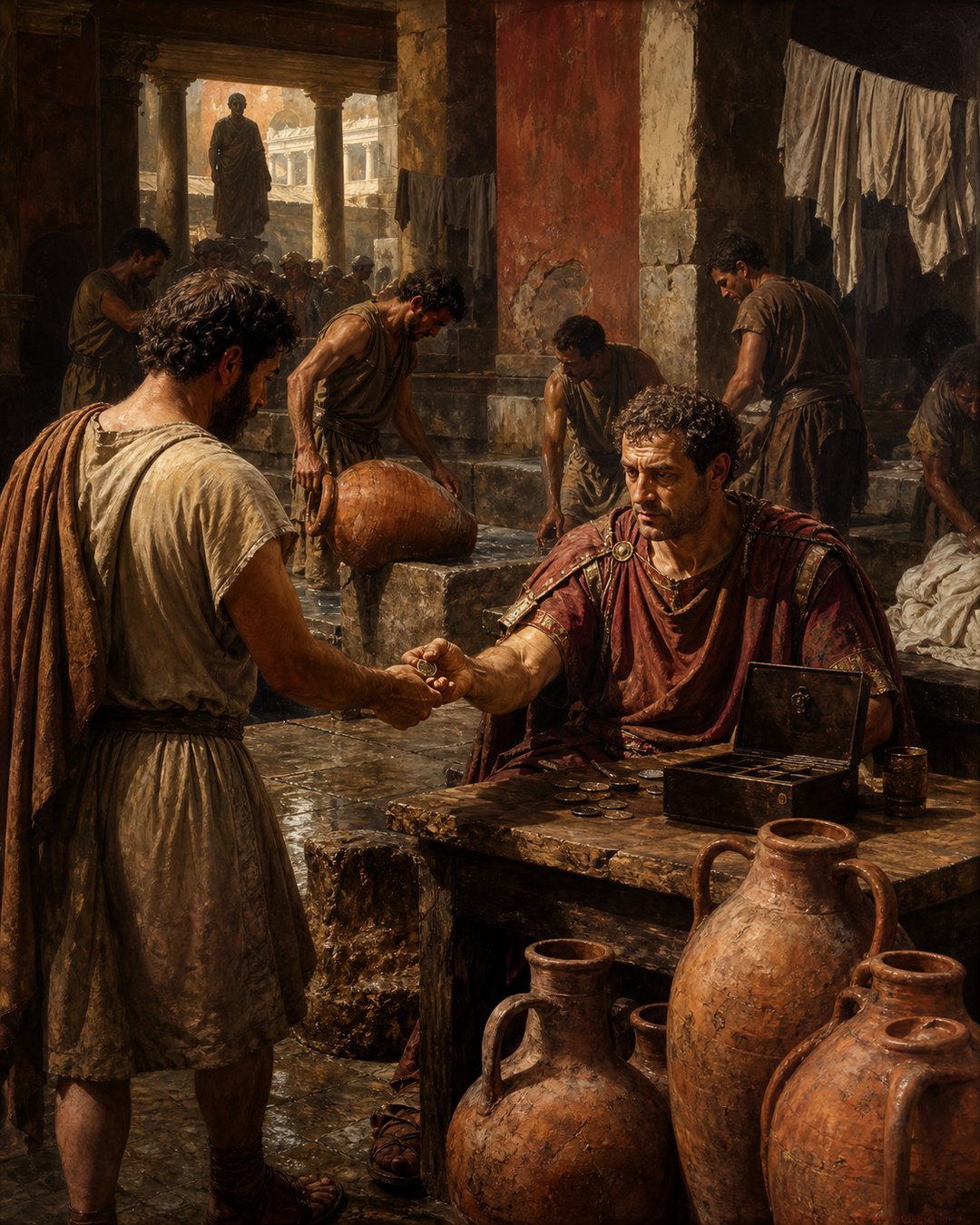
Vespasian held a coin beneath his son’s nose and asked whether it smelled. Titus said it did not. The emperor answered that it came from urine.
Suetonius tells the exchange in a few lines, but the joke depended on an entire urban process. Roman urine was not merely waste. Fullers used aged urine in cleaning cloth, collectors gathered it, workshops needed it, and the state could identify a stream of commerce worth taxing.
The modern slogan “money does not smell” is neater than the ancient scene. Vespasian’s point was practical rather than philosophical. Revenue did not carry the odor of the material that produced it. To understand why the answer landed, one has to follow the jars from the street to the laundry floor.
Fullers Needed Chemistry Before Chemistry Had a Name
Roman wool did not leave a loom ready for an elegant dinner. Fresh cloth retained oils and dirt; worn garments returned with sweat, smoke and street grime. The fuller’s craft cleaned, thickened and finished the fabric through repeated physical treatment.
Workers placed cloth in basins and trod it underfoot. Ancient visual evidence shows the compact stalls in which this labor happened. Water and cleaning agents loosened grease while repeated beating, rinsing, brushing and pressing restored a usable surface.
Stale urine supplied ammonia as it decomposed. Romans did not describe the reaction in modern chemical language, but generations of practice taught fullers that aged liquid worked. Its usefulness came precisely from the transformation that made it offensive.
That distinction matters. A laundry did not need a symbolic impurity; it needed an alkaline material available in quantity. Densely populated towns produced it every day, and workshops could convert the unpleasant supply into clean, valuable cloth.
Pliny lists human urine among substances with cleaning and industrial uses. His catalogue can look bizarre to a modern reader, yet it preserves the practical intelligence of craftspeople who judged materials by results. Rome’s textile economy depended on substances respectable customers preferred not to discuss.
Collection Jars Connected the Street to the Workshop
Urine only became useful to a fuller after someone separated, stored and moved it. Large jars placed near workshops or busy places offered a collection point. The exact arrangement varied, but the economic logic remained stable: many small contributions accumulated into a bulk input.
The jar turned private bodily waste into a public resource. Once collected, the liquid could be claimed, transported and sold or supplied. A thing with no value in one context gained value because a specialist could use it.
That change created measurable work. A fuller could estimate how many jars a batch required, a carrier could repeat a route, and an owner could compare collection cost with the value of cleaned fabric. The material remained offensive, but the transactions became ordinary enough to support a levy.
Storage also took time. Fresh urine changed as bacteria broke down urea and released ammonia. Odor announced the same maturation that made the material effective. Workshop owners therefore managed not only quantity but age, ventilation and proximity to workers and neighbors.
Roman cities routinely placed uncomfortable crafts beside ordinary life. Smoke, animals, food preparation and drainage shared crowded streets. An account of purple dye beginning with salted shellfish shows another luxury process built on smell and decay. Fine cloth concealed rough production histories.
Customers encountered the polished end: whitened wool, raised nap and pressed folds. The collection jar belonged to the hidden beginning. Vespasian’s tax made that beginning visible because taxation requires someone to define what is being collected and where value changes hands.
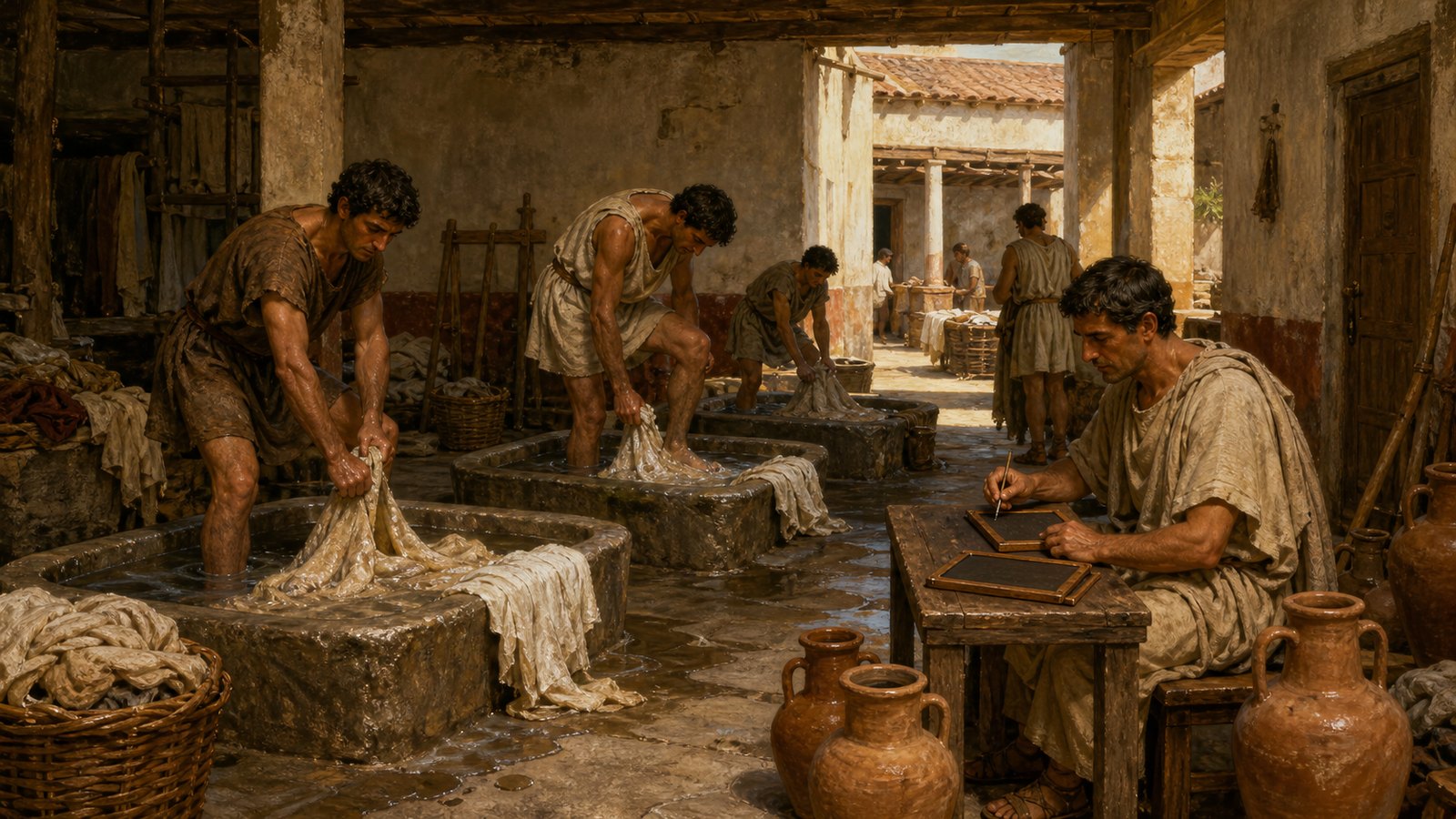
The Levy Found Revenue in an Unfashionable Place
Vespasian inherited an empire strained by civil war and by the collapse of Nero’s dynasty. Suetonius repeatedly emphasizes his attention to money. That reputation made the urine levy an ideal anecdote: it combined fiscal discipline, low material and a blunt emperor unwilling to be embarrassed.
The surviving line does not provide a modern tax code. It is safer to speak of a levy associated with urine collection or its commercial use than to invent a precise rate, license form or empire-wide bureaucracy. The anecdote proves the taxable connection; many administrative details are lost.
A tax collector did not need to understand ammonia. He needed to know that fullers required a regular input and that collection created a point where payment could be demanded. Recurrent workshop demand made the stream easier to recognize than scattered household disposal.
This was fiscal opportunism, but not irrationality. Roman government taxed trades, sales, inheritances and movement through many local arrangements. Useful waste belonged to the economy once people invested labor in collecting it.
The low prestige of the material made resistance awkward. Fullers could complain about cost, yet they could hardly deny that the supply mattered. Vespasian’s administration did not need citizens to admire the source; it needed a recurring commercial use visible enough to assess.
The levy also shifted part of a city’s sanitation problem into private production. Collection reduced random disposal while supplying laundries. That does not mean Vespasian invented a modern recycling policy. It means revenue attached itself to a practice that already converted nuisance into input.
Titus Objected to the Source, Not the Coin
Suetonius says Titus reproached his father for devising a tax on urine. The objection was moral or social before it was mathematical. Imperial revenue, in this view, should not descend to something so foul.
Vespasian waited until the first money arrived, held a coin to Titus’s nose and asked whether its smell offended him. Titus answered no. The emperor then identified its source.
The demonstration reversed the fuller’s process. The laundry took foul liquid and returned clean cloth. Vespasian took revenue from the same liquid and returned a clean coin. In both cases, transformation broke the sensory link between source and finished product.
The joke suited an emperor remembered for plain speech and provincial habits. He did not deny that urine smelled. He denied that the smell survived conversion into public money.
Suetonius’s biographies arrange character through compact scenes, and the exchange is perfectly shaped. Titus supplies refined disgust; Vespasian supplies an object lesson. Even if later retelling polished the dialogue, the story preserves what Romans found plausible about Flavian finance.
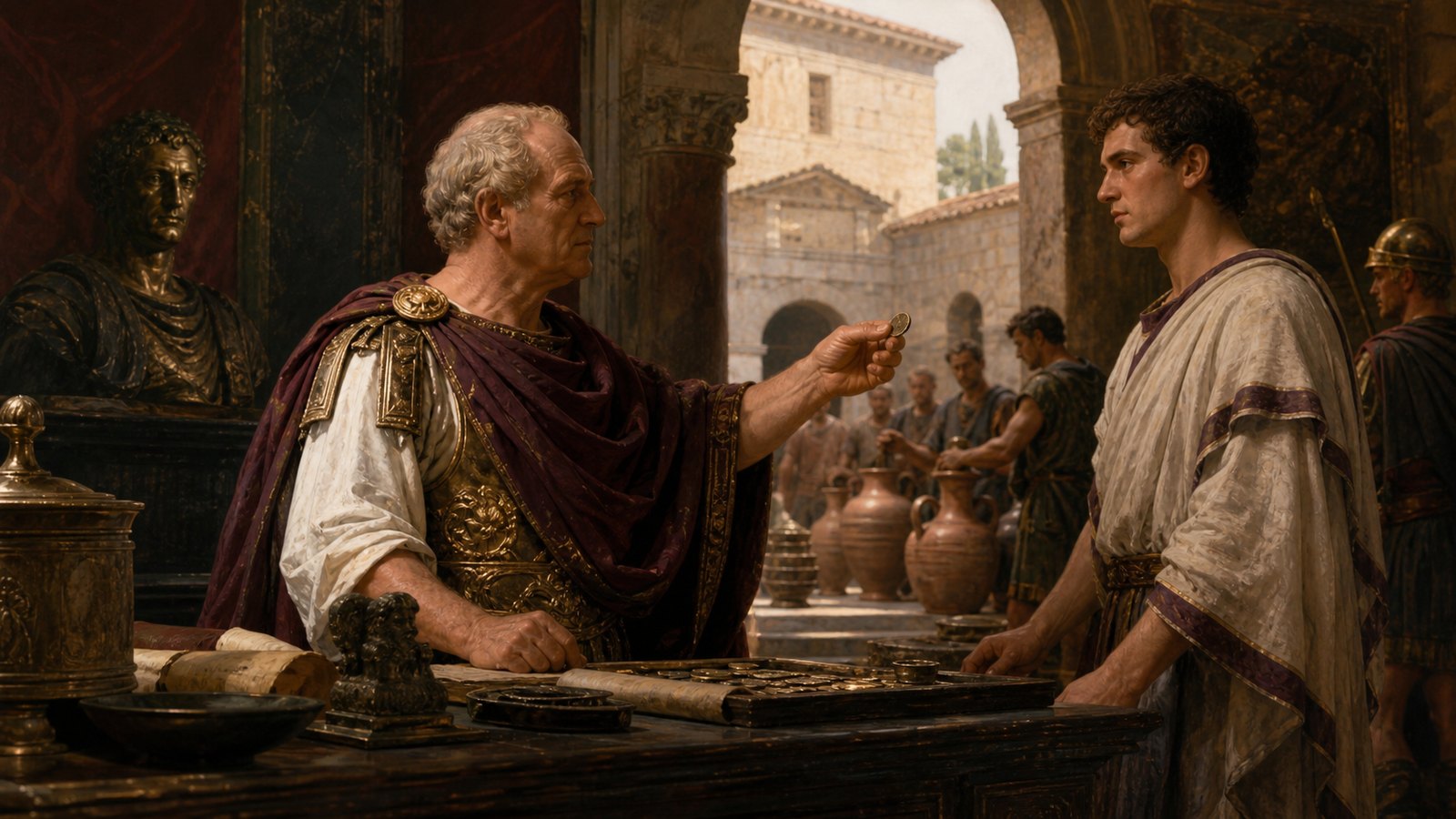
Clean Togas Rested on a Dirty Circular Economy
Roman status depended on appearance. A bright toga announced citizenship and public readiness, while neglected fabric could mark poverty or disrespect. Maintaining that surface required skilled workers who handled substances elites avoided.
The fuller stood between body, workshop and politics. His workers trod dirty cloth in alkaline liquid, rinsed it and raised its nap. Their product returned to courts, temples and dinner rooms with the process washed out of sight.
The same city could regulate a craft while depending on it. Romans understood that urban order was not made only by marble and law. It was made by people carrying jars, tending basins and recovering value from residues.
Another Roman workshop could turn dark clay jars into controlled environments for dormice. Material ingenuity often began with a container and an inconvenient biological fact. The fuller’s jar performed the same practical compression at city scale.
Vespasian’s coin endured because it reduced that system to a question anyone could answer. Did the money smell? No. Yet the absence of odor was evidence of labor, collection and exchange, not evidence that the source had never existed.
The tax reached into the least dignified part of Roman daily life and found a stable economic chain. Waste became cleanser, cleanser preserved clothing, clothing protected status, and the state took a share. The clean coin at the end concealed the jar, but the emperor’s joke made Romans remember it.
Sources
Suetonius, Vespasian 23. Pliny the Elder, Natural History 28.18.