
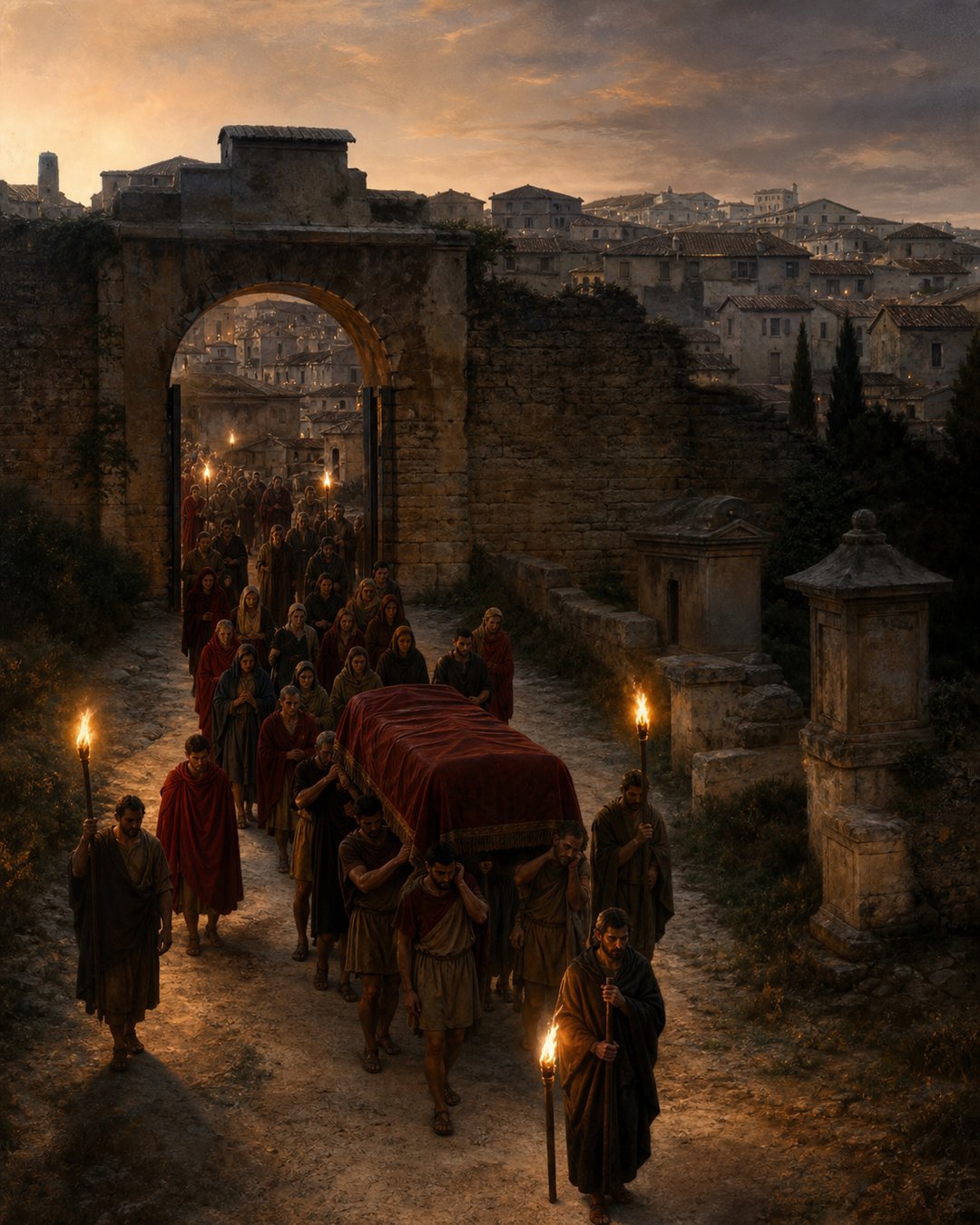
A Roman leaving the city did not pass from crowded life into empty countryside. Beyond the gates stood another population: the dead. Tombs, altars and inscribed monuments lined major roads, presenting family names to travelers while keeping bodies and funeral fires outside the civic center.
A severe sentence in the Twelve Tables helped create that landscape: a dead person was not to be buried or burned within the city. The rule joined practical danger, religious boundary and public order in fewer words than a modern municipal code might use for one permit.
Its consequence was spatial. Romans still needed places to mourn, display ancestry and preserve remains. By excluding those acts from the city, law concentrated memory along the routes by which people entered and departed. The road became both infrastructure for the living and an audience for the dead.
The Twelve Tables Drew a Boundary Around the Corpse
The Twelve Tables were remembered as Rome’s early written law, traditionally associated with the mid-fifth century BC. Their surviving language comes through later authors, because the original tablets did not endure. Cicero quotes and discusses several funeral provisions in his work on laws.
The prohibition is direct: a dead person shall not be buried or burned in the city. It names the two principal treatments of the body—inhumation and cremation—and excludes both. The rule therefore cannot be reduced to fear of smoke alone.
Roman religion treated death as a transition requiring its own rites and places. Corpses could create ritual consequences, while graves established claims that families expected others to respect. Keeping burial outside the civic core separated ordinary public business from funerary space without making the dead unimportant.
The word “city” also required interpretation as Rome changed. Boundaries were legal and sacred constructions, not merely the last continuous wall of houses. Exceptional burials could occur within privileged spaces, but their rarity reinforced the ordinary rule.
The prohibition belonged to a larger funerary code. Other provisions limited expenditure and display. The same legal memory that kept corpses outside also counted the flute players allowed in a procession. Place, noise, wealth and grief all became matters for regulation.
Fire Made Cremation an Urban Hazard
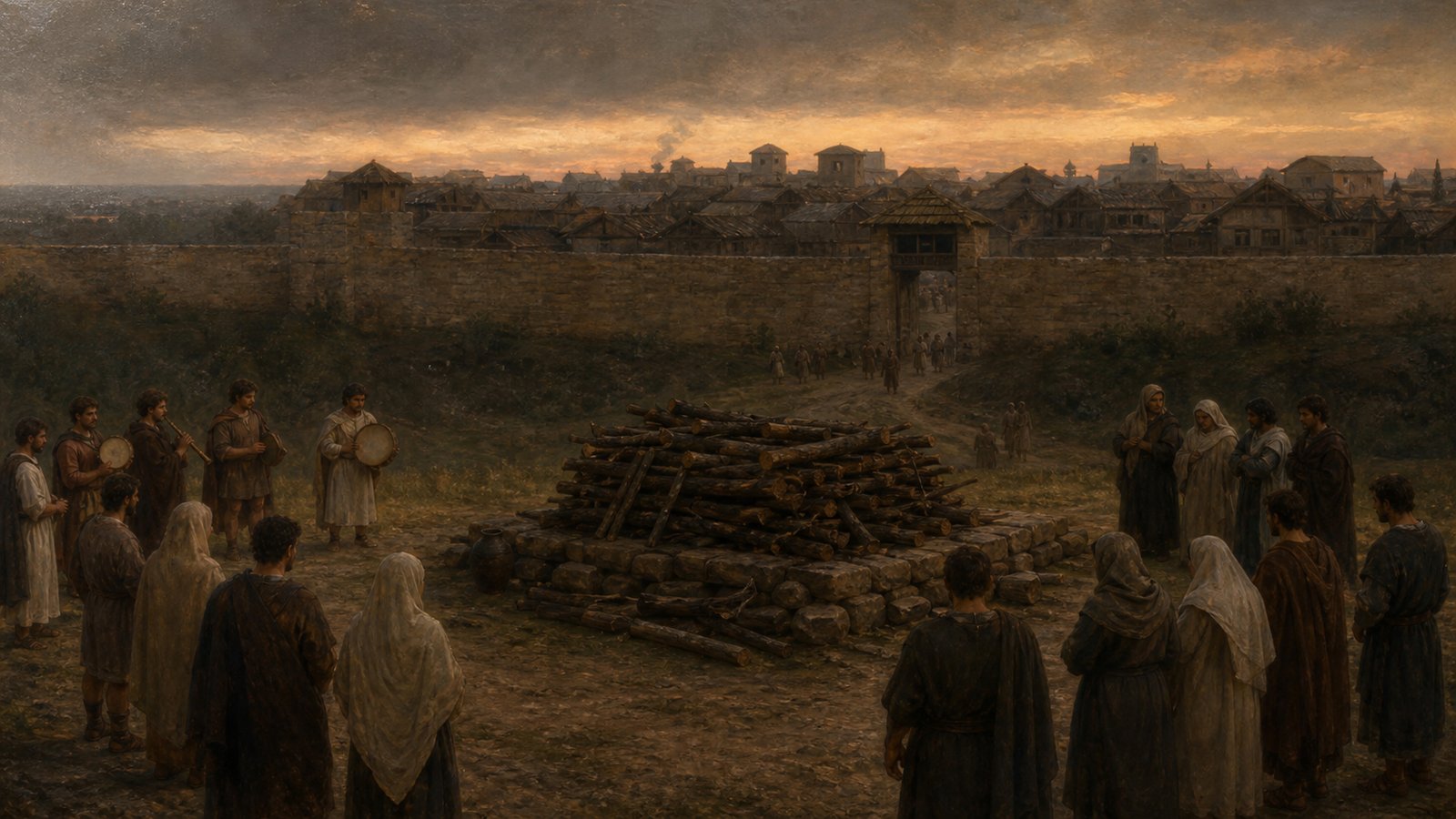
A Roman cremation required more than a symbolic flame. A pyre needed fuel, open space and time enough to reduce a body before the remains could be gathered. Inside a dense settlement of timber floors, shops, awnings and stored goods, that process brought an obvious risk.
The Twelve Tables’ wording “buried or burned” shows that lawmakers addressed the treatment itself, not only permanent graves. A pyre could threaten neighbors even if the ashes were later carried elsewhere.
Smoke, smell, crowds and processions also affected shared streets. Funeral ritual might include musicians, mourners, carried objects and family display. Moving the culmination beyond the city reduced conflict between a household’s obligations and the movement of everyone else.
Practical explanations, however, should not erase religion. Romans did not need to choose between fire safety and sacred separation. One boundary could answer several concerns at once.
The treatment of remains extended beyond the burning itself. Bone fragments and ash had to be collected, placed or buried, and revisited through family ritual. A rule that covered both burning and burial therefore governed a chain of actions rather than a single dangerous moment.
Table X also forbade gathering a dead person’s bones for a second funeral, except in the case of death in war. That provision shows lawmakers imagining how remains might be moved and ceremonies repeated. Funeral space was regulated because commemoration could continue after the first procession ended.
The city’s vulnerability to fire remained a political fact for centuries. Crassus could turn burning properties into bargains, and a provincial governor later asked Trajan for firefighters. Excluding funeral pyres was one narrow way of controlling flame before professional urban response existed.
Roadside Land Turned Exclusion into Visibility
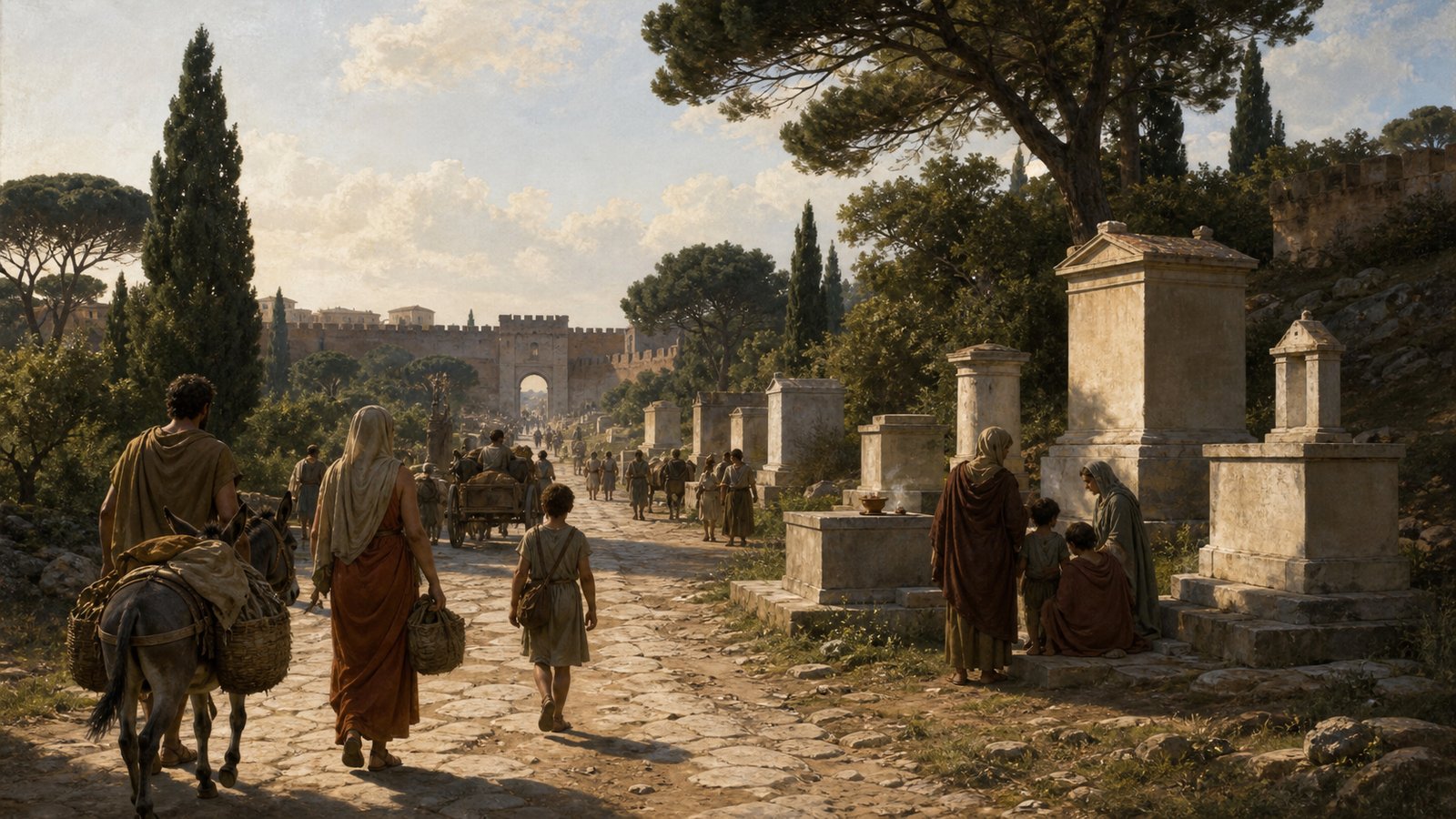
The dead were pushed outside, but not hidden. Roman tombs commonly faced roads because roads supplied viewers. Travelers could read a name, see a portrait or encounter a monument’s architectural claim to status.
That location transformed a legal restriction into an opportunity. A family unable to place a tomb inside the city could still choose a conspicuous plot near a gate or busy route. The monument addressed strangers as well as descendants.
Some epitaphs speak directly to the passerby, asking the traveler to stop, read or offer a farewell. The tomb depended on movement: remembrance happened when the living paused along their journey.
Roadside display also made social differences visible. A large mausoleum, sculpted relief or long inscription demanded resources. Smaller markers occupied the same corridor, producing a mixed landscape of citizens, freedpeople, households and associations.
The Appian Way became the most famous example, but the mechanism was not confined to one road. Restrictions on intramural burial and the value of traffic made approaches to Roman towns natural settings for cemeteries across the Roman world.
Exceptions Advertised Privilege Rather Than Erasing the Rule
Roman rules often gained definition through exceptions. Cicero notes that certain distinguished people had received burial within the city because of outstanding merit. Such honors did not make ordinary burial unrestricted; they marked the recipient as extraordinary.
An intramural grave could therefore function like a civic award. Permission converted a generally excluded corpse into a publicly accepted presence. The rarity of the privilege supplied its meaning.
Changes in settlement also complicated old tombs. As Rome expanded, places once beyond habitation could become surrounded by buildings. Legal memory, property rights and religious protection did not vanish simply because urban fabric approached.
This is why the rule should not be imagined as a clean archaeological line with every grave at the same distance. “Outside” was produced through law, custom, topography and historical growth. The broad pattern mattered more than geometric perfection.
Imperial burials added another layer. Mausoleums of powerful families occupied prominent places while negotiating the city’s sacred and legal boundaries. Their scale could dominate the horizon even when their sites respected formal separation.
The Living Met the Dead at Every Gate
Funeral law did not remove death from Roman experience. It organized encounters with it. Citizens met tombs on journeys to farms, ports, markets and other towns. Visitors met Roman ancestry before reaching the Forum.
The result changed the emotional rhythm of travel. Gates divided dense civic activity from roads where monuments stretched ahead. A traveler moved through accumulated biographies: spouses, soldiers, children, freed families and officeholders, each claiming a fragment of attention.
Families also returned to graves for commemorative meals and offerings. The tomb was not only a public advertisement; it was a place of continuing obligation. Its location beyond the city required movement between domestic life and the dead.
Roadside placement made memory cumulative. A new monument did not stand alone: it entered a corridor already occupied by older households and competing claims. Repairs, visits and new burials refreshed that corridor, so the legal boundary produced an active social landscape rather than a remote disposal zone.
The setting also changed who witnessed commemoration. Inside a house, memory belonged mostly to relatives and guests. Beside a public road, the family surrendered control over its audience but gained thousands of passing eyes. The dead became participants in the city’s outward-facing identity.
Some funerals became spectacles far beyond ordinary limits. Rome once watched a celebrated talking raven carried to a pyre beside the Appian Way. The episode was exceptional, yet its destination followed the same spatial logic: public grief traveled outward.
The Twelve Tables’ sentence endured because it linked a simple prohibition to a durable urban form. No corpse and no pyre inside meant tombs outside; tombs outside meant roads thick with monuments; roads thick with monuments made remembrance part of arriving in Rome.
Law, religion and practical danger thus worked together without needing a single motive. The city protected its shared interior, while families claimed the edge as a stage for memory.
Rome’s dead did not disappear beyond the gates. They became the last Romans a traveler saw when leaving and the first ones encountered on the way in.
Sources
Cicero, On the Laws 2.58–61. The Twelve Tables, Table X. Livy, History of Rome 1.26.