
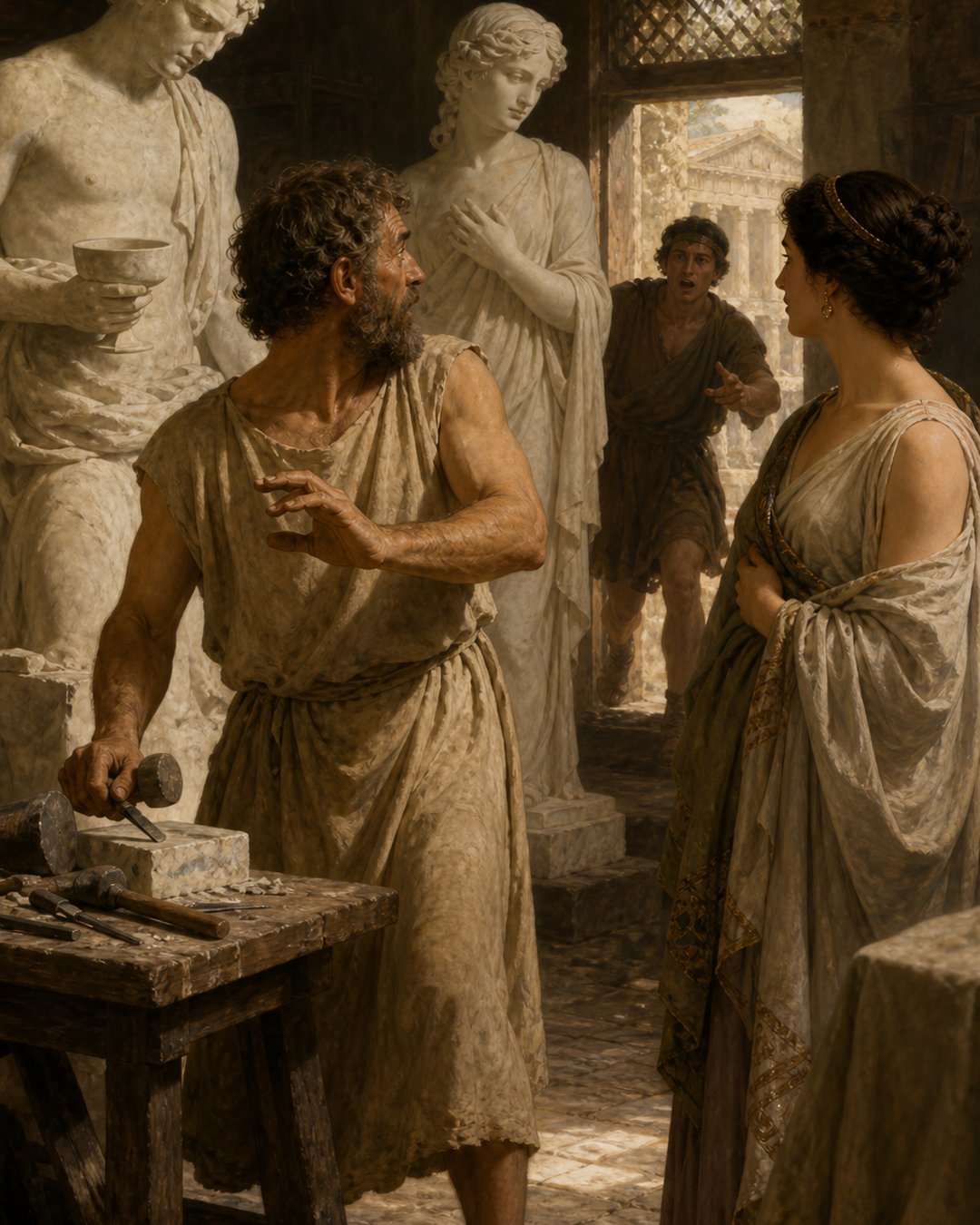
Praxiteles promised Phryne the most beautiful of his sculptures, then refused to say which sculpture that was. The gift sounded generous, but the maker still controlled the ranking. Any answer he gave could protect the work he least wanted to surrender.
Phryne answered with a false emergency. A slave rushed in claiming that fire had broken out in the studio and that most of the works were lost. Praxiteles moved for the door and cried that all his labor was wasted if the flames had caught his Satyr and his Love.
There was no devastating fire. His panic had named the pair that careful speech concealed. Phryne chose the Love. Centuries later, Pausanias told the story while walking through an Athenian landscape of tripod monuments, shrines, and displayed art. The trick survived because it turned private judgment into a scene anyone could understand.
A Gift Promise Left the Maker Holding the Ranking
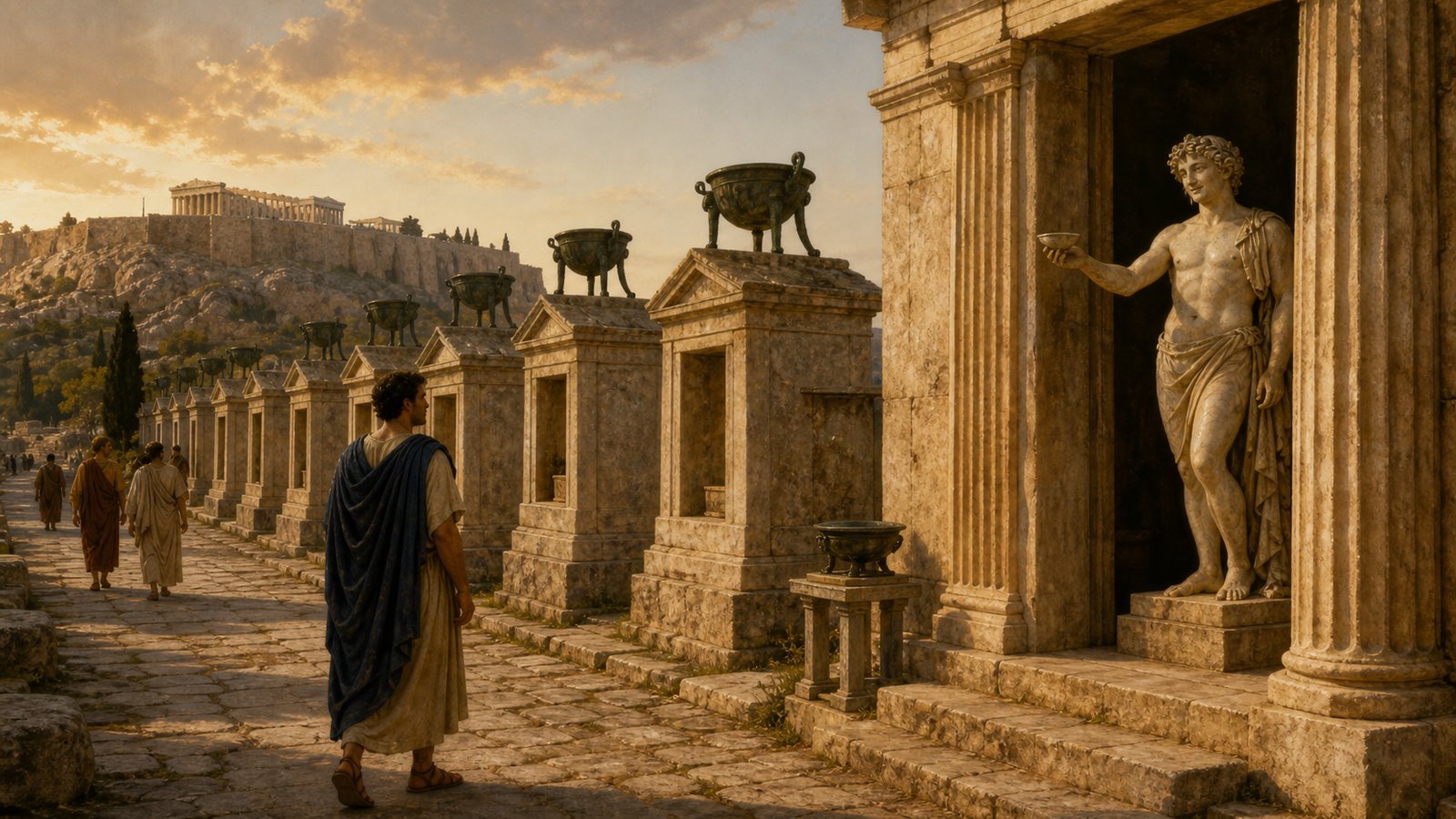
Pausanias introduces the anecdote among monuments rather than inside a biography arranged from birth to death. A road from the Athenian prytaneum was called Tripods because bronze tripods stood upon shrines along it. Those structures also contained remarkable works of art, including a Satyr of which Praxiteles was said to be proud.
The setting gives the story two levels. In Pausanias’s present, art could be encountered through routes, sanctuaries, monuments, and names attached to visible objects. In the anecdotal past, Praxiteles’s works were still subject to selection, loss, gift, and movement from the workshop.
Phryne’s request created a peculiar bargain. She did not ask for any sculpture, or for one named in advance. She asked for the most beautiful. Praxiteles, portrayed as her lover, agreed to give it. Yet he withheld the information needed to execute the promise honestly.
Beauty in this exchange was not measured by a posted price or decided by a jury. The sculptor’s own preference defined the category. That made him both donor and sole keeper of the answer. If he named a lesser work, no external test could easily expose the substitution.
The problem resembles an artistic contest without agreed rules. The contest settled by three painted lines made technical control visible through marks that rivals could inspect. Phryne had no equivalent object of proof. She needed Praxiteles to reveal a preference he had chosen not to state.
The False Report Replaced Choice with Fear of Loss
The slave’s message was carefully constructed. Fire had broken out in the studio. Most works were already lost, but not all. Total destruction would have made ranking pointless; perfect safety would have produced no reaction. Partial loss forced Praxiteles to imagine that some choices might still matter.
The report also changed the time available. A lover discussing a gift can pause, flatter, evade, or reconsider. A workshop believed to be burning turns delay into damage. Praxiteles did not have the leisure to construct an answer that balanced generosity against attachment.
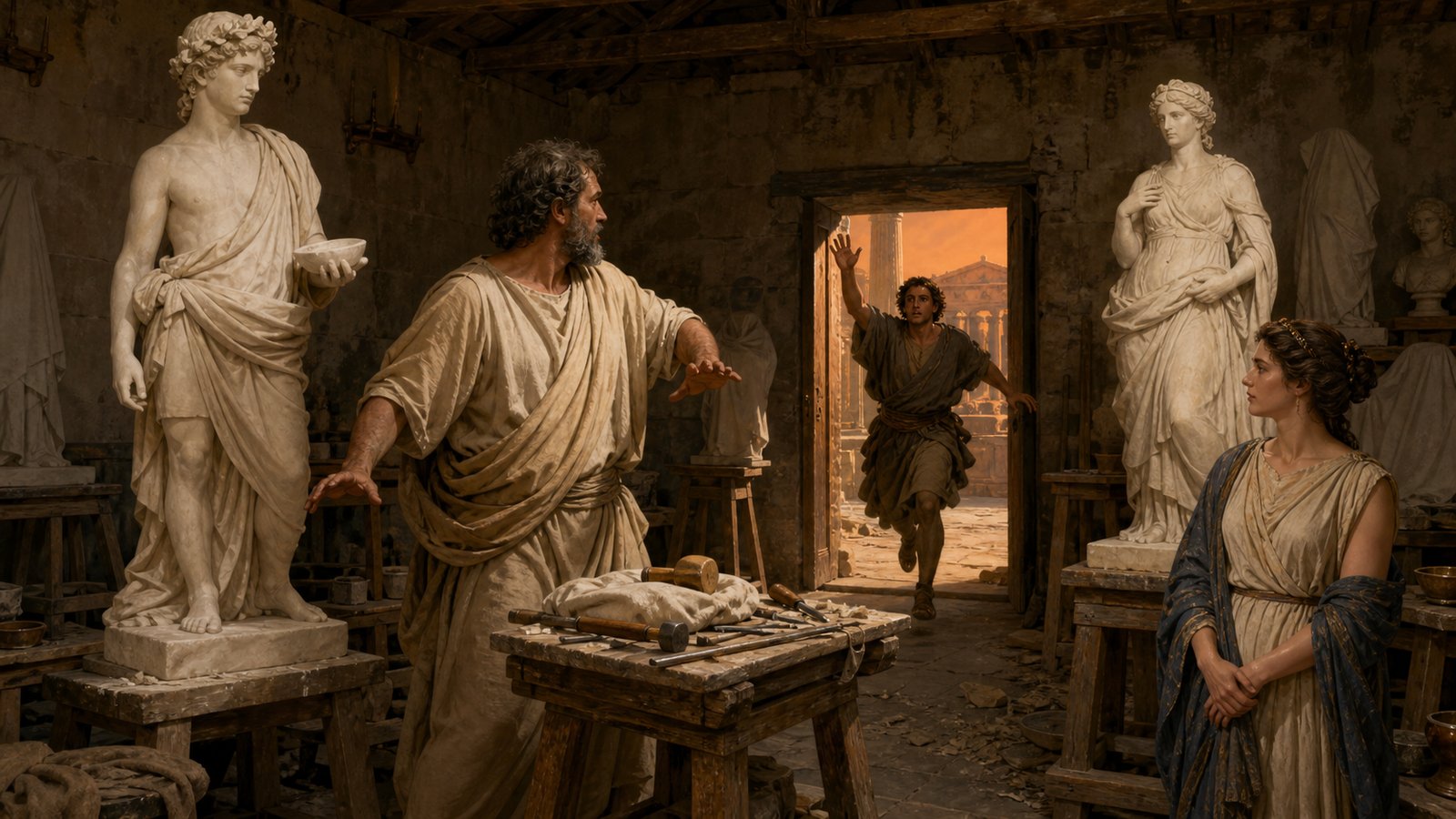
Pausanias says he immediately began to rush through the door. Motion came before explanation. Then came the revealing cry: his labor was wasted if the flames had caught the Satyr and the Love. Two titles surfaced because they represented the losses he most feared.
The test did not ask him which work would earn the highest market price, which patron was most powerful, or which statue later critics would praise. It exposed the works he named under imagined destruction. Phryne interpreted that reaction as his confession about beauty.
Her method depended on asymmetry. Praxiteles knew the ranking but would not share it. Phryne controlled the false information but watched his genuine response. The anecdote makes that contest legible without pretending that beauty itself had become mathematically objective.
Two Names Escaped Before a Deliberate Answer
Praxiteles did not name one object. He named his Satyr and his Love. The pair matters because it prevents the story from becoming a simple revelation of a single masterpiece. His alarm established a narrow top group, and Phryne still had to choose within it.
She stopped him and told him to take courage. No grievous loss had occurred. The studio report had been a trap designed to make him disclose what the original promise left hidden. Once she explained it, he could recognize the method, but he could not withdraw the words already spoken.
Phryne selected the Love. Pausanias does not preserve a long debate over why. The decisive work had already been performed by Praxiteles’s reaction. Her final choice completed the gift while leaving the sculptor’s two-part ranking visible to the audience.
The episode also distinguishes attachment from possession. Praxiteles had agreed to part with his finest work in principle, yet he resisted identifying it. The imagined fire sharpened the difference between voluntarily giving something away and losing it without control. A gift preserves agency; a fire erases it.
That contrast explains the cry that his labor would be wasted. Destruction threatened more than stone or workshop inventory. In Pausanias’s telling, it threatened the concentrated success represented by two figures. Their names carried the weight of years of practice without requiring the narrator to invent measurements or prices.
A Satyr with a Cup Anchored the Anecdote to Place
Pausanias returns from the trick to the Athenian surroundings. A Satyr stood in the nearby temple of Dionysus, shown as a boy holding out a cup. The description is economical, but it gives the reader a pose and an object. The sculpture can be imagined as more than an abstract item in a list of famous names.
The road itself gathered bronze tripods and shrine structures. Art did not sit in a neutral gallery detached from civic and religious movement. A visitor encountered it while traveling from one place to another, reading the arrangement of monuments as part of Athens.
That public placement changed how authorship worked. Praxiteles’s pride, Phryne’s selection, and the false fire were not physically visible in marble. They arrived through story. The displayed object supplied a stable focus around which an anecdote about preference could accumulate.
Other ancient art stories work through similarly compact proofs. Fabius Pictor signing a temple painting joined a name to a public work through an inscription. Praxiteles’s story joined a name to value through remembered speech: Satyr and Love were the words panic forced out.
Pausanias’s travel writing preserves both modes at once. He identifies roads, tripods, shrines, temples, poses, and makers, then adds the tale that explains why one Satyr carried special prestige. Material display and verbal memory reinforce each other without becoming the same kind of evidence.
The Anecdote Turned Panic into Art Criticism
It would be easy to retell the episode only as Phryne outsmarting Praxiteles. The trick is entertaining, and Pausanias presents it as a story. But its durability comes from the specific information problem it solves. How do you learn an expert’s true favorite when that expert benefits from withholding the answer?
The false fire produces what deliberate praise could not. Under ordinary conditions, a sculptor might tailor judgments to patron, occasion, affection, or expected payment. Under imagined loss, the first names spoken appear less managed. The anecdote treats fear as a more honest critic than ceremony.
That does not prove the named sculptures were objectively the greatest products of Praxiteles. It proves what the story asks its audience to accept: his spontaneous alarm marked them as the works he most valued. Phryne then used that exposed valuation to enforce the spirit of his promise.
The tale is also careful about its own status. Pausanias repeatedly frames details as what was said or what the story goes. A modern reader need not turn the scene into a documented studio transcript. Its historical value includes the way later viewers explained artistic excellence, clever negotiation, and the authority of a maker’s preference.
By the time Pausanias walked the Road of Tripods, the imagined flames had long vanished. What remained was a sequence with the economy of theater: promise, refusal, messenger, alarm, two names, revelation, choice. It made artistic ranking memorable because it showed value at the instant someone believed value might burn.
Sources
Pausanias, Description of Greece, Book 1, chapter 20, sections 1–2.