
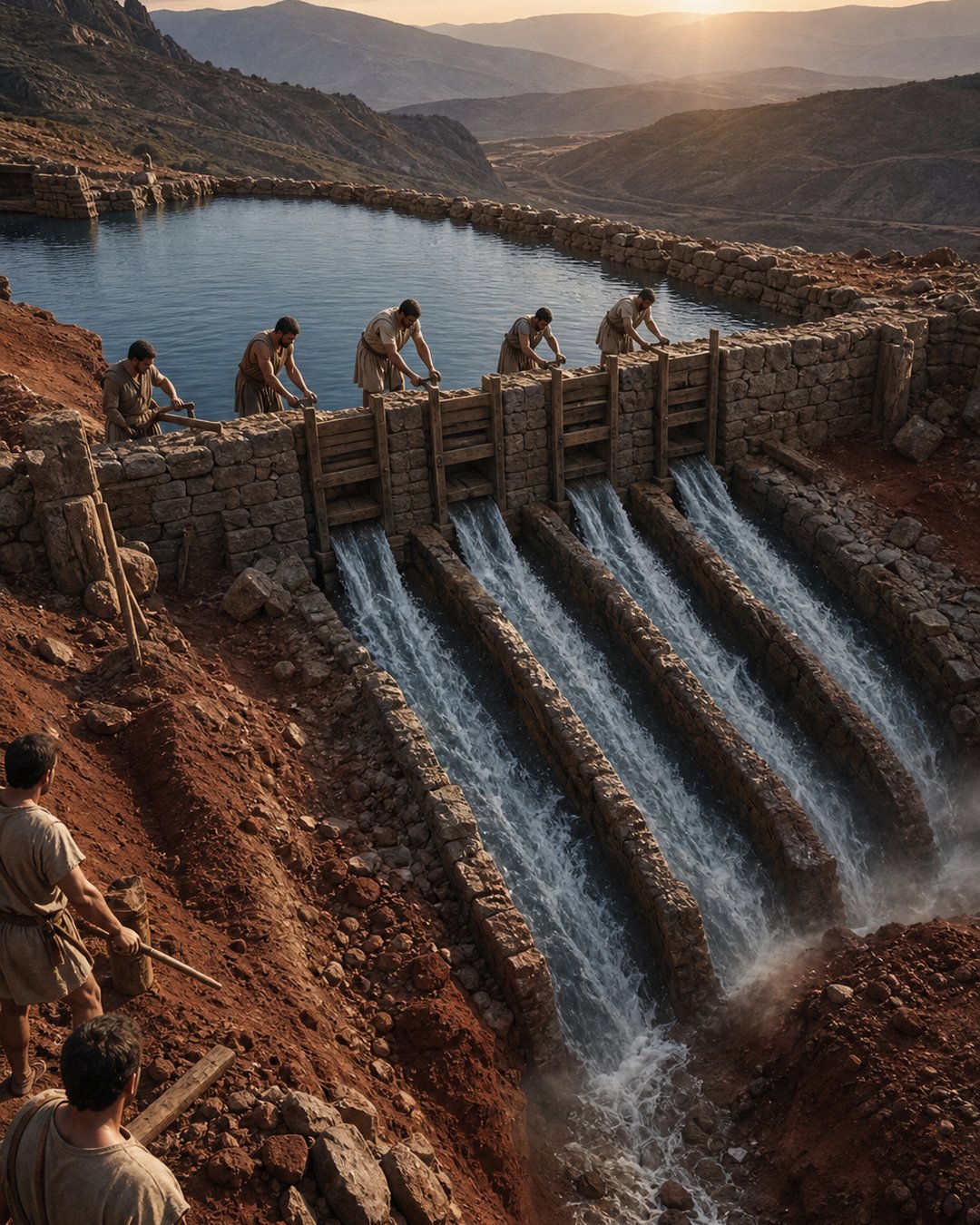
Five square openings held a reservoir above a broken mountain. Pliny the Elder says the basin could extend two hundred feet in length and breadth and reach roughly ten feet deep. Once filled, its gates were struck away. Water burst down with enough violence to roll obstructing rock.
That release came late in the work, not first. Miners had already driven galleries into the mountain by torchlight, supported the roof, broken stubborn stone, and removed debris through darkness. They had cut supports and withdrawn on a sentinel’s warning while the undermined mass collapsed. Other crews had brought water across high and difficult ground, sometimes from an astonishing distance.
The mine therefore functioned as a sequence spread across an entire landscape. Excavation prepared the fall. Surveying and channels gave water a route. Reservoirs stored force. Trenches and prickly brush caught the small material that the torrent carried. Gold stood at the end of a chain built from risk, gradient, timber, water, and repeated human handling.
Torches Measured Work Where Daylight Disappeared
Pliny calls these deep gallery workings arrugiae. He describes tunnels driven far into mountains, with torches setting the duration of a shift. Some workers, he says, went for months without seeing daylight. Sudden clefts could open, the earth could sink, and miners could be crushed below the weight they were trying to reorganize.
Supports made the danger manageable without removing it. Arches remained at intervals beneath the mountain. Hard barriers of silex could be split with fire and vinegar, although Pliny notes the suffocating smoke and vapor this produced. More often, crews used iron-shod crushing machines weighing one hundred and fifty pounds.
The material then had to leave the dark. Broken fragments passed from shoulder to shoulder, night and day, until the chain reached workers at the mouth. This was extraction before any certainty of reward. Pliny stresses that miners might complete the dangerous preparation without knowing whether the mountain would yield gold.
It was a sharply different operation from splitting a quarry face into blocks intended to remain whole. In the gold galleries, the mountain’s structural failure could become the planned result. The supports bought time only until the excavation was ready to be brought down.
A Sentinel Turned Collapse into a Timed Event
Once the underground work was complete, miners cut away the wooden pillars beginning at the far end. The coming fall gave a warning perceptible to a sentinel posted on a peak. Pliny assigns the watcher a precise duty: call the laborers out by voice and signals, then flee as well.
The arrangement separated people who weakened the mountain from the person positioned to read its larger movement. A miner inside a gallery could understand the support immediately in front of him but not necessarily the behavior of the whole slope. The sentinel’s distance gave him the view needed to turn a spreading failure into an evacuation signal.
Pliny describes the mountain cleaving with an unimaginable crash and casting debris outward beneath dense dust. His language is openly moralizing; he presents the miners as declaring victory over nature while still uncertain whether the ruin contains what they want. Yet the technical sequence inside that criticism is clear. Gallery, support, withdrawal, lookout, signal, and collapse had to occur in the right order.
The result was not usable gold. It was a newly fragmented mass. Deliberate collapse replaced one problem—a solid mountain—with another: an immense field of debris whose valuable fraction was too small to collect by sight or hand alone.
Water Had to Arrive High, Clean and Fast
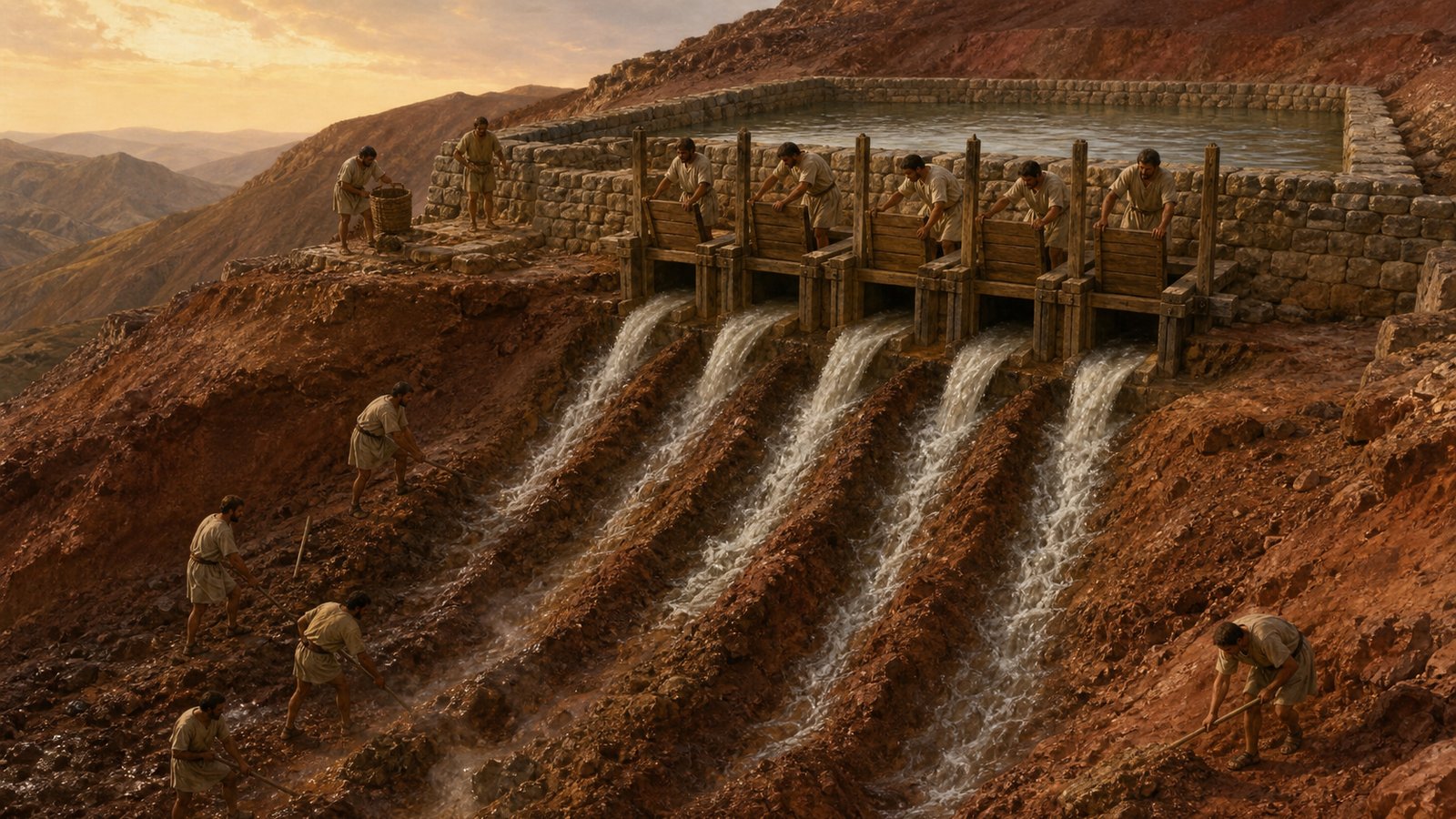
Pliny calls the water channels corrugi. They brought rivers from elevated ground, in some cases perhaps one hundred miles away. Distance by itself was not enough. The route needed a steep fall so that water would be precipitated downward rather than merely drift through the works.
That demand turned topography into part of the machine. Valleys and crevasses were crossed by aqueducts. Impassable rock was cut for wooden troughs. Pliny pictures workers hanging from ropes, taking levels and tracing a route where a person could not plant a foot. The channel depended on measured descent across terrain that resisted ordinary access.
Water quality mattered because the flow was meant to separate material. Pliny says a current carrying mud was considered unfit for washing. Crews carried channels over pebble or silex beds and avoided the earth they believed produced the unwanted mud. They were not seeking drinkable water in the manner of Roman tests that judged a spring through bodies, vessels, and boiling. They needed a current whose own sediment would not bury the signal they hoped to capture.
Every choice preserved force for the correct moment. A low channel lost useful fall. A broken crossing lost supply. A muddy current added material before washing began. The reservoir at the head of the descent concentrated the value of all that prior surveying and construction.
Five Gates Converted Storage into a Rock-Moving Pulse
The basin Pliny describes was broad and shallow compared with its footprint: two hundred feet each way and around ten feet deep. Five sluices, generally about three feet square, held back the collected water. Their number spread the release across the head of the fall rather than relying on one narrow outlet.
When the reservoir filled, the gates were struck away. The resulting torrent rolled onward fragments that obstructed its route. Storage had converted a continuous supply into a short, forceful event. The long channel gathered and delivered water; the basin waited; the sluices released it against the debris at once.
The mechanism must not be mistaken for effortless hydraulic magic. Reservoir walls, gates, channel beds, aqueduct crossings, and wooden troughs all required construction and maintenance. Someone had to know when the basin was full, clear the route, coordinate the release, and restore what a powerful flow damaged.
The torrent also moved the landscape beyond the mine. Pliny says the earth ultimately reached the sea and that shattered mountain material extended parts of Spain’s shore. Whether every scale in his account should be accepted without qualification, his description insists on an environmental consequence: the process did not end when gold left the trench.
Prickly Brush Caught What the Flood Could Not Display
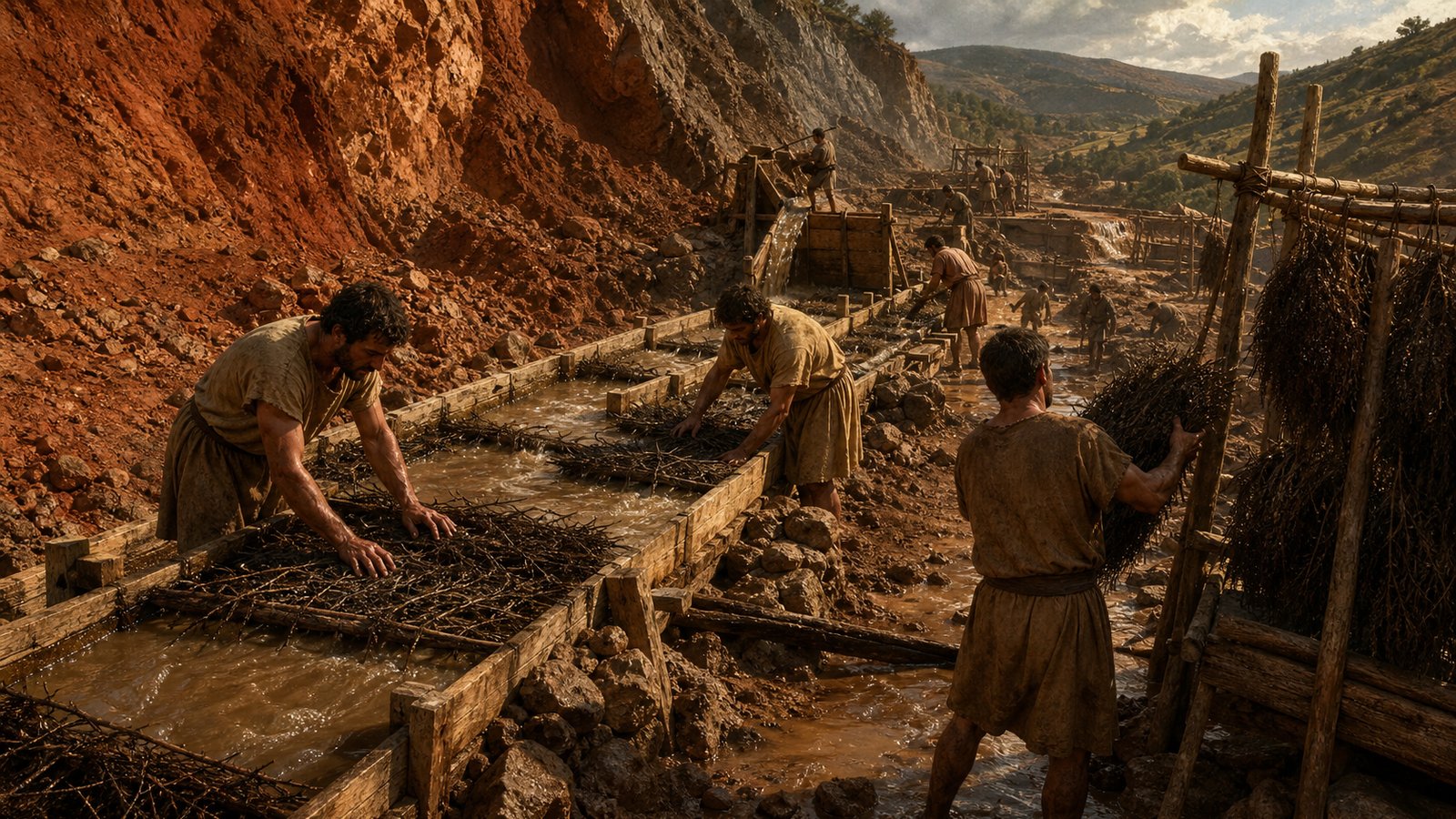
On level ground, water entered trenches called agogae. Planks closed their sides, and arches could support them over steep places. At intervals the workers laid a rough, prickly plant that Pliny calls ulex. Its tangled surface arrested pieces of gold while water and lighter waste continued onward.
The brush was an intermediate collector, not the final container. After use, it was dried and burned. The ashes were then washed over grassy turf so that the retained gold could settle. A plant body first caught metal mechanically; fire removed the plant; a second washing recovered what remained.
This last stage gives the vast operation its most revealing contrast. Galleries, a falling mountain, hundred-mile channels, and a two-hundred-foot reservoir all served a capture surface made from rough vegetation. The enormous upstream works created flow and fragmentation. The humble downstream filter made tiny valuable pieces recoverable.
Pliny reports that Asturia, Gallaecia, and Lusitania together produced, by some estimates, twenty thousand pounds of gold each year, most of it from Asturia. The figure belongs to his source tradition and should not be converted into false modern precision. It does show the scale at which Roman readers were asked to imagine the operation.
The five sluices were dramatic, but they were not the whole technology. The mine worked only when darkness, timber, warning signals, gradients, reservoirs, trenches, brush, fire, and washing met in order. The gold was the smallest visible part of a system that had rearranged a mountain to find it.
Sources
Pliny the Elder, Natural History, Book 33, chapter 21.