
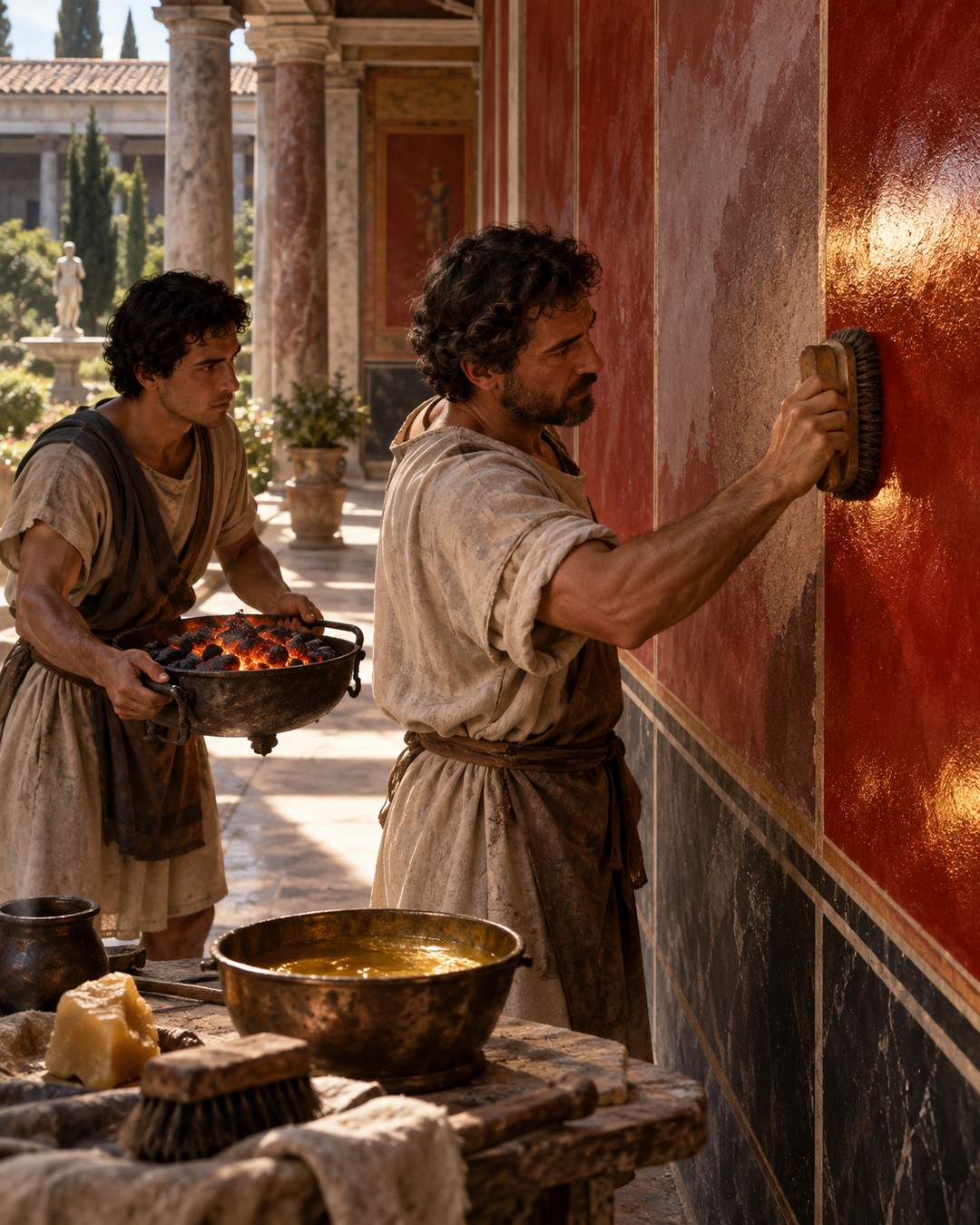
Faberius paid for brilliant red and received a blotched wall within thirty days.
The vermilion in his Aventine peristyle had met the light that reached an open colonnade. Vitruvius’s remedy began only after the colour dried: wax, oil, a hard brush, live coals, a candle and cloth.
The pigment needed a finish engineered around exposure.
One Red Worked Indoors and Failed in the Peristyle
Vitruvius treats vermilion as both a material and a problem of placement. The prepared pigment could retain its colour when used in the final plaster coat of enclosed rooms.
Open settings behaved differently. He names peristyles and exedrae, spaces where rays of sun and moon could reach the surface.
There, he says, vermilion lost brilliance and became black. The same colour that survived behind shelter could deteriorate when architecture exposed it.
The distinction prevented a simple verdict that the pigment itself was always defective. Performance depended on the wall’s relationship to light and weather.
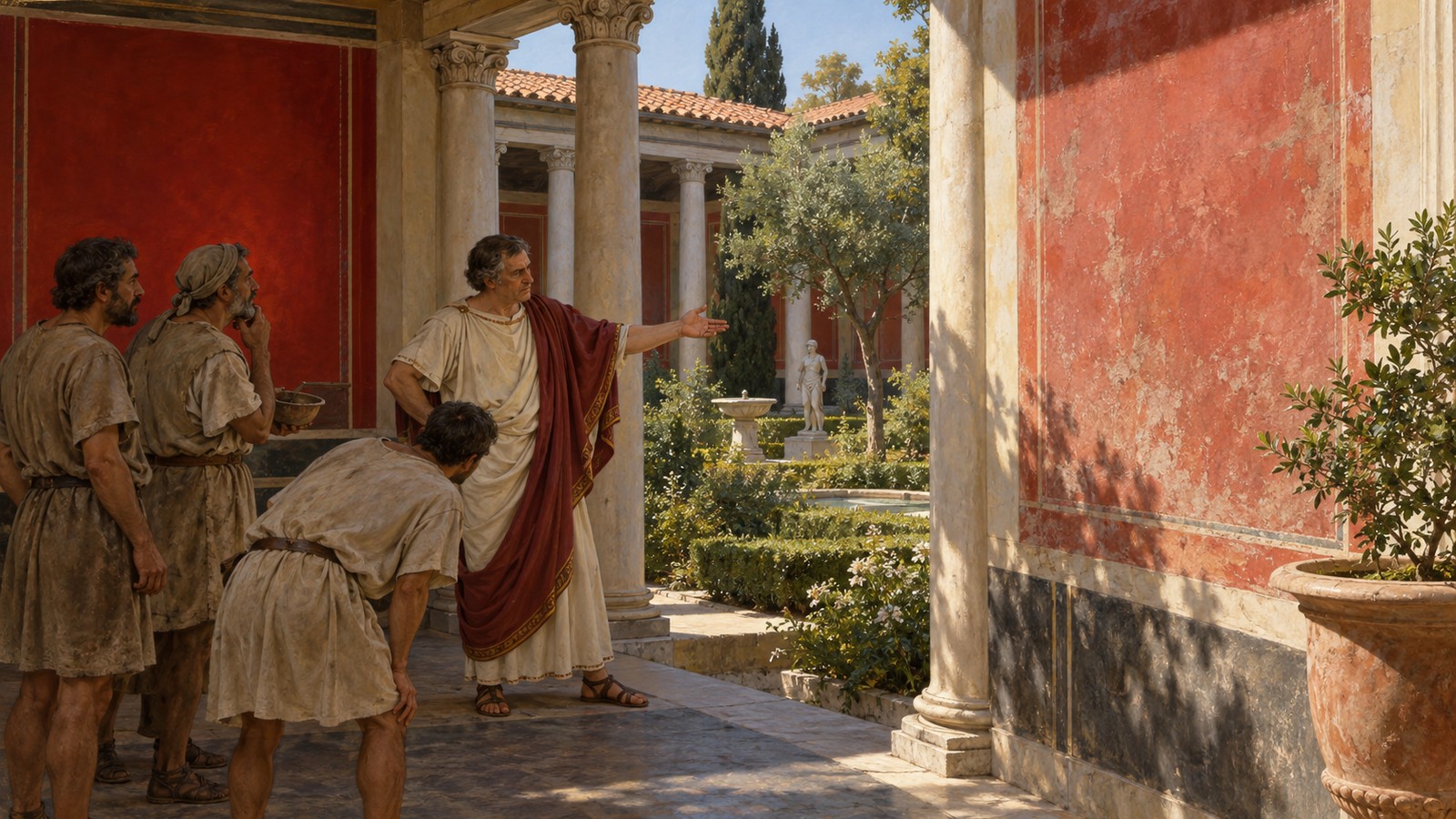
Vitruvius made the failure concrete through Faberius, a scribe who wanted the peristyle of his house on the Aventine finished elegantly.
Faberius chose vermilion. Within thirty days, the wall had turned to an unpleasant, uneven colour.
The short interval matters. This was not a slow loss noticed by descendants. A patron and contractor could see the finish fail while the project was still fresh.
Faberius agreed with the contractors that other colours should be laid on. The expensive red had not merely aged; it had forced corrective work.
Roman builders often solved problems by matching materials to forces acting on them. Vitruvius’s warning about lead pipes likewise began with observed material effects on workers and water systems. Here the observable warning was visual: exposed red no longer resembled sheltered red.
The wall therefore posed two questions. Which pigment supplied the desired appearance, and what surface treatment could keep that appearance where the building admitted light?
Punic Wax Became a Brushable Barrier
Vitruvius begins his protective method after the coloured wall has dried.
That timing separated the plaster-and-pigment work from the finish. The craftsperson was not stirring wax into wet colour. A completed red surface received another layer.
The material was Punic wax, melted and tempered with oil.
Oil altered how the melted wax could be handled. Vitruvius does not provide a modern recipe or proportion, so the account should not be expanded into one. He identifies the combination and the sequence.
A hard brush carried the warm mixture onto the wall. The brush had to distribute it across a broad vertical surface rather than leave a lump of wax sitting on plaster.
This step turned the wall into a layered object. Plaster supported the coloured finish; the wax-and-oil coating covered the colour without being the colour itself.
The barrier also had to preserve appearance. An opaque or irregular coat would defeat the purpose of protecting a brilliant red.
Application by brush could still leave ridges, overlaps and variations in thickness. Melted wax cools, and a large wall cannot be covered at one instant.
Vitruvius’s next operation addressed that unevenness with controlled heat.
The archive’s copper-green process used vapour to transform metal inside a closed arrangement. Ganosis used heat differently. It did not create the vermilion; it reorganised the protective material already lying over it.
The brush established coverage. Heat would make separate strokes settle into one finish.
An Iron Pan Carried Heat Without Burning the Wall
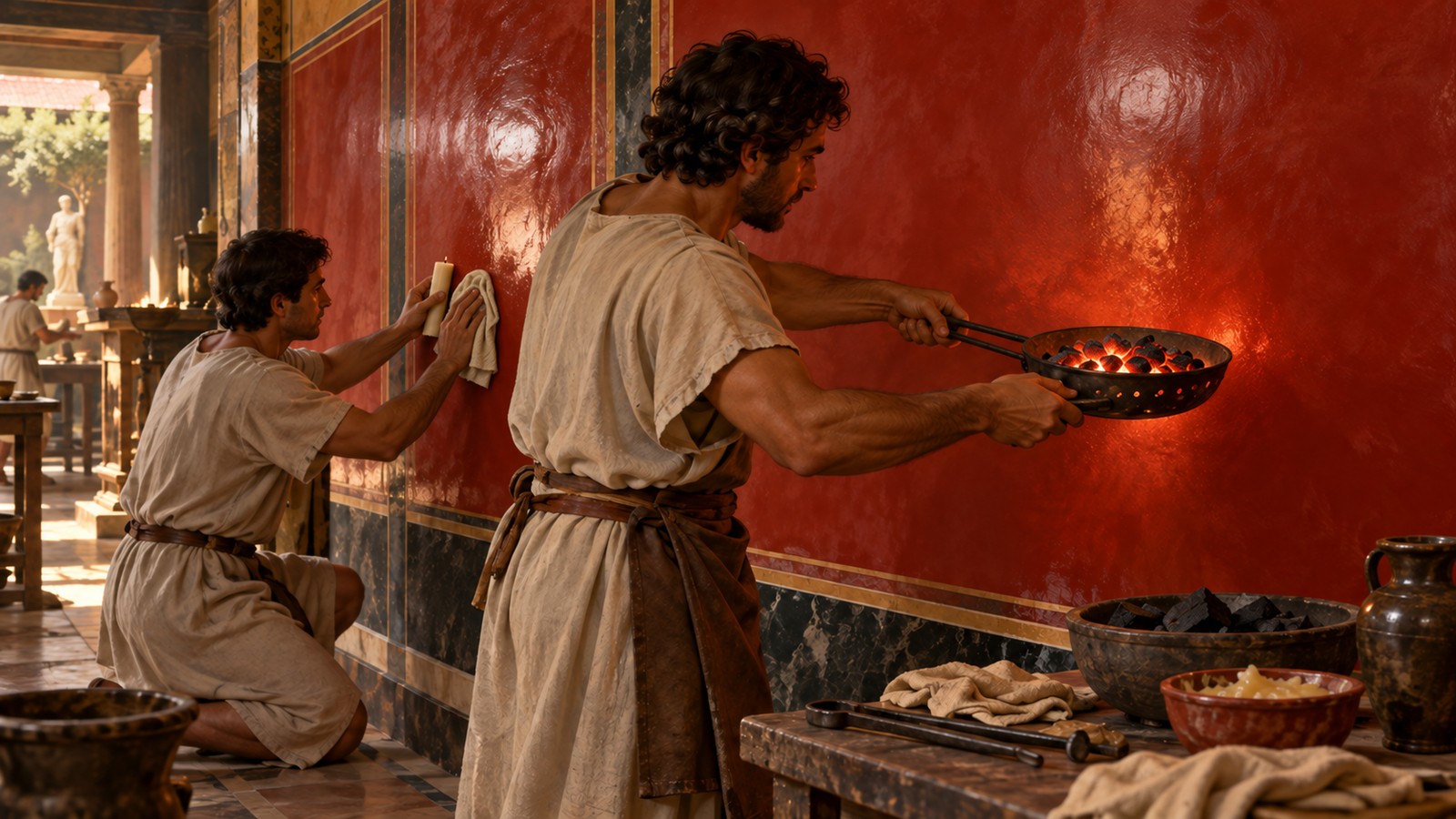
Vitruvius instructs the finisher to place live coals in an iron pan and heat the wall thoroughly.
The wall was not set on fire. The pan carried a movable source of radiant heat close enough to soften the wax.
That tool made control possible. Coals scattered at the base of the wall would heat unevenly and endanger the room. Coals in a pan could be moved across the face of the work.
The aim was to melt the applied wax again and make it lie even.
This was the second managed transition in the wax. It had first been melted so that oil and brush could turn it into a coating. After application, it was reheated in place so brush marks and local thickness could level.
Too little heat would leave an irregular surface. Too much, applied carelessly, could make the coating run or threaten the underlying finish. Vitruvius does not state temperatures, distances or duration, so the skill remains visible through what the worker had to judge.
The iron pan also separated fuel from finish. Ash and charcoal belonged inside the vessel, not embedded in the wax.
A large peristyle wall would require repeated movement. The craftsperson had to read sheen and softness across sections, carrying the coals onward while maintaining continuity between warmed areas.
The method joined materials that behaved differently. Plaster remained fixed. Vermilion supplied colour but suffered in exposure. Wax softened under heat and could then harden into a smoother cover.
Architecture provided the reason for the work. An enclosed room did not need the same response because its wall did not receive the same light.
The exposed peristyle turned finishing into maintenance performed in advance: labour invested now to prevent another thirty-day failure.
Candle and Cloth Turned Coverage into Polish
Heating was not the last operation. Vitruvius says the wall was rubbed with a candle and a clean cloth, as marble statues were treated.
The candle supplied more wax at the immediate point of contact, while the cloth distributed and polished the surface through friction.
Comparison with marble statuary indicates the finish expected: not a visibly brushed film but a coherent, worked surface whose lustre belonged to the object.
Vitruvius gives the practice a Greek name, ganosis. Naming it places the sequence within an established craft vocabulary rather than presenting it as an improvised rescue for Faberius alone.
The result was supposed to defend the vermilion from both sunlight and moonlight. His explanation reflects ancient observation and theory; it should not be translated casually into a modern laboratory claim about radiation.
What the passage securely shows is that Roman practitioners connected exposure with fading and blackening, and used a wax coating to reduce the damage.
The procedure also reveals why “painted wall” is too small a description of the finished product. Colour choice, location, drying, brushing, reheating and polishing all contributed to what viewers finally saw.
Faberius’s first wall lacked the successful relationship among those stages. Its visual failure forced another contract and another finish.
Ganosis treated the surface as a boundary. Light met wax before it met vermilion. Dust and handling met polish before pigment.
The barrier could work only if it remained visually subordinate. Its purpose was to let the red continue looking like red.
Vitruvius’s instructions preserve the craft through verbs: melt, temper, rub, heat, level, polish. Each action changed the handling of the same thin coat.
The order also protected completed work from contamination. Colour dried before wax touched it; coals stayed inside iron rather than scattering ash across the wall; the final cloth was specified as clean. The sequence controlled not only heat but contact between materials that could spoil the finish if introduced at the wrong moment.
Faberius’s failed wall gives the instructions a practical benchmark. A finish that looked elegant on completion was not enough if exposure made it uneven before a month had passed. The protected surface had to preserve visual continuity across days of changing light, not merely impress the patron while the plasterers packed their tools.
The live coals are the most dramatic part, but they make sense only between brush and cloth. Fire without the applied wax had nothing to level; wax without final rubbing remained merely spread material.
A Roman finisher protected colour by managing phase, thickness and sheen. The red wall lasted not because pigment stood alone, but because another craft made itself nearly invisible above it.
Sources
Vitruvius, On Architecture, book 7, chapter 9.