
The fragrance reached buyers only after the caravan had paid almost everyone along the road.
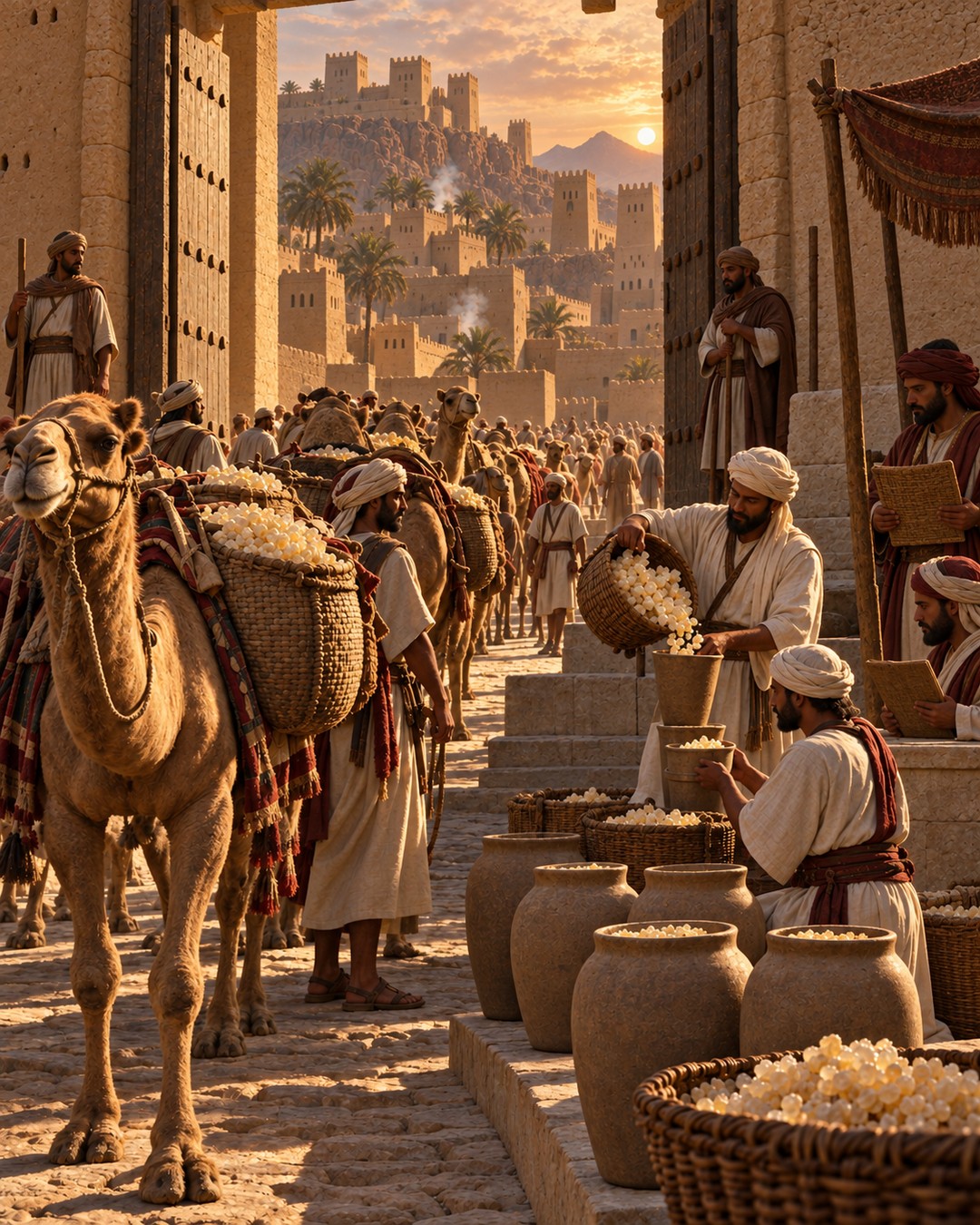
At Sabota, frankincense entered through one gate. Priests removed a measured tenth before anyone could sell it, and law kept the remaining resin on an authorised route.
By the Mediterranean, Pliny counted 688 denarii of expense on each camel.
Sabota Compressed the Trade into One Gate
Pliny begins the commercial journey after frankincense had been collected in Arabia. The resin was loaded onto camels and carried to Sabota.
The city did not admit the commodity wherever a caravan found an opening. A single gate was left available for frankincense.
Concentrating entry made inspection and collection possible. If every bundle passed through one point, authorities did not need to chase caravans across every approach.
The route was backed by severe law. Pliny says deviation from the high road while carrying incense was a capital offence.
That penalty shows how much depended on visibility. An alternative path did more than shorten a journey. It could bypass the institutions entitled to inspect, measure or charge the load.
At the gate, priests took a tenth for the god Sabis.
The tenth was assessed by measure, not by weight. Pliny makes the distinction explicit, reminding us that an ancient levy depended not just on a fraction but on the instrument and method used to define it.
No one was allowed to dispose of the incense before this share had been removed.
The sacred collection also funded public expense. Pliny says the god generously entertained strangers who had completed the required number of days on the journey.
Religion, hospitality and revenue therefore met in the same transfer. The offering left a merchant’s cargo, entered temple control and supported obligations attached to the trading centre.
The archive contains another case in which a required share shaped movement before profit. Imperial rules could force a portion of senatorial wealth into Italian land before officeholders enjoyed the rest freely. Sabota’s tenth acted on goods rather than estates, but it likewise made compliance a condition of proceeding.
The Export Route Created Layers of Claimants
Leaving Sabota did not release incense into an open market.
Pliny says it could be exported only through the country of the Gebbanitae. Their king received a tax because the route passed through his territory.
Compulsory geography created fiscal power. The commodity had value, but those controlling the permitted corridor could make movement conditional on payment.
Other shares accumulated around the official path. Pliny names priests and royal secretaries, keepers, soldiers, gatekeepers and various additional workers.
Not every recipient performed the same function. Some represented sacred authority, some royal administration, some custody and some physical security.
Together they formed the human infrastructure around a resin valuable enough to protect and regulate.
The list also prevents us from imagining one simple toll paid once. A caravan encountered several kinds of claim, each attached to a person or institution placed along the chain.
Pliny’s figures deserve caution. His geography and totals come through an ancient author describing a distant trade, not a surviving set of audited caravan accounts.
Yet the structure of his report is unusually concrete: one gate, a tenth, one permitted export territory, named categories of recipients and repeated travel costs.
The frankincense trade thus carried a trail of payments before the resin entered Roman fiscal reach.
That differs from Cato’s attempt to divide maritime exposure across fifty ships. The incense caravan could distribute loads among camels, but it could not distribute away a checkpoint that every authorised load had to cross.
The corridor made the trade legible to rulers precisely by making merchants less free to choose their path.
Sixty-Five Camel Stages Turned Distance into Cost
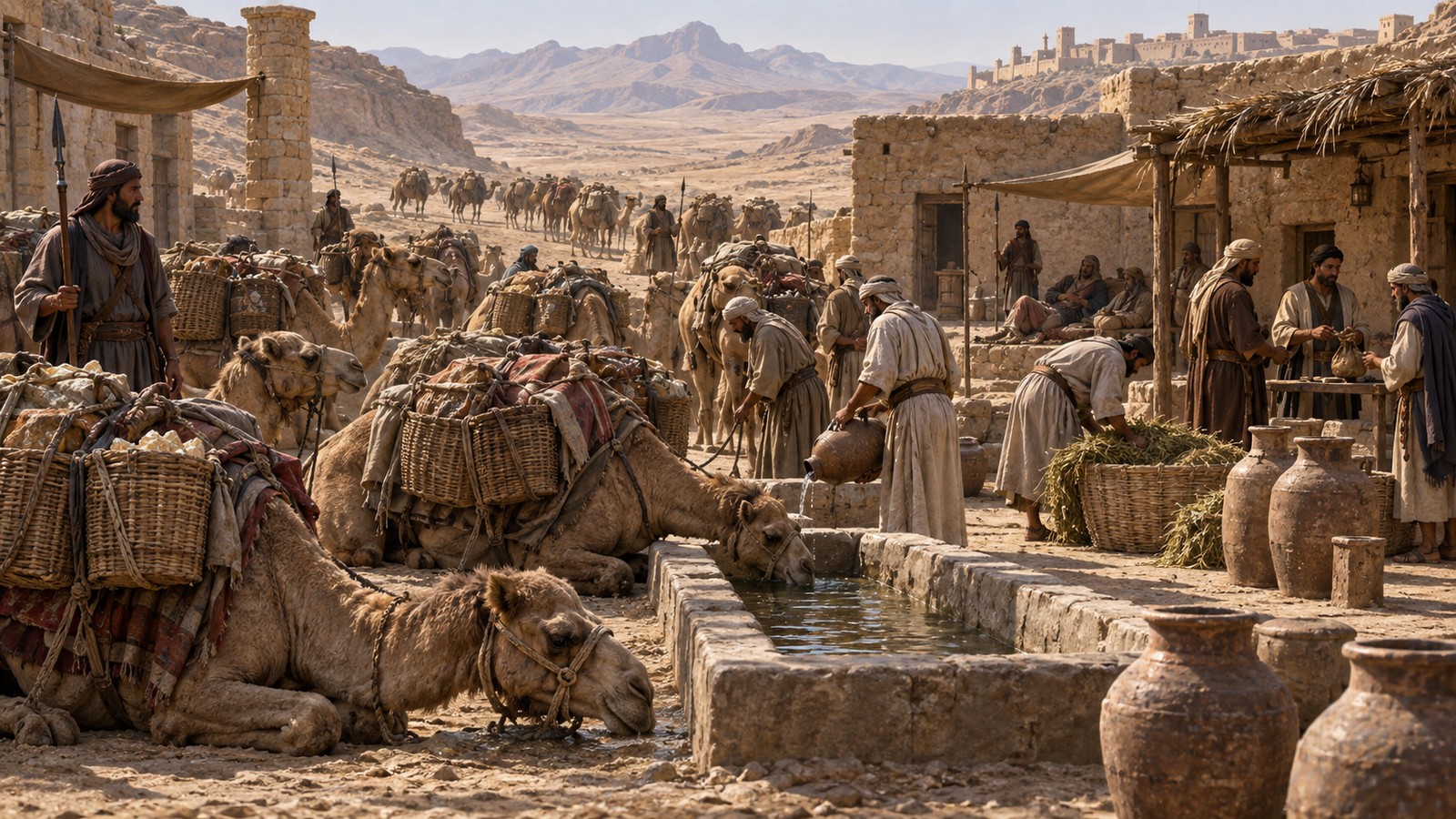
Pliny describes the journey from Thomna, the Gebbanite capital, toward Gaza on the Mediterranean side as sixty-five stages by camel.
The transmitted distance figure in old translations is difficult and should not be made to carry more precision than the text can support. The stage count is enough to show an extended caravan operation.
Each stage consumed resources. Water was charged at one place, fodder at another and lodging at stations along the road.
These were not ornamental expenses. Camels and travellers could not cross arid territory on the value of the cargo alone.
A well, supply of feed or secure stopping place became valuable because the route concentrated demand and the environment made refusal difficult.
Pliny adds various taxes and imposts beyond the named supplies. By his reckoning, expense reached 688 denarii for each camel before it arrived at the Mediterranean shore.
“Per camel” is an important unit. Cost attached to carrying capacity, so the caravan’s scale multiplied the burden as well as the volume of incense delivered.
The total did not close the account. Payments still awaited the farmers of Roman revenue.
A buyer seeing frankincense in a shop encountered the end of this accumulation. The price represented resin, but also guarded gates, compelled roads, temple shares, royal claims, feed, water, beds and tax collection.
The trade could sustain those charges because a small quantity carried concentrated value. Frankincense served ritual and luxury demand far from the trees that produced it.
Distance did not simply make the commodity rare. Institutions along the distance converted control into income.
The caravan’s physical needs ensured that even a merchant who wished to avoid official charges still faced practical dependence on stations. Route control and environmental constraint reinforced each other.
By the time Roman revenue farmers appeared, much of the final price had already been assembled beyond Roman territory.
Roman Buyers Tested What Survived the Journey
Pliny gives three retail grades, priced at six, five and three denarii per pound.
The descending prices show that “frankincense” was not a single uniform commodity. Buyers distinguished quality after transport had brought the resin into the market.
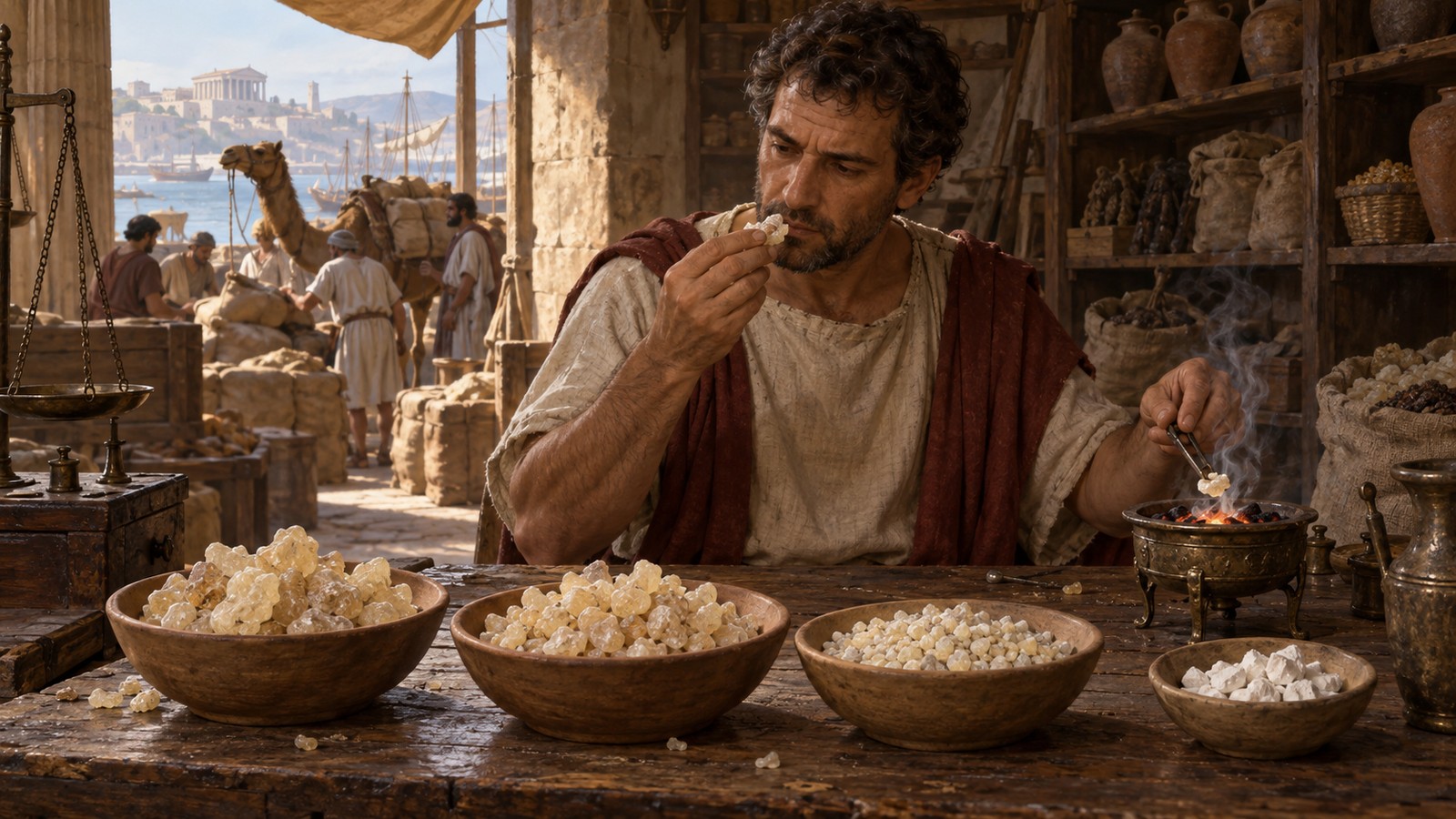
He lists whiteness, size and brittleness among desirable signs.
A sample placed on heated coals should take fire readily. Pressure from the teeth supplied another test: good material should crumble from natural brittleness rather than yield softly.
Those checks joined sight, touch, heat and fracture. They let a purchaser inspect a small piece without knowing every stage of its origin.
The need for tests followed from the opportunity for fraud. Pliny says drops of white resin could be mixed into frankincense because of their close resemblance.
Adulteration exploited the same visual quality that buyers valued. A pale substitute entered among pale resin, attempting to capture the price built by the long route without possessing the expected behaviour.
Testing therefore connected the Roman shop to the Arabian caravan. Gatekeepers protected and taxed identity at the beginning; merchants tried to verify identity at the end.
The graded prices also complicate the 688-denarius route total. Pliny does not provide enough information here to calculate profit per camel, because he does not state one universal load weight, loss rate or grade mixture.
What he does provide is the anatomy of cost. Sacred levy came before sale. Territorial tax followed controlled export. Salaries or shares went to officials and guards. Supplies and lodgings kept the caravan moving. Roman collectors waited beyond them.
Only then did a pound reach a buyer who might bite it and place it over coals.
The incense’s smell could fill a ritual space in moments, but its price preserved a much longer sequence.
Every authorised passage narrowed the merchant’s choices and opened another claim. The single gate at Sabota was not merely an entrance to the city.
It was the first visible machine in a route that turned distance, custody and permission into the cost of fragrance.
Sources
Pliny the Elder, Natural History, book 12, chapter 32.