
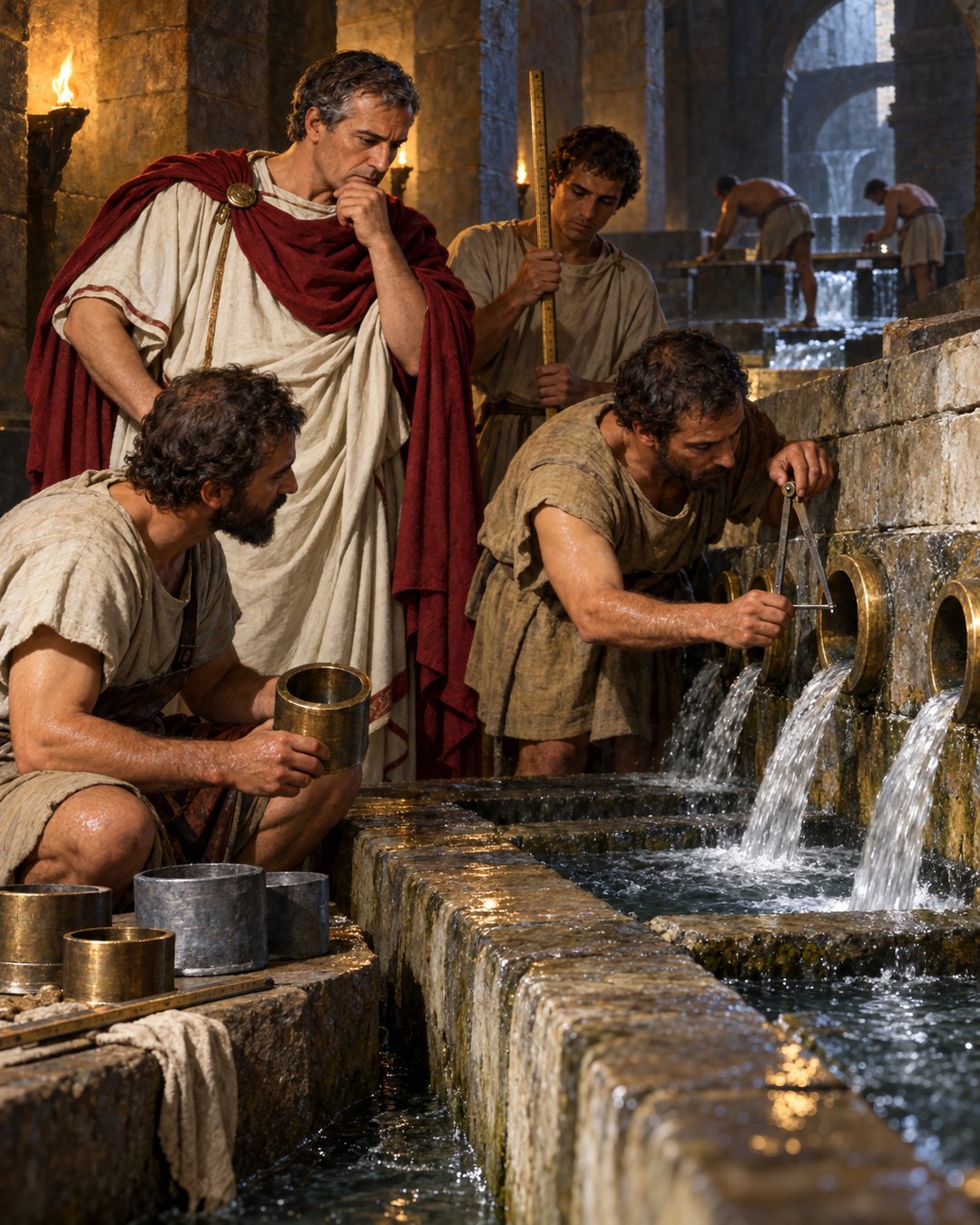
A quarter-digit sounded like a small and orderly increase. Inside a water pipe, it changed an area.
Frontinus found that Rome’s outlet names mixed diameter, sheet width, and cross-section. Similar labels did not guarantee equal additions of water.
Before he could audit supply, he had to audit the hole.
Digits and Inches Did Not Describe the Same Opening
Frontinus pauses his history of Rome’s aqueducts before listing how water was distributed. He first explains the devices used to gauge it.
The sequence matters. Totals assigned to fountains, public buildings, imperial uses, and private consumers meant little unless the unit behind them was stable.
He begins with two familiar linear standards. The digit was understood as one-sixteenth of a foot; the inch as one-twelfth.
Even the digit was not uniform when applied to an opening. Frontinus distinguishes a square digit from a round digit.
The corners of the square gave it more area than the circle described by the same nominal width. A word that sounded like one small measure could therefore identify different passages for water.
Water administration turned geometry into an institutional problem. A grant written in units had to correspond to metal installed in a reservoir wall.
Frontinus calls these outlets ajutages. They formed the controlled mouths through which a share of the aqueduct supply entered another conduit or consumer system.
If an outlet were too large, the error did not stay on paper. More water passed every hour, reducing what remained for other users.
Secret street pipes show how unauthorised connections turned public flow into private profit. Standard outlets addressed the same vulnerability at an earlier point: the official connection itself needed a trustworthy size.
Measurement therefore belonged to enforcement. Officials had to compare authorised quantities with physical bores, not merely accept a pipe’s traditional name.
The Quinaria Carried Competing Origin Stories
Rome eventually used the quinaria in place of older measures, but Frontinus found disagreement about why it was called that.
One explanation credited Agrippa. Five small outlets used when the supply was scanty were supposedly combined into one pipe, giving the new unit its name.
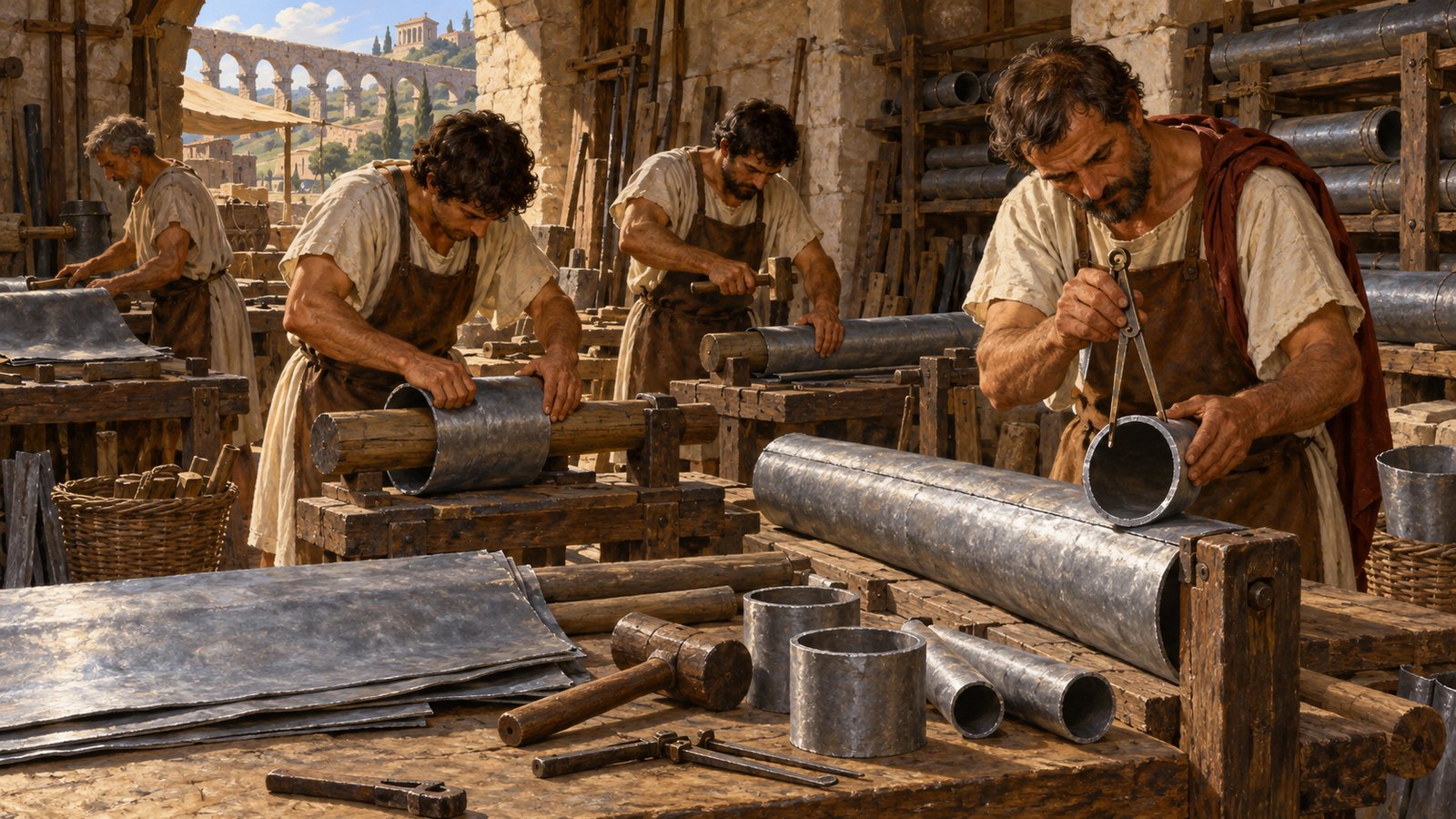
Another explanation connected the measure with Vitruvius and Roman plumbers. A flat sheet of lead five digits wide, rolled into a round pipe, was said to create the outlet.
Frontinus objected to the sheet-width account because bending changed what mattered.
The exterior surface stretched around the larger outside circumference. The interior contracted around the smaller opening through which water actually moved.
Sheet thickness stood between those two circumferences. “Five digits wide” did not by itself settle the clear diameter.
His preferred explanation treated the quinaria as an outlet with a diameter of five-fourths of a digit.
That definition could be checked at the bore. It did not depend on reconstructing how a plumber had cut and wrapped a sheet.
The disagreement illustrates a larger administrative problem. A name might preserve craft tradition or historical memory while an audit required a reproducible dimension.
Frontinus did not need to prove which inventor first spoke the word. He needed a standard that let different installations be compared.
The interior opening was the practical object because water could not pass through the lead surrounding it.
This attention to workmanship complements Frontinus’s insistence that aqueduct crews record where each day’s labour occurred. Records made people accountable; calibrated outlets made quantities accountable.
Quarter-Digit Names Hid Nonlinear Capacity
From the quinaria, a sequence of pipe names grew by diameter.
The quinaria’s diameter was five quarters of a digit. The six-pipe measured six quarters, the seven-pipe seven quarters, and the progression continued to the twenty-pipe.
The names advanced in regular steps. Capacity did not.
Frontinus explicitly warns that adding one quarter of a digit to the diameter of a quinaria did not add one whole quinaria of capacity.
The reason lies in the shape. Water passes through a circular area, and area grows with the square of radius. Equal increases around the diameter create larger and larger additions to the opening.
Frontinus expresses the relationships through ancient fractional calculations rather than a modern classroom formula. His administrative insight is the same: linear naming and volumetric expectation must not be confused.
An official who treated a seven-pipe as though it carried one simple unit more than a six-pipe would misstate delivery.
A plumber could also exploit that confusion. Small changes at the circumference could create meaningful changes in the clear opening without sounding dramatic in words.
Frontinus says an ajutage could be gauged from diameter, circumference, or clear cross-sectional area. Each route had to resolve into capacity.
The clear opening was crucial. Measuring an outside dimension that included metal would overstate the passage available to water.
A standard also had to survive manufacture. Lead sheet could be cut correctly yet rolled around a form that left a different inner bore. A seam could intrude; an edge could spread. Inspecting the finished circle tested the object that actually governed delivery rather than trusting the dimensions of its raw material.
Wear, deformation, careless manufacture, or deliberate enlargement could further separate an installed fitting from its authorised specification.
Thus the quarter-digit was not pedantry. Repeated across a network, every discrepancy multiplied through continuous flow.
The Twenty-Pipe Marked a Change in Naming Logic
Frontinus describes two principles for larger outlets.
One combined the equivalent of several quinariae in a single orifice. This was useful when a conduit delivered water to a reservoir that later divided the supply among consumers.
A larger common inlet avoided tapping the main conduit repeatedly. The reservoir became the place where individual shares separated.
The other principle continued to enlarge diameter through named quarter-digit steps up to the twenty-pipe.
After that point, Frontinus describes outlets named by the number of square digits in their cross-section. A twenty-five-pipe, for example, referred to twenty-five square digits of opening rather than a diameter of twenty-five quarter-digits.
The twenty-pipe stood at the boundary between the systems.
That boundary protected interpretation. Below it, an increasing numeral could describe successive quarter-digit additions to diameter. Above it, the numeral could identify square digits of area. The arithmetic behind neighbouring names had changed even though both ended in the word “pipe.”
This was more than vocabulary. Two pipes whose names were both numbers might derive those numbers from different dimensions.
An auditor needed to know whether a label referred to a diameter sequence, a multiple of quinariae, or an area count.
Without that distinction, tables of water rights could appear precise while combining incompatible units.
Frontinus’s project was to expose such discrepancies and correct them. He wanted allocations to correspond to standard physical outlets rather than local habit or convenient interpretation.
Rome’s aqueducts are often admired at the scale of arches and valleys. At the distribution end, public control narrowed to circles small enough for dividers to span.
Those circles linked several professions. Surveyors and builders delivered water to the city; plumbers shaped the fittings; clerks recorded grants; administrators compared paper rights with installed metal. A fault in any hand could become a permanent stream rather than a one-time loss.
Frontinus’s discussion also distinguishes theoretical size from actual hydraulic behaviour. Diameter, circumference, and clear area established the geometric capacity of an outlet, while elevation and conditions of flow could affect delivery. His immediate task here was to make the opening itself knowable before more variables entered the account.
A reservoir could hold an immense supply, but fairness depended on the bores cut through its walls.
The quarter-digit mattered because it sat between state record and running water. It translated permission into metal.
Frontinus understood that an impressive aqueduct could still lose integrity at the final inch. Administration lived inside the opening.

Sources
Frontinus, On the Aqueducts, book 1, sections 24–30.