
An older Roman once expected the first seat because he was older. Younger diners might escort him home, and age could outrank both birth and wealth.
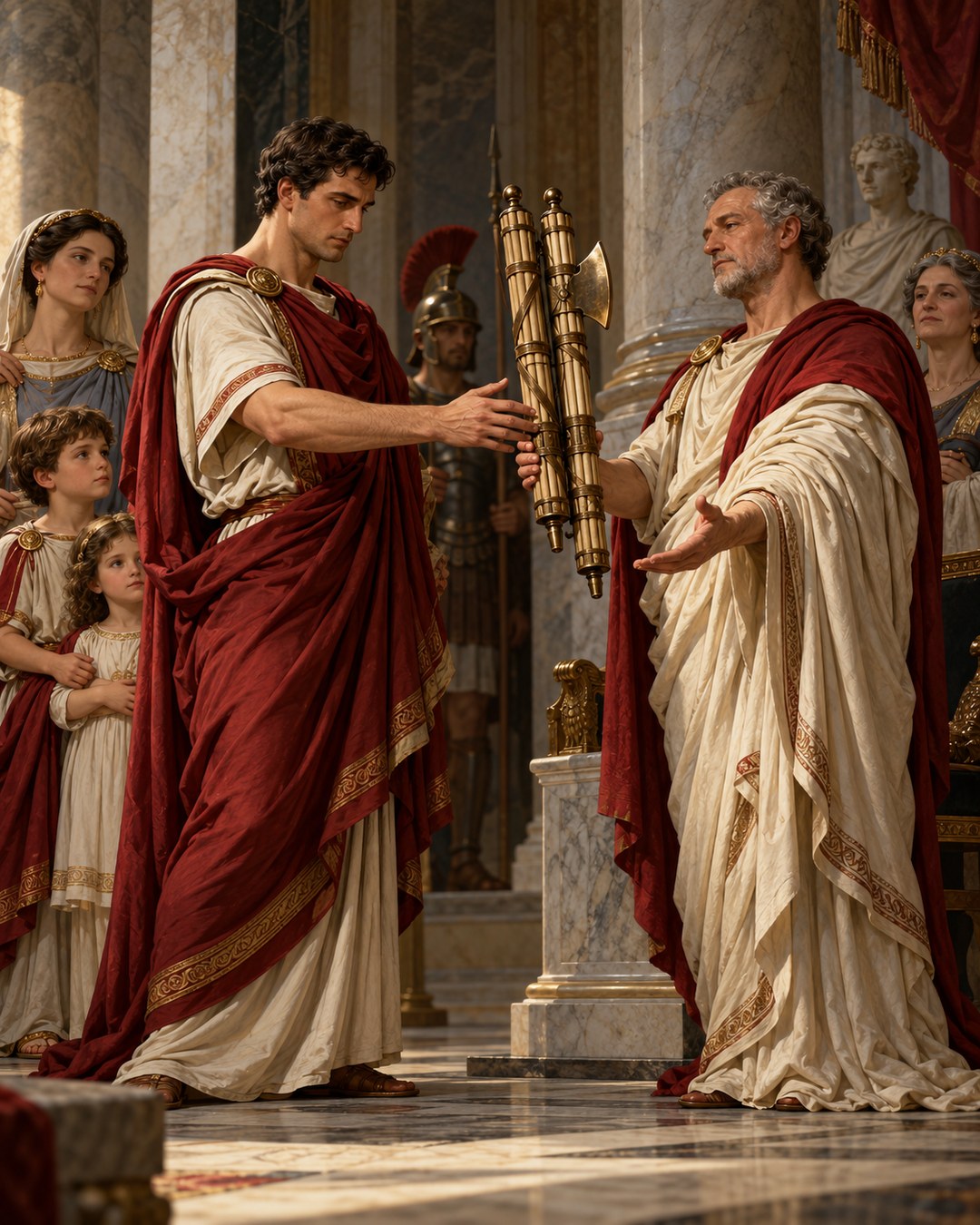
Then public policy added a competing measure. When two consuls assumed the emblems of power, the Julian law could put the younger man first if he had more children. A child lost in war still counted.
Aulus Gellius preserves the rule as a sequence of comparisons. Its interest lies in the order: family status did not erase seniority everywhere, but it could interrupt seniority at the highest annual office.
Age First Operated as a Social Habit
Gellius begins before the statute. Among the earliest Romans, he says, neither noble birth nor wealth normally received more honour than age. Juniors revered elders almost as they revered gods and parents.
The language is broad, but Gellius adds a small physical custom. After a dinner party, younger men escorted older men home. Precedence did not end when couches were left behind. It accompanied the elder into the street.
Roman tradition connected the practice with Sparta, where the laws of Lycurgus were said to give greater honour on every occasion to greater age. The claim is about remembered origin, not proof of one documented borrowing event. Gellius uses the comparison to define the ethic: years themselves generated rank.
Such rank was relational. An old man did not need a special office for a younger companion to yield. The custom worked through repeated acts—seat, order, escort—rather than one permanent title.
It also differed from the institutional timing in Augustus’s twice-monthly Senate schedule. That reform organized when men met. Gellius’s older habit organized who went first once people were together.
The simplicity should not be romanticized. We are told the principle, not every conflict between an impoverished elder and a powerful youth. Its importance is that later family incentives had a recognizable hierarchy to modify.
Population Policy Inserted a New Claim
Gellius says a different calculation emerged when offspring were understood as necessary to the state. Premiums and other inducements encouraged productivity. Husbands and fathers then received greater deference in certain respects than older men who had neither wives nor children.
“In certain respects” is essential. The passage does not announce that all old-age honour vanished. It identifies a policy exception attached to civic reproduction.
The rule made family life visible in public precedence. Marriage and parenthood were no longer only household facts. They could alter the order in which officeholders exercised symbols of authority.
This is the administrative edge of the moral campaign explored in Germanicus’s children as Augustus’s argument for marriage. A crowded family could serve as public persuasion; in Gellius’s legal example, children entered an actual comparison between colleagues.
The policy did not ask whether one consul was a better parent or had a happier household. It counted statuses that could be recognized. That makes the device crude but operable. Officials needed a rule for priority, not an inquiry into domestic virtue.

The Consuls Passed through a Decision Tree
Chapter seven of the Julian law supplied the sequence.
First compare children under each consul’s control. The consul with more takes priority in assuming the emblems of power. Gellius adds that children lost in war belong in the count. A dead child’s public sacrifice therefore continued to affect the father’s standing.
If the number of children was equal, the next comparison concerned marriage. The man with a wife, or the one eligible for marriage, was preferred. The exact wording preserved by Gellius makes legal status, not private affection, decisive.
If both men were married and fathers of the same number of children, the ancient standard returned. The elder was first to assume the rods.
The sequence matters more than any single preference. Age had not become irrelevant. It had become a tiebreaker after family claims were exhausted in a specified combination.
The emblems at issue were not decorative keepsakes. The rods and accompanying insignia materialized consular authority. Deciding who assumed them first made abstract precedence visible to attendants, senators and public observers.
Gellius does not say that one consul thereby became superior for the whole year. The rule governs priority, a narrow but symbolically charged relation between equal colleagues.
Nor does the wartime clause merely increase the population count. A child lost in war cannot contribute future descendants. Counting that child recognizes sacrifice within the same legal machinery used to encourage living families. The categories of demographic policy and military memory overlap.
Uncovered Cases Reveal the Rule’s Edges
Gellius then notices what the law did not say.
If both consuls lacked wives but had the same number of sons, the cited provision offered no rule based on age. The same gap appeared when both men were husbands but had no children.
Those combinations are revealing because they interrupt the neat ladder a modern summary might invent. One cannot simply write “children, then marriage, then age” and assume every branch closes. The text restores age explicitly only when both consuls are married fathers with equal numbers.
Gellius also reports a practice outside the bare entitlement. A consul who possessed legal priority might yield the rods for the first month to a colleague who was older or more distinguished.
Voluntary yielding allowed social honour to soften statutory order. It did not cancel the law: generosity has meaning because the right first belongs to someone. The preferred consul could demonstrate respect by surrendering the immediate advantage.
The interaction of rule and courtesy is the chapter’s most Roman texture. Law makes family policy legible and predictable. Custom still creates room for age and distinction to be acknowledged without rewriting the criterion.
That balance also explains why the opening dinner escort belongs in the same chapter as consular fasces. Gellius is tracing precedence across settings. At home, repeated courtesy honoured years. In office, legislation rewarded family status. At the boundary, a man with the legal claim could choose to behave like the younger dinner guest and let his elder go first.
The law did not settle every possible pair. It did something more historically useful: it shows the state turning marriage, children and wartime loss into an ordering device, then leaving old respect visible around the edges.
The phrase “under his control” also warns against translating the rule into a modern headcount of biological children. Roman household status was legal as well as genealogical. Gellius preserves the category used by the provision; he does not invite us to replace it with a broader emotional definition of parenthood.
Likewise, eligibility for marriage is not identical to having a wife. Its presence in the second comparison suggests that law could distinguish a person barred from the rewarded status from one currently without a spouse but legally able to enter it. The rule ranked public capacities, not merely visible companions at a ceremony.
Counting children lost in war gives the mechanism its most severe edge. The state could not reward those fathers by pointing to a larger living household. It instead treated public loss as if the paternal claim endured. The dead child remained present in the arithmetic of honour.
No clause tells us how often two consuls actually reached each branch or whether colleagues disputed documentary proof. Gellius’s purpose is antiquarian comparison, not a casebook. Still, the detail is sufficient to show that precedence required administration. Someone had to know family status before the rods moved.
The ceremonial first month then offered space for character. A man could insist on his legal priority, or yield it to seniority and distinction. Law assigned the choice; courtesy made the choice visible. The result was not a clean victory of new policy over old custom, but a layered performance in which both could be honoured.

Sources
Aulus Gellius, Attic Nights, 2.15, including his account of chapter seven of the Julian law.